Coffee Experiences Sharp Weekly Decline Amid Harvest in Vietnam and Favorable Weather in Brazil
• Arabica coffee in NY dropped by 7.7%, closing at US¢ 340.65/lb (March);
• Robusta in London fell by 8.2%, priced at USD 3,669/t (March);
• In Brazil, arabica decreased by 5.2% (R$ 2,135 per bag) and robusta by 8.1% (R$ 1,223 per bag);
• Progress in Vietnam's harvest puts pressure on robusta prices;
• Favorable weather in Brazil contributes to bearish trends;
• Net long fund positions reduced in London;
• Forecast suggests less rain next week, followed by an increase towards year-end;
• USDA lowers global surplus for 2024/25 and 2025/26;
• Global consumption revised upward by USDA.
Coffee Under Pressure in New York and London
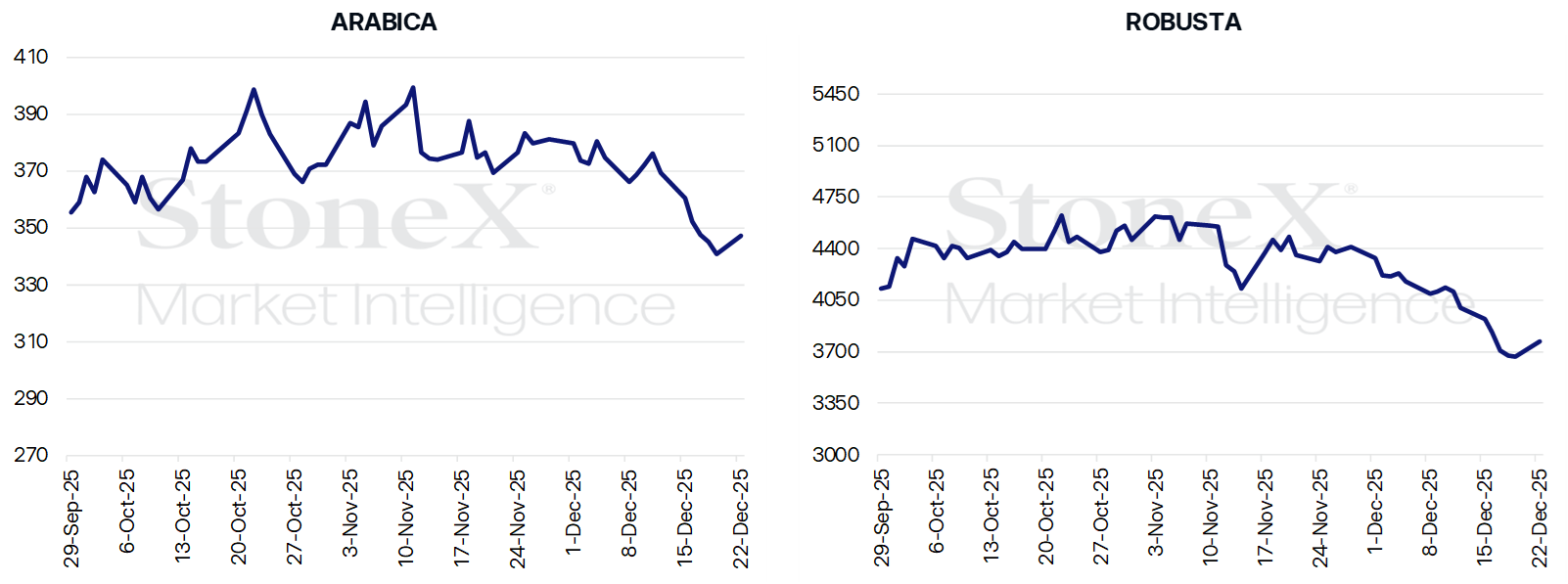
Amid favorable weather conditions in Brazil and increased supply from Vietnam, international coffee prices extended their downward trend from the previous week, experiencing significant declines between December 12 and 19. In New York, the most traded contract for March delivery recorded a 7.7% drop, closing Friday at US¢ 340.65/lb. In London, robusta saw an even sharper decline, with the March contract slipping 8.2%, finishing at USD 3,669 per ton.
In the Brazilian market, a similar trend was observed. Cepea's arabica coffee indicator fell by 5.2%, priced at R$ 2,135 per bag. Robusta mirrored the external movement more closely, with an 8.1% drop, reaching R$ 1,223 per bag.
For another week, robusta prices faced greater pressure compared to arabica, both in international and domestic markets. This scenario largely reflects the progress of Vietnam's harvest. Additionally, sustained favorable weather conditions for the development of Brazil's 2026/27 crop, both arabica and robusta, have contributed to maintaining the market's bearish sentiment.
Future Prices: Arabica Coffee (US¢/lb) and Robusta Coffee (USD/ton)
Source: Cmdty View. Prepared by: StoneX.
Monday (22)
Following last week's sharp declines, coffee futures began this Monday (15) with a slight rebound, likely a technical adjustment after recent losses.
The March contract in New York rose 1.9% during the week's first trading session, priced at around US¢ 347.30 per pound, while in London, the most active contract closed at USD 3,768/t, up 2.7%. Net long positions reduced from December 2 to 12,571 contracts, a 27.7% drop.
Harvest Progress Lowers Short-Term Risk Perception
The sharp correction seen in coffee futures last week once again reflected the dominance of bearish fundamentals over bullish factors. Among the key drivers are improved outlooks for Vietnam's harvest, impacting robusta, and harvests in Central America and Colombia for arabica.
Harvest Progress: In Vietnam, it is worth noting that the country faced adverse weather conditions weeks ago, with excessive rainfall impacting post-harvest activities, causing quality losses, delays, and logistical challenges.
- However, losses so far have not been significant, and impacts appear limited to harvest pace and coffee quality.
- With weather improvements, the harvest has progressed, and expectations are for increased availability of Vietnamese coffee in the coming months.
- In Central America and Colombia, the absence of negative news suggests normal activity, limiting potential short-term bullish impulses.
Weather Conditions in Brazil: Beyond harvest progress in other countries, much attention remains on the development of the 2026/27 crop in Brazil.
- Weather prospects for the world's top exporter remain favorable, supporting positive production expectations.
- While forecasts indicate lower rainfall volumes this week, below average across most of the coffee belt, late 2025 and early 2026 are expected to see favorable rainfall levels, likely exceeding seasonal averages.
- In November, StoneX released a preliminary estimate of 70.7 million bags for 2026/27, a 13.5% increase. Early 2026 will see our team in the field again to evaluate this potential, subject to revisions based on climatic variations.
Increase in Fund Short Positions: Fund behavior reinforces the bearish sentiment.
Speculative Fund Positions in Robusta Coffee on the London Exchange (thousand contracts)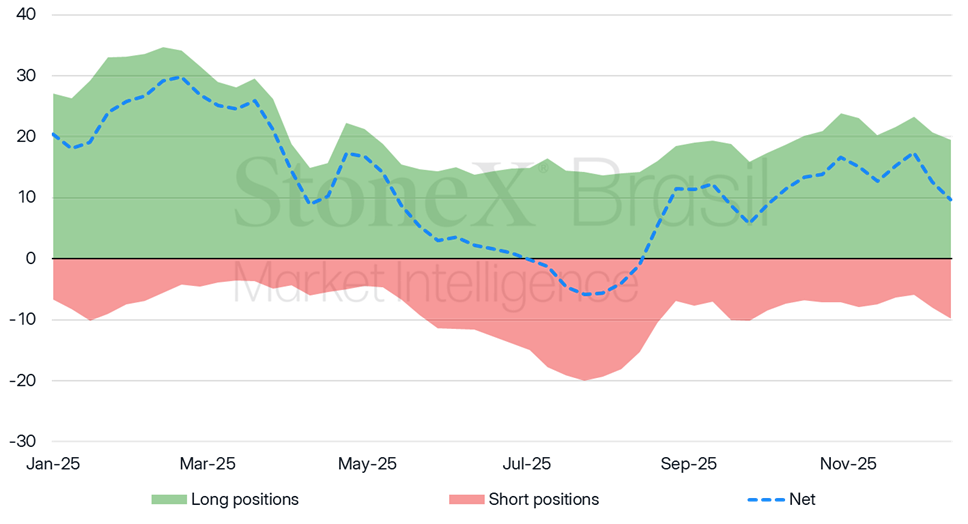
Source: ICE. Prepared by: StoneX.
What to Watch: In the coming weeks, trading volumes are expected to decrease due to Christmas and New Year's holidays. Market focus will remain on Vietnam's and Central American harvest pace, as well as Brazil's weather developments. Adverse weather conditions could shift expectations for the 2026/27 crop and reshape price dynamics.
USDA Revises Global Coffee Balances and Stocks
Last Thursday (18), the U.S. Department of Agriculture (USDA) released its semiannual report, “Coffee: World Markets and Trade,” updating production and consumption projections for the 2025/26 season.
- Estimates for the 2026/27 crop will only be published in June 2026.
Global Balances and Stocks: The report revised downward global balances and available stock estimates for the 2024/25 and 2025/26 seasons:
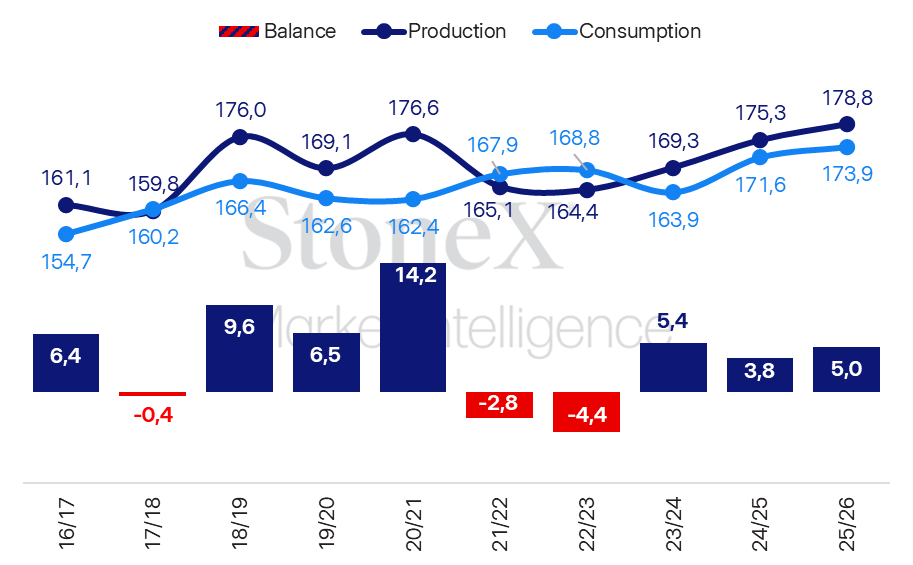
- 2024/25: The projected surplus dropped from 7.9 million to 3.8 million bags, primarily due to increased demand, now at 171.6 million bags (+5.1 million from the previous estimate). Production was slightly revised upward to 175.3 million (+0.9 million).
- 2025/26: The global balance also decreased from 9.3 million to 5 million bags, with adjustments focused on consumption, now estimated at 173.9 million (+4.5 million). Production saw a marginal adjustment to 178.8 million (+0.1 million).
- Stocks: Ending stock forecasts for the 2025/26 crop dropped to 20 million bags, compared to the previous expectation of 23 million.
USDA Global Coffee Supply and Demand Balance (million bags)
Source: USDA. Prepared by: StoneX.
Report Analysis: The adjustments released by the USDA are expected to have limited market impact, as expectations for both harvests are already largely priced in. Currently, price movements are concentrated on 2026/27 projections, especially since Brazil's current crop is mostly sold.
- Nonetheless, it’s worth noting that the USDA aligned its estimates with StoneX’s projections for Brazil in 2025/26, indicating production of around 63 million bags, compared to StoneX’s estimate of 62.3 million.
- For other major producers, key adjustments were already highlighted in attaché reports earlier this month, including a slight downward revision for Vietnam and production increases for Colombia and Indonesia.
- Other production revisions were minimal. Click here for a summary of the USDA report.
- The demand-side adjustment, however, was more significant and deserves attention. The report estimates a new historical record for global consumption, even amidst significant price increases throughout the year. The data reinforces the perception of consumer market resilience.
- Key highlights include increased consumption estimates for the European Union (from 40.1 to 41.9 million bags) and the United States (from 22.5 to 26.5 million bags) in 2025/26.
- It’s worth noting the ongoing inconsistencies regarding stocks, which continue to undergo revisions without substantial clarification from the Department. Thus, despite the USDA's view of three consecutive surpluses, ending stocks have declined over the same period.
- The global balance outlook remains significantly divergent from StoneX’s September report, which projected four consecutive deficits between 2021 and 2024. Click here to access StoneX’s Global Supply and Demand Balance Report for 2025/26.
Note: Due to the year-end holidays, the weekly oil reports will not be published for the next two weeks, resuming on January 12.
INDICATOR TABLE
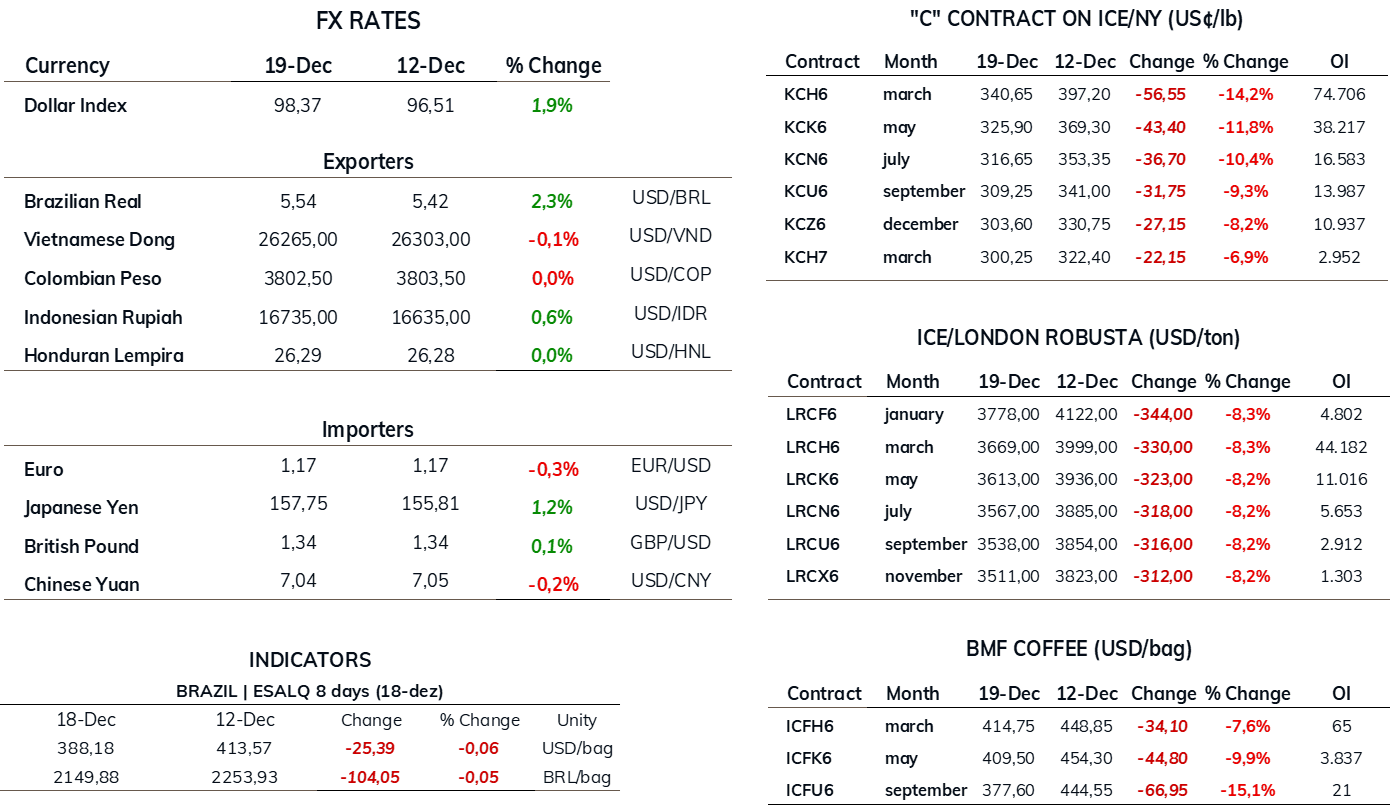
Sources: ICE/NY; ICE/EU; B3; Commodity Network Trader’s Pro.