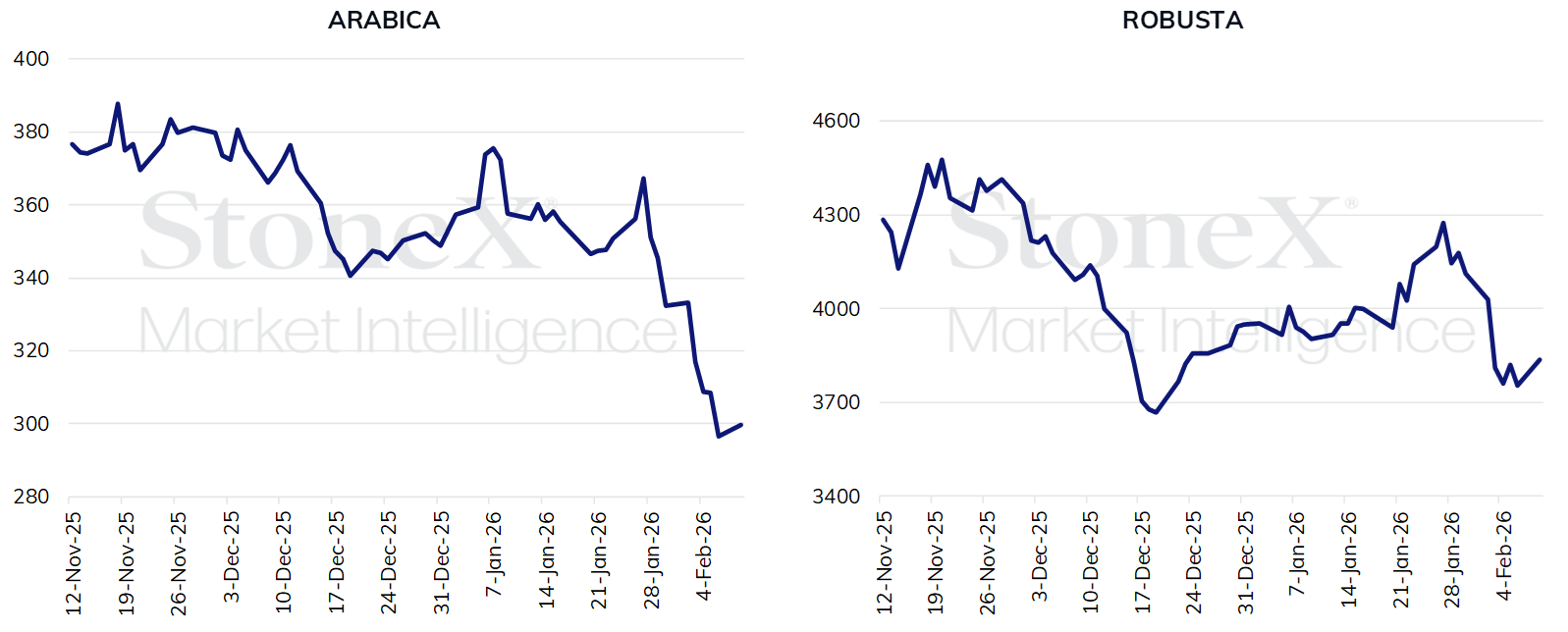
The past week saw significant pressure on coffee prices across major trading exchanges, driven primarily by optimistic expectations for global supply, both for arabica and robusta coffee.
Conab and Private Estimates Shake the Market
Last week, Brazil's National Supply Company (Conab) released its first forecast for the 2026/27 crop, predicting an increase of 9.5 million bags, or 17.1%, compared to the previous season.
- Arabica coffee: Production was estimated at 44.1 million bags, a rise of 8.3 million or 23.3%. Productivity increased by 18%, going from 24.1 to 28.5 bags/ha.
- Key factors driving arabica’s recovery, according to Conab, include: positive bienniality, favorable weather conditions, increased investment in cultural practices boosted by high prices, and expansion of cultivation areas.
- Conilon coffee: Conab estimates production at 22.1 million bags, an annual increase of 1.3 million bags or 6.4%. Average productivity rose from 55.9 to 57.1 bags/ha.
- Positive factors for conilon include area expansion, crop renewal, improved cultural practices, as well as favorable water reservoir conditions and milder temperatures, which helped mitigate the effects of below-average rainfall during Q4.
Why This Matters: In recent years, the market has demonstrated skepticism toward Conab’s figures, which historically tend to underestimate compared to other institutions and, at times, deviate from observed reality. Although the current projection remains on the lower band of available estimates, the substantial increase — close to 10 million bags — reinforces the outlook for significantly higher supply in 2026.
Market Consensus Points to a Likely Record
Besides Conab, several private consultancies recently released their estimates for the new cycle, with most also predicting strong growth for Brazil’s crop. While weather conditions in the coming months will be decisive for the crop's final outcome, the current consensus, broadly optimistic, has steered market sentiment toward a predominantly bearish stance.
Funds Reduce Bullish Bets
The latest CFTC report revealed a significant liquidation of long positions by speculative funds on the New York exchange. As of February 3, speculators held a net long position of 7,331 lots in futures and options, down over 12,000 positions compared to the 19,512 lots held the previous week.
This brought the funds' net long position to the lowest level since November 2023.
Net Position of Speculative Funds in Coffee on the New York Exchange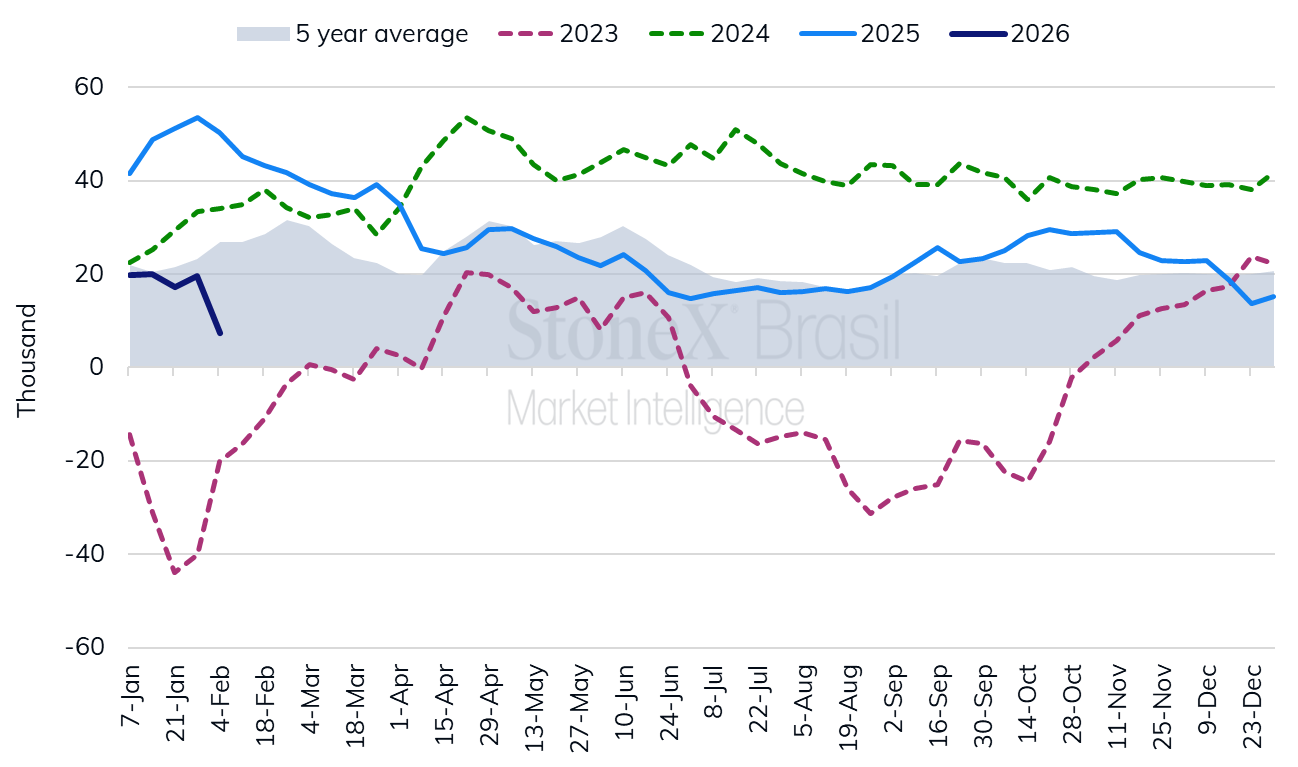
Source: CFTC. Analysis: StoneX.
Why This Matters: In recent years, amid successive disappointments in global supply, speculators predominantly adopted bullish bets, contributing to prices reaching historically high levels — as seen in early 2025, when the sharp increase in long positions helped sustain the peaks achieved during that period.
- The substantial liquidation by funds underscores the market’s shift toward expectations of lower average prices in 2026.
- There’s still room for further liquidations by speculators; however, after last Friday’s (6) substantial profit-taking, the market is likely to await new fundamental triggers before deepening the trend.
- In this context, positive climate news from Brazil could be the main catalyst for further reductions in funds’ long positions.
Asian Coffee Exports Accelerate
Last week, export data from Asia’s two largest coffee producers, Vietnam and Indonesia, indicated a significant acceleration in export activity for both countries. This trend likely contributed partially to the recent bearish pressure on international coffee prices during recent trading sessions.
Vietnam: The top coffee producer in Asia reported another impressive increase in January exports, up 56% compared to the same month last year.
- Considering the first four months of the current 2025/26 crop season, from October to January, accumulated export growth stands at approximately 48% compared to the same period of the prior season.
- January’s results reinforce the trend observed throughout 2025, a year Vietnam concluded as the most successful in its history for coffee export revenue.
- In recent months, export momentum has intensified significantly, supported by high international prices, robust demand from Europe, and exceptional performance in emerging import markets.
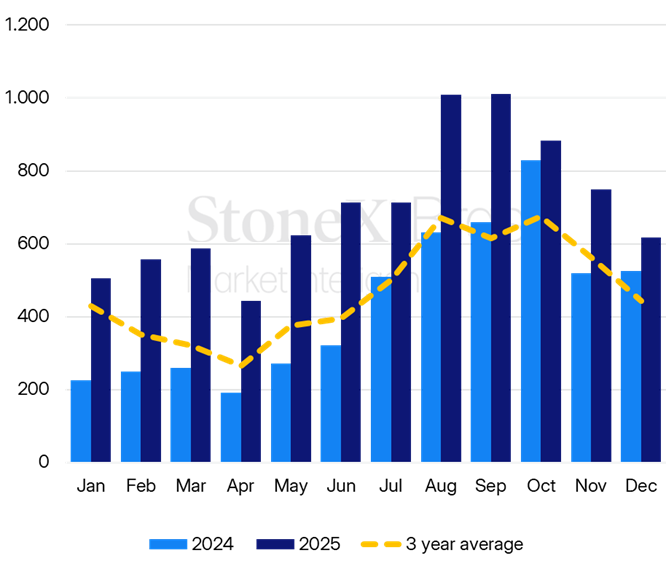
Indonesia: According to the country’s trade data, Indonesian coffee exports totaled 8.4 million bags in 2025, a 62% increase compared to 2024 and about 50% above the three-year average.
- Of the total exported in 2025, approximately 89% was robusta coffee, while 11% was arabica.
- In the first three months of the 2025/26 season, from October to December, exports accumulated growth of nearly 20% compared to the same period of the previous season.
- Improved production reflects better weather conditions and increased investments in the sector over recent years, particularly in area expansion and agricultural management improvements.
- Sumatra remains the country’s main production hub, accounting for around 70% to 75% of national production, with the island’s southern region focusing on robusta and the northern region producing primarily arabica.
- Meanwhile, Indonesia’s domestic consumption remains relatively stable, estimated at around 4.8 million bags for the 2025/26 season according to the USDA, indicating that most production growth will likely be directed toward exports.
Why This Matters: The strong performance of Asian exports reinforces expectations that the global robusta coffee crop for 2025/26 will see a significant increase compared to previous seasons, during which Asian producers struggled particularly with climatic inconsistencies.
- Alongside this, the expectation of a favorable harvest for Brazil’s 2026/27 crop should further support the outlook for lower prices compared to last year.
- This scenario is likely to keep pressure on London's curve and robusta coffee prices in physical markets of producing countries, potentially narrowing price differentials.
Monthly Coffee Exports from Vietnam by Crop Year (millions of bags)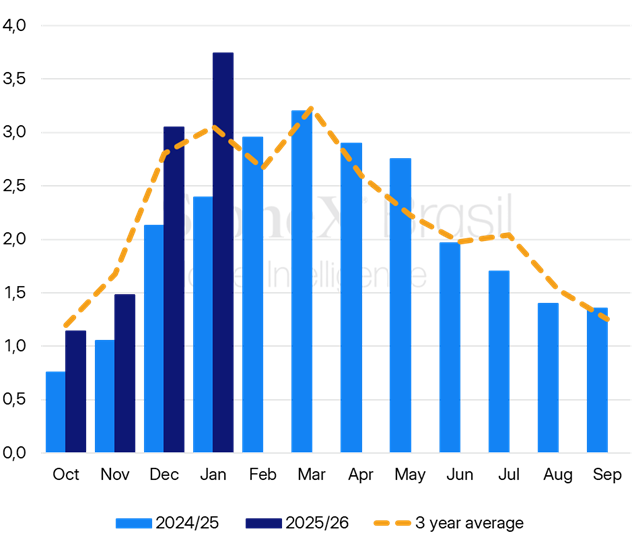
Source: Vietnam Customs. Analysis: StoneX.
Monthly Coffee Exports from Indonesia (thousand bags)
Source: BPS. Analysis: StoneX.
2025/26 Crop Falls Short of Expectations in Colombia
According to data from Colombia’s National Federation of Coffee Growers, coffee production in the country totaled 893,000 bags in January, a 34% drop compared to the same month last year, when output reached 1.35 million bags.
- In the first four months of the 2025/26 crop season, from October to January, cumulative production fell 26.5%, decreasing from 6.25 million bags during the same period last season to 4.6 million bags this season.
- In its latest estimate, the USDA projects Colombian production at 13.8 million bags for the 2025/26 crop, down from 14.8 million in 2024/25, representing a decline of approximately 7%.
- Thus far, crop performance indicates a weaker outcome than anticipated by projections.
Monthly Coffee Exports from Colombia (millions of bags)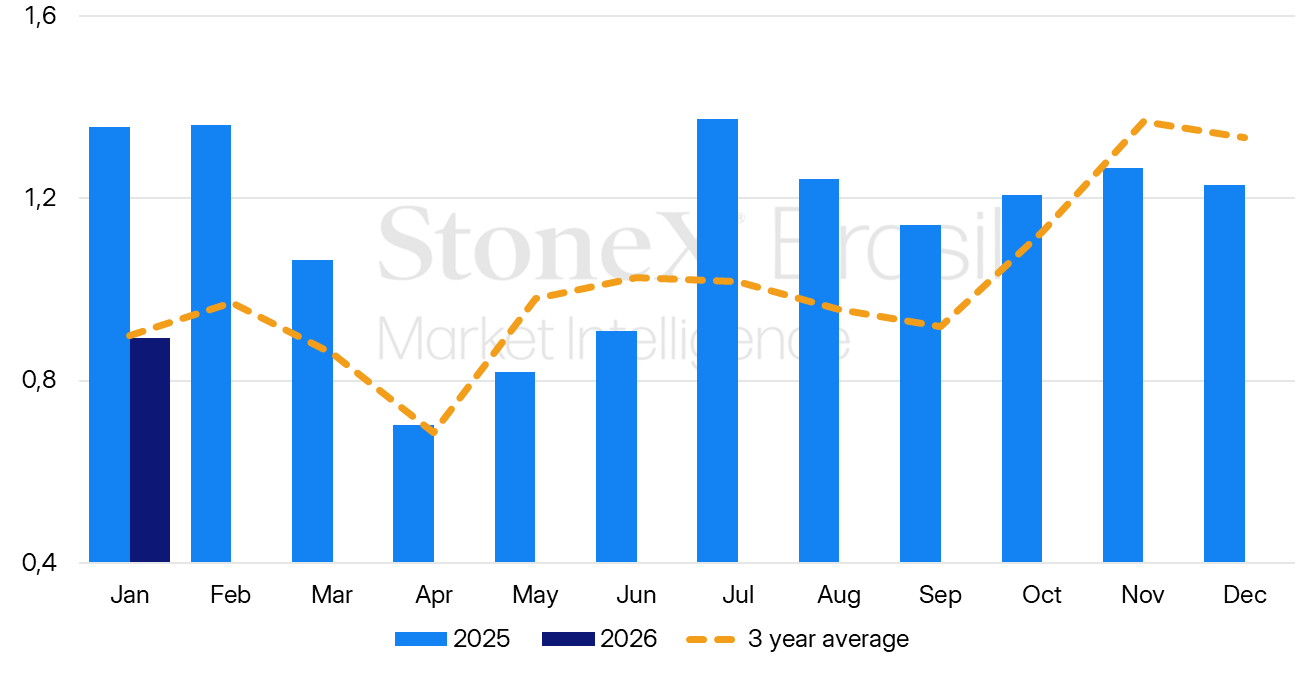
Source: FNC. Analysis: StoneX.
This Week
Prices began Monday with corrections on both the New York and London exchanges following last week’s sharp declines. The arabica March contract rose by just over 1.1%, while robusta ended the session up 3.3%.
- The Relative Strength Index indicates that arabica coffee remains oversold, suggesting room for further corrections throughout the week as the market seeks a new equilibrium point while awaiting fresh information.
- This Tuesday (10), Cecafé will release official data on Brazilian exports for January. Expectations are for significantly lower figures compared to both the prior month and January 2025.
- A confirmation could indicate that, although the outlook for the upcoming crop is favorable, the market remains tighter in the short term, particularly for arabica coffee, potentially limiting further steep price drops.
- Brazil’s coffee-growing regions are expected to continue receiving rainfall over the next two weeks, albeit slightly below average in areas like Cerrado, São Paulo, and Espírito Santo, which will be closely monitored by the market.
INDICATORS TABLE
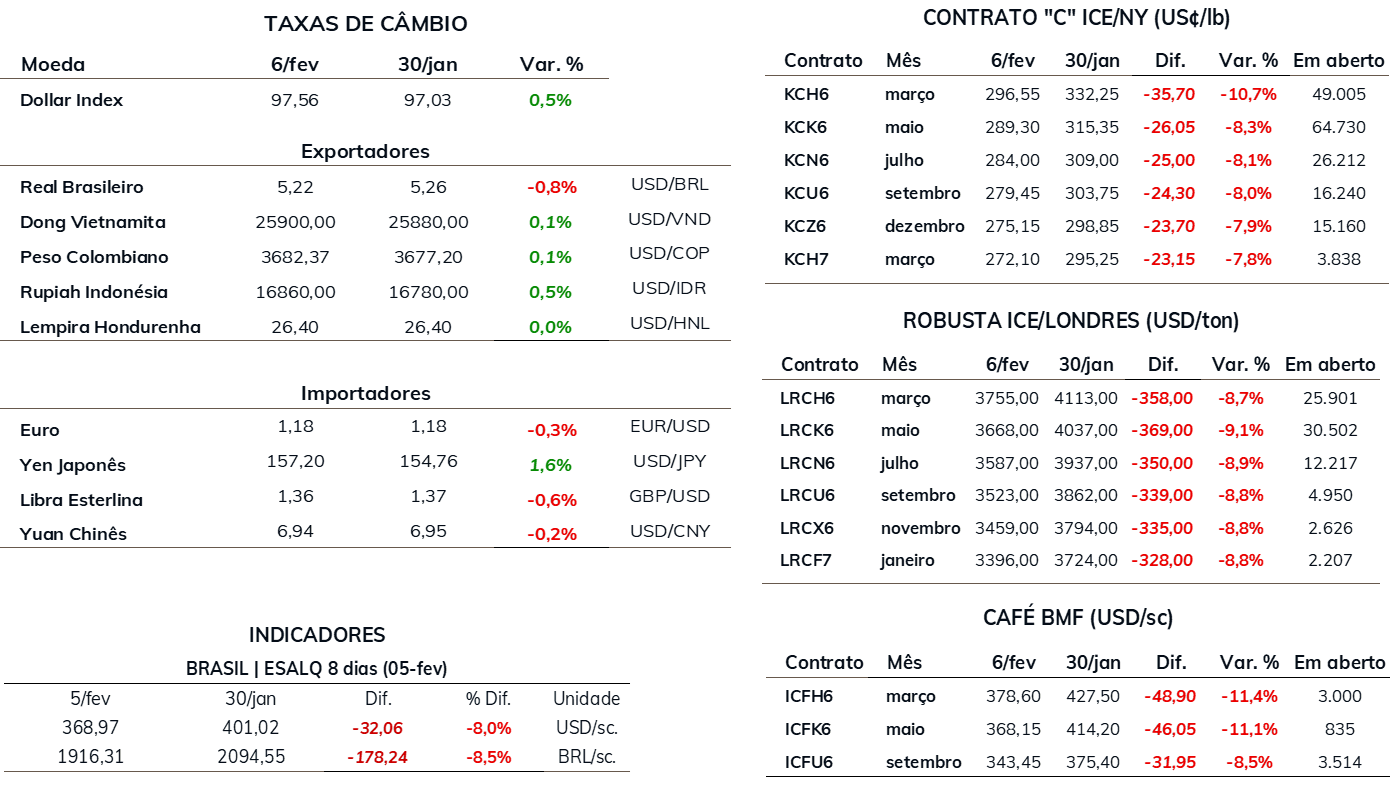
Sources: ICE/NY; ICE/EU; B3; Commodity Network Trader’s Pro.


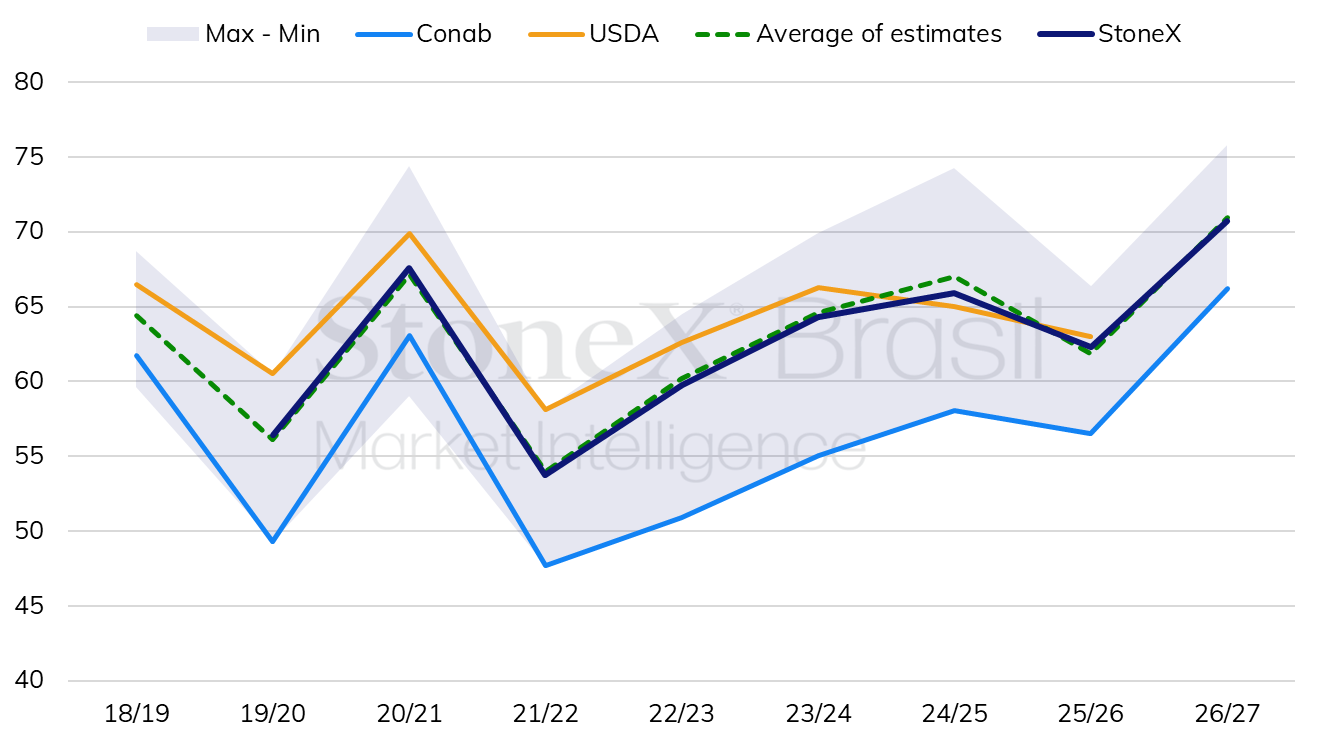
 Source: Conab, USDA, and StoneX. Analysis: StoneX.


