Coffee undergoes corrections during the week, but tensions in the Middle East remain on the radar
- Bullish
- Oil continues to pressure the commodity complex;
- Risks of logistical disruptions in the Middle East region;
- Chances of El Niño occurring and its intensity are increasing for the second half of the year.
- Bearish
- Positive crop development and stable weather in Brazil;
- Positive projections for Vietnam and Indonesia volumes in 2025/26.
Prices decline on exchanges and in the physical market
The movement of coffee futures contracts, as well as financial markets as a whole, remains conditioned by geopolitical uncertainties stemming from the conflict in the Middle East, with news on the issue generating different fluctuations in each trading session.
The strong upward movement observed in the first week of March, driven mainly by the intensification of the conflict, however, lost strength in recent sessions. Even without any relevant diplomatic advances, coffee posted declines on the main international exchanges throughout last week, in a process of adjustment to an environment of greater uncertainty.
Regarding specific market fundamentals, attention once again turned to supply prospects in Brazil. In particular, the report released by StoneX on Wednesday (11) revised upward the estimates for the 2026/27 crop, projecting production at a record level. Expectations of greater bean availability from the world’s largest producer increase bearish pressure on futures prices. In the opposite direction, Cecafé data indicated a 23.5% drop in Brazilian shipments in February, introducing an additional element of caution in the short term.
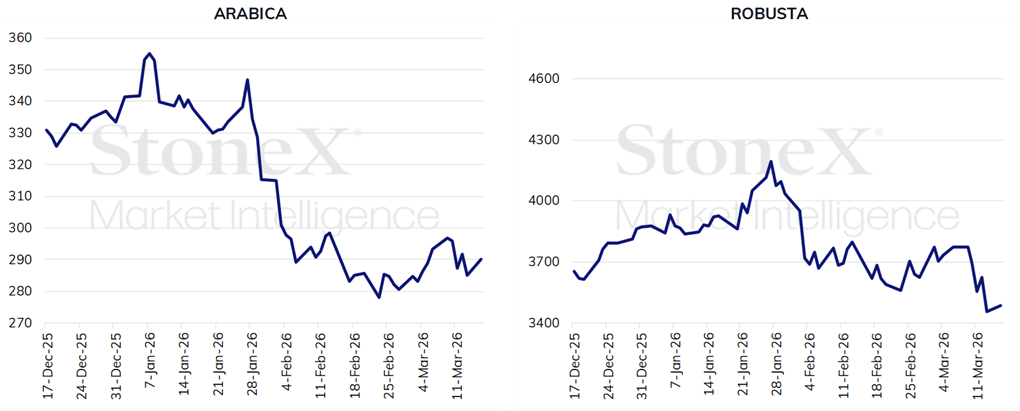
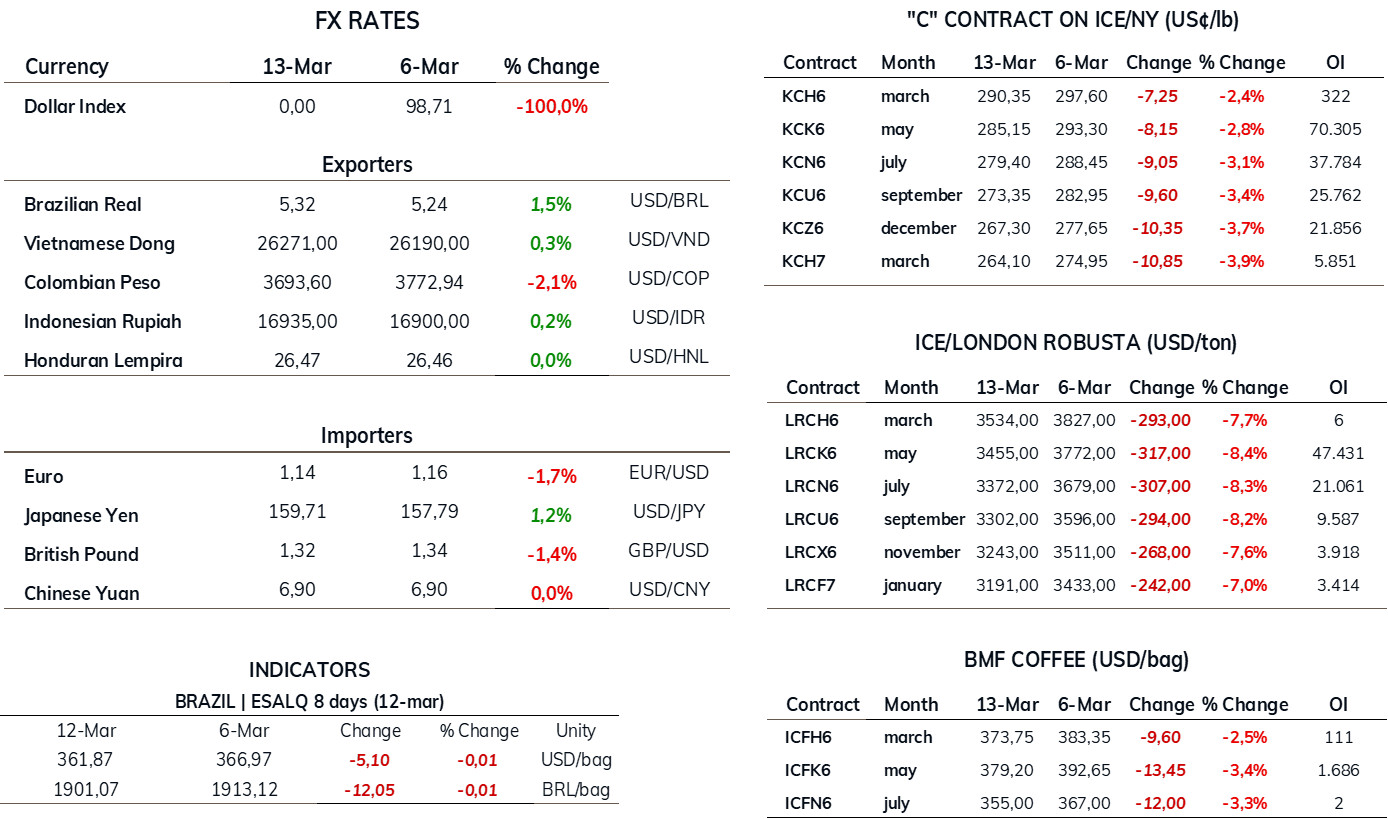
Arabica: The May Arabica coffee contract closed Friday at US¢ 285.15/lb on the New York Exchange, down 2.7% for the week. At this moment, Arabica appears less exposed to the direct impacts of the conflict on logistics routes, given that its main producers are in South America, far from the affected areas. Even so, rising costs associated with fertilizers and fuels are pressuring longer-dated contracts.
Robusta: On the London Exchange, Robusta futures fell 8.4% during the week, with the May contract closing at R$ 3,455/t. After posting gains greater than Arabica in the previous week, Robusta was more affected by the repricing of the risk of an escalation in the conflict and its possible effects on production chains in Asia, which partly explains the steeper decline last week.
Arabica coffee futures prices (US¢/lb) and Robusta coffee (USD/ton)
Source: CmdtyView. Prepared by: StoneX.
Physical market: In the domestic market, the Cepea indicator for Arabica coffee closed the previous week at R$ 1,878/bag, down 2.6%. The Robusta indicator declined 0.6%, ending the period at R$ 1,000/bag.
Opening this Monday: This Monday, coffee futures contracts were trading higher, following the recovery observed in several assets classified as higher risk, such as other agricultural commodities, stock indices, and emerging market currencies. The move suggests a partial correction after the strong risk aversion recorded on Friday (13), which broadly pressured these assets.
StoneX raises estimate for Brazil’s 2026/27 crop to 75.3 million bags
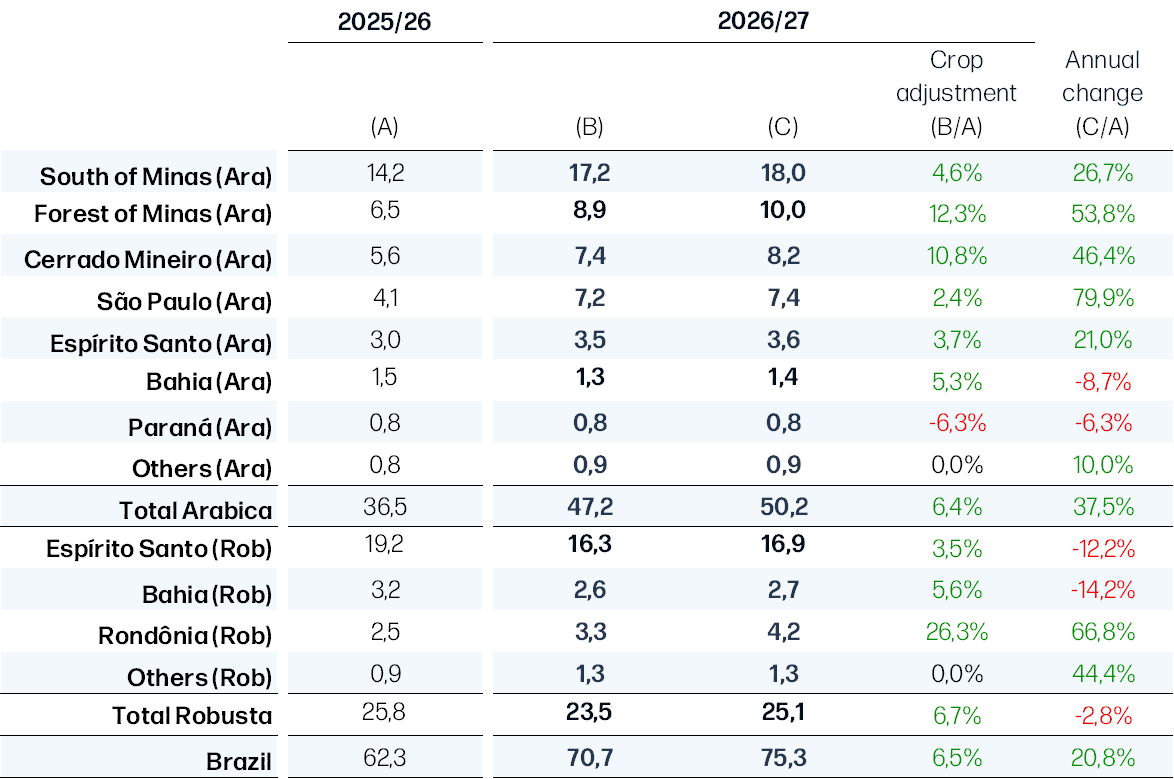
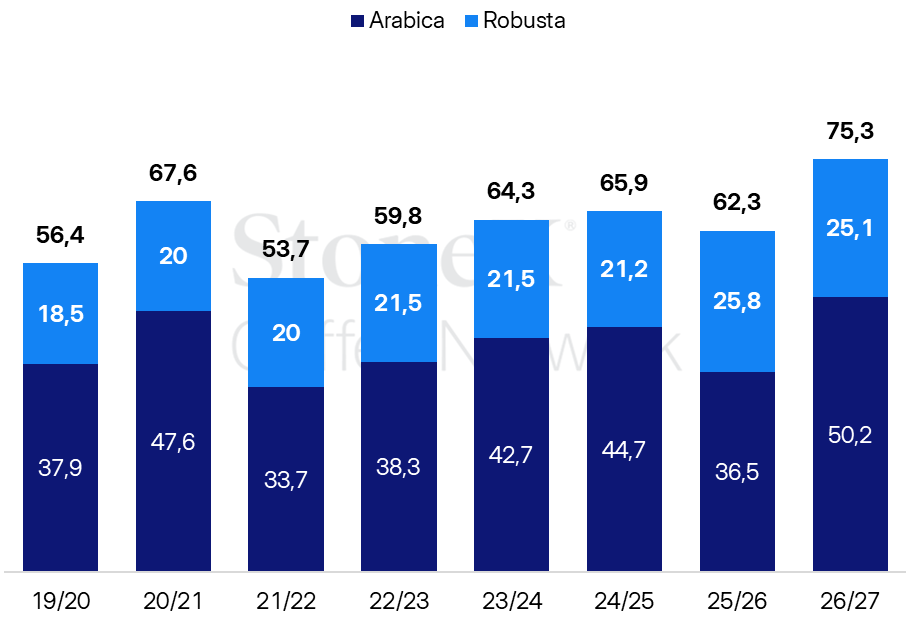
Last Wednesday (11), the StoneX Market Intelligence team released the revision of its Brazil Coffee Crop Survey, raising the production estimate for 2026/27. The projection increased from 70.7 million to 75.3 million bags, a significant increase compared to the 62.3 million estimated for the 2025/26 season.
Why this matters: The estimated improvement in Brazilian supply, coming from the world’s largest producer and exporter, tends to reduce concerns about availability in the next cycle. This scenario should favor the rebuilding of international coffee stocks and therefore exerts bearish pressure on futures prices.
In detail: The new projection represents a 20.8% increase compared to the 2025/26 crop and marks the largest volume ever recorded by Brazilian coffee farming.
- Arabica: 50.2 million bags (+37.5%)
- Conilon (Robusta): 25.1 million bags (+2.8%)
Overview: Even though some Arabica regions may not post such high yields for the 26/27 crop, the national outlook is supported by important structural factors:
- Regions with strong productive recovery, especially after the sharp losses in last year’s crop;
- New areas entering production, as a result of the expansion of coffee-growing acreage in recent years;
- Strong Robusta performance, which has been supporting the growth of national production;
- Structural renewal of plantations, with modernization of the planting system.
Access the official report with details and images on all the main producing regions.
Brazil coffee production (million bags)
Sources: StoneX.
Historical Brazilian coffee production (million bags)
Sources: StoneX.
Cecafé reports a 23.5% decline in coffee exports in February
According to data from the Brazilian Coffee Exporters Council (Cecafé), Brazil exported 2.618 million bags of all types of coffee in February, a decline of 23.5% compared to the same month of the previous year.
In detail:
- Arabica: 2.06 million bags
→ monthly increase of 12.2% and annual increase of 29%.
- Conilon (Robusta): 226 thousand bags
→ monthly increase of 24% and a slight decline of 2% versus Feb/2025, influenced by stronger domestic demand and the competitiveness of Southeast Asian coffees, currently in the middle of harvest.
- Soluble: 320 thousand bags
→ monthly increase of 27% and annual decline of 14%.
Monthly Brazilian green coffee exports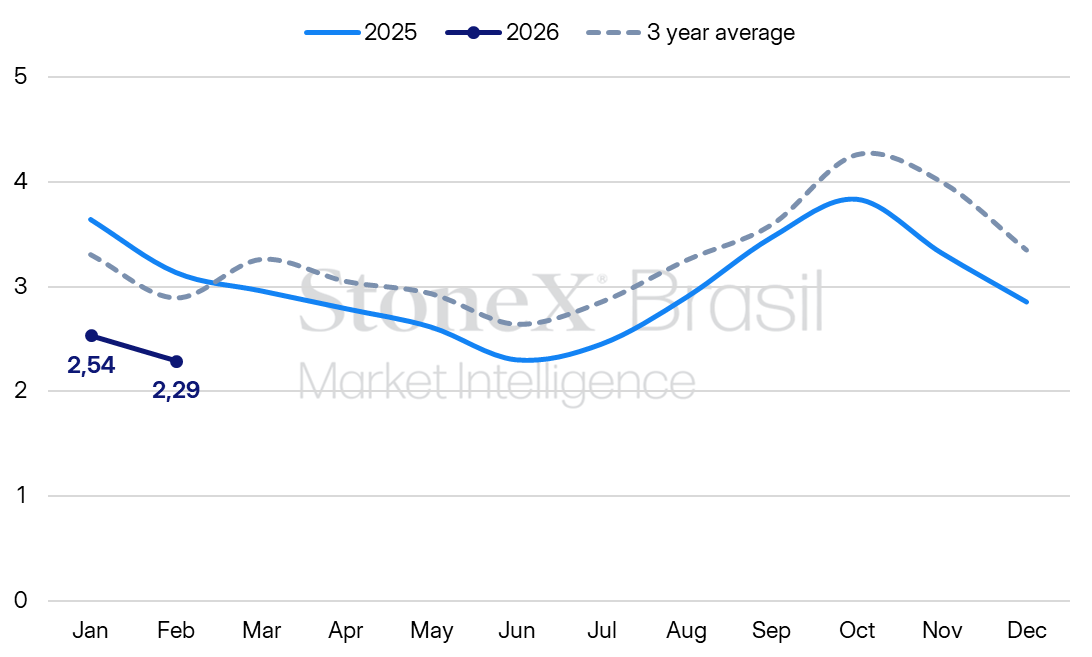
Source: Cecafé. Prepared by: StoneX.
Why this matters: Although expectations of greater supply in the 2026/27 crop are exerting bearish pressure on prices, Cecafé data reinforce the perception of tighter bean availability in the short term. Brazil recently harvested its smallest crop in four years and is currently in the inter-crop period, when the volume available for export naturally declines.
- Lower supply from Brazil may act as a supporting factor for futures prices, especially if Colombian production, an important competitor in Arabica, continues below its historical pace.
Soluble coffee exports recover: The positive highlight of the month came from soluble coffee exports, which reached around 320 thousand bags, the highest monthly volume since May 2025.
- This movement is likely to continue gaining traction in the coming months, especially after the end of the tariff restrictions imposed by the United States on the product.
- Soluble coffee had continued to suffer from the 50% tariff imposed by the United States in 2025, while other coffee types were exempted in November, along with several other agricultural products.
- The high tariff significantly reduced the competitiveness of Brazilian soluble coffee in its main buyer market.
- The situation changed on February 20, when a U.S. court decision suspended the legal basis used by the Executive Branch to impose additional tariffs, reducing the charge applied to soluble coffee to the standard rate (10%).
- As a result, the product is once again competing under more balanced conditions, and it is plausible that March exports will post an additional recovery, since it will be the first full month under the new tariff regime.
Despite the recovery in soluble coffee, total shipments to the U.S. decline
Despite the normalization of tariffs on Brazilian green coffee since November of last year, shipments remain below expectations.
- Total coffee shipments (green, soluble, and roasted) to the U.S. totaled 270 thousand bags, down 30% from the previous month and 44% from February of last year.
- In terms of share, the U.S. was only the third-largest destination, behind Germany (394 thousand bags) and Italy (283 thousand bags).
- Although, seasonally, February is a month of declining shipments and supply in the country is more restricted, the monthly drop observed in U.S. purchases was steeper than among the other main importers, with Germany even posting a slight monthly gain.
- Why this matters: While the figure indicates that shipment flows to the U.S. have not yet fully normalized, the result may also raise questions regarding consumption in the American market. Therefore, it will be important to monitor the country’s February imports, which will be reported at the beginning of next month, to determine whether the country actually posted a total purchase volume below normal, or whether other countries were able to supply significant volumes to American importers.
Monthly Brazilian coffee exports to the top 5 destinations (thousand bags)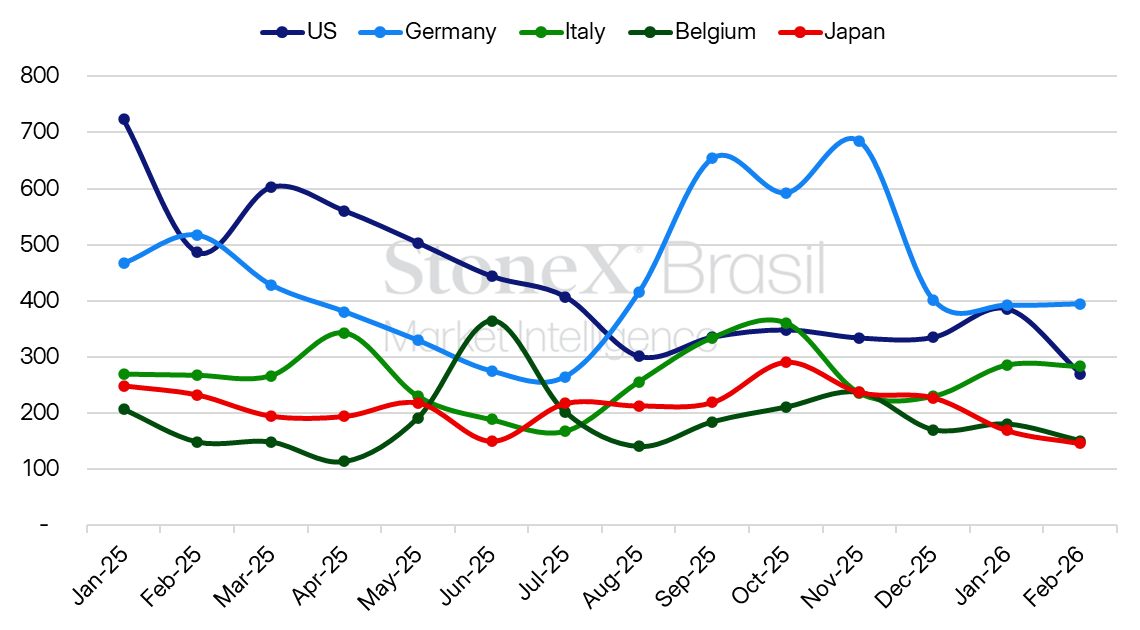
Source: Cecafé. Prepared by: StoneX.
Possibility of a strong El Niño increases production risks for coffee
Last week, NOAA, the U.S. weather agency, updated its climate outlook and projections for the ENSO phenomenon, which encompasses the La Niña and El Niño cycles. The main points of the report are highlighted below:
La Niña still present, but weakening: The La Niña pattern persisted between February and early March, with Pacific temperature anomalies close to -0.4 °C, in addition to characteristic wind and rainfall patterns. However, the signals indicate that this condition should lose strength in the coming weeks.
Imminent transition to ENSO-Neutral: The ocean is showing rapid and deep warming, reaching as deep as 250 meters. Models indicate a shift to neutral conditions as early as next month, with this phase expected to be relatively short, concentrated between May and July, with a 55% probability.
El Niño alert for the second half of 2026: Starting in June 2026, the probability of El Niño formation rises to 62%. Given the intensity and speed of ocean warming, NOAA highlights a high probability of a strong El Niño between October and December 2026. Although charts from the International Research Institute (IRI) at Columbia University still do not clearly signal a strong-intensity event, NOAA already indicates that by the end of the year anomalies may exceed +1.5 °C, characterizing a strong El Niño.
Implications for the coffee market: While coffee market fundamentals had been mostly bearish, it is possible that the climate phenomenon may bring moments of reversal in this market perception during the second half of the year.
It is worth noting that, while a weak El Niño may at certain times bring localized beneficial effects to Brazil, the phenomenon tends to be associated with warmer conditions in the period preceding flowering, which keeps the market on alert.
If the possibility of a more intense El Niño continues to be reinforced in future updates, the market is likely to begin pricing in climate risks for the 2027/28 crop, which could become an important support factor for prices in the second half of the year.
Oceanic Niño Index (ONI) history and forecast - Temperature anomalies (ºC)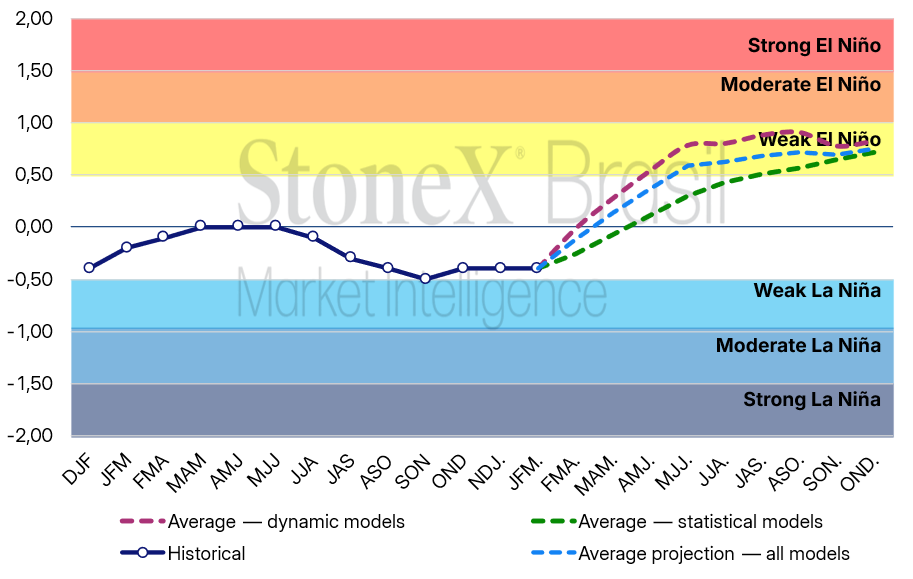
Source: CPC/IRI. Prepared by: StoneX.
INDICATORS TABLE
Sources: ICE/NY; ICE/EU; B3; Commodity Network Trader’s Pro.