Arabica Coffee Declines Amid Fundamentals and Speculative Movement
- Bullish
- Smaller current crop and sales restrictions boost Arabica coffee premiums in Brazil in the short term;
- Colombia reports lower production and exports again in April;
- Despite significant export volumes, producers in Vietnam continue to limit new sales.
- Bearish
- Global surplus expected in the 2026 balance;
- Forecasts of record crop in Brazil;
- Harvest season approaching in Brazil;
- Vietnam reports strong exports in April.
Colombian Decline and Tight Stocks Provide Support, but Brazilian Surplus Outlook Dominates Sentiment
The week of May 4–9 saw selling pressure on Arabica futures, with the continuous contract hitting its lowest levels in nearly a year and a half. The week was marked by a return to more comfortable balance sentiment for the year and technical movements that added pressure to prices in the latter half of the period. The global macroeconomic environment remains complex: the conflict in the Middle East continues to create logistical uncertainties regarding cargo flow and elevated freight costs. The trajectory of the Brazilian real, which approached R$ 4.90 for the first time since January 2024, acts as a mixed vector: it eases domestic inflationary pressure but compresses Brazilian exporters' margins in reais, reducing incentives to offload stocks. Overall, the bearish bias prevailed, dictated by the prospect of a global surplus in the 2026/27 balance.
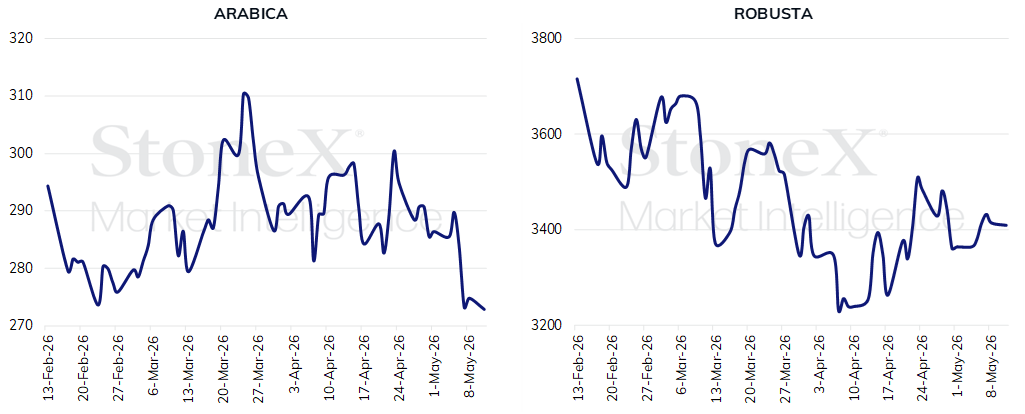
Source: CmdtyView. Prepared by: StoneX.
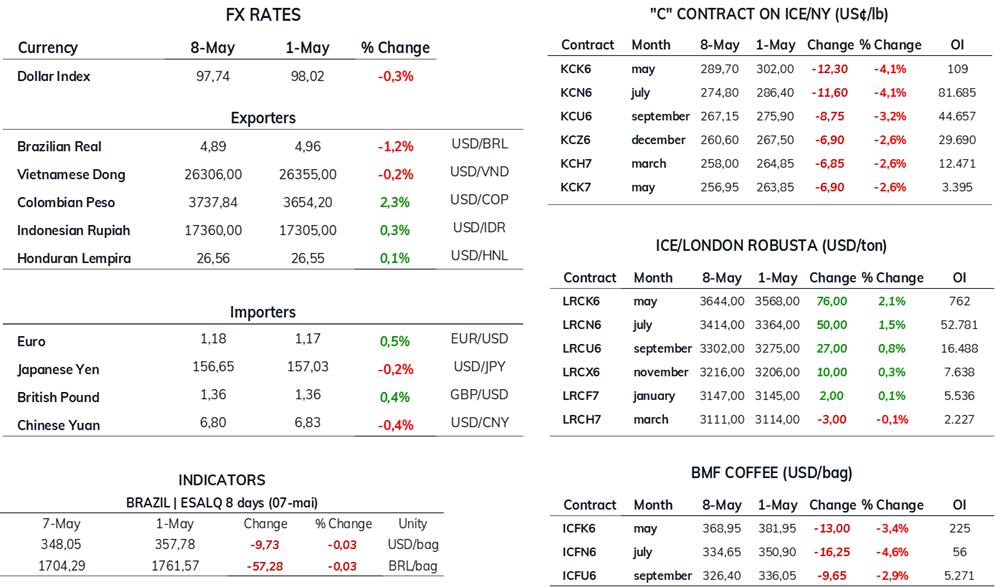
Arabica: The July Arabica contract closed the week at US¢ 274.8/lb on the New York Stock Exchange, down 4.1% for the week. This marked the lowest closing for the continuous contract since mid-November 2024, with an intraday low of US¢ 268.0 recorded on Thursday. The fundamental narrative pressuring prices throughout the week was the gradual confirmation that the Brazilian crop is progressing as expected. Andrea Illy, president of Illycaffè, one of the major coffee industry groups, visited farms in Brazil and confirmed the perception of significant progress in plantations. Additionally, the executive's remarks drew attention regarding his concerns about investments spurred by historically high prices, potentially leading to excessive planting and future price crises.
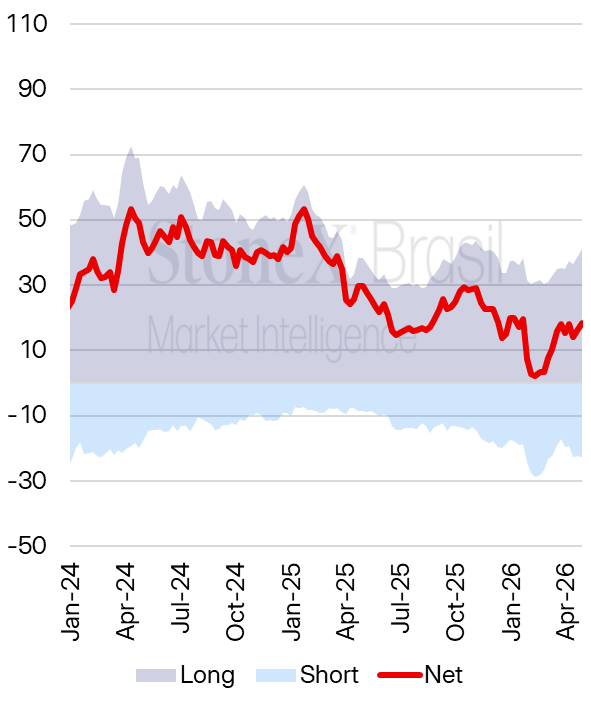
In the short term, the appreciation of the real continues to encourage producers to withhold supply, as their revenues have been negatively impacted. Moreover, preliminary data from Secex indicated that Brazilian exports in April fell 1.1% year-over-year, signaling a slower-than-expected pace of shipments for the season. On the speculative front, the CFTC report released Friday showed that funds increased their net long position in Arabica by 1,644 lots to 18,271 lots, a factor that contributed to the sharp drop observed on Wednesday and Thursday, which will be analyzed in a later session.
Robusta: The July Robusta contract closed the week at USD 3,414/t on the London Stock Exchange, up approximately 1.0% for the week. The relatively superior performance compared to Arabica reflects distinct supply dynamics between the two varieties. Certified stocks on the London Exchange continued their downward trajectory, accumulating declines over the week and remaining at historically low levels.
One of the main supporting factors continues to be reports that producers in Vietnam's Central Highlands region have been withholding sales, even though export figures show progress. Operators have reported that buyers are already redirecting attention to Indonesia, where the harvest is advancing in the Lampung region.
Physical Market: In Brazil, the Cepea Indicator for Arabica coffee closed the week at R$ 1,669.93/bag, down 5.2%. The Cepea Indicator for Robusta finished at R$ 912.99/bag, with a decrease of 1.3%. The movement in Arabica mirrored the decline on the exchange and was amplified by the appreciation of the real. It's worth noting that while the real's appreciation reduces the valuation of coffee in the Brazilian physical market, it also contributes to withholding supply, which can act bullishly on the exchange in a secondary moment.
This Monday (May 11): Coffee futures opened higher in the session. Arabica posted a significant recovery of 2.7% in New York, quoted at US¢ 282.1/lb, correcting after last week's sharp drop and finding additional support from the real's appreciation. Meanwhile, Robusta advanced 2.7% in London, trading at USD 3,504/t.
The harvest in Brazil — particularly in Arabica-growing areas — remains slow, with regions like South Minas and Cerrado still reporting very low volumes. In contrast, for Robusta coffee, the harvest in Rondônia is progressing, with volumes starting to become more significant and expected to pick up pace throughout May.
Short-term supply constraints are helping sustain the correction movement on the exchanges. Market participants are awaiting the release of Cecafé's April export data, which should provide greater clarity on the recent export flow.
In the coming days, the market will focus on monitoring the progress of the Brazilian harvest and weather developments in key producing regions.
Vietnam — Exports Remain Strong
The General Statistics Office of Vietnam reported last week export data for April, maintaining the pattern of strong performance for the year.
- Monthly performance: Exports totaled 3.164 million bags, down 15% compared to the previous month but 9.2% higher than the same month last year.
- Accumulated (Oct/April): In the first six months of the season, the country reached 18.6 million bags, surpassing the 15.4 million bags in the same period last season by 21%.
- Revenue decline: Despite the volume increase, export revenue fell 7% year-over-year, totaling USD 3.69 billion, highlighting the impact of significantly lower prices in the current cycle.
Vietnam's Monthly Coffee Exports (Millions of Bags)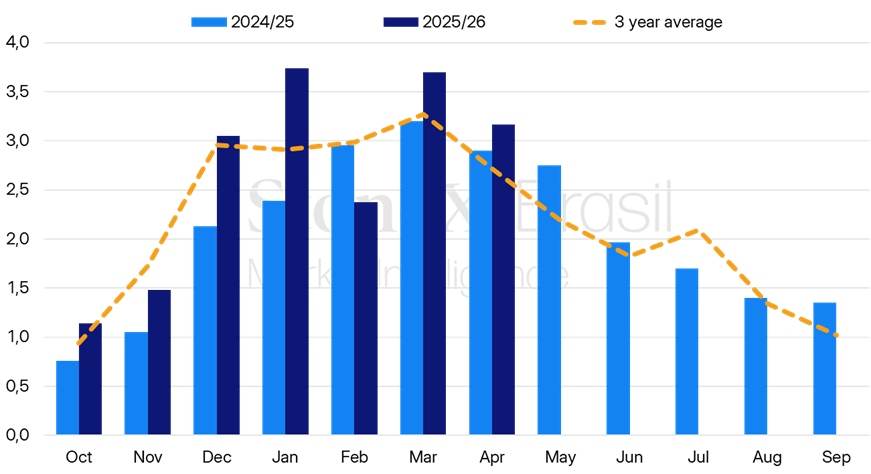
Source: Vietnam Customs. Prepared by: StoneX.
Why this matters: Vietnam's strong numbers reinforce the reality of a season with significantly higher Robusta coffee volumes in the global market, underpinning the predominantly bearish outlook for prices in London this year. This perspective holds as the Brazilian Robusta coffee harvest approaches, with significant progress already observed in Rondônia.
Details: In Hanoi's physical market, Central Highland farmers have been selling below their historical willingness, with reports of increasing stock withholding as future prices approach levels considered unattractive. Traders reported this week that commercial activity remains "weak," with sellers waiting for price rebounds to increase coverage. The fact that reported export levels remain high despite frequent reports of weak activity and producers withholding their product reinforces the situation of ample availability in the country, suggesting continued pressure on prices and premiums.
Colombia — Seventh Consecutive Month of Declining Production
The Federación Nacional de Cafeteros (FNC) released April 2026 data this week, which continued to show weak performance for the year, albeit closer to averages for April, traditionally the month with the lowest volumes.
- Production: Totaled 697,000 bags, down 0.8% year-over-year, marking the lowest volume for the month since April 2023 and confirming the seventh consecutive month of annual decline, signaling persistent structural and climatic limitations in supply.
- Exports: Fell 15% year-over-year to 682,000 bags, reflecting both lower coffee availability and a less favorable external environment for shipments.
- Accumulated production (Jan–Apr): Reached only 3.21 million bags, a sharp 28% drop year-over-year, demonstrating that the expected recovery at the beginning of the year did not materialize.
- Accumulated exports (Jan–Apr): Totaled 3.25 million bags, down 26% year-over-year, aligned with production contraction and reduced shipment capacity.
Colombia's Monthly Coffee Exports (Millions of Bags)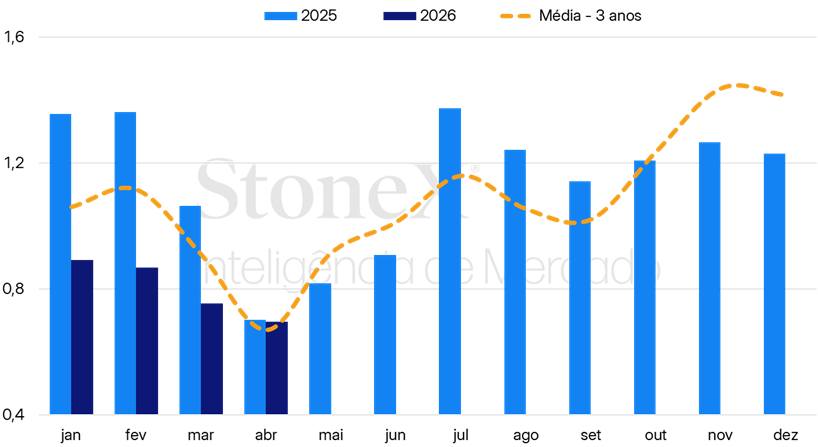
Source: FNC. Prepared by: StoneX.
Why this matters: Colombia is the largest global supplier of washed Arabica, the variety preferred by premium roasters and leading global coffee chains. When Colombian supply contracts, the washed Arabica market often struggles to find direct substitutes with similar attributes in the short term. This structural tightening helps maintain elevated Colombian coffee premiums.
Details: FNC's general manager, Germán Bahamón, attributed the declines to delays in the secondary harvest (mitaca), typically occurring between April and June, but compromised by heavy rains in southern regions. Departments such as Huila, Antioquia, and Cauca — the country's three largest producers — experienced rainfall up to three times above historical averages in recent months, according to Cenicafé data.
Colombian stocks also continue to decline: total reserves dropped to 818,000 bags in April, compared to 883,000 bags in March and 1.085 million bags in January — a 25% reduction in just four months. FNC is utilizing its own stocks to fulfill export commitments. If reductions persist, scarcity premiums and tight stocks may continue to support Colombian coffee with high premiums.
Outlook: In the short and medium term, Colombia's outlook remains structurally restrictive for Arabica. The lack of a dry period between January and March compromised first-half flowering, which tends to negatively impact the main harvest, typically occurring from October onward. The growing likelihood of El Niño in the second half of the year could be somewhat beneficial, reducing excessive rainfall and favoring gradual production recovery. However, if El Niño intensifies, it could pose new risks of water stress.
Speculative Positioning Helps Explain Recent Coffee Price Correction
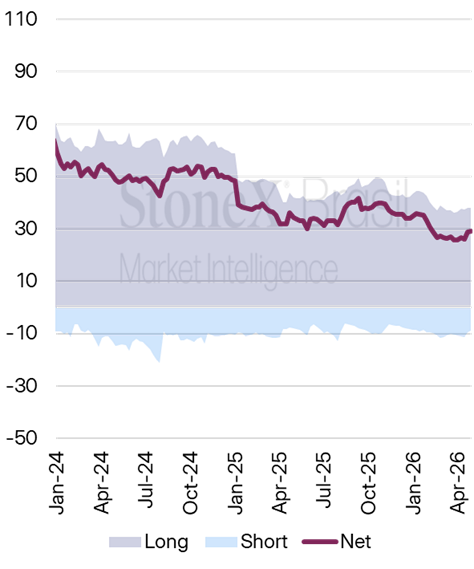
The sharp correction observed in coffee futures last week can largely be attributed to adjustments in speculative positioning, with agents carrying elevated long exposure in ICE contracts.
- In the latest CFTC report, with data up to Tuesday (May 5), funds showed a net long position of 18,271 contracts, the highest level since January, indicating a market already relatively “stretched” on the long side.
- This elevated exposure increased the market's vulnerability to profit-taking movements, especially in the absence of new bullish fundamentals.
Why this matters: Markets with high speculative positioning in one direction tend to exhibit greater short-term risk asymmetry.
- When agents are excessively long, the absence of new bullish news can lead to liquidation of these positions, causing more intense price drops.
- This process occurs independently of significant changes in fundamentals, driven primarily by technical adjustments and risk management.
Details: The dynamic observed between Wednesday and Thursday reflects precisely this process of reducing long positions by funds.
- After reaching higher technical levels earlier in the week, the market began to see position liquidation, pressuring Arabica contracts, which posted significant declines across three consecutive sessions.
- The movement occurred despite the absence of clear new fundamental triggers, reinforcing the view that speculative flow was the primary driver of the correction.
Net Positioning of Speculative Funds and Index Funds, respectively (Thousands of Contracts)
Source: CFTC. Prepared by: StoneX.
INDICATOR TABLE
Sources: ICE/NY; ICE/EU; B3; Commodity Network Trader’s Pro.