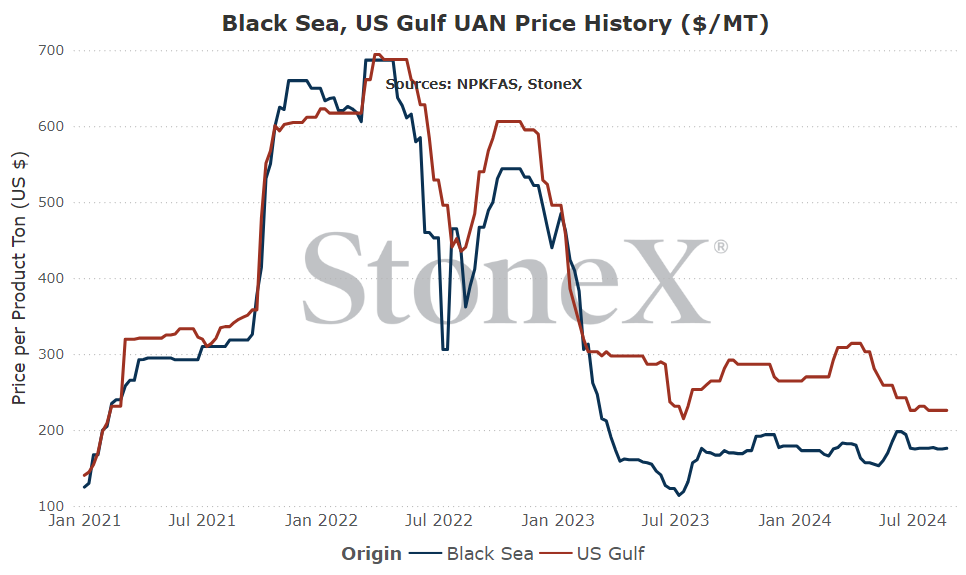
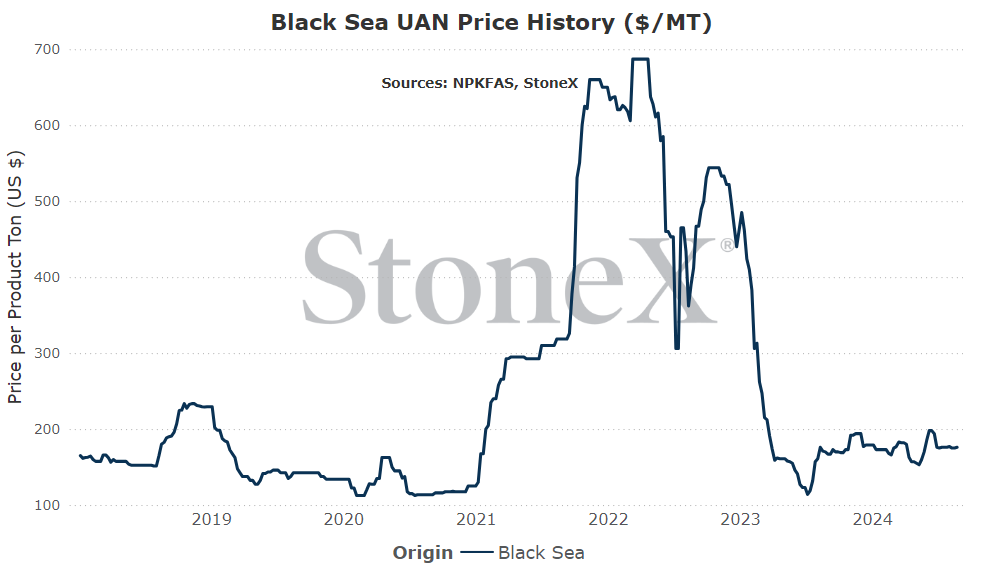
The intention of the below graphs are not to use to say "my price should be X based on this graph". These prices are derived from an FOB price point average. The intent is to show major global price movement trends. Your values will likely have significant basis difference (similar to your local grain price being different than the traded market price).
This graph is labeled as MT in USD currency.
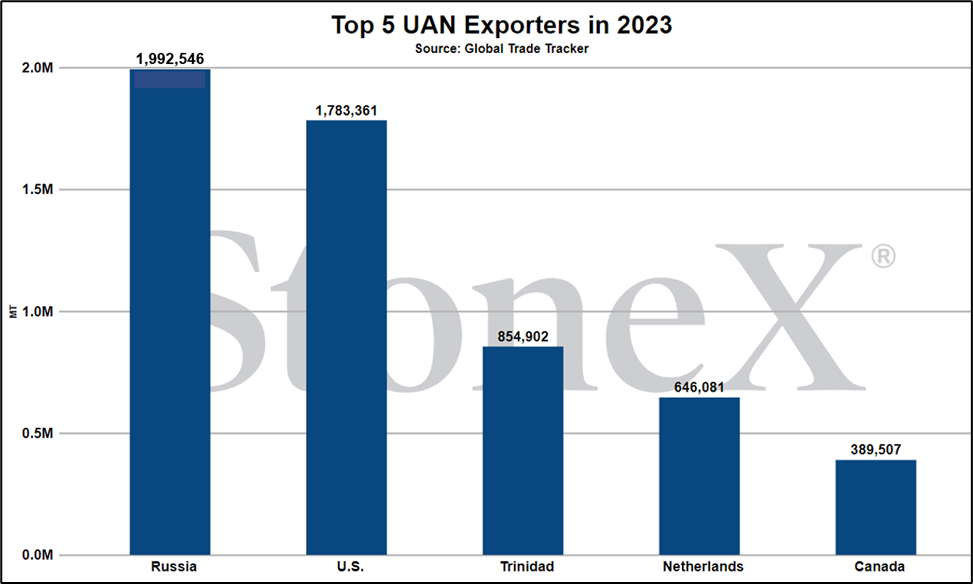
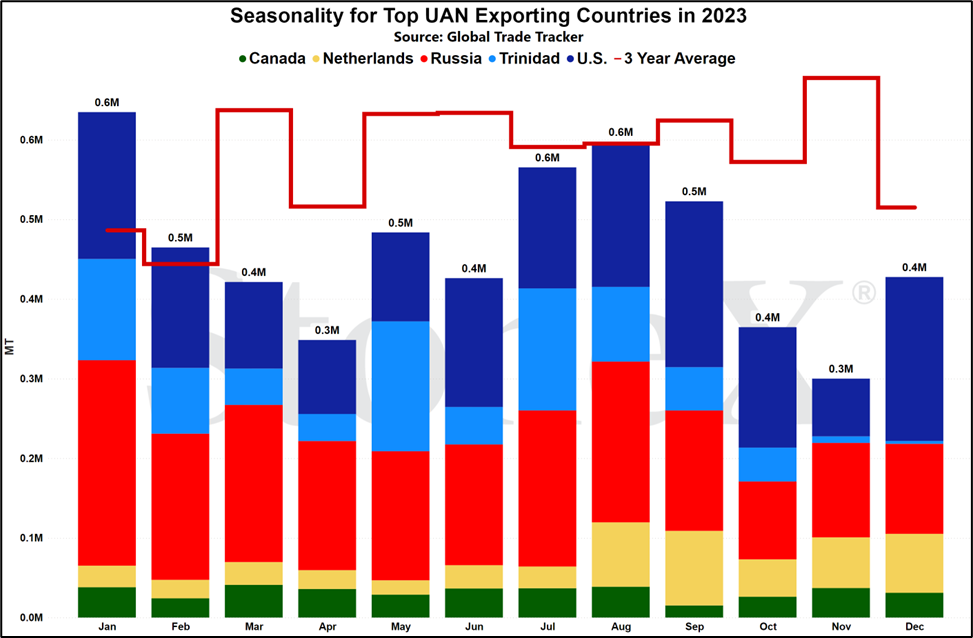
Global production update (there are issues...)
As listed in the urea newsletter, there are some production/supply issues around the world. Unlike urea, the UAN list is mostly bad for farmers....
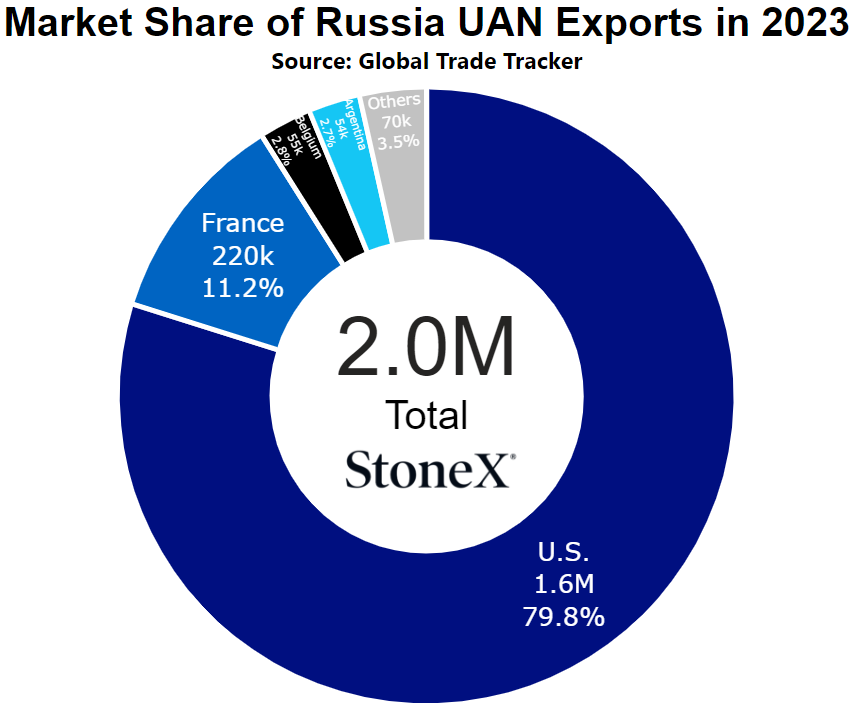
Russia (good for farmers) - actually, Russia stands out as a bright spot in the global UAN marketplace. They continue to export higher than normal volumes and while they are cut from certain markets (Canada/Australia), they are finding enough homes to stay comfortable.
U.S. (bad for farmers)- there have been planned production downtime...and unplanned production downtime. For the planned facilities, both Borger, TX and Pt. Neal, IA saw plants go down for scheduled repairs. This downtime was factored into forecasted markets and everything seems to have gone to plan. Unfortunately, Verdigris, OK saw storms cause damage (reportedly). I say reportedly because information on situations like this are typically thin with the owning company not wanting to give a lot of information. What we have seen were plenty of reports as well as statements from the plant that customers were not to send trucks or expect any deliveries for the short term.
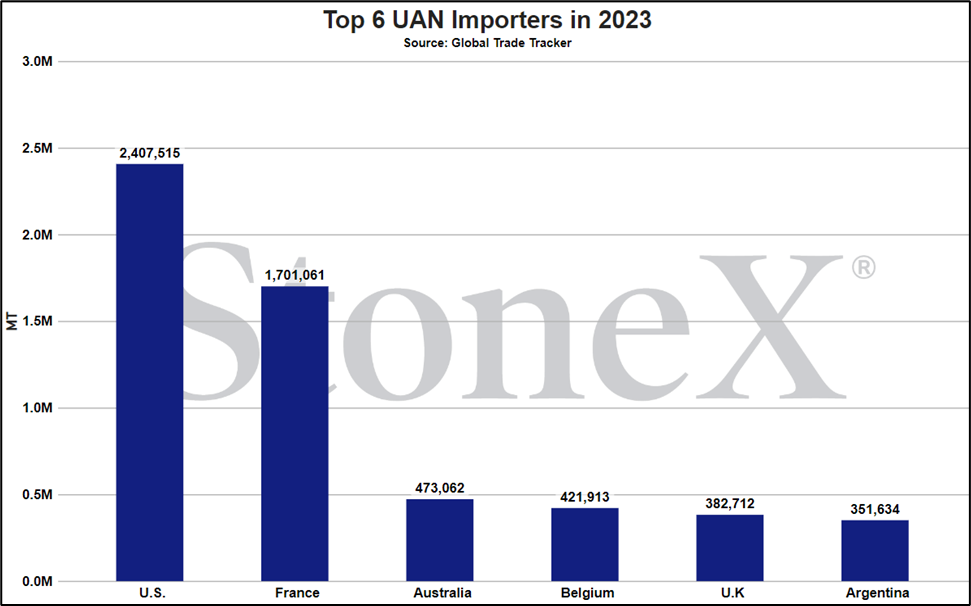
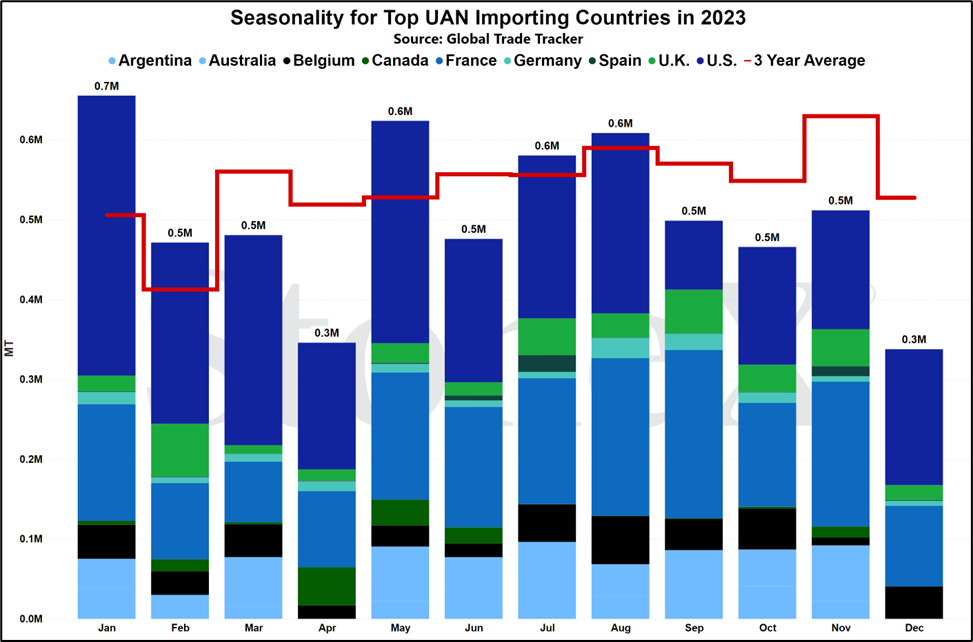
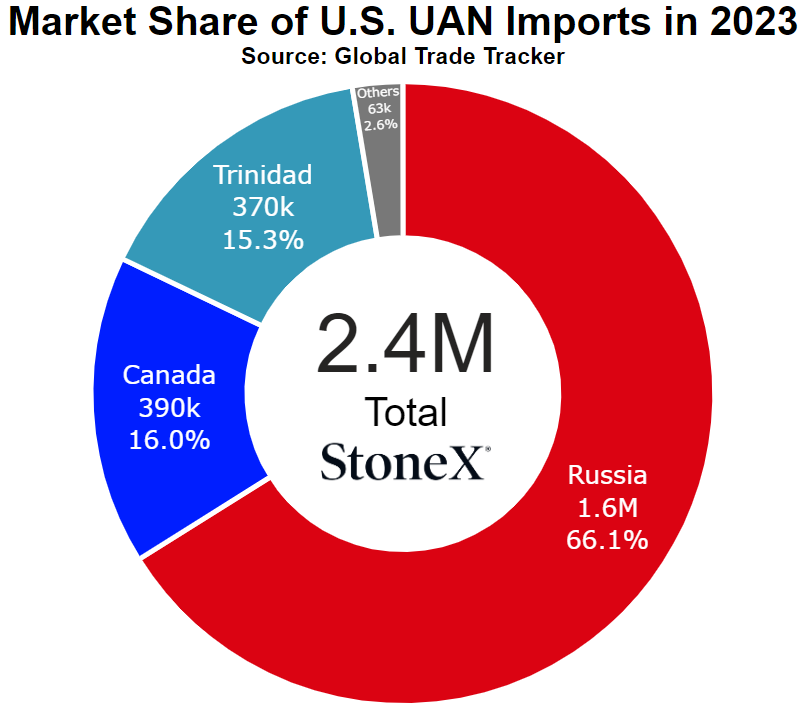
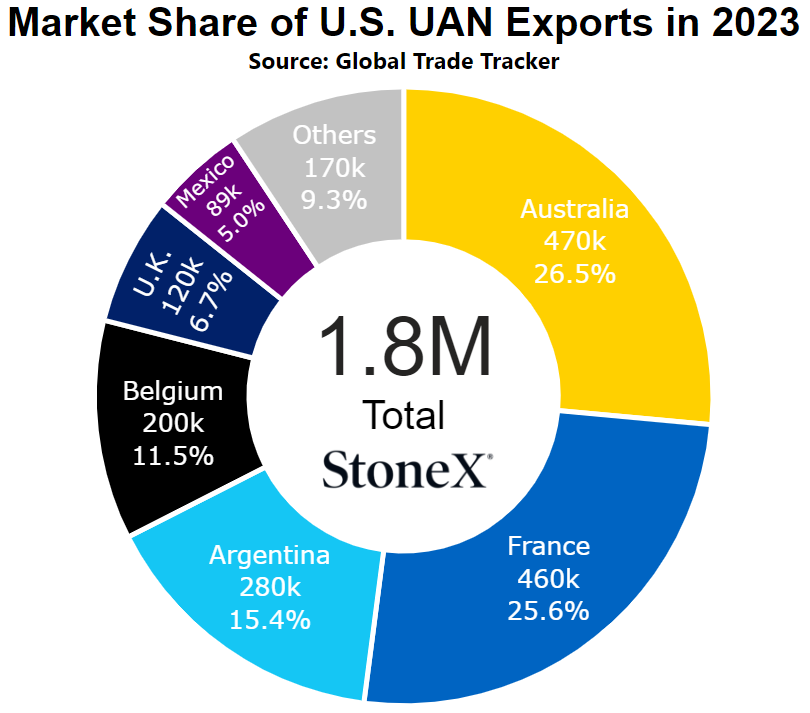
Trinidad (bad for farmers) - gas supply issues has been a story around Trinidad for some time. Fortunately, they recently approved the exploration and development of new territorial waters with the intention of boosting natural gas supplies. This is great...when it happens. It isn't as though these rigs and infrastructure were already in place. It will take time to develop. In the meantime, gas shortages will continue to hamper production rates. Hopefully, the hiccups will be relatively far and few between but when they happen, they dig into expected supplies. In 2023, product flowed to U.S. (43%), France (28%), and Canada (9%). That not only tightens supply availability for these nations but also think about what it means for the U.S. Imports shrink while export opportunities rise.
There are other manufacturers/exporters but those are the main 3 that I track. Good news from the Russian angle but not so good news from the others...
What this means for farmers
The tighter the supplies, the more easily a price can go higher.
No, it does not guarantee that to be fact. That is especially true today with demand so unwilling to engage the market. However, our 2025 forecast continues to point to relatively even nitrogen demand to 2024. Farm economics suck, but demand should be there.
Hopefully these production hiccups can be solved and we can move forward relatively unscathed but if they continue, supplies are lower with demand level. Econ 101 says prices trend higher in that environment.
...have I mentioned lately to please do not shoot the messenger?!
Market stalemate continues
So there are some supply hiccups in the U.S. and Trinidad but market prices are not moving higher. What gives?
Well, you all!
The biggest story for the last couple months has had less to do with fertilizer directly and more to do with grain prices continuing to fall. There are a lot of younger people in the industry that have not seen grain prices as low as they are today. Not only that, a lot of more mature (...yes, old which I am in) folks got spoiled the last few years. I hate to say it but the last few years have been easy. Everyone was making money and it was easy to make sales. Not perfect, but much easier.
Now, farmers are hoping that they can make enough this year to make payments. When they look to 2025, it isn't much better. So after years of profitability, grain prices have fallen hard while most inputs have held steady. That does not put farmers in a spending mood...and that weighs on the market.
Most folks that I talk with agree that nitrogen demand should remain relatively steady and also that there are production problems but without buyers, it is hard for prices to reflect that. No one wants to try and push it higher in this environment.
So for now, the market continues in a stalemate. This will not last forever. Eventually, buying has to occur. It is possible that demand stays away long enough to impact market pricing, but that would be short lived I'm afraid.
What this means for farmers
A stale market means that values are not moving...yet. This gives us time to see if grain prices start to jump. This gives us time to save some interest cost. This gives us time to see if a better avenue for next year opens up.
Unfortunately, I am still more bullish than bearish on the forward markets. I would love nothing more than for everyone to do nothing, the price falls out of bed and you can tell me I told you so. I really would. When I look at the market today, I just do not see it as a likely outlook.
UAN prices feel high...but are they
Short answer is yes they are, but they are more in line than they seem!
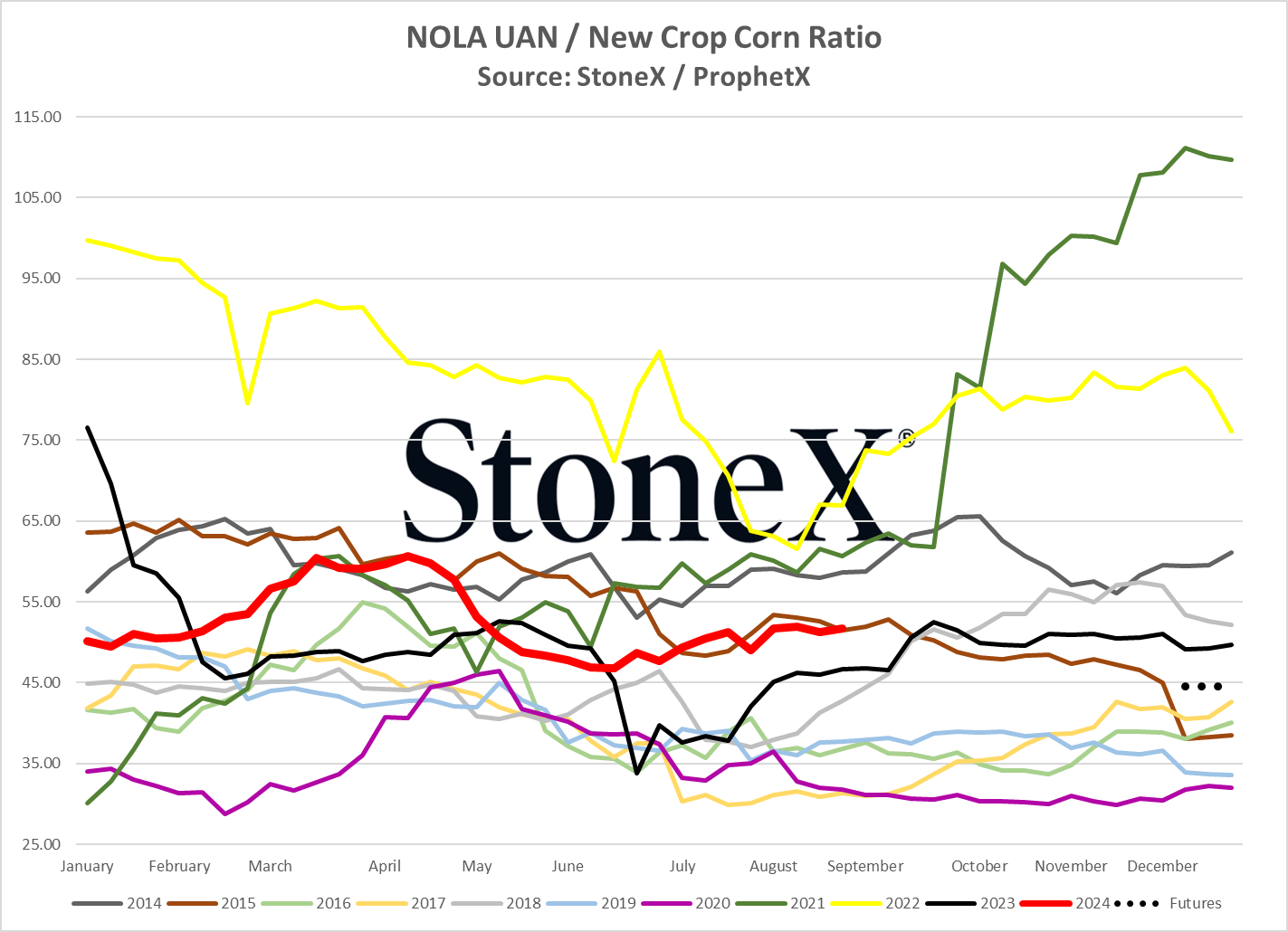
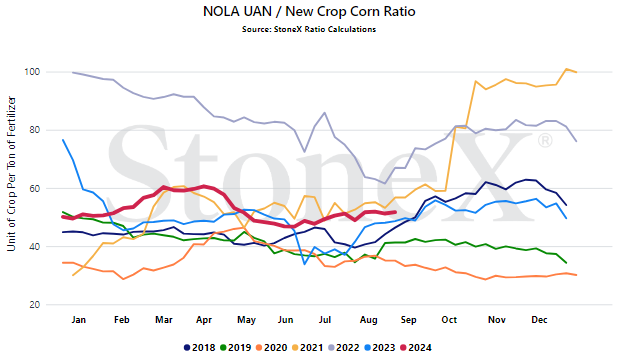
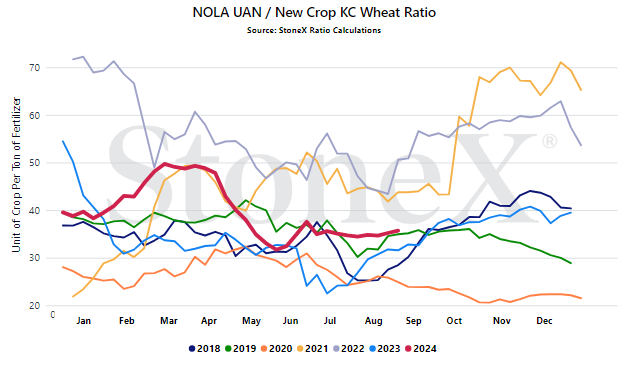
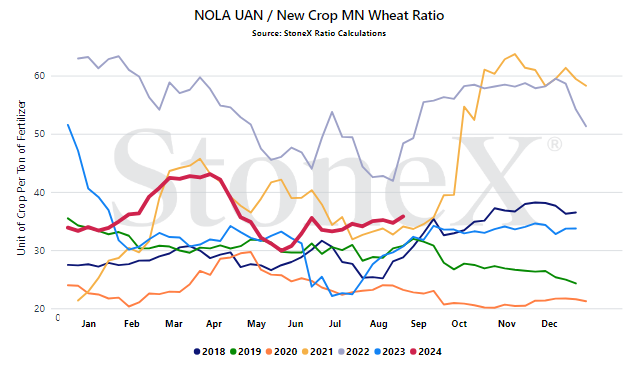
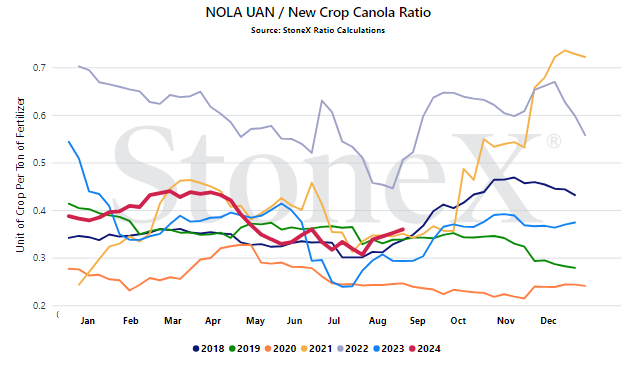
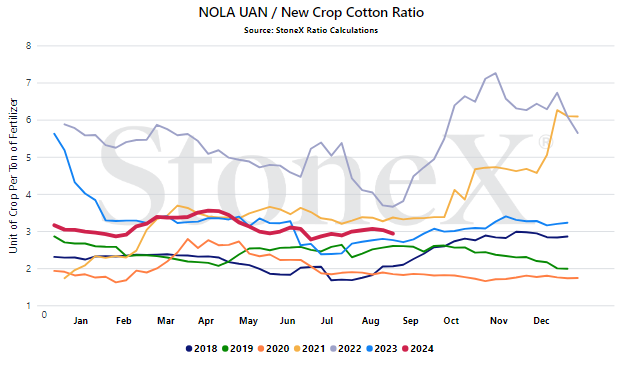
If you have seen any of my stuff, you have likely seen the ratio charts. All these charts do is look at how many bushels of X it takes to pay for 1 ton of fertilizer Y. If only looking at this input/output relationship, the flat prices do not matter (they do on the larger scale). The question becomes "would you rather spend 50 or 80 bushels of corn to pay for 1 ton of UAN". I have yet to have anyone get it wrong. Everyone wants to do the lower number so to me, it is the better indicator of "value".
That said, the first chart below is the NOLA UAN/Chicago New Crop Corn Ratio graph. Now, your numbers will look different. I do not know where everyone is reading this from so I go as high level as I can. Please remember that your charts locally will look different because of basis. I have run this graph back to 2014 to give a decade of history. The larger red line is this calendar year. When glancing, I hope that you will see that while it is certainly on the higher side of the last decade, it is still "in range" of what can be considered normal. It has been much better (look to summer 2023 for recent example), but it has also been worse.
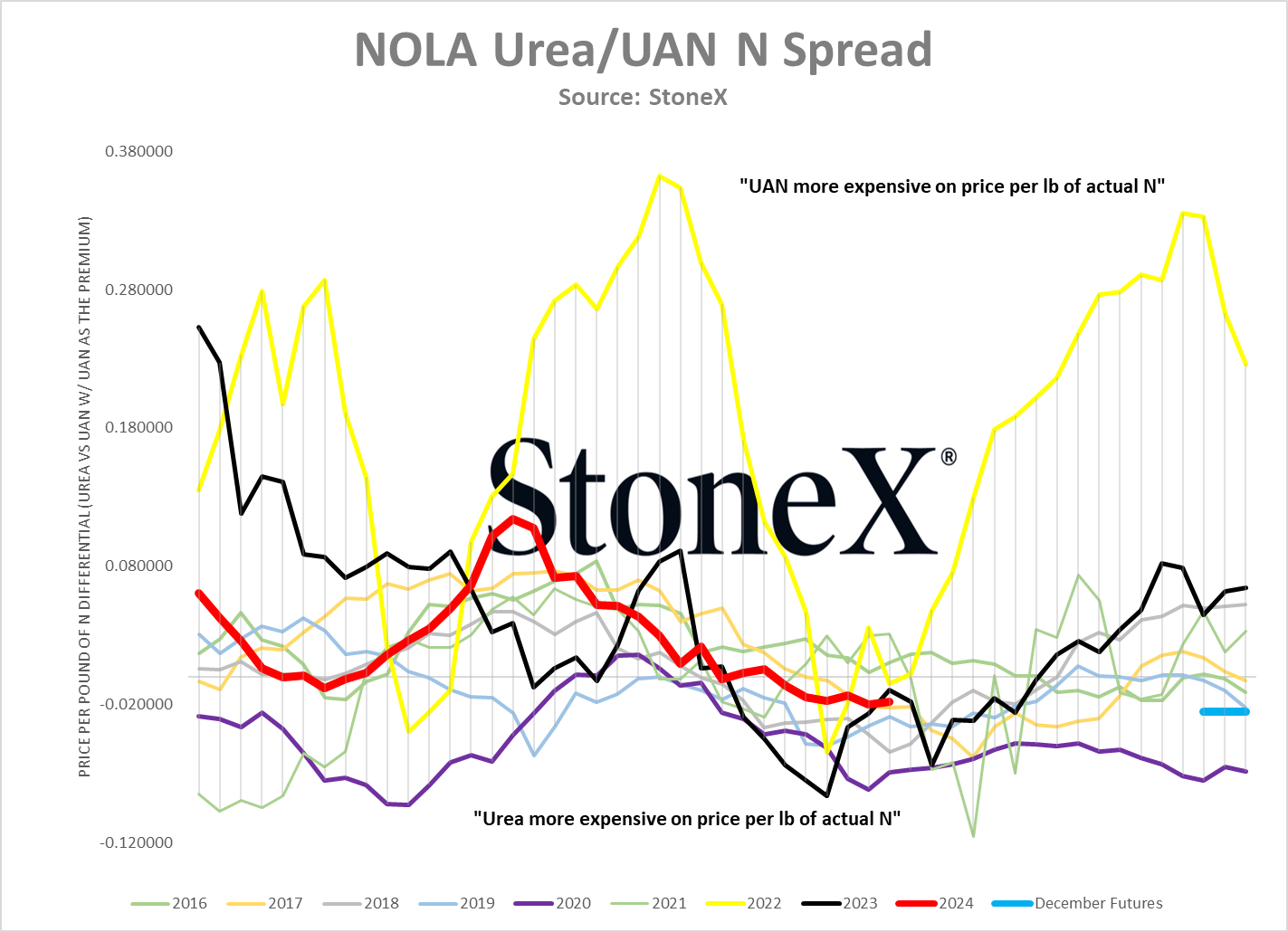
The other comparison is again urea which is shown on the 2nd chart. Again, I am looking at NOLA (New Orleans, Louisiana). I'm trying to stay high level. That chart breaks down urea and UAN to a price per pound of actual N basis because that is what really matters. It then looks at the difference. Anything below the horizontal line means urea is more expensive than UAN. Anything above the horizontal line means UAN is more expensive than urea. Again, UAN is "right priced" vs urea. It isn't a steal, but it isn't overpriced.
I guess I really do not have a "message" for this section or any sort of great ending wisdom. This is more to just show how it is priced relative to some comparisons that I watch. Again, trying to give further insight into the industry.
NOLA/New Orleans, Louisiana
Number 2 global importer in 2022
Number 1 global exporter in 2022
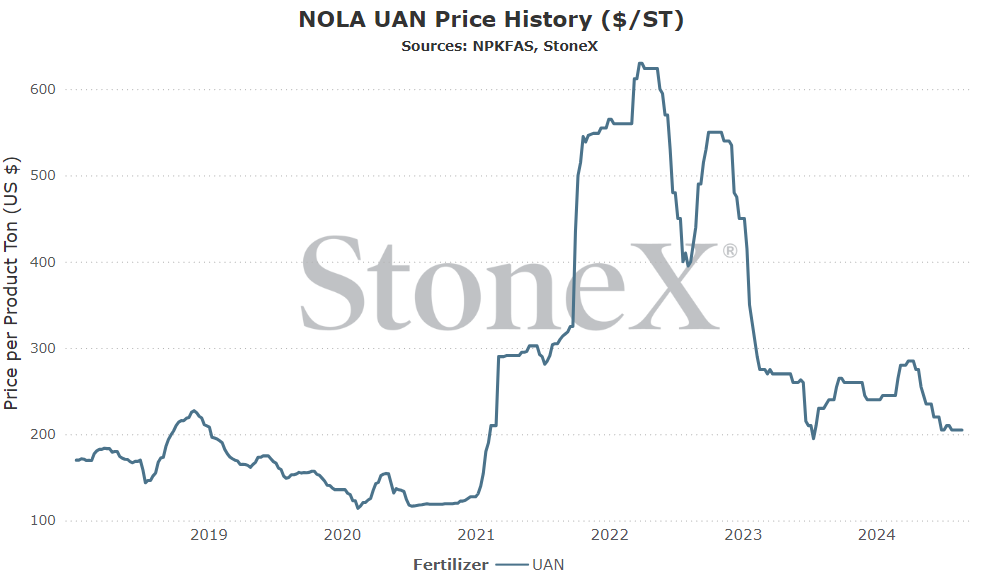
Price Comparisons
Vs 30 days ago - unchanged vs last month
Vs 90 days ago - -13% or approximately $30 lower
Vs 6 months ago - -23% or approximately $60 lower
Vs 1 year ago - -15% or approximately $35 lower
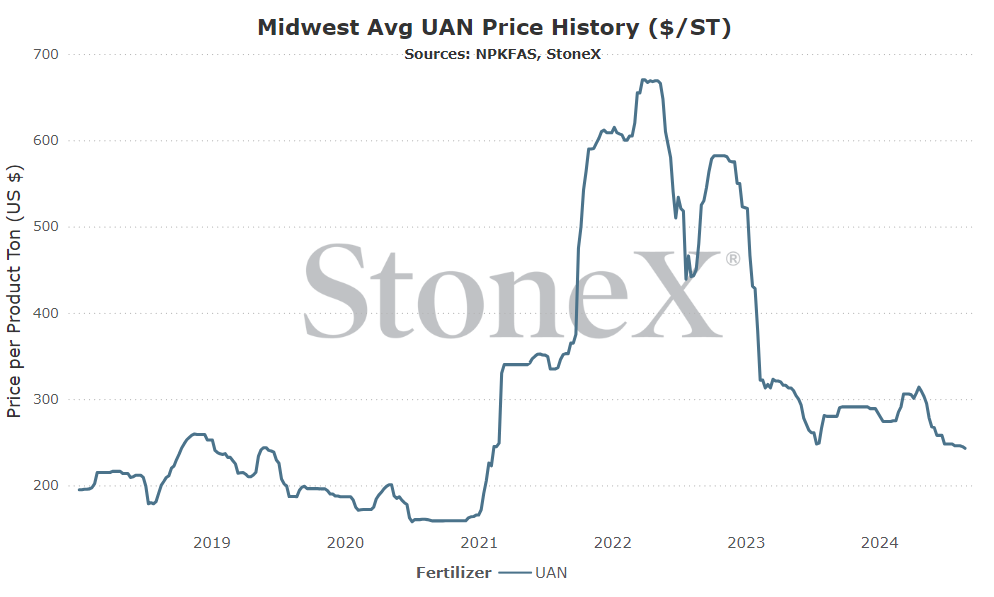
U.S. Midwest Average
Vs 30 days ago - -1% or approximately $4 lower
Vs 90 days ago - -9% or approximately $25 lower
Vs 6 months ago - -17% or approximately $49 lower
Vs 1 year ago - -13% or approximately $37 lower
Black Sea (Russia)
Number 2 global exporter in 2022
Price comparisons
Vs 30 days ago - unchanged vs last month
Vs 90 days ago - 4% or approximately $6 higher
Vs 6 months ago - 1% or approximately $1 higher
Vs 1 year ago - 4% or approximately $6 higher
- Trinidad production hiccups hurt supply, could continue in the future – insufficient gas supplies in Trinidad has been an off/on story for a while. Fortunately, new waters have been opened to exploration and development which should mean the future sees much more reliable flows...eventually. But that isn't today. That process takes time and that means until then, further UAN production issues could continue to pop up.
- EU production continues to suffer, creating unnatural buyer – unfortunately, this looks very feasible. Dutch TTF gas values continue to hold with few signs of falling. As a result, EU production rates appear steady at 75% of normal. That means they are still an unnatural buyer in the market that helps certain nations clear "excess" tonnages.
- U.S. government could seek Russian import sanctions – I do not see this as a very high probability outcome...but if it happened it would be huge so we need to list it and watch for it. U.S. manufacturers have enjoyed being able to export UAN to Europe since their production suffered from high natural gas prices. However, Russian imports have also climbed creating a near perfect balance. If, and it is a big if, D.C. decides to block Russia (and continue to allow exports), N.A. farmers are going to be in a bad way. U.S. manufacturers will be able to say "buy this or we will export it".
- Farmer economics are poor and spring is a long way off – spring '25 is still 7 - 8 months away and the biggest current story continues to be poor farming economics for not only 2024 but the 2025 outlook. That doesn't make farmers want to spend money in a bad situation...and they are not. If they are not, retailers are not. That continues down the line. If this lasts long enough, we could see some short term bearishness on values...but it wouldn't last long as 90+M acres of corn in 2025 will require N applied.
- Russian imports continue to balance U.S. exports – Russian continues to be the counter weight on U.S. exports. We could see those flows continue to pick up from where they are today. If that happens, it could make UAN start feeling "long" and put more pressure on manufacturers in N.A. to be competitive to clear produced product.
- I am struggling with a 3rd bearish factor – you know I do not like doing this but I am struggling with a convincing, actually possible 3rd bearish factor. I am really hoping I can come up with something before I publish this...
We believe that only looking at the flat price of either grains or fertilizer can be misleading:
-
Only selling grain can hurt you if fertilizer prices rise substantially
-
Only buying fertilizer can hurt you if grain prices fall
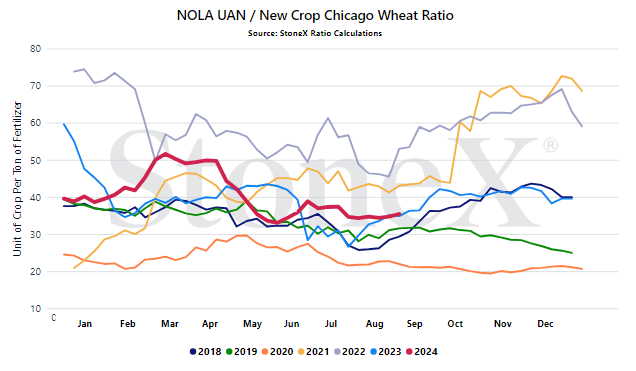
We look at the ratio "value" to get a better indication of where we are or how many bushels of X does it take to pay for 1 ton of fertilizer.
Would you rather:
-
Spend 100 bushels to pay for 1 ton of UAN
-
Spend 60 bushels to pay for 1 ton of UAN
When we compare the current ratio value against recent years, we start to see if we are high or low.
YOUR VALUES MAY LOOK DIFFERENT
This graph looks at the NOLA UAN price vs the flat grain price. There are no logistics on either product. Your location will look different due to fertilizer logistical costs, grain basis, etc.
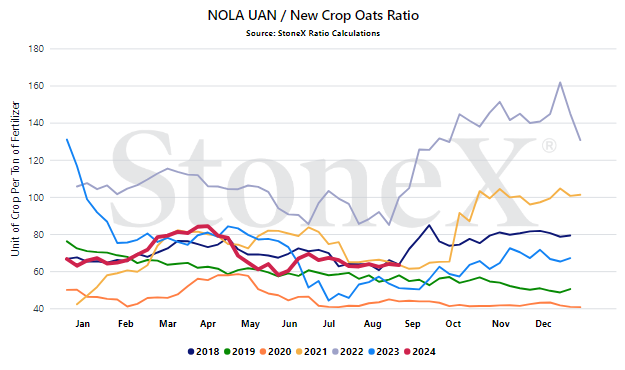
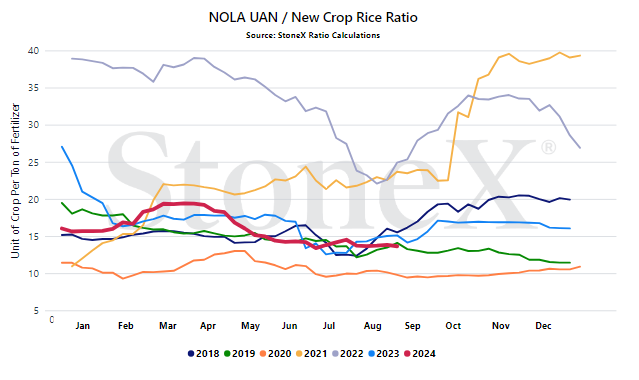
- Make smart/unemotional decisions - your grain price stinks. Your inputs costs are still high. You are not expecting to make much/any money this year and next year isn't much better. Blood pressure up yet? Has it ever come down? Listen, it is easy to be frustrating/pissed off/angry/etc. today and there is nothing wrong. I do not even farm and it gets under my skin. All I am saying is that when it comes time to make marketing decisions on either buying inputs or selling grains, set the emotion aside as best you can. I've made a lot of emotionally charged decisions in my life and my wife will be first in line to tell you none have worked out well. This is your livelihood. Your farm/family/etc. are counting on you to see it thru tough times. Treat it as such.
- Remember that even though things are calm now, they can get out of hand still - how the hell can it get worse?! I'm guessing that is the thought going thru your mind right now!!! There are still plenty of avenues to worse conditions for urea. Iran attacks Israel. Russia escalates against Ukraine. China invades Taiwan. Any/all of these possibilities have the ability to really mess up the market. It can get worse.
- There is plenty of time between now and spring...but not forever - we have 7 - 8 months before we are in the middle of spring '25. That seems like a lifetime away...but it isn't. Harvest will start in earnest in a couple weeks. Once that wraps up, fall application starts. Christmas/New Years gets celebrated, we take a couple naps and it is April again. There is no need to panic buy today but it is well worth your time/energy to talk to you supplier about plans for next year.
- Watch the politics (U.S. / N.A. farmers) - right now, Canada continues to block Russian imports but the U.S. allows it. Fortunately, U.S. allowing their shipments means the N.A. S&D remains decently balanced (helps offset large exports). However, we cannot assume that will last forever. If D.C. starts to contemplate similar measures like China, UAN changes substantially as imports fall flat and exports continue.
StoneX Ratio Calculation
The ratio calculation is derived from Bloomberg historical grains values as well as fertilizer values from StoneX, NPKFAS, and Argus.
The calculation is simply dividing the fertilizer price by each grain price.
All data was sourced from StoneX unless otherwise noted.