September '25 PHOSPHATES
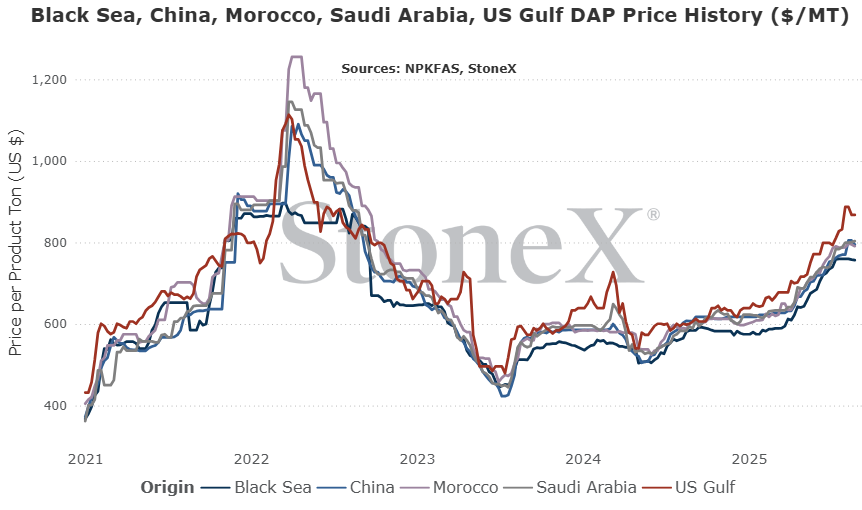
Major global phosphate export location price graphs
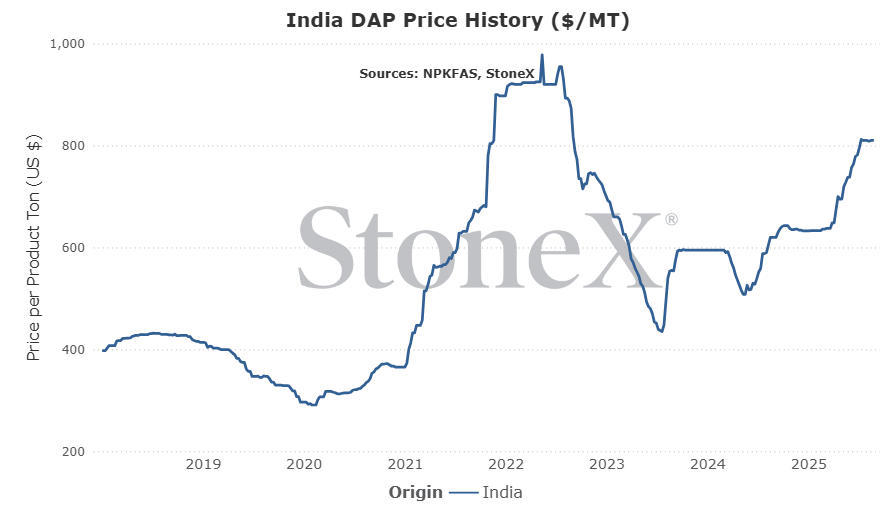
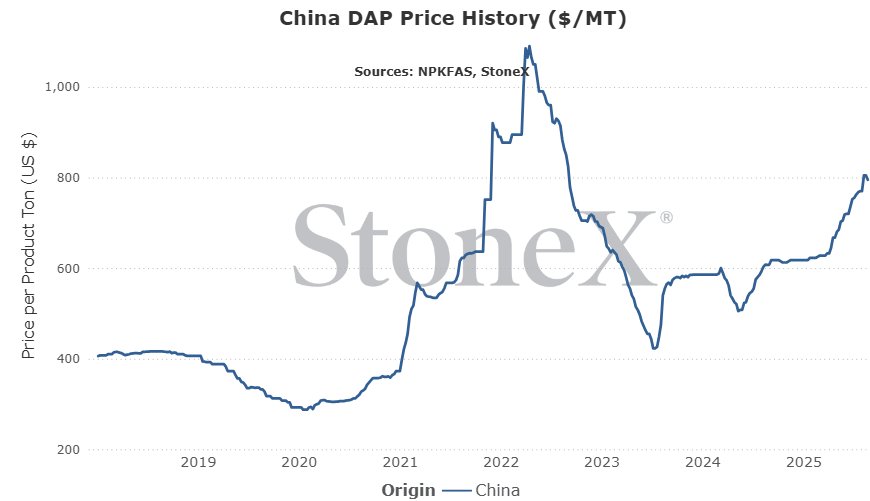
I will say this now and will say it going forward to eternity: these are the flat price graphs for each individual location. Your price where you are is going to be different. There are logistics. There is the cost of storage/interest/insurance/etc. These graphs should not be taken as "it shows the price at $700, why isn't my price $700". These graphs should be used to give an appreciation for price movements.
All values are in metric tons and USD currency.
What everyone wants to know first, what do we think will happen going forward
Global
We are in an interesting time for global phosphates. China, typically the world's largest exporter/supplier, has started allowing exports to happen which was seen in their July trade data. Not only that, but there have been some rumors/reports that they may loosen export restrictions slightly. Nothing huge, but maybe a bit more here and there. That has had some in the space starting to take notice.
However, this has continued to pale in comparison to the demand side which continues to be dominated by India. Last month, they locked up 600K tons from Saudi Arabia on a "single" contract (actually broken out by multiple importing Indian entities but done as a single big sale). Fortunately, this will help Indian stockpiles improve...unfortunately, they still need more.
Outside of those two parties which have continued to dominate the global discussion, the rest of the world's demand has been quiet which reflects the current high price. This has been seen the most by Brazil where multiple parties have pointed out that buyers are not excited to do anything at these grain/fertilizer values. I would be lying if I said that slow demand isn't something we are watching closely as it could be a huge indicator for the rest of the world. We expect slow demand and lowered demand...but to what extent?
Our POV continues to be that global values will remain flat to higher (more tendency to flat right now) as long as Chinese exports are low and India continues to buy. If we suddenly see Brazilian buyers stepping forward, watch out as it means their return means the removal of a possible bear factor. Their return would also mean competition for Indian buyers/importers.
North America
Fall application for much of North America is 60 days or less away from starting. In the world of fertilizer logistics, that is not very long.
On the one side, we fully expect fall demand destruction. There is simply no way around it. These phosphate values are far too high vs grain prices which are atrocious in comparison. Farmers are bleeding and many will need to make cuts to their input programs to have a chance of getting through 2026.
On the other side, there is a big crop out there. Now, I am not saying it is 175, 180, 185, or anything else. I am not a grain guy and I do not make forecasts for it. However, most agree it is going to be a solid yield number and it is just a matter of how big. If that is true, that removes a lot of nutrients from the ground and for many fields to have a shot at repeating it again next year, those nutrients need to be replaced. There is also the issue of the lack of imports and poor domestic production keeping supplies low...
I want phosphate values to fall out of bed in the absolute worst way. I want to be able to tell you that if you wait a little longer, delay application until spring, etc., that values will plummet and you will get a chance to lock in substantially lower prices.
However, I rarely get what I want.
Right now, N.A. phosphate values are mostly being propped up due to the global marketplace which doesn't show much signs of correcting anytime soon. Yes, N.A. values are higher due to duties/tariffs but this only accounts for roughly $75 - $100 of the current price.
I continue to believe that values will hold at the very least through fall and if fall demand isn't lowered as much as expectations point to today, we could see in season values jump even further. I believe this enough that I have told family/friends to get their stuff locked up. If I am wrong, you will have to get in line behind them to slap me around!!!
General Global DAP/MAP Information
What has happened in the last 30 days?
Chinese July phosphate exports pick up as expected? How much more coming?
Chinese phosphate exports have been making some nice gains over the last couple months.
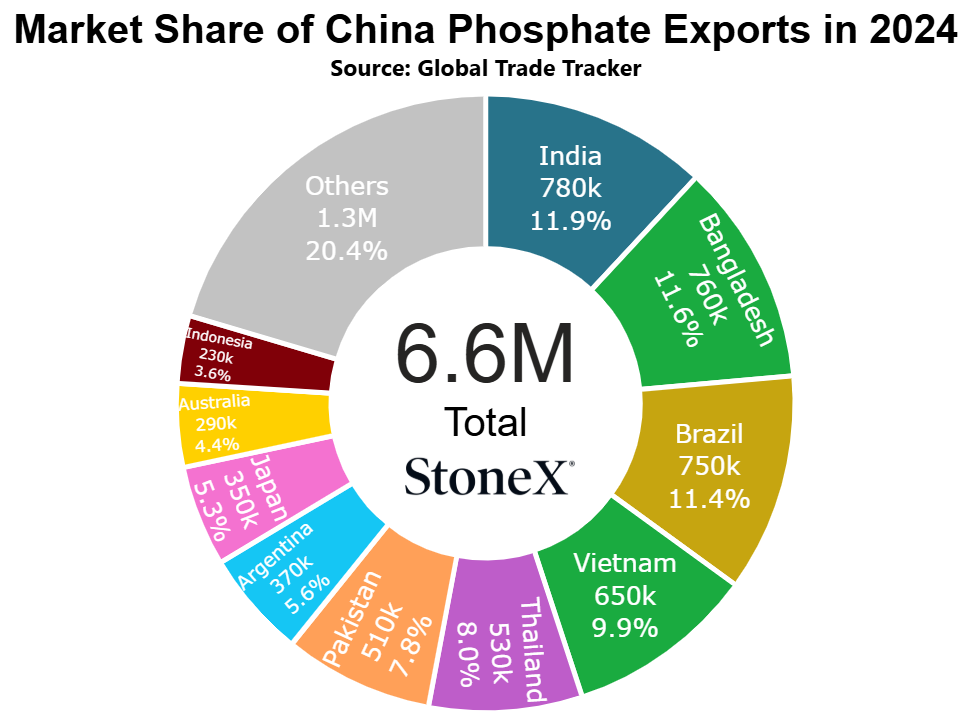
For a bit of backstory for the new crowd, China was historically the world's largest phosphate exporter with around 8 to 10M tons exported per year. Back in 2022, when global values were skyrocketing on the fear of losing Russian tonnages and increasing grain prices, the Chinese government started to restrict exports in an effort to ensure adequate domestic supplies and lower than global domestic values. Fortunately for Chinese farmers, this approach worked. Unfortunately for the rest of the world, this approach worked.
2025 looked to be much worse than any other year since this new export program started taking place. The government had indicated that only 4.5M tons would be allowed to export. A significant drop from normal which would leave a massive supply hole in the global S&D. To further complicate matters, China had blocked the ability of their tons to flow directly to India. This put India in a larger bind and had them buying from anywhere else they could find product at higher and higher prices.
Fortunately for the rest of the world, there has been some softening around the edges of China's approach to phosphate as well as the start of those 4.5M tons starting to flow.
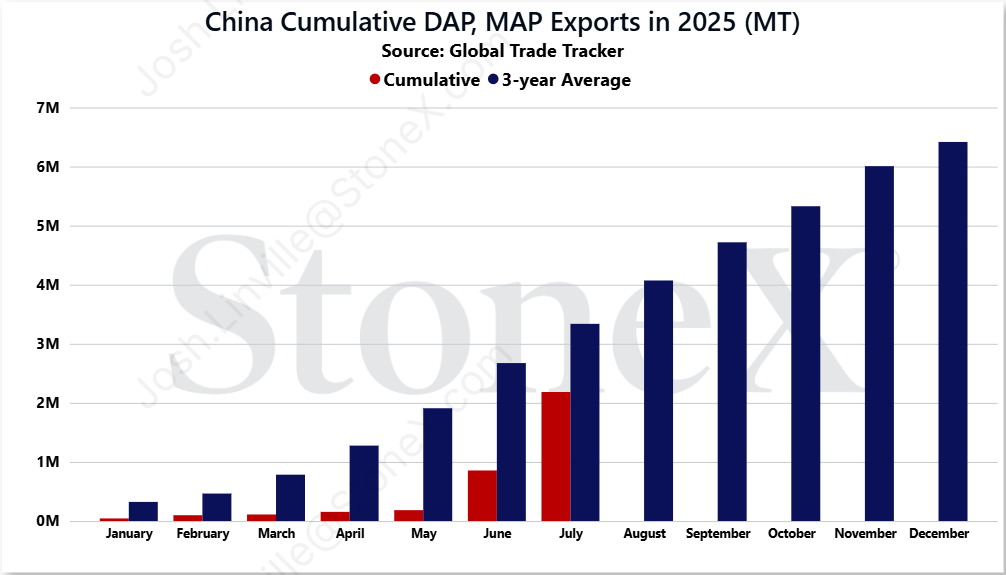
Through May, there was growing concern that China would not even attempt to hit their 4.5M ton export quota. Exports for the 5-month period only hit 184K. This, combined with India's desperation buying, helped to push values to extremely high levels.
Fortunately, June saw the total jump to 856K tons and then July surged to nearly 2.2M tons. This helps to show why you should never say "China cannot" when talking markets. When they are pushed to do something, in this case export as much as possible for fear the government might change their minds, they get it done.
This bump in export volumes have helped to steady global values. Unfortunately, we have not see values soften...yet.
The other part of this equation that we are watching closely is that the government continues to soften their stance on India. Originally, India was not allowed as a destination. Whether that was due to their fear that too much volume would be shipped or their simply disdain for the Indians (there is history there...), that trade route was not available even though it was the most logical one. Now, it sounds that they are allowing tons to flow that direction.
Looking at the chart below, it is hard to not get a little excited. They have suddenly exported 2.2M tons through July with most of that shipping in the last 60 days. There is still 5 months left to 2025. In theory, they could start overloading the global phosphate market with supplies and blow through the 4.5M ton quota. Is this a possibility? Yes. Is this probable? No. The Chinese government continues to want to ensure adequate domestic supplies and lower domestic values vs the world. However, nothing in the world is guaranteed so this needs to be watched.
What does this mean for farmers?
For right now, not much as it has not had the bearish tone some had hoped to see. Yes, 2.2M tons in a short amount of time is great, but it does not solve or heal the current market. Until China sees a return to their normal export form, it is going to be hard for global values to correct to anything close to normal.
However, if China surprises us...
India makes big purchase gains in August. Removes supplies for rest of world.
I know that I have beat the "India needing to rebuild phosphate stockpiles" story to death in the last year. Was about to write months, but it has been a year plus. Unfortunately, it still rings true but they made major strides last month.
It was heard that a major purchase of 600K tons of DAP was made from Ma'aden (Saudi Arabia) across many of India's importing companies. These tons will ship in September and October.
This is good for Indian farmers.
This is bad for farmers who may have needed fall tons (I'm looking at you, North America).
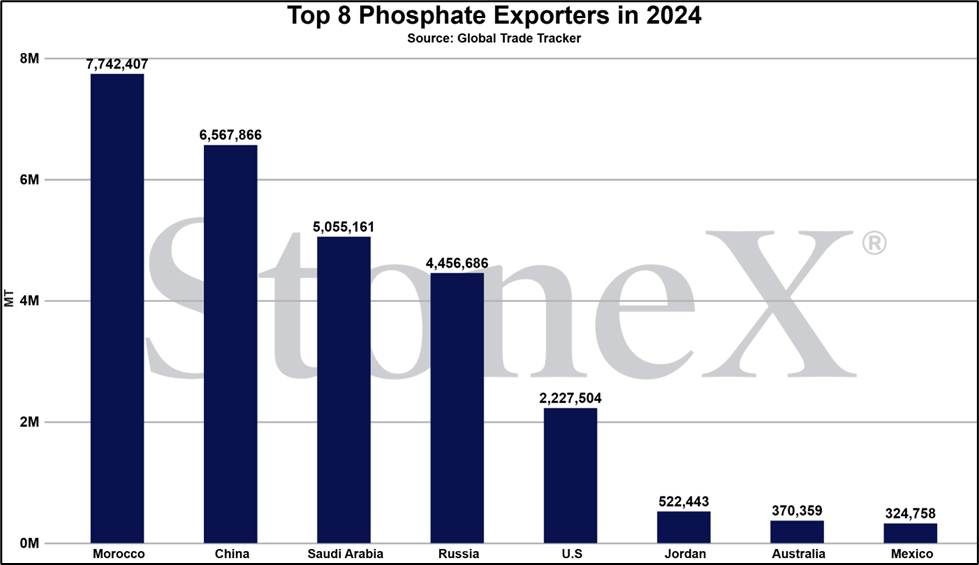
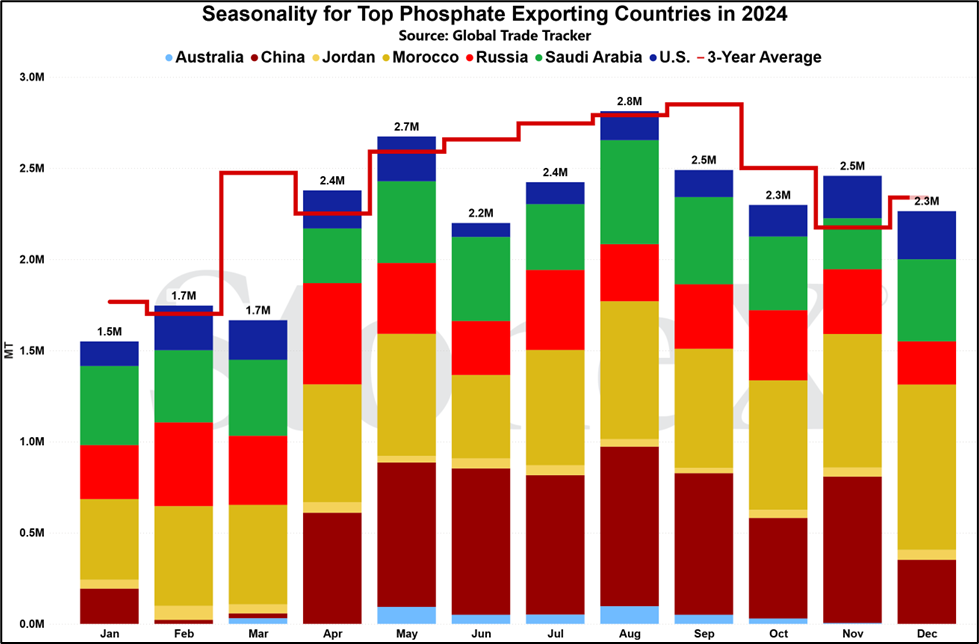
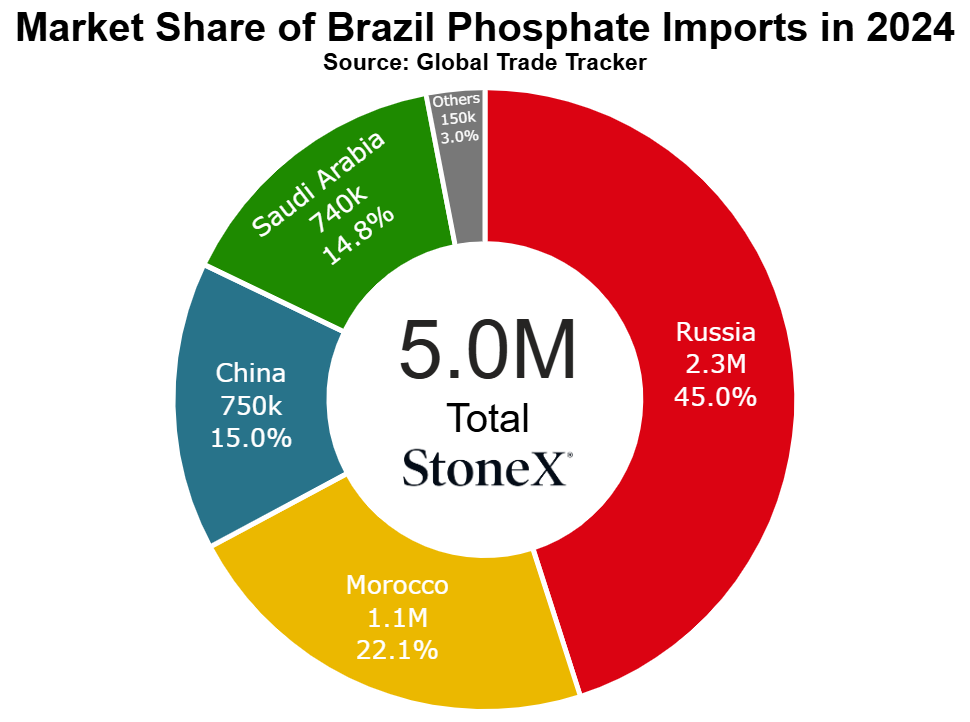
Looking at 2024, Saudi Arabia exported around 5M tons of phosphate. That breaks down to roughly 420K/month. That means that India's 600K ton purchase equates to roughly 70% of their September/October export flow. Ma'aden has been linked to some smaller sales for September which should have them nearly fully sold for the period.
So here is why that matters for North America.
U.S. phosphate production rates have been suffering since early 2021. While the hope remains that production will return to normal, hope doesn't put tons in the bin or on the field. There is an anticipation that fall phosphate demand will be markedly lower due to high prices, we continue to believe that at least some imports are still needed to make sure there is enough to go around.
Normally, imports would be easy to find. However, the U.S. has place duties and/or tariffs on the other 4 major phosphate producing/exporting countries. Saudi Arabia only had a 10% tariff and so represented the best chance of imports arriving. In fact, NOLA DAP values had finally climbed high enough for Saudi Arabia to start considering the U.S. as a destination. Now, with most of their export capacity secured by India, that is likely not happening.
As has been the case, India continues to lock up large quantities of phosphate which continues to help keep global prices high and supplies tight.
What does this mean for farmers?
For global farmers, this just takes the "tight global phosphate supply" story a step further. It supports the POV that global supplies are very tight and manufacturers like to use that to justify high prices.
For North American farmers, it makes a bad situation worse. If imports are truly needed, Saudi Arabia was our best bet. In order to get product to arrive to the farms in time for fall application, product needs to ship early September. Figure 30 days sail time and then another several weeks to distribute inland. A September 1 departure ton does not get put into place until November 1. The others:
- Morocco - has heftier duty rates in place and just out of principal have been unwilling to pay any rate even when it was 2.14%. Not likely to send anything here until the rate is zero.
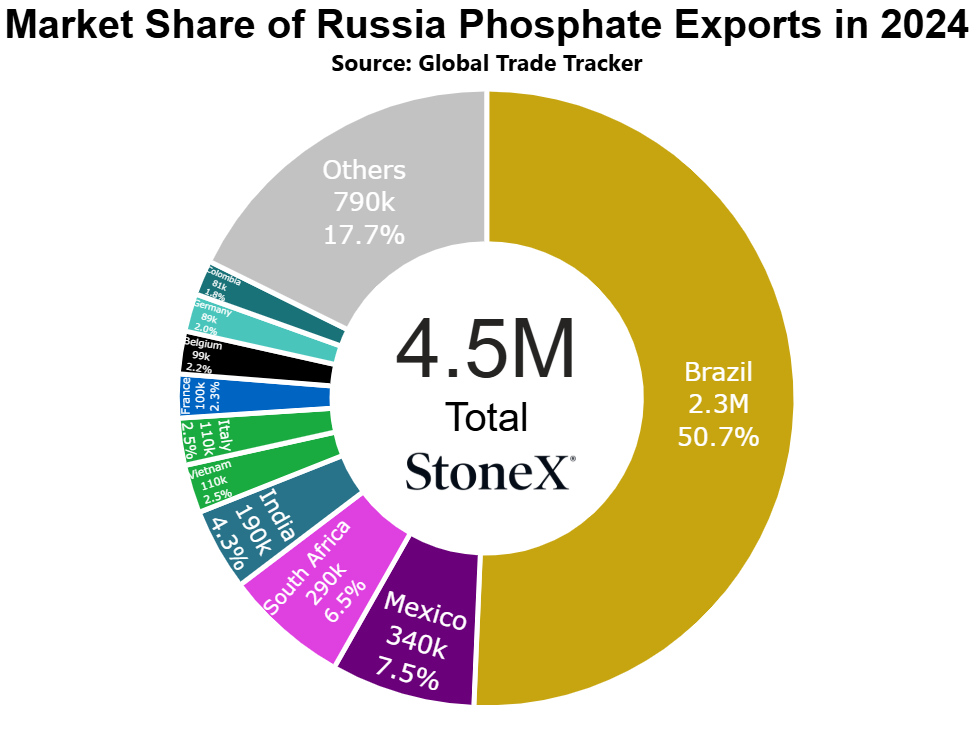
- Russia - Russian phosphate producers have counter vailing duty rates that are high enough to all but ensure they cannot send anything. Tariffs have to be feared as well given the lack of peace progress.
- China - we haven't seen any Chinese fertilizer in the U.S. since the 1st Trump administration due to the high tariff rate. Not likely to change anytime soon.
We may see fall demand much lower than we already expect which could make this story mean nothing. Import economics do not matter if imports are not needed. However, if we figure out we need imports very close to November, it may be too late.
N.A. fall demand in question/could be substantially lower. Supplies also questioned.
I have been beating this story to death. Unfortunately, until it vastly improves, I am going to continue beating this story to death.
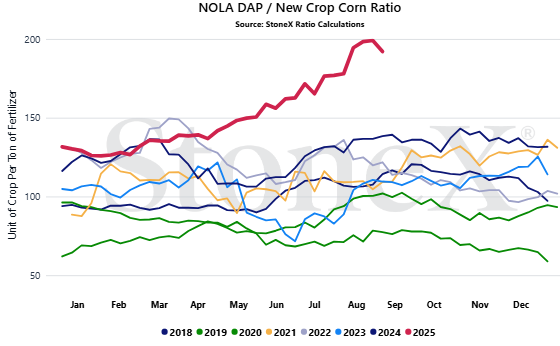
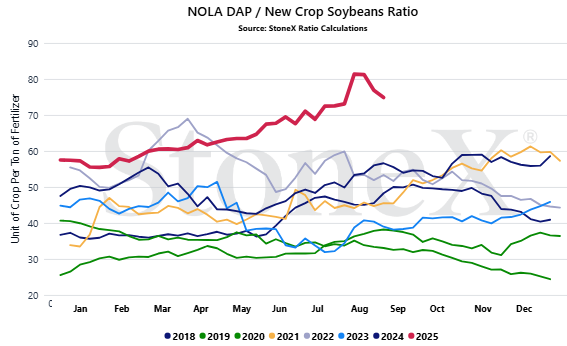
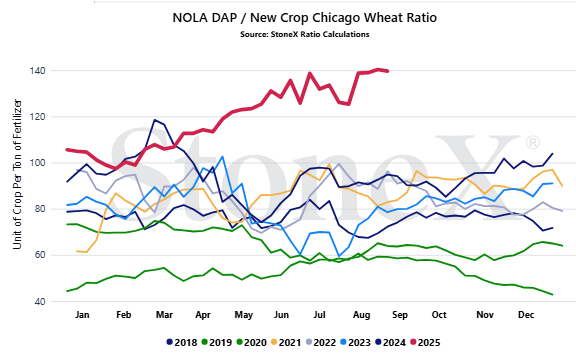
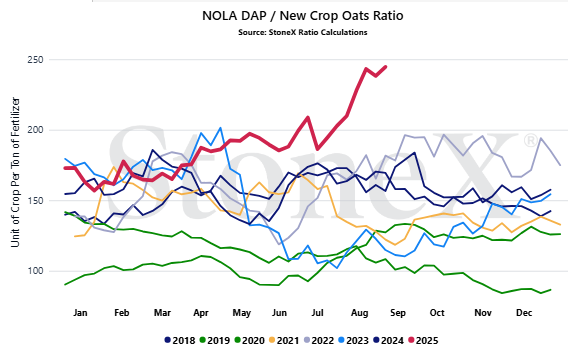
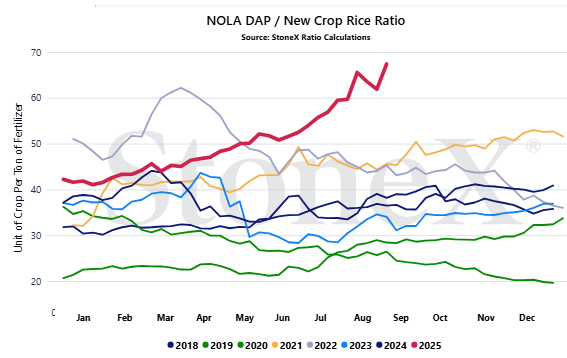
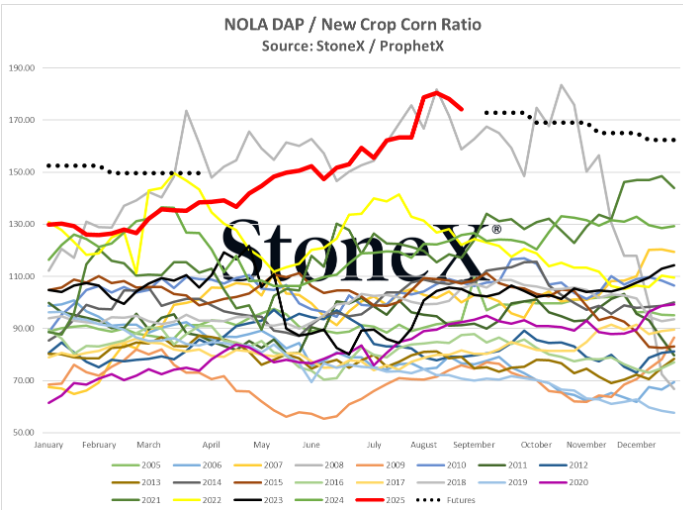
If you have spoken to your supplier about fall phosphate values, you no doubt already know how overpriced phosphate is. The flat price is bad. It gets drastically worse when we look at it vs the grain values.
For corn, the worst weekly average ratio in history occurred in late 2008 with the ratio hitting 183.43. The only "good" thing about that ratio is that corn values had been significantly higher and farmers had a chance to lock up a lot of their new crop.
This year, there has been no such opportunity. Corn values, even when they were higher, never felt "high". This was especially true when looking at them vs grain values. The ratios started high and have done nothing but get higher.
While the weekly averages have not broken the 2008 all-time high, there have been some spot instances where it has. The worst that we had seen was when we saw a NOLA DAP barge trade at $825 and corn prices dipped on the day. That resulted in a ratio of 185.5.
So now the question is what fall demand is going to look like. Farmers everywhere are struggling this year. 2026 does not give much hope that things will improve. When checkbooks get this tight, inputs start to get reviewed very closely. Unfortunately, it remains at the front of the line for reduced/cut applications. Unfortunately, we have never seen anything like this so it is all educated guesses for what the fall will entail.
I'm jumping on my soapbox for this: MAKE RATIONAL APPLICATION DECISIONS. What I mean by that is if you are going to make an application rate cut, make sure it does not cost you more in 2026 yield potential. I know there are a lot of farms/farmers out there who have done a great job of applying solid phosphate rates and building the soil levels. Those farmers/fields can likely withstand a lower application rate. However, we also have to bear in mind yields. There is a big crop out there. Big crops remove big nutrients. I am simply trying to say to make sure we do not make hasty, angry, irrational cuts that end up hurting us in the long run. I am all for "mining" the soil where the phosphate levels are high. However, if your field does not have that, do not make a decision that you might regret a year from now.
With supplies as tight as they are due to lowered Chinese exports, increased Indian buying, U.S. production rate struggles, etc., the phosphate market needs some demand destruction to rebalance its S&D. Just please make rational decisions.
Where are current values in relation to the past
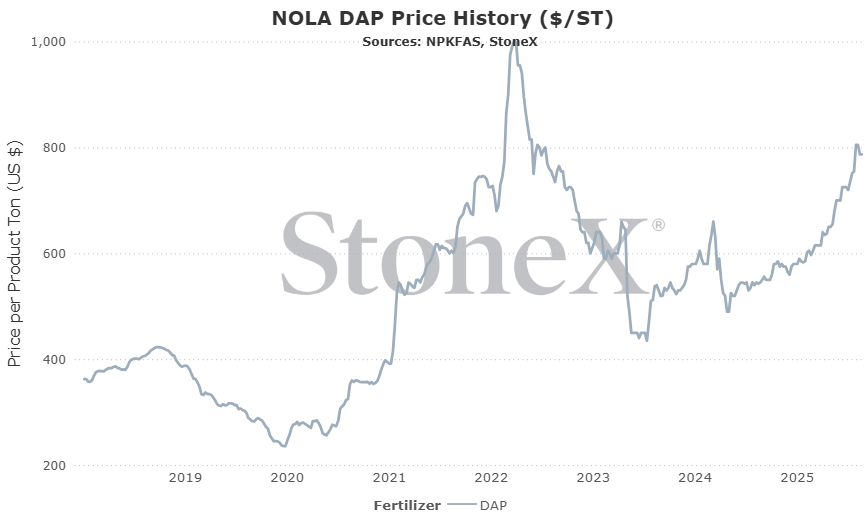
NOLA/New Orleans, Louisiana DAP price comparison
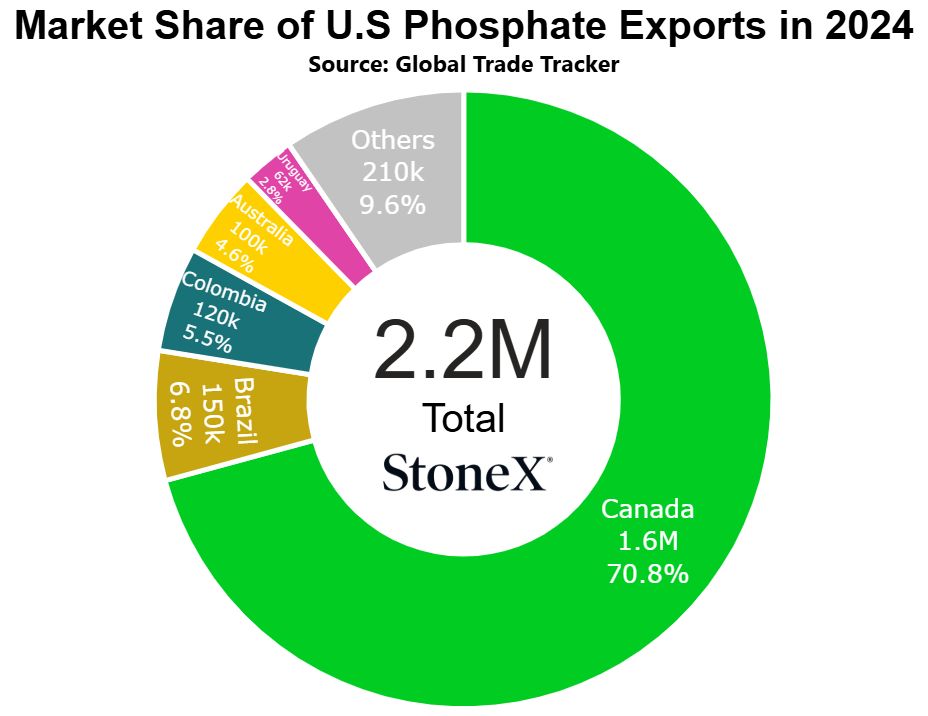
Number 5 global exporter in 2024
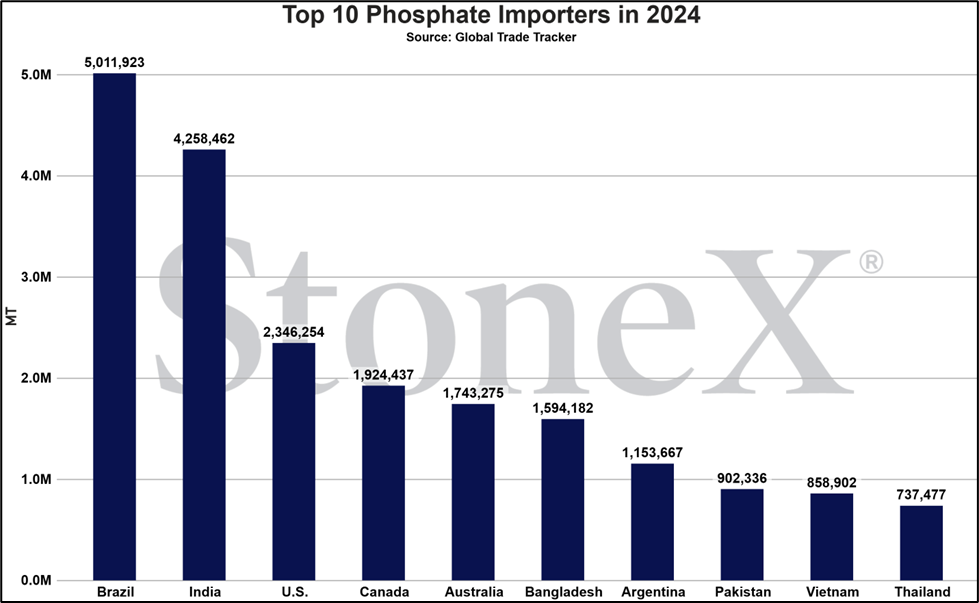
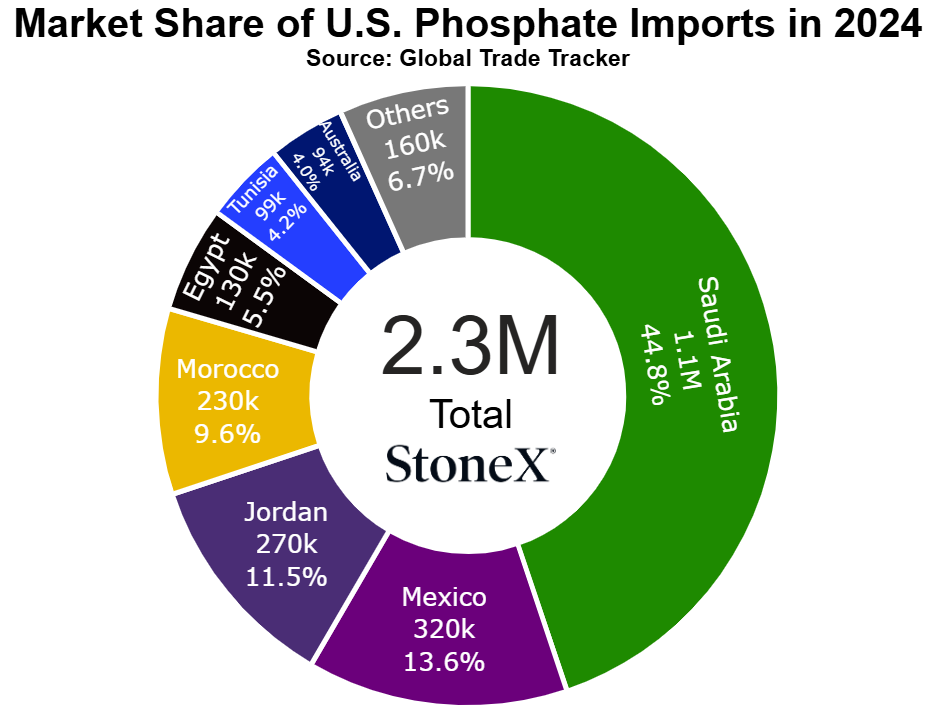
Number 3 global importer in 2024
Price comparisons
Vs 30 days ago - 4% or approximately $32 higher
Vs 90 days ago - 12% or approximately $87 higher
Vs 6 months ago - 30% or approximately $182 higher
Vs 1 year ago - 44% or approximately $242 higher
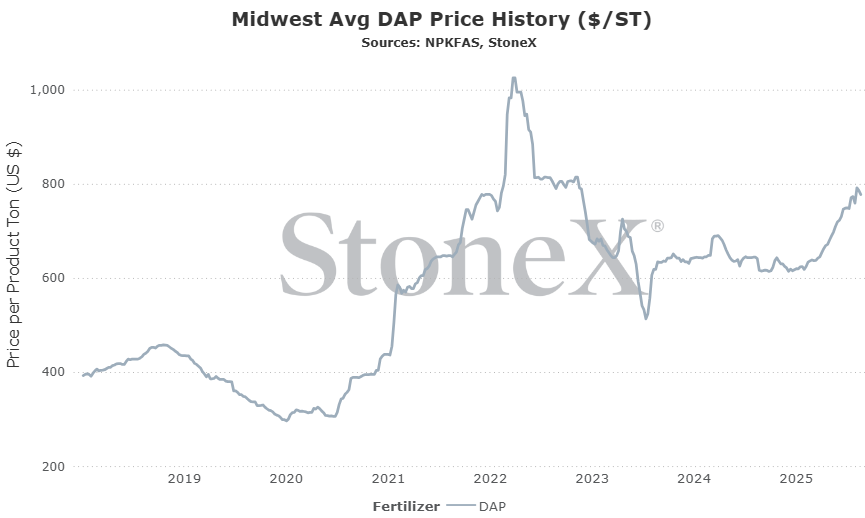
U.S. Midwest Average (using multiple points across Midwest) price comparison
Vs 30 days ago - 1% or approximately $4 higher
Vs 90 days ago - 8% or approximately $59 higher
Vs 6 months ago - 22% or approximately $139 higher
Vs 1 year ago - 26% or approximately $161 higher
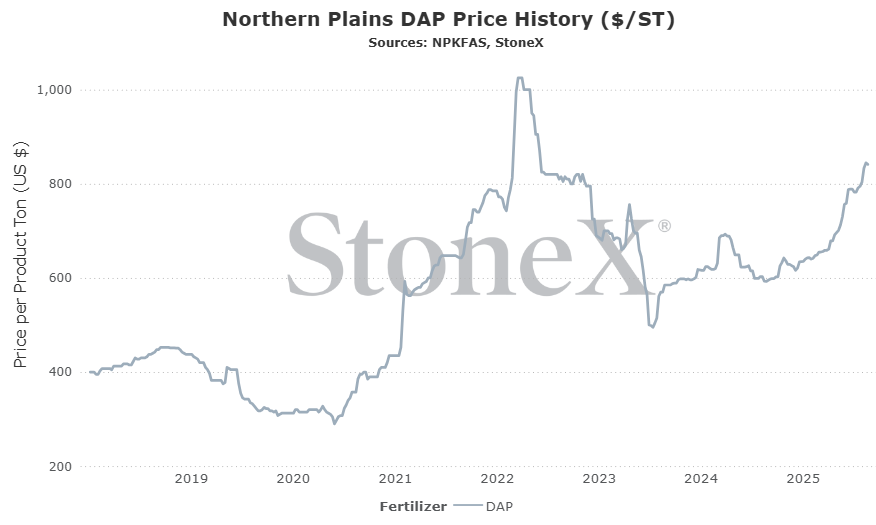
U.S. Northern Plains Average price comparison
Vs 30 days ago - 6% or approximately $47 higher
Vs 90 days ago - 11% or approximately $85 higher
Vs 6 months ago - 28% or approximately $186 higher
Vs 1 year ago - 42% or approximately $249 higher
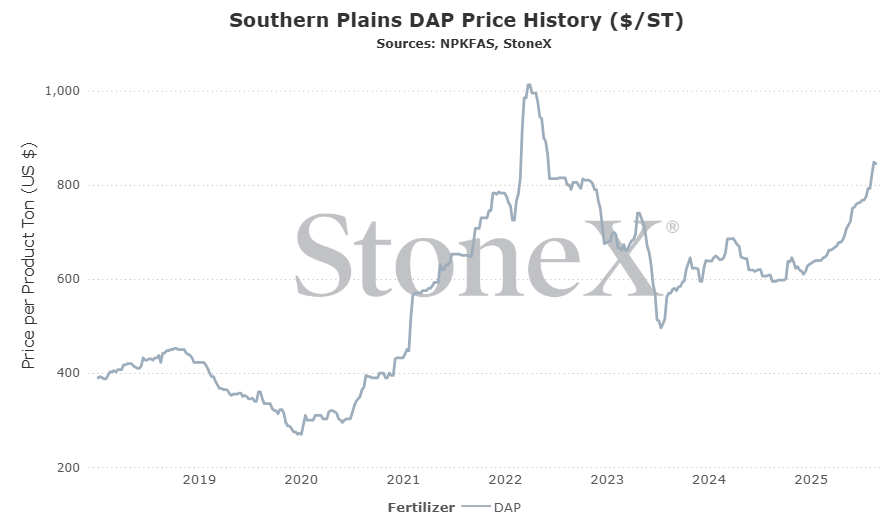
U.S. Southern Plains Average price comparison
Vs 30 days ago - 7% or approximately $53 higher
Vs 90 days ago - 13% or approximately $95 higher
Vs 6 months ago - 30% or approximately $194 higher
Vs 1 year ago - 42% or approximately $250 higher
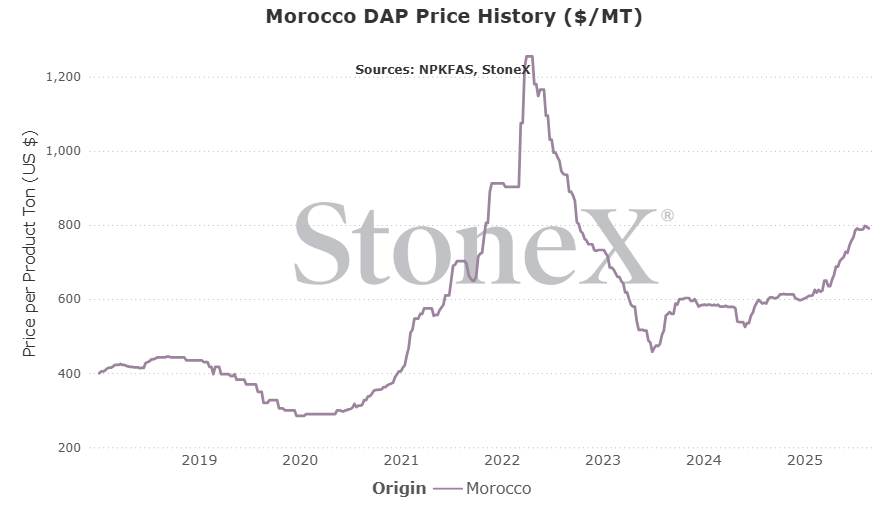
Morocco DAP price comparison
Number 1 global exporter in 2024
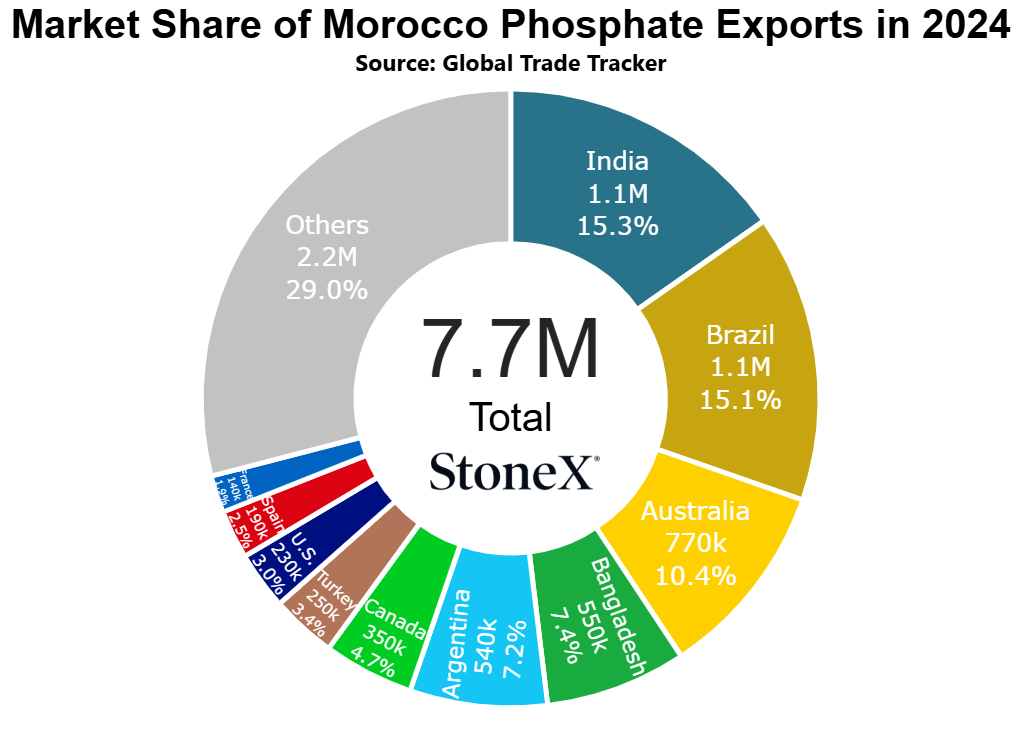
Price comparisons:
Vs 30 days ago - 0% or approximately $4 higher
Vs 90 days ago - 9% or approximately $64 higher
Vs 6 months ago - 28% or approximately $171 higher
Vs 1 year ago - 32% or approximately $191 higher
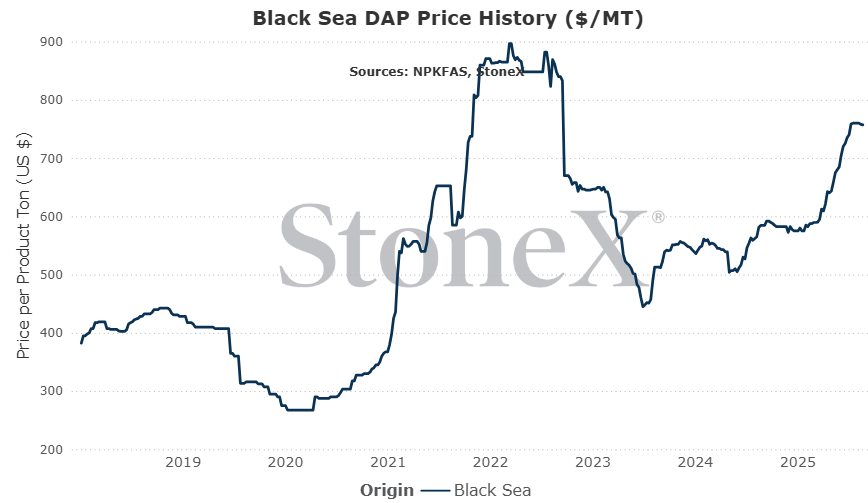
Black Sea DAP price comparison
Number 4 exporter of DAP/MAP in 2024
Price comparisons:
Vs 30 days ago - 0% or approximately $3 lower
Vs 90 days ago - 11% or approximately $72 higher
Vs 6 months ago - 28% or approximately $168 higher
Vs 1 year ago - 30% or approximately $173 higher
India DAP price comparison
Number 2 global importer in 2024
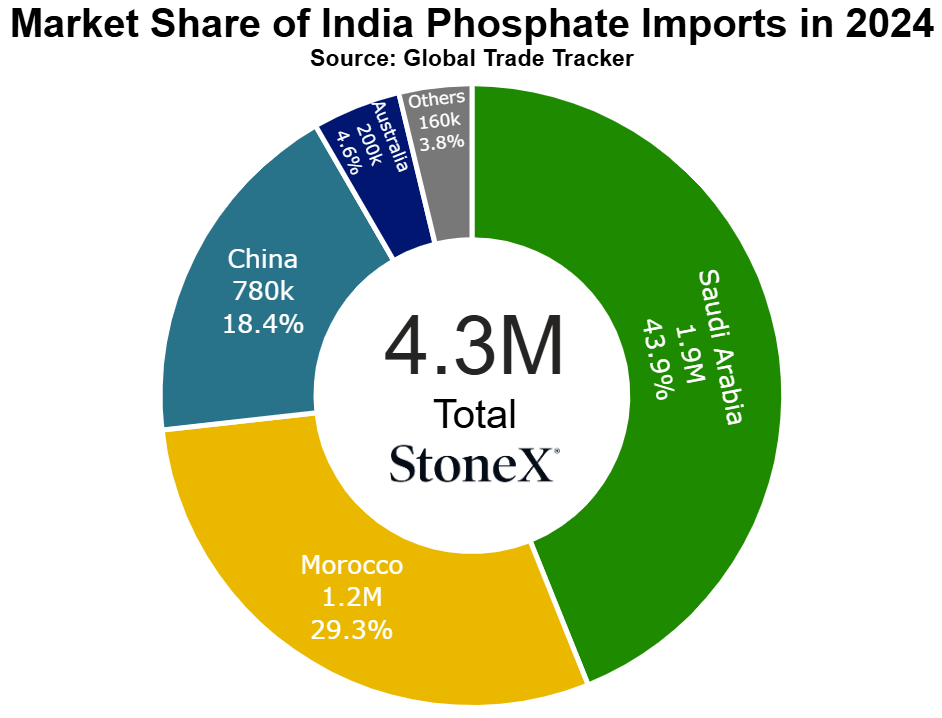
Price comparisons:
Vs 30 days ago - 0% or approximately $0
Vs 90 days ago - 10% or approximately $72 higher
Vs 6 months ago - 27% or approximately $174 higher
Vs 1 year ago - 31% or approximately $190 higher
China DAP price comparison
Number 2 global exporter in 2024
Price comparisons:
Vs 30 days ago - 3% or $25 higher
Vs 90 days ago - 11% or approximately $77 higher
Vs 6 months ago - 27% or approximately $168 higher
Vs 1 year ago - 31% or approximately $188 higher
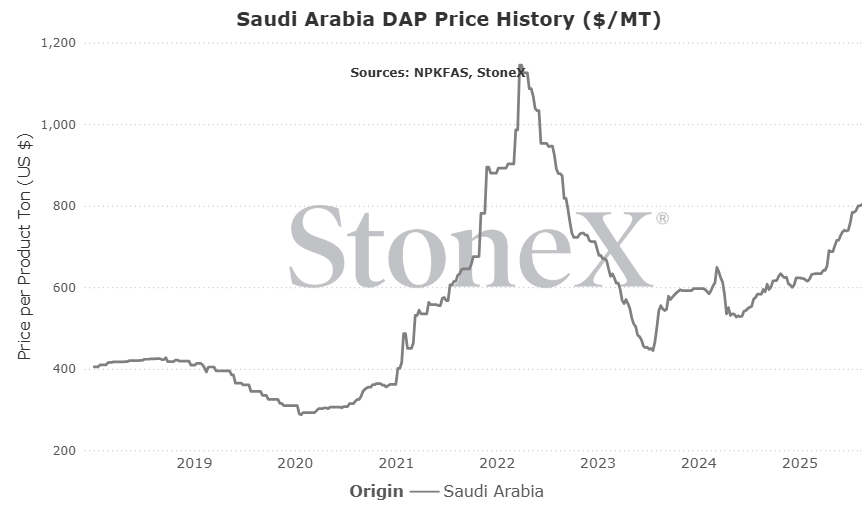
Saudi Arabia DAP price comparison
Number 3 global exporter in 2024
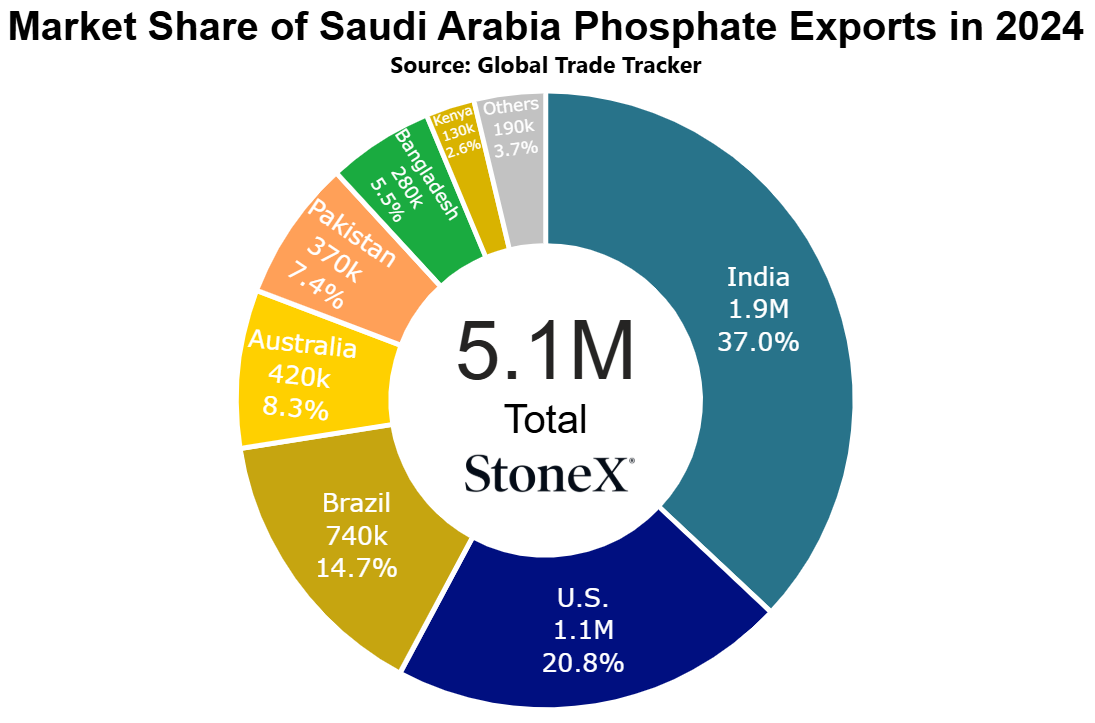
Price comparisons:
Vs 30 days ago - 2% or approximately $15 higher
Vs 90 days ago - 11% or approximately $77 higher
Vs 6 months ago - 27% or approximately $170 higher
Vs 1 year ago - 35% or approximately $209 higher
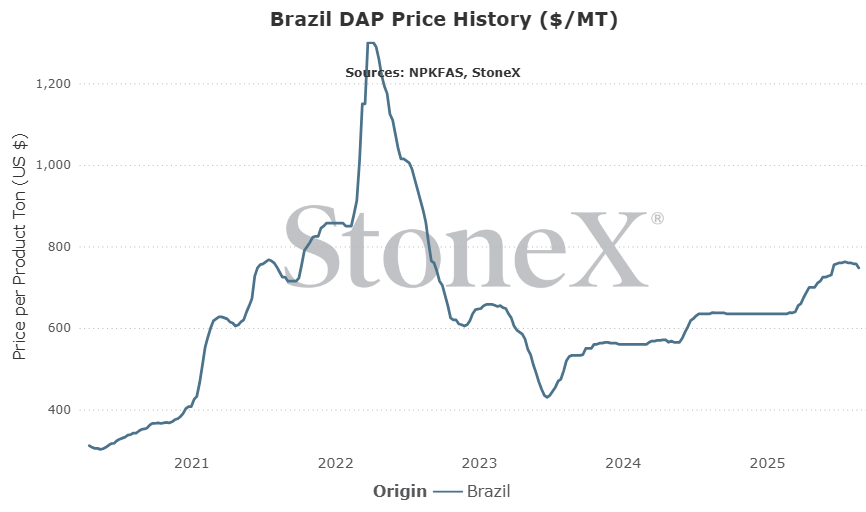
Brazil DAP price comparison
Number 1 global importer in 2024
Price comparisons
Vs 30 days ago - -2% or approximately $13 lower
Vs 90 days ago - 3% or approximately $23 higher
Vs 6 months ago - 17% or approximately $110 higher
Vs 1 year ago - 17% or approximately $110 higher
Bull/Bear Factors
Because no market is ever guaranteed to go higher/lower, we try to consider the factors that can sway values so that we are able to act when they occur rather than react.
- Bullish Factors
- China further reduces export allowances - recent market conversations actually have hopes rising that Chinese phosphate exports might improve...but I'm not holding my breath just yet. In fact, given global pricing/demand for phosphate, I'm actually more worried about the opposite. China is normally the world's leading exporter. However, after the 2021/22 debacle, the government has had a heavy hand in what does/does not get exported. They have been successful in making domestic values fall vs the world and with global prices still high and global inventories still tight, I would not be surprised to see them squeeze export flows shortly. That would hurt the world.
- India continues to play the stockpile catch up game and fails to maintain price ceiling - India just cannot seem to get caught up on their phosphate stockpiles and after a very good monsoon season, their next round of application demand is just around the corner. The India population links the government to their fertilizer stockpiles. If stockpiles are low, they will blame government officials who desperately want to keep hold of power (like every politician does). As long as the government continues to support more and more purchases, it helps keep global values propped higher.
- Farmers do not cut application rates as threatened - a lot of folks are threatening their phosphate approach this year. Fall applicators may wait until spring. Full application rates may get reduced or cut altogether this year. Given where prices are, there is not a single person that I would argue with on their current POV. However, demand may not get hit as much as folks currently discuss. We could spend all weekend at the bar talking about the size of this years crop but but eventually would agree it is huge, just a matter of how huge. Huge yields equate to huge nutrient removal. I am not saying it has to be replaced in all cases but demand very well may be higher as some fields show the replacement is needed...or 2026 yields may hurt.
- Bearish Factors
- China completely shocks the market and lifts export restrictions - we very well may see a little extra product be allowed to be exported in 2025 from China. I do not think small shifts in tons will make a huge difference, but a complete return to normal certainly would. Heck, even a couple million tons would help. If China surprises the world and lifts their export quotas, we could see global buyers shy away and start to see prices start to soften.
- Farmers around the world follow thru with application cuts - at the end of the day, there are only so many dollars (or whichever currency) to go around for farming operations. One of the first things on the chopping block, in my opinion, would be phosphate. If this becomes true/holds into fall, demand could be low enough everywhere that suppliers/manufacturers are forced to lower their price to bring buyers back. The phosphate S&D is a delicate thing today.
- U.S. production returns to normal levels - this is what feels to be another low probability watch point. However, anything is possible. U.S. phosphate manufacturing has been suffering for several years now. Q4 '24 saw record lows at 58%. Q1 '25 matched that percentage. Q2 '25 improved slightly to 61%. That is helping current prices hold value. However, if suddenly there was a breakthrough and production returned to the upper 80% range, that surge in product availability could have sellers getting more aggressive. Again, not holding my breath on this one, but it is worth watching for.
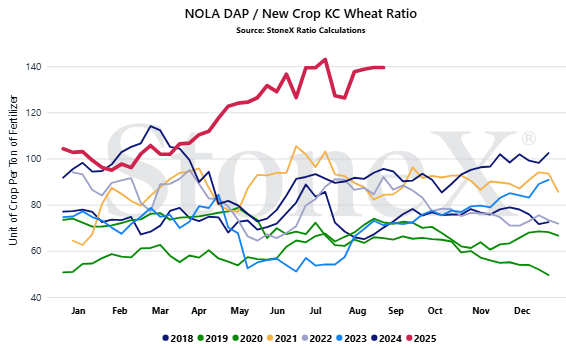
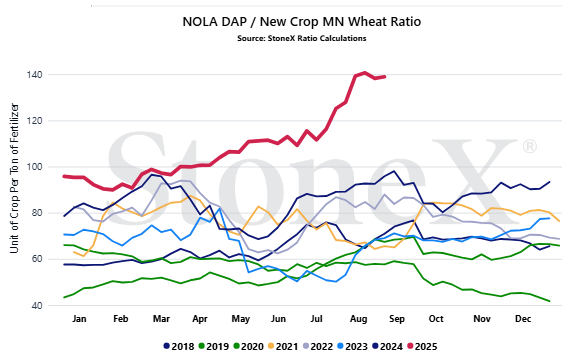
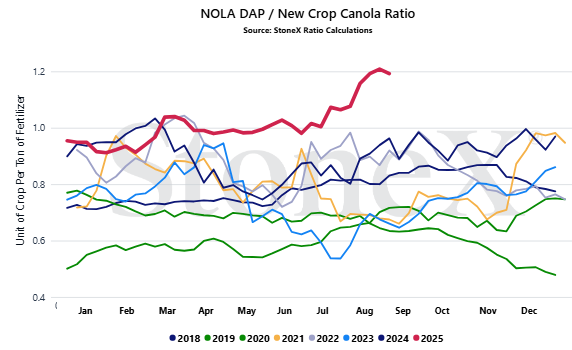
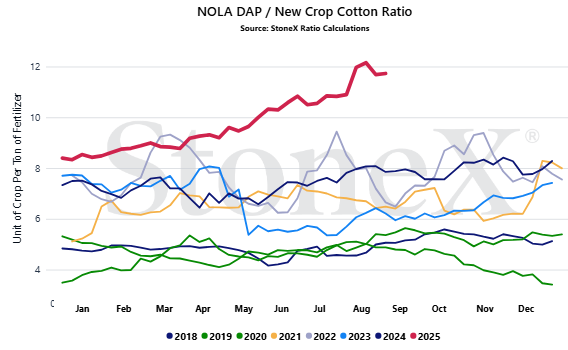
Where are the current phosphate/grain ratio values today?
We believe that only looking at the flat price of either grains or fertilizer can be misleading:
We look at the ratio "value" to get a better indication of where we are or how many bushels of X does it take to pay for 1 ton of fertilizer.
Would you rather:
When we compare the current ratio value against recent years, we start to see if we are high or low.
YOUR VALUES MAY LOOK DIFFERENT
This graph looks at the NOLA DAP price vs the flat grain price. There are no logistics on either product. Your location will look different due to fertilizer logistical costs, grain basis, etc.
- Josh Linville’s Focal Points
- Chinese export flows - China continues to be the root cause of the current high global phosphate price situation. Normally speaking, China was the world's largest supplier of phosphate with approximately 8 - 10M tons being exported annually. Now, for 2025, the expectation is half that with most recent volumes only expected to be 4.5M tons. That is a massive amount of tons that are missing and with so much of the global phosphate market controlled by 5 countries, there simply isn't a lot of other options. Now, China can still surprise us and flood the market with tons. That just doesn't seem feasible today, but it is possible.
- India's buying patterns - India's buying approach to phosphate has not done the world any favors. Since the middle of 2024, the Indian government has tried to overplay their hand on phosphate purchases, tried to coax global values lower, etc. All of these attempts have hurt their import capabilities and put them further and further behind normal stockpiles. That all means that inventories have been low, needing to be rebuilt, and a low supplied global market knows it. It feels like as India continually steps forward to buy more tons to rebuild stockpiles, the global supply market takes advantage by moving prices higher. India has done a solid job of securing big volumes recently which should alleviate their "desperation". If they could slow their buying pace, it could give the rest of the world a chance to lean on prices.
- Global demand reaction to a way too high priced market - unless you reside in an area where you do not see global price volatility (i.e. places like India), you know the pain that is being felt in terms of phosphate. That is a global phenomenon. Farmers everywhere are struggling with high phosphate prices and contemplating how to proceed. If we ultimately see global demand remain high as farmers push to keep maximizing yield potential, that will keep manufacturers/suppliers in control. If we see farmers around the world push back and lower/skip their coming application, that can eventually overwhelm the supply side and force a price change.
- 2025 crop yields - everyone, crop yields still matter to fertilizer. Yes, farmers can make decisions to reduce/cut/etc. their phosphate approach. However, there is a big crop out there. Big crops tend to remove big nutrients from the soil. Big nutrient removal can have big impacts on the next years yield potential if not replaced. Today, the common conversation is that applications will be lower. However, once everyone is in the combine and seeing the yield monitor flash big numbers, minds might change.
- U.S. tariff/duty approach to the world - right now, NOLA phosphate values are a solid premium vs the world due to U.S. tariffs/duties against most of the world's largest phosphate exporters. These restrictor situations, coupled with poor domestic production, means that values "should" be higher...but they are not the overall reason for higher prices. From our estimation, current values are ballooned around $75 - $100 higher than they would be without these import penalties. If we suddenly woke up tomorrow and tariffs/duties were gone, we could see phosphate lower by 5 - 10% which would be a huge help, but it still isn't the silver bullet some believe it to be.
StoneX Ratio Calculation
The ratio calculation is derived from Bloomberg historical grains values as well as fertilizer values from StoneX, NPKFAS, and Argus.
The calculation is simply dividing the fertilizer price by each grain price.
All data was sourced from StoneX unless otherwise noted.
This material should be construed as the solicitation of an account, order, and/or services and represents the opinions and viewpoints of the individual authors or presenters. It does not constitute an individualized recommendation or take into account the particular trading objectives, financial situations, or needs of individual customers.
The views are current only through the date stated and are subject to change at any time based upon market or other conditions, and StoneX Group Inc. (“SGI”) disclaims any responsibility to update such views. Actual results, performance, or achievements may differ materially from those expressed or implied. Information is based on data gathered from what we believe are reliable sources. Past performance does not guarantee future results.
The StoneX Group Inc. group of companies provides financial services worldwide through its subsidiaries, including physical commodities, securities, exchange-traded and over-the-counter derivatives, risk management, global payments and foreign exchange products in accordance with applicable law in the jurisdictions where services are provided.
References to certain OTC products or swaps are made on behalf of StoneX Markets, LLC (SXM), a member of the National Futures Association (NFA) and provisionally registered with the U.S. Commodity Futures Trading Commission (CFTC) as a swap dealer. SXM’s products are designed only for individuals or firms who qualify under CFTC rules as an ‘Eligible Contract Participant’ and who have been accepted as customers of SXM.
StoneX Financial Inc. (SFI) is a member of FINRA/NFA/SIPC and registered with the MSRB. SFI is registered with the U.S. Securities and Exchange Commission (SEC) as a Broker-Dealer and with the CFTC as a Futures Commission Merchant and Commodity Trading Advisor. StoneX Financial (Canada) Inc. (SFCI) is registered in Canada and is a member of CIRO and CIPF. References to certain securities trading are made on behalf of the BD Division of SFI and are intended only for an audience of institutional clients as defined by FINRA Rule 4512(c). References to certain exchange-traded futures and options are made on behalf of the FCM Division of SFI. Wealth Management is offered through SA Stone Wealth Management Inc., member FINRA/SIPC, and SA Stone Investment Advisors Inc., an SEC-registered investment advisor, both wholly owned subsidiaries of SGI.
R.J. O’Brien & Associates, LLC (RJO) is registered with the CFTC as a Futures Commission Merchant and is a member of NFA.
StoneX Financial Ltd (SFL) is registered in England and Wales, company no. 5616586. SFL is authorized and regulated by the Financial Conduct Authority (FCA) (registration number FRN:446717) to provide services to professional and eligible customers including: arrangement, execution and, where required, clearing derivative transactions in exchange traded futures and options. SFL is also authorized to engage in the arrangement and execution of transactions in certain OTC products, certain securities trading, precious metals trading and payment services to eligible customers. SFL is authorized and regulated by the FCA under the Payment Services Regulations 2017 for the provision of payment services. SFL is a category 1 ring-dealing member of the London Metal Exchange. In addition SFL also engages in other physically delivered commodities business and other general business activities which are unregulated and not required to be authorized by the FCA.
This communication is issued in the European Economic Area by StoneX Financial Europe GmbH (SFEG). StoneX is the trade name used by STONEX GROUP INC. and all its associated entities and subsidiaries. StoneX Financial Europe GmbH (“SFEG”) is a securities trading firm registered in Germany under Company No. HRB 80844.
StoneX Financial Pte Ltd (Co. Reg. No 201130598R) (“SFP”) is regulated by the Monetary Authority of Singapore and is a Capital Markets Service Licence holder (for dealing in capital market products), an Exempt Financial Adviser (for advising on investment products and issuing or promulgating analyses/ reports on investment products) and a Major Payment Institution (for domestic and cross-border money transfer services).
SFP may distribute analysis/report produced by its respective foreign affiliates within the StoneX Group of companies pursuant to an arrangement under Regulation 32C of the Financial Advisers Regulations Recipients should contact SFP at (65) 6309 1000 for any matters arising from, or in connection with, this webinar.
StoneX APAC Pte. Ltd. (“SAP”) (Co. Reg. No 200616676W) is regulated as a Dealer (PS20190001002) under the Precious Stones and Precious Metals (Prevention of Money Laundering and Terrorism Financing) Act 2019 for purposes of anti-money laundering and countering the financing of terrorism.
StoneX Financial (HK) Limited (CE No.: BCQ152) (“SHK”) is regulated by the Hong Kong Securities and Futures Commission for Dealing in Securities and Dealing in Futures Contracts.
StoneX Financial Pty Ltd (ACN 141 774 727) holds an Australian Financial Service License (AFSL: 345646) for Dealing in Securities, Exchange-Traded Derivatives Contracts, OTC Derivatives Contracts and Foreign Exchange Contracts, and is regulated by the Australian Securities and Investments Commission.
StoneX Securities Co., Ltd. (“SSJ”) (Co. Reg. No 010401047199) is regulated by the Japanese Financial Services Agency as a Type-I Financial Instruments Business Operator (Kanto Local Finance Bureau (FIBO)No.291’), is a member of the Financial Futures Association of Japan for dealing and broking FX and FX Option transactions, and is a member of the Japan Securities Dealers Association for dealing and broking stock indices and option transactions.
Trading swaps and over-the-counter derivatives, exchange-traded derivatives and options and securities involves substantial risk and is not suitable for all investors. Past performance of any futures or option is not indicative of future success. Indicators are not a trading system and are not published as a specific trade recommendation. The information herein is not a recommendation to trade nor investment research or an offer to buy or sell any derivative or security. It does not take into account your particular investment objectives, financial situation or needs and does not create a binding obligation on any of the StoneX group of companies to enter into any transaction with you. You are advised to perform an independent investigation of any transaction to determine whether any transaction is suitable for you. No part of this material may be copied, photocopied or duplicated in any form by any means or redistributed without the prior written consent of StoneX Group Inc.
The report/analysis herein is not directed to, or intended for distribution to or use by, any person or entity who is a citizen or resident of or located in any locality, state, country or other jurisdiction where such distribution, publication, availability or use would be contrary to law or regulation.
© 2026 StoneX Group Inc. All Rights Reserved.