September '25 POTASH
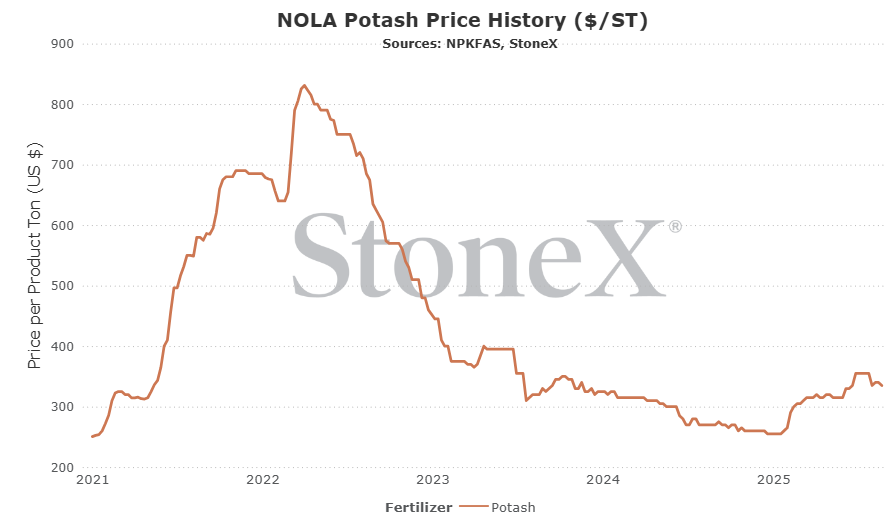
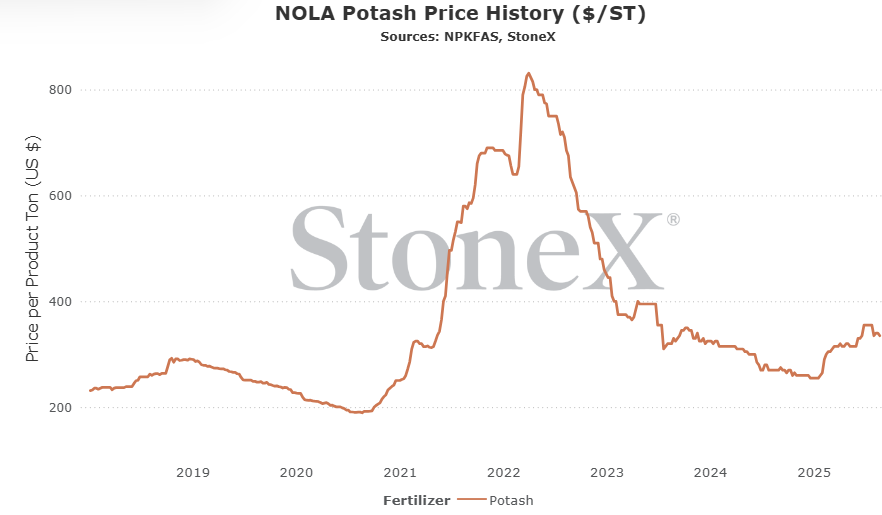
NOLA Potash Price Graph
Please remember that this is looking at the cost of one short ton of potash sitting in a barge at NOLA (New Orleans, Louisiana). Your cost is not going to be the same. This should be looked at more in regards to the price direction rather than the actual pricing.
What everyone wants to know first, what do we think will happen going forward
Global
It is amazing how quickly potash turned back into potash!
Global markets have been extremely quiet without much new to point to. Manufacturers appear to be comfortably sold and able to effectively sit back and relax until the next round of demand steps forward. That should allow them to keep prices elevated for the time being.
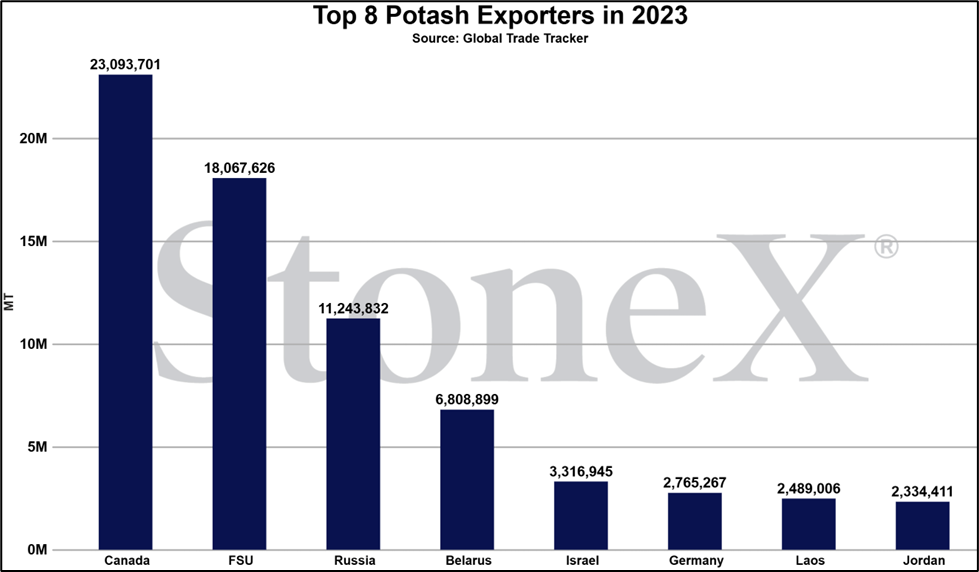
However, we do need to watch the Russia/Ukraine peace talks from a long term POV. There are potash production expansion projects that are still expected by the marketplace that are being delayed by the ongoing war. If peace were to be found, one would have to assume that these expansion projects would start in earnest.
Short term (i.e. next several months at least), we continue to believe that potash prices remain flat to higher as manufacturers are simply too comfortably sold to need to lower values.
Longer term (i.e. long enough I contemplated not writing this but still important), there is still enough new/expanded production projects out there that we expect potash to become very well supplied which has a calming/bearish effect on prices. Likely not something we will see now through next spring, but something to keep in the back of our minds.
North America
It is September. The start of fall application seasons (November) is not far away. If manufacturers needed to drop their price to bring demand forward, one would have thought it would have happened by now. That just does not seem to be the case.
At this point on the calendar, it is VERY hard to see potash values anything but flat to higher priced. Manufacturers/distributors appear very well sold and able to wait until fall demand steps forward.
Fall will be interesting. If there is a big November/December application run (our current expectation), the system will likely be emptied and suppliers be able to spend winter pointing to low inventories and spring just around the corner. However, on the flip side, if fall demand is bad and it causes the market to go into winter with healthy positions, it could have prices slip during the cold months.
General Global Potash Information
What has happened in the last 30 days?
Potash values decent vs grains but high phosphate values may hurt demand
When looking at current potash prices by themselves or against current grain values, it isn't bad and on its own there shouldn't be any cause for alarm in regards to fall application demand.
...but things are rarely viewed on their own.
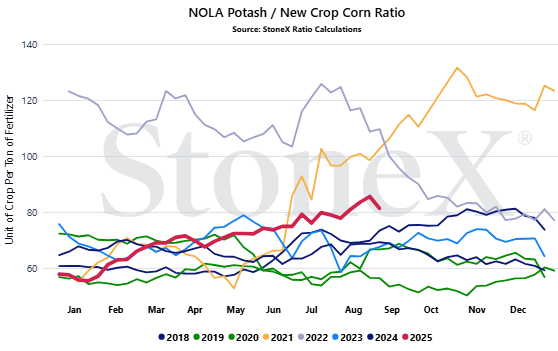
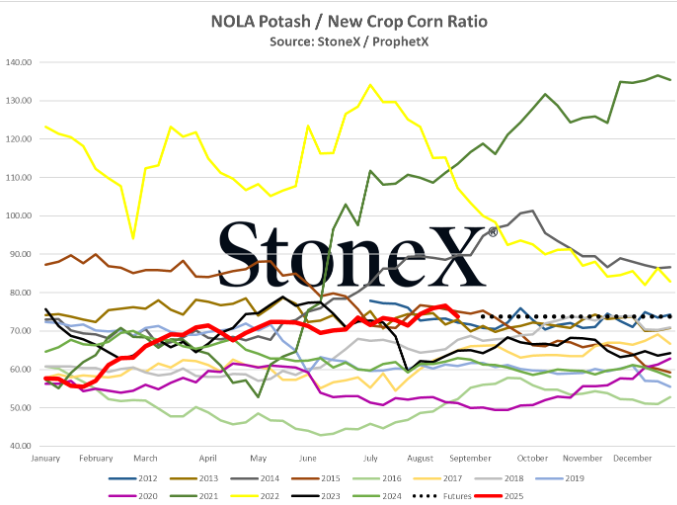
When looking at the current potash vs December 2026 corn value, it gives us a rough ratio of 74 bushels per ton of potash. On the graph below, that is the black dotted line. It is certainly on the high side of what recent year "normal" values would be, but it is far better than what we have come to expect from both nitrogen and phosphate.
Therein lies the issue. A lot of farmers and retailers, when looking at potash, do not look at it alone. Many of the folks we work/talk with view their phosphate and potash as one application. It is rare to find someone who will apply their potash and then come in next season to do their phosphate. Who in their right mind would pay for 2 applications and deal with that much more compaction?!
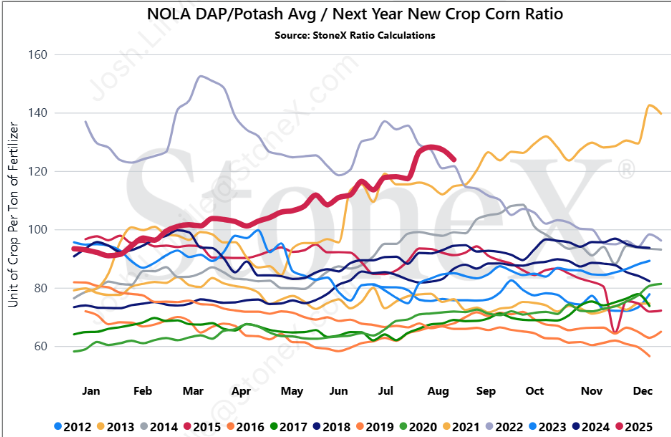
That is where the 2nd graph below comes into play. That graph takes a 50/50 split between the phosphate/corn and potash/corn ratios and overlays that against historical values. Now, potash values we only have back to 2012 so it is possible that 2008 was worse than today, but I'm not sure that is the case. Still, when we look at that phosphate/potash combination, it is the worst that we have ever seen for this time of year. For farmers who are looking at their fall decisions, this will weigh large and could have some cutting back their potash demand just because phosphate demands it.
Obviously it is still too early to tell. It is one thing to say that application cuts will occur during the slower summer. It will be harder to hold to that approach as harvest begins and yield monitors in combines start showing large numbers. Big yields equal big nutrient removal. There will be operations who can mine the soil another season or two due to healthy applications in recent years, but not all will have that luxury.
We will find out in around 60 days...
What does this mean for farmers?
This is sort of two-fold.
On one side, let's assume there is large demand cut back because of the heightened ratios. In that case, even with potash values looking "ok", demand could be low enough to cause higher than expected inventory carryover into the winter. That ultimately could weigh on price ideas for a short time. Unfortunately, the lack of fall season could mean a massive spring demand run that could hurt worse. There is a reason the market has a normal fall/spring split.
On the other side, fall potash demand could be solid. This is our current POV. The "decent" potash price could be enough to offset the high phosphate price. Or, we could see farmers go heavy potash and light phosphate. This would cause fall ending inventories to be very low which would usher in stories of "there is not much time between the end of fall season and the start of spring. This lack of time weighs against the markets ability to get refilled.
For this, we are in a wait and watch mode. Farmers will get last say.
Could peace between Russia/Ukraine help increase global supplies?
Very long story short: yes!
There continue to be some Russian potash production expansions that are currently planned but as we understand, have been delayed due to the ongoing war with Ukraine. Seems that construction projects take a backseat when there is a war going on. That isn't great for near-term, but it does give us a chance to hold out hope for the future. If there can be peace between Russia and Ukraine that holds, we could see these expansion projects get started. This would give the global potash market another reason to doubt higher prices (increased supply + unchanged demand = lower values).
Then there is the Belarus POV. Remember during the lead up to Russia's invasion. Russia asked Belarus to give their troops access to the southern part of their country. This allowed their military to attack Kiev from the north and east. Their hope was that a two-front war would bring a swift end to the invasion. That allowance hurt Belarus more than I think they anticipated.
Belarus is landlocked and had been almost solely reliant on Lithuania to export their potash. The issue is that Lithuania sides with western nations and very quickly put things into law that effectively blocked any/all trade with Belarus and even went so far as to take any Belarusian assets within Lithuania. After this, Belarus couldn't ship potash south. Ukraine would never allow it. They couldn't go west as Poland was another western country who had no intention of helping. The only option was east through Russia but there was not enough logistics to keep up with normal exports so totals dropped.
Since that time, export flows from Belarus through Russia have improved but still mark a more difficult road. If there is peace between Russia and Ukraine, Russia could do its ally a favor and demand that Lithuania reopen transit lanes for Belarusian potash flows. I'm not going to act like I am a brilliant international political mind, but to get peace, this option could be on the table. Until that day comes, Belarusian potash is going to struggle through unnatural routes to access the world.
What does this mean for farmers?
If there is peace between Russia/Ukraine and it includes the allowance of Belarusian potash through Lithuania, it could usher in a softer market. Even if it does not increase overall supplies, there is a possibility that a small step back to normal could put more minds at ease.
Where are current values in relation to the past
NOLA/New Orleans Louisiana
Vs 30 days ago --6% or approximately $20 lower
Vs 90 days ago - 6% or approximately $20 higher
Vs 6 months ago - 10% or approximately $30 higher
Vs 1 year ago - 24% or approximately $65 higher
U.S. Midwest Average (average of several points across the Midwest)
Vs 30 days ago - 1% or approximately $4 higher
Vs 90 days ago - 2% or approximately $8 higher
Vs 6 months ago - 9% or approximately $33 higher
Vs 1 year ago - 9% or approximately $31 higher
Bull/Bear Factors
Because no market is ever guaranteed to go higher/lower, we try to consider the factors that can sway values so that we are able to act when they occur rather than react.
- Bullish Factors
- Unexpected production issues in larger export countries – there is so little happening in the world of potash that I'm forced to take some pretty generic points and put them in here this month!!! Right now, global production appears to be rolling smoothly. Prices are following suit. However, if there is a sudden change and we were to see Russian production stop due to war, as an outlandish example, that would likely have prices jumping.
- N.A. fall demand larger than expected due to large harvest yields - right now, the common rally cry of farmers is that fall applications are going to be cut to fight back against high fertilizer prices. There is nothing in that statement that I can argue with. Farmers are getting the brunt end of a crap market situation. However, what happens when combines start to roll and yield monitors start showing big numbers? Big yields equal big nutrient removal. Potash is just as important as every other input and if it is neglected, you end up in some cases with a limit on 2026 yields. There is still a route where fall demand is much larger than we currently think.
- Manufacturers are able to maintain a solid sales book, can be patient and wait for buyers – this one is pretty simple. Manufacturers did a great job of building a solid sales book early on. They got the price at a level where they were able to sell a lot of tons. That puts them on the front foot. With a solid sales book, they do not "have" to sell anytime soon. That means they can have patience until the next round of demand comes. That patience is a huge help in them keeping price ideas high...or moving higher when that demand does come.
- Bearish Factors
- High phosphate values wreck potash demand – for a lot of farmers, phosphate and potash go hand in hand. I have yet to meet a farmer who was willing to apply potash in the fall and then apply phosphate in the spring. Who in their right mind would pay to apply twice?! Let's face it, current phosphate values are out of hand. If it remains high enough, we could see large portions of farmers decide to skip fall application in hopes of a better spring situation. That approach would drag potash with it. End the fall with heavy inventories and we could see prices lower.
- Russia/Ukraine peace is found and Russian production expansions begin/pick up - Russia has been linked to a decent amount of new potash production. However, those expansions have been delayed due to the ongoing war with Ukraine. If peace is found, my guess is you will see a lot of things start picking up in Russia. Potash production expansions could lead the charge which would bring a lot of new tons to the market.
- Manufacturers are found to be overplaying their "sold out" hand – good luck finding a manufacturer willing to share all of their sales data. It doesn't happen because they do not want it to happen. Honestly, I do not blame them. I wouldn't either. So we have to take the manufacturer at their word that they are really well sold out...but what if they are not. What if they are embellishing a bit to keep the market higher priced? If this was the case and buyers continue to refuse to come forward, maybe they get to be a little more desperate to sell than we currently think.
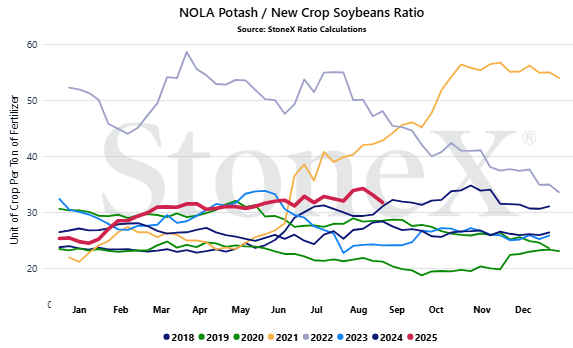
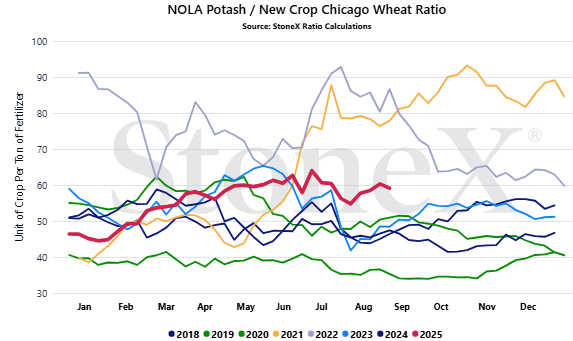
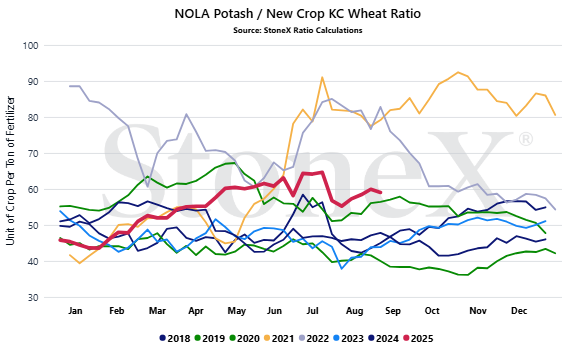
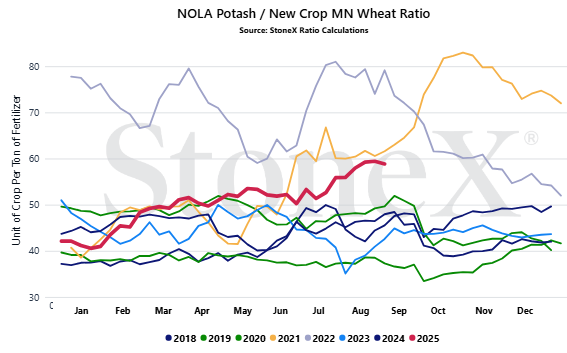
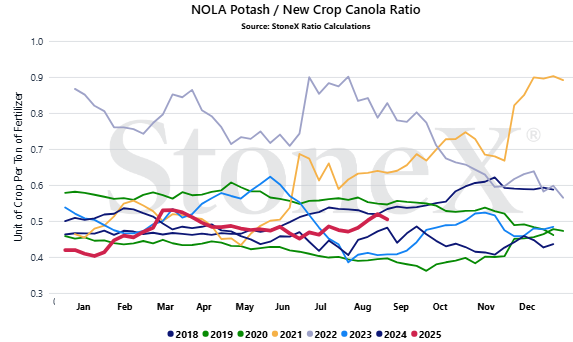
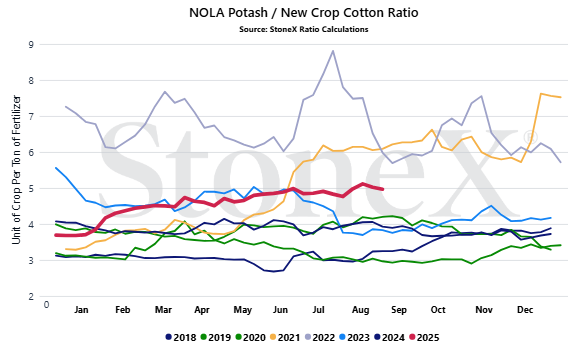
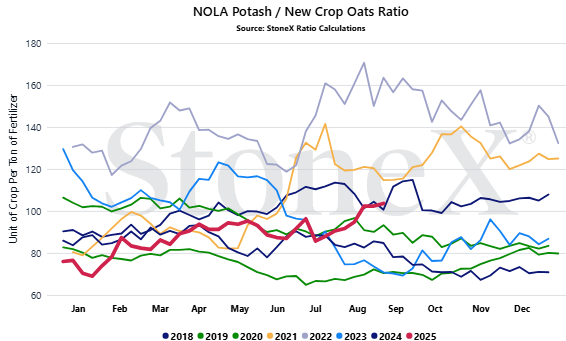
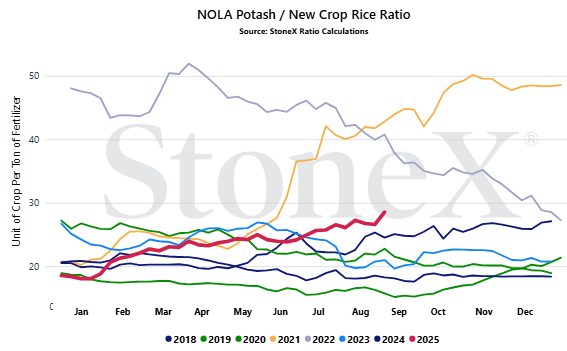
Where are the current potash/grain ratio values today
We believe that only looking at the flat price of either grains or fertilizer can be misleading:
We look at the ratio "value" to get a better indication of where we are or how many bushels of X does it take to pay for 1 ton of fertilizer.
Would you rather:
When we compare the current ratio value against recent years, we start to see if we are high or low.
YOUR VALUES MAY LOOK DIFFERENT
This graph looks at the NOLA potash price vs the flat grain price. There are no logistics on either product. Your location will look different due to fertilizer logistical costs, grain basis, etc.
- Josh Linville’s Focal Points
- Global production/supply availability in the next several months - this is about as generic a focal point as I think I can come up with!!! However, there is truth in it. As long as global production continues at a high rate, it keeps the market comfortable. A comfortable market does not need to freak out to buy product to get ahead of price movements. That approach allows market values to remain relatively steady...however, if production starts to suffer, the opposite needs to be feared.
- Global demand in the next several months - it appears that most global manufacturing companies/countries are comfortably sold. Steady values in the potash realm would certainly support that POV. It begs the question: will global potash buyers be forced to buy their next layer before global potash manufacturers need to sell? Right now, it appears that sellers are in a more comfortable position. That should keep a floor on pricing.
- Will potash demand suffer due to phosphates excessive high price - potash prices are decently well priced in relation to history/current grain values/etc. If viewed by itself, one would think that there is little reason to be concerned with demand. However, a lot of farmers view potash and phosphate in the package and farmers do not view phosphate well today. Even the combination of phosphate and potash ratios to grains are still very high. It is possible that phosphate could have an adverse impact on potash demand in the coming weeks and months.
StoneX Ratio Calculation
The ratio calculation is derived from Bloomberg historical grains values as well as fertilizer values from StoneX, NPKFAS, and Argus.
The calculation is simply dividing the fertilizer price by each grain price.
All data was sourced from StoneX unless otherwise noted.
This material should be construed as the solicitation of an account, order, and/or services and represents the opinions and viewpoints of the individual authors or presenters. It does not constitute an individualized recommendation or take into account the particular trading objectives, financial situations, or needs of individual customers.
The views are current only through the date stated and are subject to change at any time based upon market or other conditions, and StoneX Group Inc. (“SGI”) disclaims any responsibility to update such views. Actual results, performance, or achievements may differ materially from those expressed or implied. Information is based on data gathered from what we believe are reliable sources. Past performance does not guarantee future results.
The StoneX Group Inc. group of companies provides financial services worldwide through its subsidiaries, including physical commodities, securities, exchange-traded and over-the-counter derivatives, risk management, global payments and foreign exchange products in accordance with applicable law in the jurisdictions where services are provided.
References to certain OTC products or swaps are made on behalf of StoneX Markets, LLC (SXM), a member of the National Futures Association (NFA) and provisionally registered with the U.S. Commodity Futures Trading Commission (CFTC) as a swap dealer. SXM’s products are designed only for individuals or firms who qualify under CFTC rules as an ‘Eligible Contract Participant’ and who have been accepted as customers of SXM.
StoneX Financial Inc. (SFI) is a member of FINRA/NFA/SIPC and registered with the MSRB. SFI is registered with the U.S. Securities and Exchange Commission (SEC) as a Broker-Dealer and with the CFTC as a Futures Commission Merchant and Commodity Trading Advisor. StoneX Financial (Canada) Inc. (SFCI) is registered in Canada and is a member of CIRO and CIPF. References to certain securities trading are made on behalf of the BD Division of SFI and are intended only for an audience of institutional clients as defined by FINRA Rule 4512(c). References to certain exchange-traded futures and options are made on behalf of the FCM Division of SFI. Wealth Management is offered through SA Stone Wealth Management Inc., member FINRA/SIPC, and SA Stone Investment Advisors Inc., an SEC-registered investment advisor, both wholly owned subsidiaries of SGI.
R.J. O’Brien & Associates, LLC (RJO) is registered with the CFTC as a Futures Commission Merchant and is a member of NFA.
StoneX Financial Ltd (SFL) is registered in England and Wales, company no. 5616586. SFL is authorized and regulated by the Financial Conduct Authority (FCA) (registration number FRN:446717) to provide services to professional and eligible customers including: arrangement, execution and, where required, clearing derivative transactions in exchange traded futures and options. SFL is also authorized to engage in the arrangement and execution of transactions in certain OTC products, certain securities trading, precious metals trading and payment services to eligible customers. SFL is authorized and regulated by the FCA under the Payment Services Regulations 2017 for the provision of payment services. SFL is a category 1 ring-dealing member of the London Metal Exchange. In addition SFL also engages in other physically delivered commodities business and other general business activities which are unregulated and not required to be authorized by the FCA.
This communication is issued in the European Economic Area by StoneX Financial Europe GmbH (SFEG). StoneX is the trade name used by STONEX GROUP INC. and all its associated entities and subsidiaries. StoneX Financial Europe GmbH (“SFEG”) is a securities trading firm registered in Germany under Company No. HRB 80844.
StoneX Financial Pte Ltd (Co. Reg. No 201130598R) (“SFP”) is regulated by the Monetary Authority of Singapore and is a Capital Markets Service Licence holder (for dealing in capital market products), an Exempt Financial Adviser (for advising on investment products and issuing or promulgating analyses/ reports on investment products) and a Major Payment Institution (for domestic and cross-border money transfer services).
SFP may distribute analysis/report produced by its respective foreign affiliates within the StoneX Group of companies pursuant to an arrangement under Regulation 32C of the Financial Advisers Regulations Recipients should contact SFP at (65) 6309 1000 for any matters arising from, or in connection with, this webinar.
StoneX APAC Pte. Ltd. (“SAP”) (Co. Reg. No 200616676W) is regulated as a Dealer (PS20190001002) under the Precious Stones and Precious Metals (Prevention of Money Laundering and Terrorism Financing) Act 2019 for purposes of anti-money laundering and countering the financing of terrorism.
StoneX Financial (HK) Limited (CE No.: BCQ152) (“SHK”) is regulated by the Hong Kong Securities and Futures Commission for Dealing in Securities and Dealing in Futures Contracts.
StoneX Financial Pty Ltd (ACN 141 774 727) holds an Australian Financial Service License (AFSL: 345646) for Dealing in Securities, Exchange-Traded Derivatives Contracts, OTC Derivatives Contracts and Foreign Exchange Contracts, and is regulated by the Australian Securities and Investments Commission.
StoneX Securities Co., Ltd. (“SSJ”) (Co. Reg. No 010401047199) is regulated by the Japanese Financial Services Agency as a Type-I Financial Instruments Business Operator (Kanto Local Finance Bureau (FIBO)No.291’), is a member of the Financial Futures Association of Japan for dealing and broking FX and FX Option transactions, and is a member of the Japan Securities Dealers Association for dealing and broking stock indices and option transactions.
Trading swaps and over-the-counter derivatives, exchange-traded derivatives and options and securities involves substantial risk and is not suitable for all investors. Past performance of any futures or option is not indicative of future success. Indicators are not a trading system and are not published as a specific trade recommendation. The information herein is not a recommendation to trade nor investment research or an offer to buy or sell any derivative or security. It does not take into account your particular investment objectives, financial situation or needs and does not create a binding obligation on any of the StoneX group of companies to enter into any transaction with you. You are advised to perform an independent investigation of any transaction to determine whether any transaction is suitable for you. No part of this material may be copied, photocopied or duplicated in any form by any means or redistributed without the prior written consent of StoneX Group Inc.
The report/analysis herein is not directed to, or intended for distribution to or use by, any person or entity who is a citizen or resident of or located in any locality, state, country or other jurisdiction where such distribution, publication, availability or use would be contrary to law or regulation.
© 2026 StoneX Group Inc. All Rights Reserved.