- World production estimated above consumption in 2023/24, according to the USDA;
- Improvement in productivity with the harvest progress in Brazil;
- USDA cuts Brazil's crop by just 1 million tonnes;
- Crop should be favorable in Argentina;
- Concerns about the pace of global demand;
- Weak export sales from the US;
- More pronounced production cut by Conab;
- USDA revises Chinese exports upwards;
- NOPA shows stronger grinding in the US in February;
- Hot and dry weather affected crop conditions in Argentina;
- The Argentine situation still favors holding soybean as insurance.
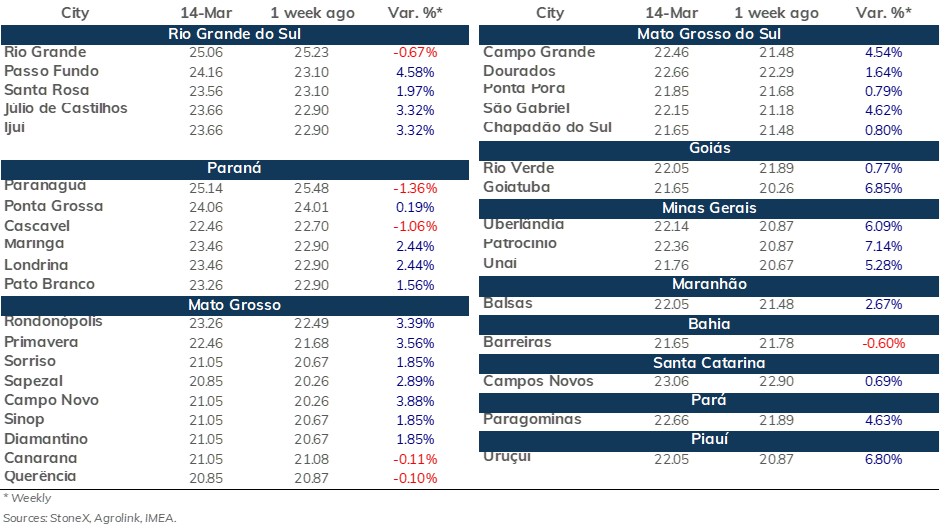
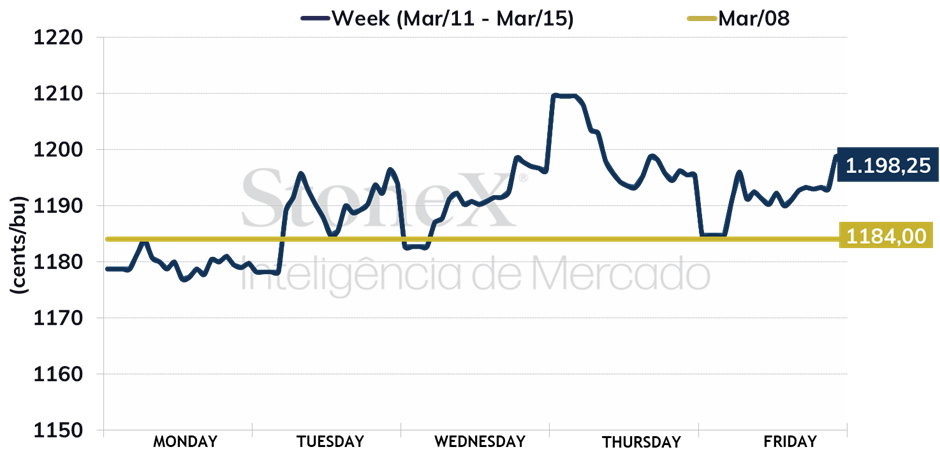
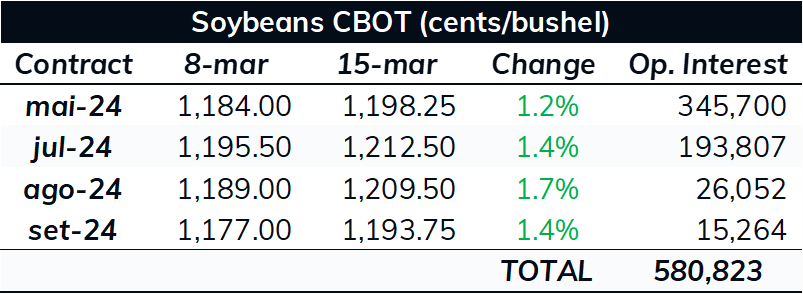
Last week, soybean quotes continued the recent upward movement and ended the period with a 1. 2% gain for the May/24 contract, which closed Friday's session (15) at 1198. 25 cents per bushel.
The South American crop continues to be in the spotlight with the release of CONAB's monthly crop estimate. This estimate lowered Brazilian production to 146. 9 million tonnes, a significantly lower volume than the USDA, which cut it by only 1 million tonnes to 155 million. In addition, several other estimates from private institutions, including different figures, are available.
Conab highlighted that the negative productivity adjustments were a result of the adverse weather that affected the crops in the first months of the cycle, while what was planted later benefited from the more recent rains, a scenario in line with what has been observed by StoneX, with the difference that Conab is more pessimistic regarding the initial impacts.
Although there are doubts about the size of the Brazilian crop, the decline in production here is still more than offset by the expected advance in Argentine production. The Rosario Exchange raised its crop figure from 49. 5 to 50 million tonnes, while the Buenos Aires Exchange's figure remains at 52. 5 million tonnes.
This lower figure from Conab contributed to the more positive tone of the market recently, remembering that, as short positions are very high, there is room for hedging.
On the demand side, it is worth noting that Brazilian soybeans remain more competitive than American ones, which is usual for this period, given the harvest progress here.
US export inspections reached 706.3 tmt in the week ended on 03/07, a lower volume than the previous week but higher than reported in the same week last year. In the accumulated, the country's shipments reached 35 million tonnes, against 43. 3 million in 2023. Nonetheless, it is important to remember that the USDA estimates exports 7. 4 million weaker annually.
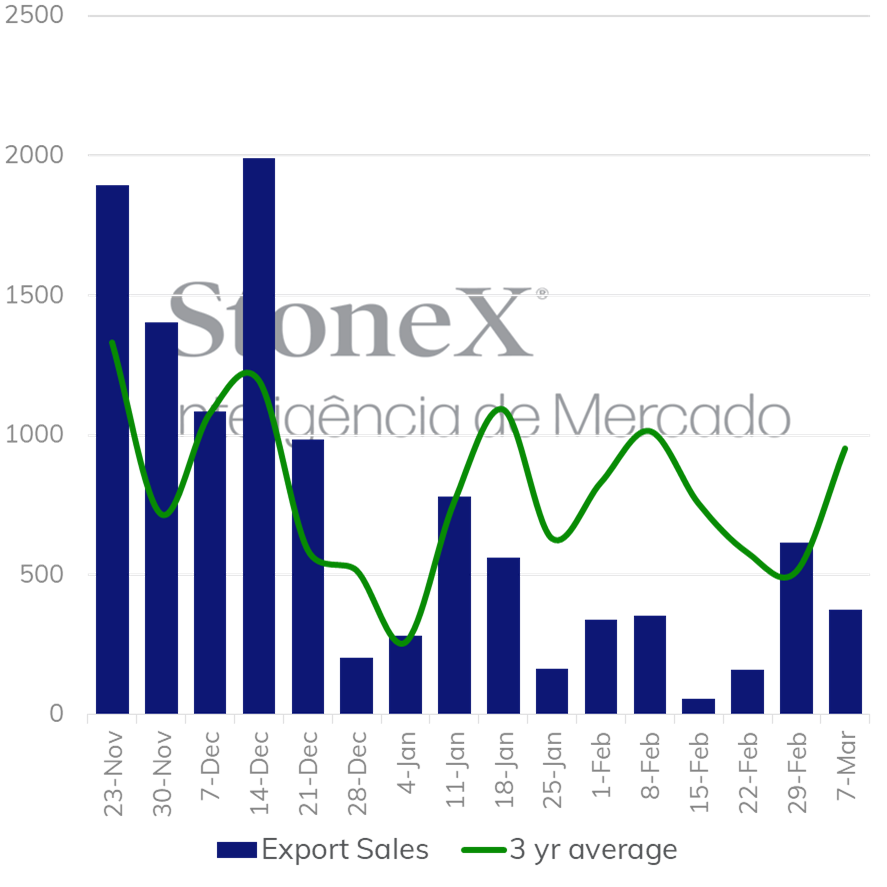
Regarding the country's export sales in the same week, net negotiations for the 23/24 crop stood at 376 thousand tonnes, within the expectations range from 250 to 800 thousand tonnes. Of this total, 230 thousand were traded with China, but it is worth noting that the world's largest importer bought 7. 9 million tonnes less from the US than in the same period last year. In total, accumulated sales are behind by 9. 7 million tonnes, reaching 39 million tonnes.
Despite USDA bringing more positive outlooks for Chinese imports in the report released on March 08, revising previous crops, concerns about the pace of the country's demand continue, as well as prospects for increased introduction of GMO seeds, which should boost crop productivity in the country, potentially affecting the distribution of acreage.
Regarding domestic consumption in the United States, the National Oilseed Processors Association (NOPA) reported a crushing of 5. 07 million tonnes in February, slightly above the previous month and significantly above the market's average expectations of 4. 85 million tonnes. This pace of soybean processing would be even stronger than necessary to reach the USDA's annual estimate. On the other hand, stocks also grew above expectations, reaching 766.6 thousand tonnes, fueling concerns about the renewable diesel segment, which is already facing pressured RINs values.
This week, Brazil's and Argentina's crops will continue to be on the radar, along with the USA's exports. It is worth mentioning that the market is already waiting for the planting intention data in the US, which will be released on 03/28.