- Bearish Factors
- According to the USDA, world production in 24/25 widens the gap compared to consumption.
- Improvement in productivity with the harvest progress in Brazil;
- USDA estimates Brazilian crop for 23/24 at 154 million tonnes;
- Crop should still be favorable in Argentina;
- Concerns about the pace of global demand;
- Growth prospects for the area in the USA.
- Bullish factors
- Lower production figure by CONAB;
- Possible impact of rains on the planting pace in the US;
- Crop losses in Rio Grande do Sul due to floods;
- Buenos Aires Exchange shows concern about the pace of harvest and yields in the northern region of the country;
- USDA continues to bet on very heated Chinese imports.
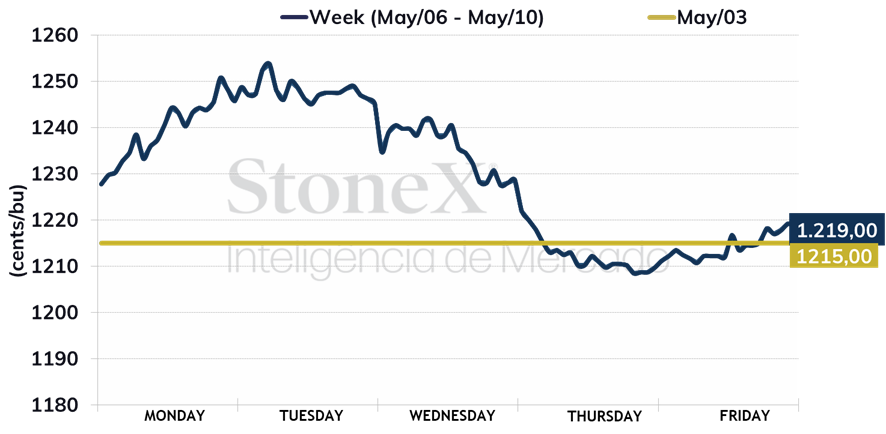
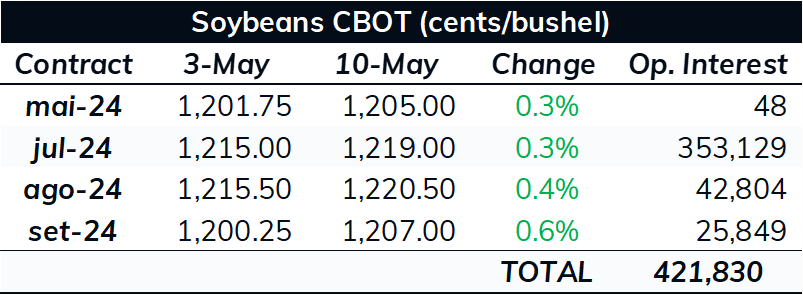
Soybean quotes posted volatility in the last week in Chicago, starting the period with sharp gains, but these gains were given back, and the quotes closed near the values of seven days before. The July contract closed Friday's session (10) at 1219 cents per bushel, a slight weekly increase of 0.3%.
The considerable gains at the beginning of the week are conditioned by climatic issues, amid some concern about the progress of planting in the US and the floods that devastated Rio Grande do Sul in Brazil.
In the case of American soybeans, rain in part of the oilseed-producing area has hindered fieldwork. In the week ending on 05/05, the USDA reported that 25% of the crops had been planted, a percentage above the average of 21% but below the figure recorded in the same period last year, at 30%, indicating a lagging pace, as soybean planting was more advanced. Nonetheless, in the case of soybeans, this slowdown is not very concerning since the window for oilseed is a few weeks later than that of corn, with the scenario for cereals attracting more attention.
Regarding Rio Grande do Sul, the initial concerns regarding soybean losses caused by historic rains also influenced the sharp increase recorded in Monday's trading session (06), with funds shortcovering. However, it still is not possible to assess the real impact, as it affects not only the crops but also the entire associated activity, such as storage logistics, the protein industry, etc. In addition to the ongoing loss accounting, the current main concern is with people.
Before this climatic event, the state would be, in this 2023/24 cycle, the second-largest soybean producer in the country. Nonetheless, 30% of the crop had not been harvested when the rains started, resulting in productivity losses. The North and Northeast regions of the state concentrate approximately 67% of the soybean area, where 10% of the crops still need to be harvested. In the southern half, representing 33% of the soybean area, approximately 60% of the crops had not yet been harvested at the start of the weather event.
After an initial survey of the impacts on the crops, StoneX reduced the soybean productivity estimate by 13%, which represents a cut of 3 million tonnes in the final production. Thus, the estimated crop in Rio Grande do Sul decreased from 23 to 20 million tonnes. The latest national figure from StoneX, of 150.8 million tonnes, would decrease to 147.8 million tonnes.
Although soybean prices in Chicago have reacted and the implications for the entire oilseed chain in the state are expected to be very relevant, this three million tonne decrease is not enough to change the global scenario, with USDA maintaining its production estimate considerably above consumption. Thus, the quotes returned the gains in the following sessions.
However, it is important to remember that, as much as the supply has the potential to move prices more abruptly and significantly, concerns on the demand side remain with a focus on China's behavior, despite the USDA estimating more significant imports than the official Chinese customs figures.
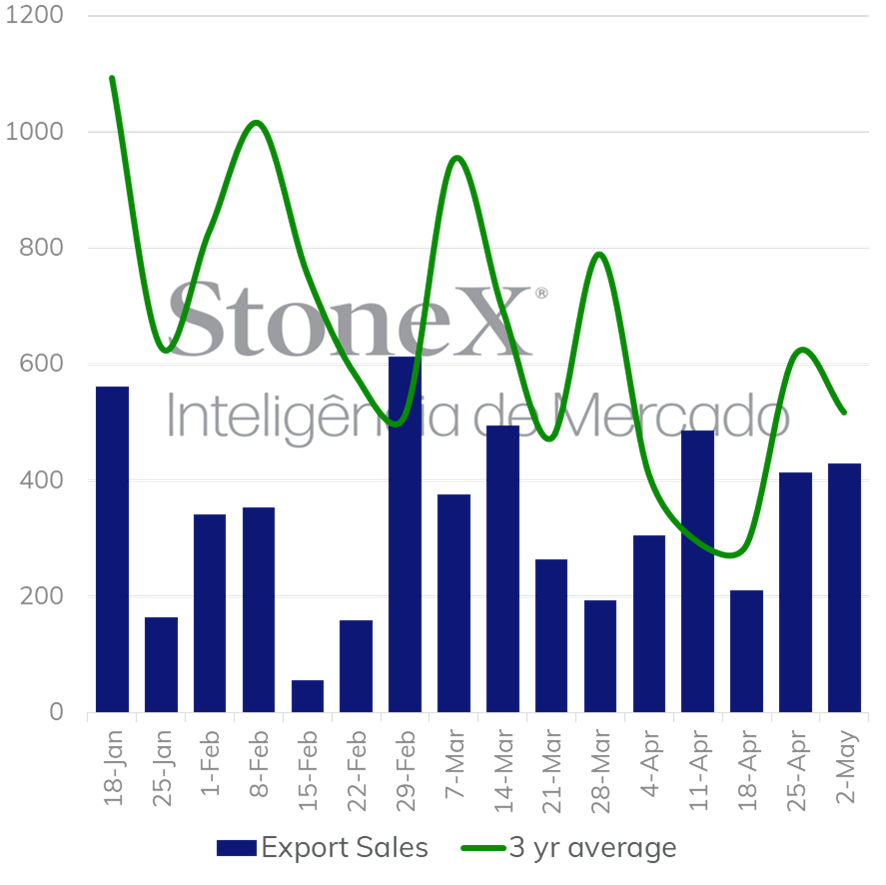
In the week ended 05/02, US crop 2023/24 export sales reached 428.9 tmt, a volume within the estimates, bringing the total to 42.3 million tonnes, 8.4 million tonnes less than last year. However, it is worth noting that USDA estimates for shipments in the cycle are lower than last year. Of this "delay," China is responsible for 7.3 million tonnes, with the world's largest importer concentrating its purchases in Brazil.
Furthermore, last week ended with the release of the USDA's WASDE report, which was highly anticipated because it would bring the first figures for the 2024/25 global crop.
However, before discussing the new crop, the USDA adjusted Brazilian production for 2023/24, which decreased from 155 to 154 million tonnes. This reduction still keeps the Department's figures as one of the largest in the market and has not yet reflected the situation in Rio Grande do Sul. The Argentine crop was kept at 50 million tonnes, a figure in line with the Rosario Exchange and below the Buenos Aires Exchange, which continues to estimate the country's soybean crop at 51 million tonnes. Despite maintaining this figure of 51 million tonnes, the Buenos Aires Exchange highlights concerns about the delay in harvesting in the northern region of the country and lower yields in that area, which could eventually lead to the need for future crop adjustments.
Regarding USDA figures for the 2024/25 cycle, the expected growth in global production would continue to outpace consumption, with this difference increasing to over 20 million tonnes, boosting stocks.
In addition to the full crop prospects in the US, considering a rebound in production and acreage increase, USDA estimated the Brazilian crop in 2024/25 to be 169 million tonnes and the Argentine crop to be 51 million. On the demand side, there is a notable perspective of considerable annual growth in Chinese imports, which would increase from 105 to 109 million tonnes in the annual comparison. Still, it is important to highlight, once again, the discrepancy between USDA data and official Chinese customs data. The Chinese demand is a cause for doubt amid the weaker economic performance and the government's efforts to reduce the use of soymeal in animal feed. Given the huge dependence on imported soybeans, the market is subject to greater supply risks.
These data are still very preliminary, and important changes may occur in the US and South America, especially because the Brazilian crop will only start planting in September.
This week, in addition to the usual data, such as exports, the release of CONAB's crop survey on Tuesday (14) stands out.