- Bearish Factors
- World production in 24/25 widens the gap compared to consumption, according to the USDA;
- Improvement in productivity with the harvest progress in Brazil;
- Crushing margins are pressured in China;
- Concerns about the pace of global demand;
- Growth prospects for the area in the USA.
- Bullish factors
- Drier weather in the eastern US belt;
- Crop losses in Rio Grande do Sul, due to floods;
- Spec funds reduce short position;
- Heated crushing in the U.S. in May;
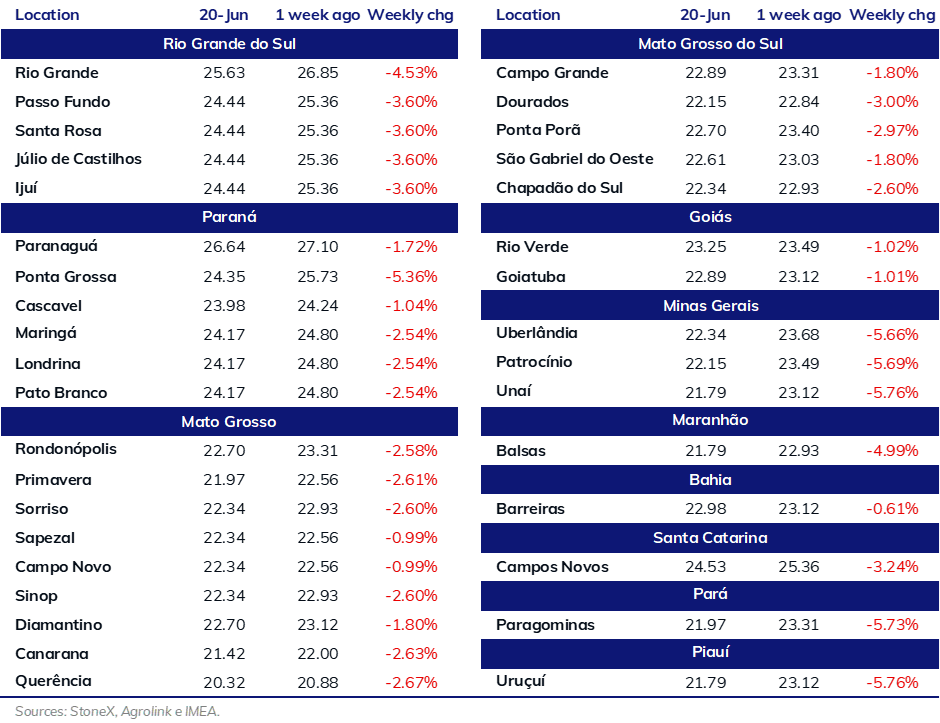
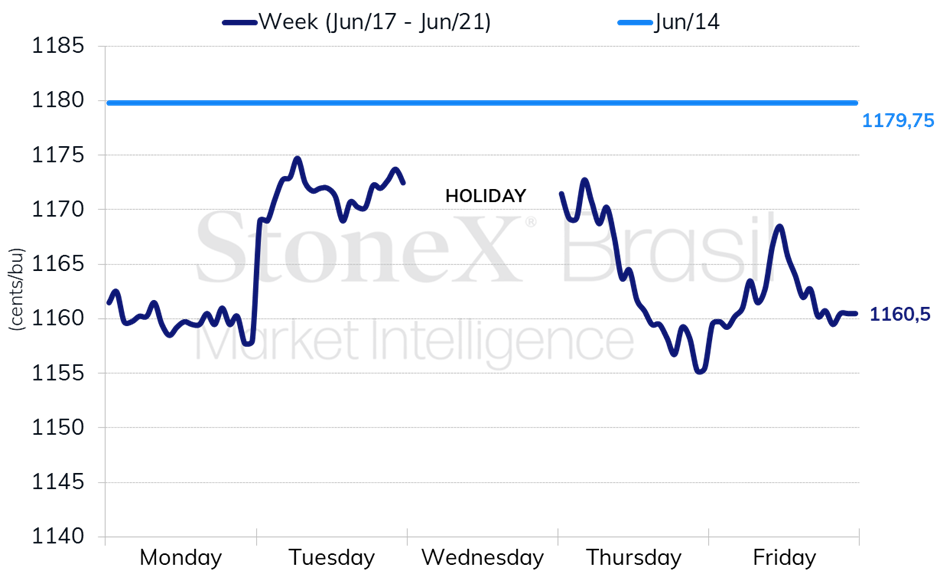
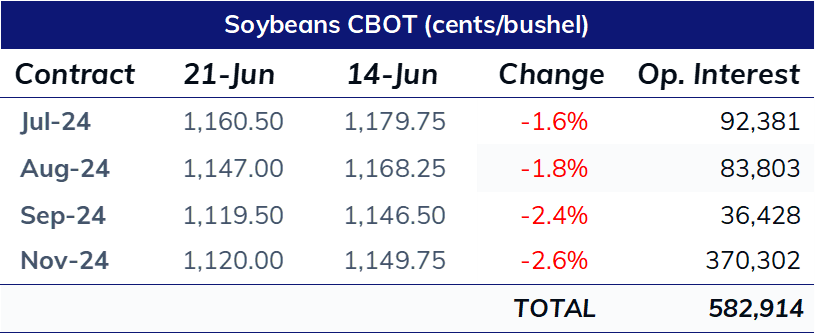
Last week, soybean prices in Chicago fluctuated, with the downward trend prevailing. The July contract ended Friday's session (21) at 1160.5 cents per bushel, a weekly decrease of 1.6%.
Even though the 2024/25 season is just beginning in the Northern Hemisphere, the weather in the US has already been impacting the market, highlighting that the country is the second-largest producer of soybeans in the world.
The USDA started releasing its weekly update on the American crop in April. Planting was initially progressing quickly, but heavy rains in some parts of the American agricultural belt in May delayed field work progress. For soybeans, planting was slowed down by the rains, but overall progress remained above the five-year average during this period. By the week ending on 06/16, 93% of the country's 24/25 soybean crop had been planted, which was higher than the five-year average of 91%, but lower than the level recorded at the same time last year, which was at 97%.In the recent period, a drier climate in the eastern belt resulted in support for prices on the exchange, but it did not hold up, with frequent changes in weather forecasts and divergences between the American and European models.
In some parts of the US, the dry weather has led to a decline in crop quality according to the crop conditions report for 06/16. However, the percentage of soybeans rated as good or excellent is at a high level, standing at 70%. This is above last year's level and the five-year average. In previous years, such high ratings have been associated with excellent or even record yields.
It is also worth noting that it is still early, with the soybean grain filling period, considered the most critical in terms of lack of moisture, focusing on August. Even so, any weather issue in the US tends to bring volatility to the market.
In Argentina, the harvest is nearing its end, having reached 98.3% of the total by last Wednesday (19), with an average yield of 3 tonnes per hectare, confirming the estimate of the Buenos Aires Exchange at 50.5 million tonnes.
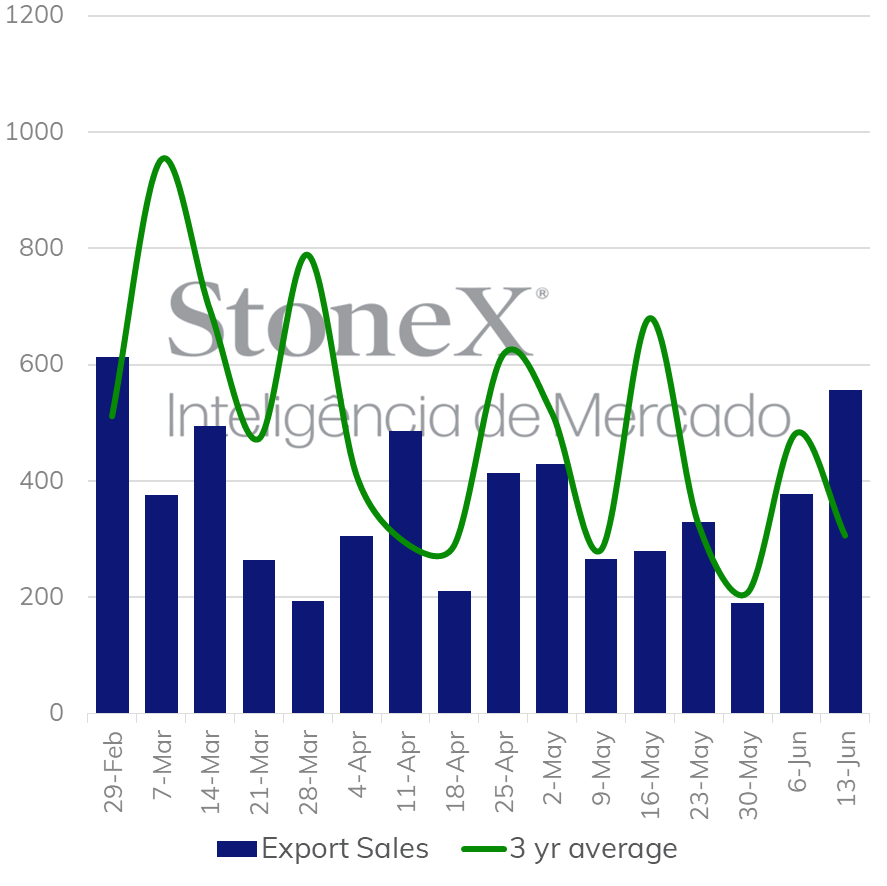
On the demand side, US export sales in the week ended on 06/13 reached 556.5 thousand tonnes, a volume within the range of estimates, which ranged from 375 to 850 thousand. In total, 44.3 million tonnes were traded.
Of particular note is the US soybean crush data, released by the National Oilseed Processors Association (NOPA), which represents about 95% of the country's industry. In May, 5 million tonnes were crushed, while the market estimates averaged 4.85 million. In addition, soybean oil stocks fell to 782 thousand tonnes, which goes against the prospects of increased consumption by the renewable diesel sector.
When it comes to soybean products, the market is keeping an eye on the crushing operations in Argentina, especially after last year's crop failure. There's an expectation that Argentina will resume processing its usual volumes of soybeans, leading to increased competition in the export market with Brazil and the USA, particularly for soybean meal, as both Brazil and the USA are consuming more soybean oil domestically. Despite the soybean harvest in Argentina being almost finished, the country's crushing operations have not fully recovered, which could create a longer export opportunity for its competitors.
In Brazil, preliminary data shows that soybean exports in June are very strong. As of June 14, 7.3 million tonnes of the oilseed were shipped. However, despite the currently high volumes, it is expected that there will be a slowdown in the coming months due to the inter-crop period and the fact that the 23/24 production was lower than last year's record.
This week, Friday (28) will bring important and highly anticipated releases: the acreage, which revises planting intentions from March and can bring sharp movements to the market, as seen in previous years. For soybeans, the area of 35 million hectares remained in line with expectations in March, but surprises may occur. The market does not bet on major changes, with the average expectation at 35.11 million hectares. In addition, the quarterly position of stocks on 06/01 will also be disclosed, which gives a good idea of the progress of consumption in the US, signaling what will be the size of the ending stocks of the 23/24 crop on 09/01.