- Bearish Factors
- World production in 24/25 widens the gap compared to consumption, according to the USDA.
- Improvement in productivity with the advancement of the harvest in Brazil;
- Pressured crushing margins in China;
- Concerns about the pace of global demand;
- Harvest completion in Argentina, strong crop;
- Favorable crop conditions in the USA.
- Bullish factors
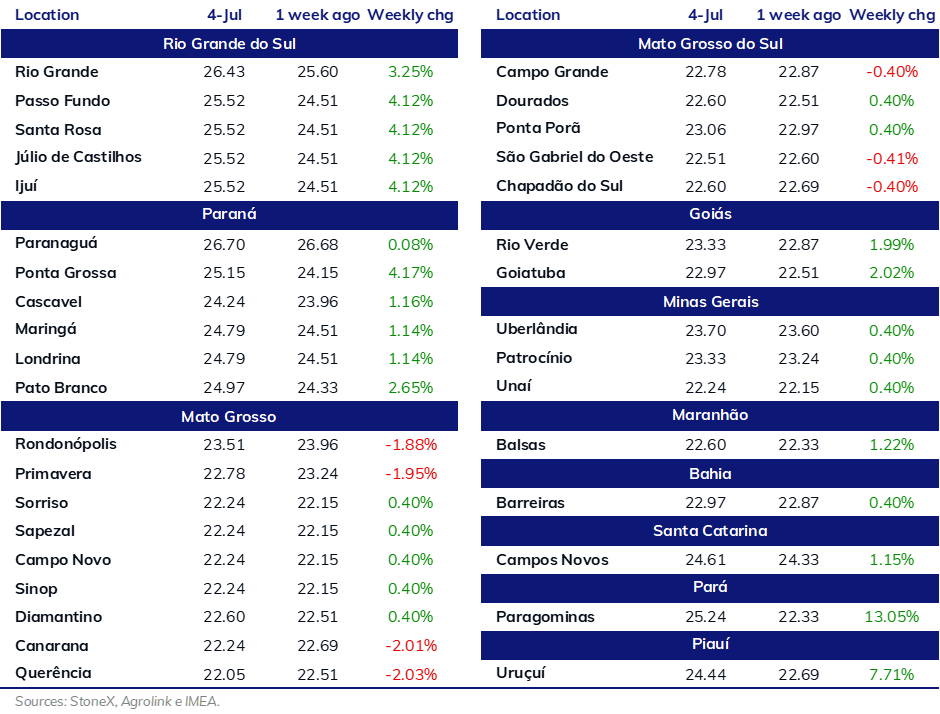
- Crop losses in Rio Grande do Sul due to floods;
- Spec funds reduce short position;
- Heated grinding in the US in May;
- Conversion of plants to renewable diesel in California;
- USDA continues to bet on very heated Chinese imports.
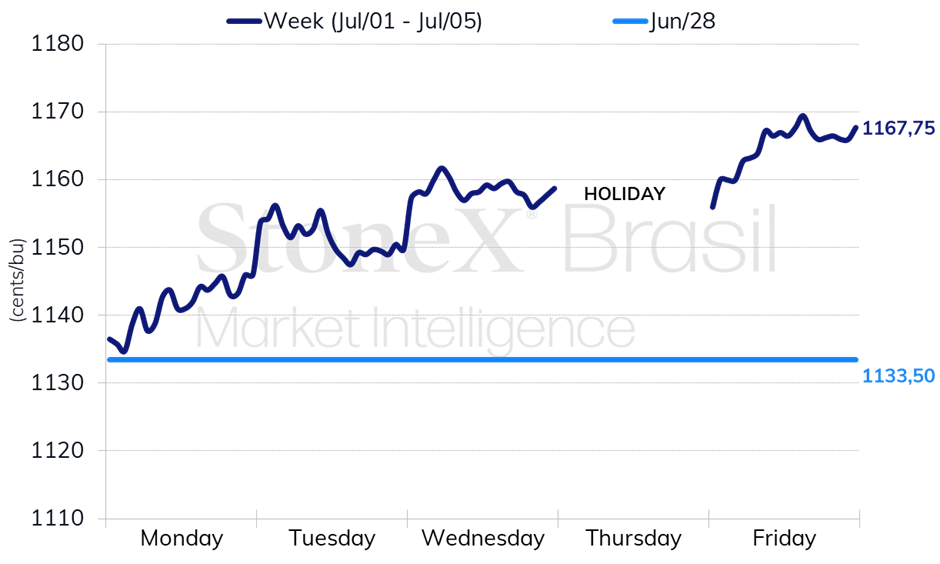
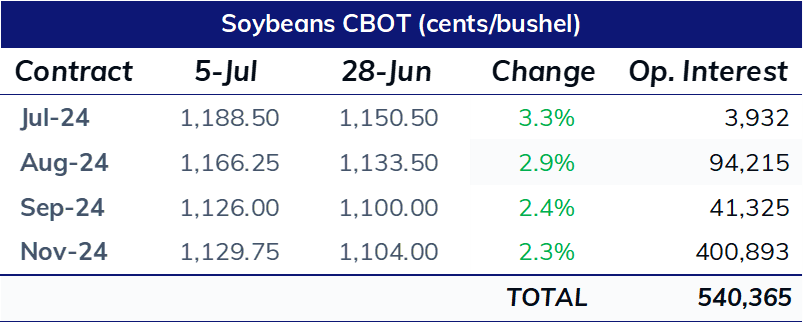
The first week of July was positive for soybean quotes in Chicago, with the August contract ending Friday's session (5) at 1166.25 cents per bushel, a 2.9% gain in the period.
The US crop continues to be one of the main factors influencing the market, but demand issues also played a role in the increase.
Although the American planted acreage for 24/25, released on 06/28, did not fall much below expectations, with limited impacts on the supply and demand balance, the country's crop result ends up relying even more on productivity, given this scenario of slightly smaller acreage.
With that, the crop progress and the weather are closely monitored. The good/excellent conditions of American crops on 06/30 remained stable at 67%, a level considerably above the five-year average for the period, at 59%. There was an improvement in conditions in states like Missouri, Indiana, and Illinois, while the areas further northwest saw a decrease, amid the rainier weather.
Anyway, as highlighted in the previous report, if the good/excellent conditions remain at higher levels until the beginning of August, the chances of productivity above trend are high. August concentrates the grain filling in the US, a determining phase for crop yields.
Regarding demand, the official US soybean crushing data in May was in line with the previously released by the National Oilseed Processors Association (NOPA), which represents 95% of the country's crushers. In the fifth month of 2024, 5.23 million tonnes of soybeans were processed, a level that is consistent with USDA's projections for crushing of the 23/24 crop year, at 62.32 million tonnes.
The processing of soybeans in the US has been driven by the biofuels market, with a focus on renewable diesel, with the country directing the supply of vegetable oil to the domestic market. The announcement of the total conversion of a large plant to biofuels in California last week was seen as a sign that the market remains hot. In this scenario, concerns about the supply of palm oil from Southeast Asia are also on the radar, with the weather in Indonesia and Malaysia being monitored. It is worth mentioning that the USA imports palm oil for other uses while reinforcing the consumption of soybean oil for biofuels.
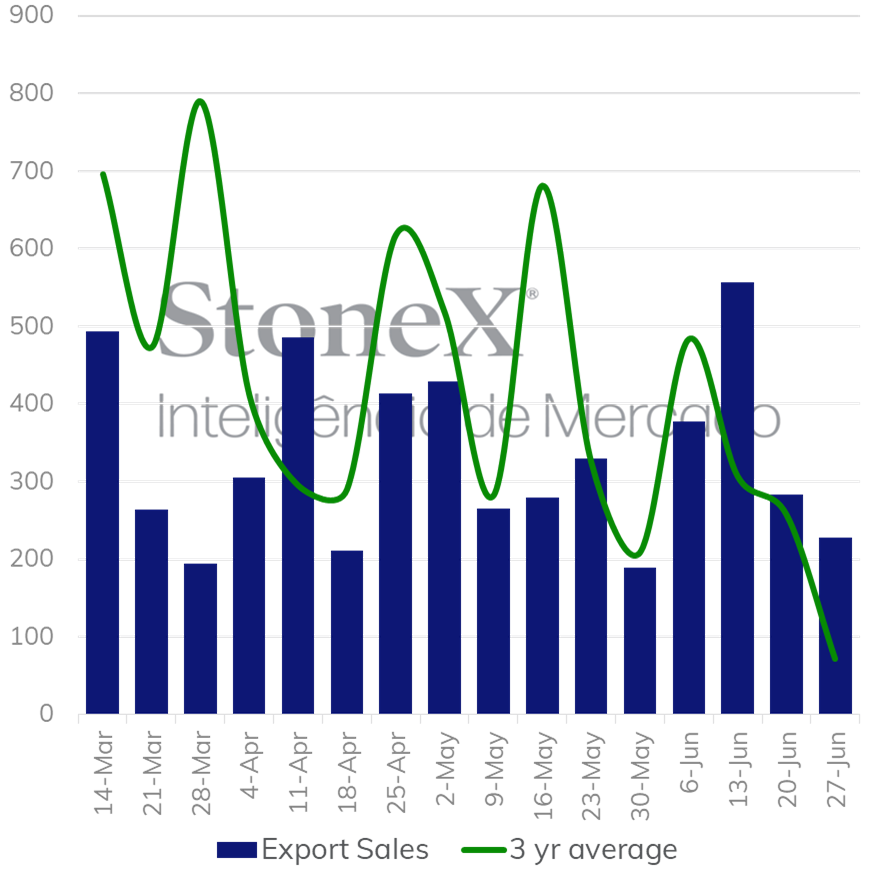
US export sales in the week ended on 06/27 reached 228.4 thousand tonnes, at the lower end of market estimates, which ranged from 200 to 600 thousand tonnes. In total, 44.8 million tonnes were traded and, even with the low weekly volume, the USDA estimate of 46.27 million tonnes is still on track to be reached.
In Brazil, soybean exports in June reached 13.9 million tonnes, bringing the total to 64.2 million tonnes, a volume still higher than that recorded in the first half of 2023 when it was at 62.8 million tonnes. Anyway, as the surplus available for export this year is lower, since the 23/24 crop suffered from weather losses and did not repeat the previous record, the next few months are expected to see weaker exports, which coincides with the inter-crop period of the oilseed here.
This week, as expected, the American crop should continue to influence prices. In the last three days, it rained in practically the entire grain belt of the country, with the highest volumes recorded in central Iowa, part of Oklahoma, and Louisiana. In the coming days, areas further east of the producing region are expected to receive more significant precipitation, but there may be a risk of flooding in some areas. On the other hand, the northwest of the belt should become drier, a welcome situation after the recent heavy rains.
Regarding the disclosures, in addition to the weekly data, such as the crop follow-up report from the USDA, this week, the CONAB crop survey and the USDA supply and demand report will be published.