- Bearish Factors
- World production in 24/25 widens the gap compared to consumption, according to the USDA.
- StoneX estimates record productivity for the US;
- Pressured crushing margins in China;
- Concerns about the pace of global demand;
- StoneX estimates record production for the 24/25 Brazilian crop;
- Favorable crop conditions in the USA.
- Bullish Factors
- Incentive measures adopted by the Chinese government;
- Investment funds with a high short position
- Heated crushing in the US;
- Conversion of plants to renewable diesel in California;
- Drier weather forecasts in some regions of the US;
- USDA increases Chinese imports again.
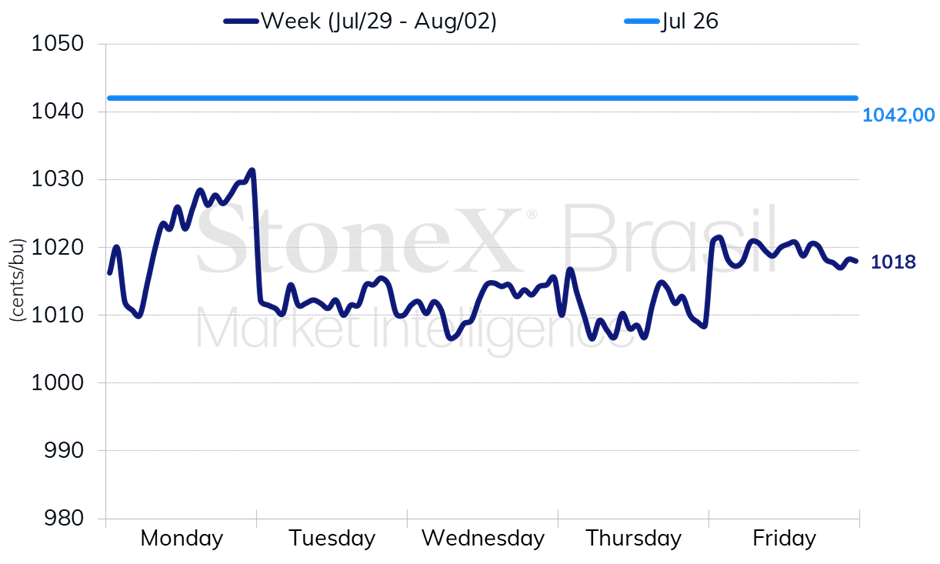
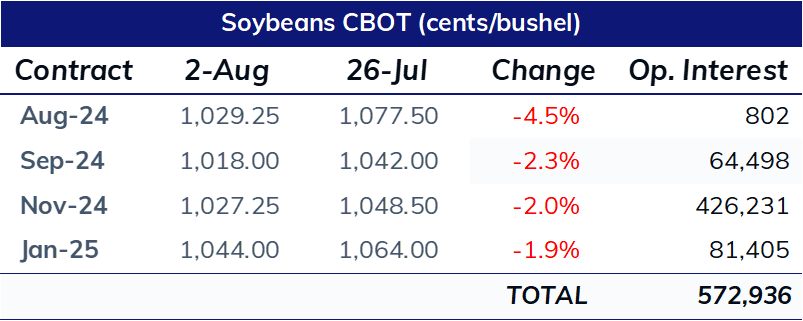
Last week, soybean quotes oscillated in Chicago, but ended the period lower. The September contract closed Friday (02) at 1018 cents per bushel, a decrease of 4.5% in the period.
The very positive outlook for the North American crop continues to weigh on prices and limit the possibility of more sustained increases, at a time when the USDA estimates more comfortable global balance, with an increase in the difference between production and consumption in the 24/25 cycle.
The USDA's weekly crop progress report indicated that 67% of the soybean fields in the US 24/25 were in good/excellent conditions, 1 percentage point lower than the previous figure, but still well above the five-year average for the period.
American soybean is entering the grain filling period, critical for determining productivity. As a result, the weather continues to be closely monitored. At the beginning of last week, forecasts indicated a dry and hot pattern for much of the Midwest, which could prevail for some time. Nonetheless, the weather models have changed, becoming more favorable. The most recent forecasts again indicated drier weather in the next 10 days in the southern and central Midwest, which could lead to some stress on crops.
It is worth noting that StoneX released its first production estimate for the US 24/25 crop, based on productivity survey and considering USDA's official acreage. The expected production was 122 million tonnes, with a national record productivity for the country, at 3.54 tonnes per hectare. This result would lead ending stocks to reach 13.15 million tonnes, considering the demand variables currently estimated by USDA, with a stock-to-use ratio of 11.1%, maintaining comfortable balance outlook.
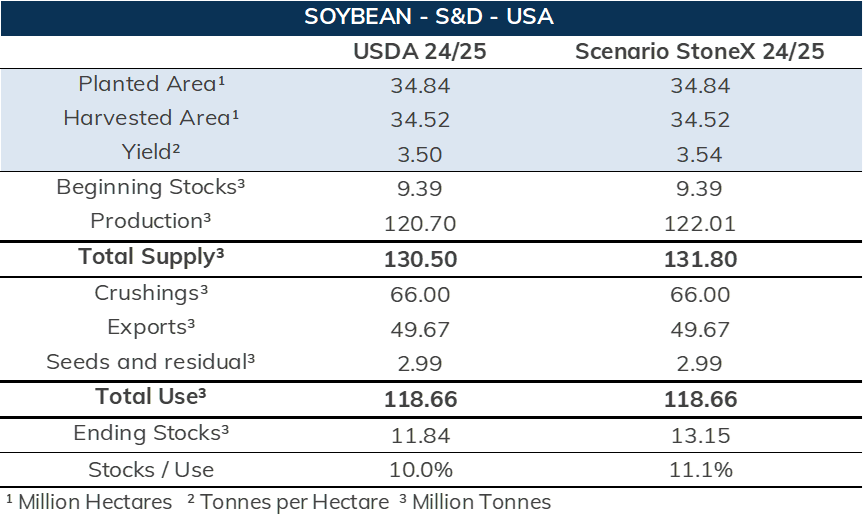
Sources: USDA and StoneX.
In Brazil, the 24/25 crop season begins to be planted only in September, with possibilities of a record, according to the first figures from StoneX. An estimated production of 165 million tonnes is projected, an increase of 10.8% compared to the previous cycle, impacted by weather issues.
This increase results from the expected productivity rebound, as long as the weather does not bring any major surprises, and also the continued area growth. The national acreage was estimated at 46.5 million hectares, an increase of 0.79% compared to last year. Highlight for increases in the Center-West region and, to a lesser extent, in Paraná and Santa Catarina. This annual variation in the area is more modest compared to that observed in the recent past since the oilseed price scenario is less favorable.
In any case, in the case of South America, it is still early, with the possibilities of La Niña at the end of the year bringing risks of drier weather in Argentina and southern Brazil.
On the demand side, Brazil shipped more than 10 million tonnes of soybean in the first four weeks of July, bringing the total since January to 74.3 million tonnes. In any case, as the 23/24 crop was smaller, the trend is for volumes to be weaker in the coming months.
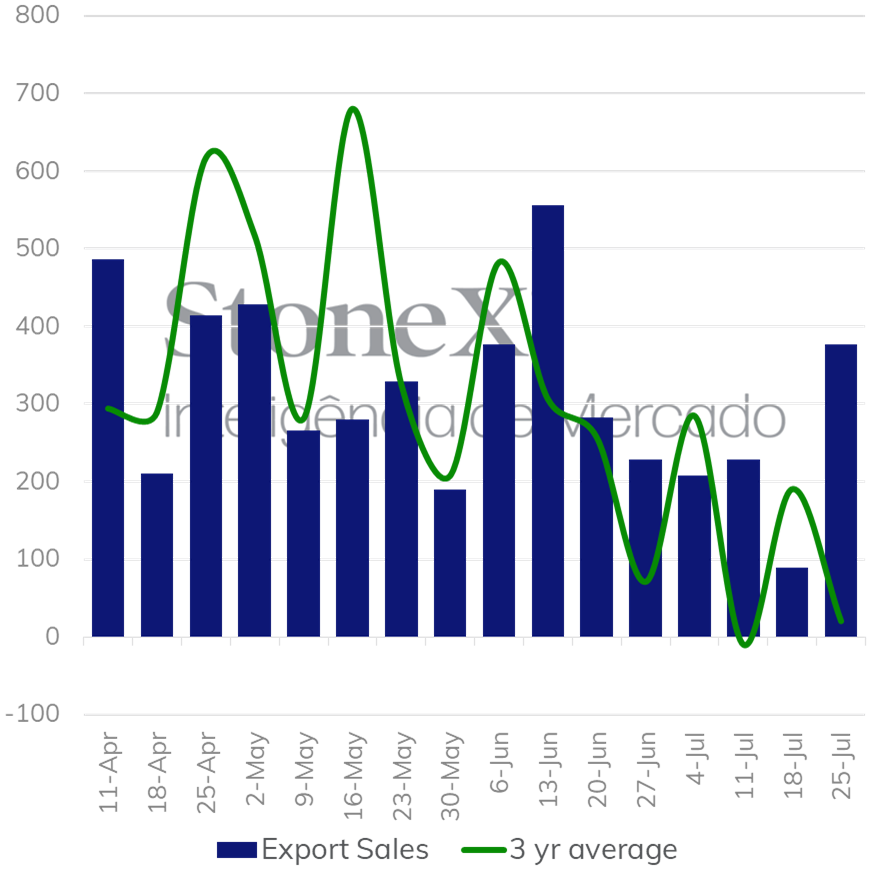
In the US, export sales in the week ended on July 25 reached 376.4 thousand tonnes for the 23/24 crop, exceeding the upper end of market estimates, which ranged from 75 to 300 thousand tonnes. In total, 45.5 million tonnes were traded, against a shipment estimate of 46.2 million, remembering that the cycle ends at the end of August.
Attention should continue to be very focused on the US crop, as the plants are in the most critical period for determining productivity. On the next Monday (12), the USDA monthly report will be updated, with the August edition always highly anticipated, as it will now include field information on American productivity.
Today, in the late afternoon, the very important update refers to the US crop conditions, whose good/excellent percentages have been consistently above the five-year average for the period.