

- Bearish Factors
- World production in 24/25 widens the gap compared to consumption, according to the USDA.
- StoneX estimates record productivity for the US;
- Concerns about the pace of global demand;
- StoneX estimates record production for the 24/25 Brazilian crop;
- Favorable crop conditions in the USA.
- Bullish Factors
- Incentive measures adopted by the Chinese government;
- Investment funds with a high short position
- Heated crushing in the US;
- Conversion of plants to renewable diesel in California;
- Investigation into fraud in UCO imported by the US from China;
- USDA increases Chinese imports again.
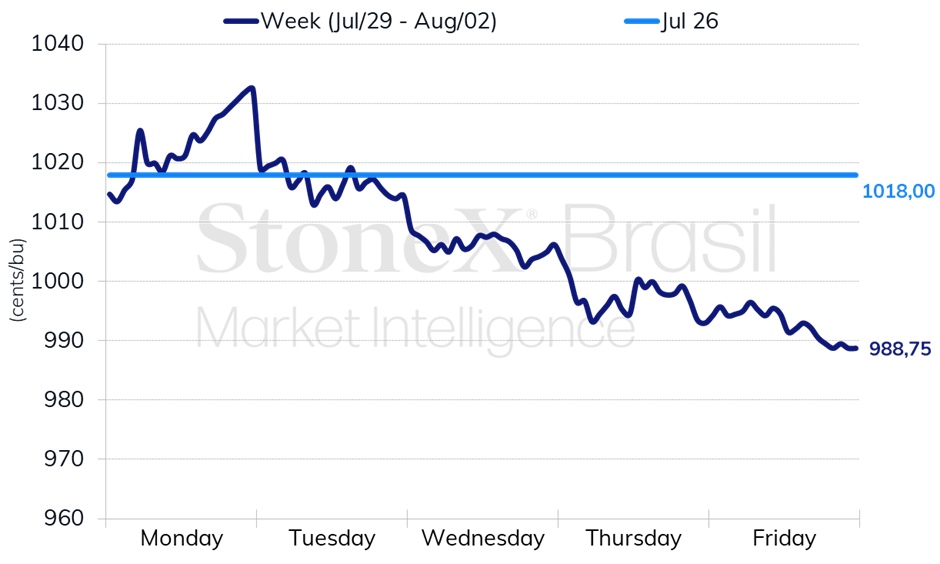
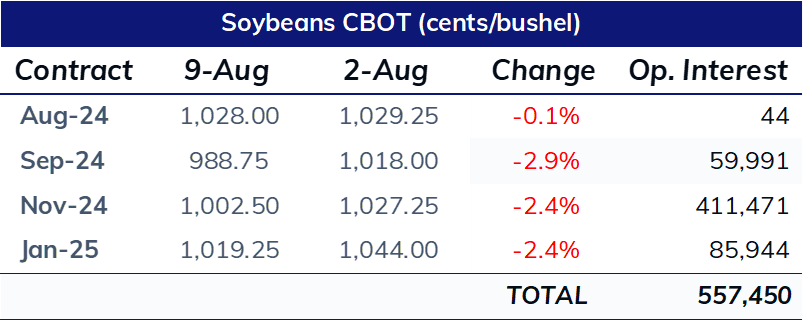
Soybean quotes in Chicago posted a significant decline last week, with the September contract ending Friday (9) at 988.75 cents per bushel, a 2.9% decrease in the period.
The good outlook for the US crop and concerns about the pace of Chinese demand continue to weigh on the evolution of oilseed prices.
The conditions of American soybean 24/25 remain favorable. The latest USDA report, as of 08/04, indicated 68% of crops in good or excellent conditions, an increase of 1 percentage point compared to the previous release, when a slight drop was expected. The five-year average for the same period was 60%. Thus, this high percentage at a time when the soybean is in its critical phase, grain filling, tends to be related to high yields, with the national average potentially exceeding the trend. StoneX, for example, in its August survey, indicated an average yield for the 24/25 American soybean crop at 3.54 tonnes per hectare, a level that, if confirmed, would be a record.
In addition, weather conditions, without major threats, reinforce the scenario of a full harvest. Last weekend was drier in the Midwest, but soil moisture is still adequate in most areas, bringing no relevant threats. This week, more widespread rains are expected in practically the entire producing region, increasing moisture and contributing to the development of crops. Starting next weekend, the weather should become drier again, especially in the west of the belt, but no major stress is expected for the plants. Furthermore, the milder temperatures help to minimize the potential impacts of a drier climate.
With that, the expectations for the USDA report, which will be released this Monday (12) are high as the August update usually revises productivity already considering field information. Additionally, there could be some area adjustment, based on information shared by producers with the USDA. Anyway, if there is any change in the acreage, it is not expected to be relevant enough to alter the scenario of a robust crop for the country.
On the demand side, the pace of the Chinese economy remains on the radar, even with the recent stimulus measures announced by the government. The country's imports have been strong in recent months, but expectations point to the building of stocks, as there is no bet on a more active behavior of the country's feed market. Brazil is the preferred origin for Chinese imports, but currently, with the reduced availability of the national oilseed, the Brazilian product for China is no longer proving to be more competitive than the American one, which is usual for this inter-crop period here.
In July, Brazil exported 11.2 million tonnes of soybean, a volume higher than the same month last year. With this, the accumulated total since the beginning of January reached 75.4 million tonnes, still above the level recorded in the first seven months of 2023, but it is expected to forfeit strength, as the 23/24 crop was smaller and there is greater competition with Argentina, for example.
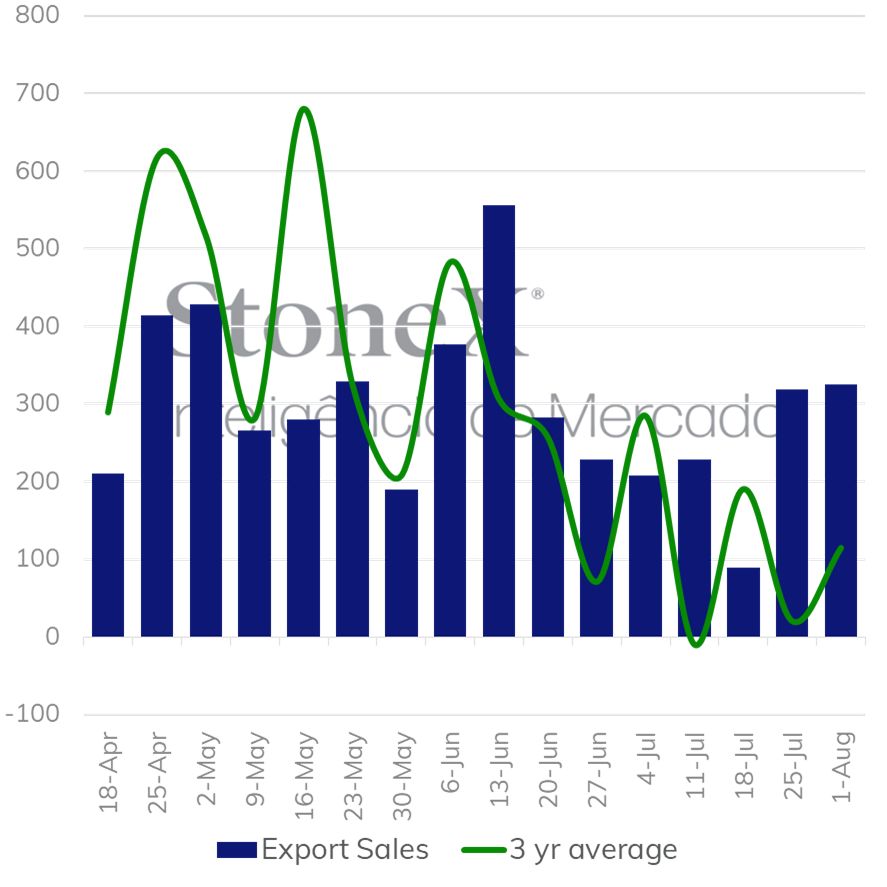
In the US, export sales in the week ended on 08/01 reached 325.45 thousand tonnes, a volume above the top end of expectations, between 100 and 300 thousand tonnes, bringing the total for the crop year 23/24 to 45.8 million tonnes, maintaining the pace on track to reach the USDA's export estimate of 46.3 million.
It is worth noting that despite the bearish trend in soybean quotes, domestic consumption in the US is also closely monitored, following the recent years of significant investment in renewable diesel production capacity. News that the Environmental Protection Agency of the USA (EPA) would continue investigating suspicions of fraud in feedstocks, such as UCO (used cooking oil) coming from China, supported soybean oil. There are reports that the product is being mixed with virgin palm oil to obtain subsidies for biofuels. The volume of UCO entering the USA would surpass the available supply.
Another point of attention in the soybean market is the strike of workers in the oilseed industries in Argentina, demanding salary adjustments, given the very high inflation scenario in the country. The strikes are already going to complete a week, creating concerns about impacts on Argentine shipments.
Even so, the soybean quotes on the CBOT started the week in negative territory, awaiting the USDA report, with bets that today's revisions may further reinforce the positive outlook for the 24/25 US crop.




