- Bearish Factors
- Global production for 24/25 exceeds consumption, according to USDA;
- USDA maintains high productivity in its September estimates review;
- Concerns about the pace of global demand;
- StoneX estimates record production for the 24/25 Brazilian crop;
- Favorable crop conditions in the US;
- US cumulative export sales for the 24/25 crop remain below the previous cycle.
- Bullish Factors
- Incentive measures adopted by the Chinese government;
- Funds with large short positions;
- Strong crush demand in the US;
- Conversion of plants for renewable diesel in California;
- US considers limiting the import of used cooking oil (UCO);
- Prospects for the start of the Fed's interest rate cut cycle.
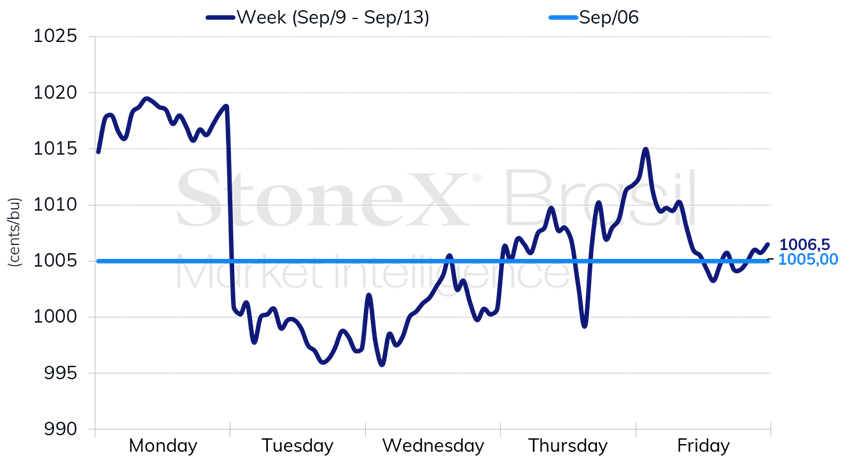
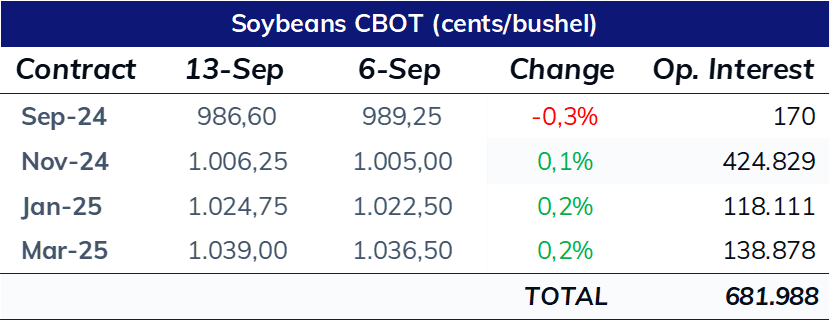
Soybean prices ended near stability last week on the Chicago Board of Trade, with the market remaining under pressure, mainly influenced by the outlook for a comfortable supply and demand balance for the 2024/25 season, following a USDA WASDE report without significant changes. The November contract closed on Friday at 1006 cents per bushel, a slight gain of 0.1% for the week.
Regarding the USDA estimate update last Thursday (12), the highest expectations were related to productivity, as it was the first report in which the Department would provide updates based on field research. However, the soybean complex saw no major changes, with the supply and demand balance remaining comfortable. US soybean yield remained unchanged, with the 2024/25 US production estimate seeing a marginal reduction from 124.89 to 124.81 million tonnes, with a 1.8% downward adjustment in ending stocks to 14.87 million tonnes. Nonetheless, stocks are still 61% higher than the estimate for 2023/24. Globally, production saw a slight 0.1% upward adjustment while ending stocks and the stock-to-use ratio for soybeans were both adjusted up by 0.2%.
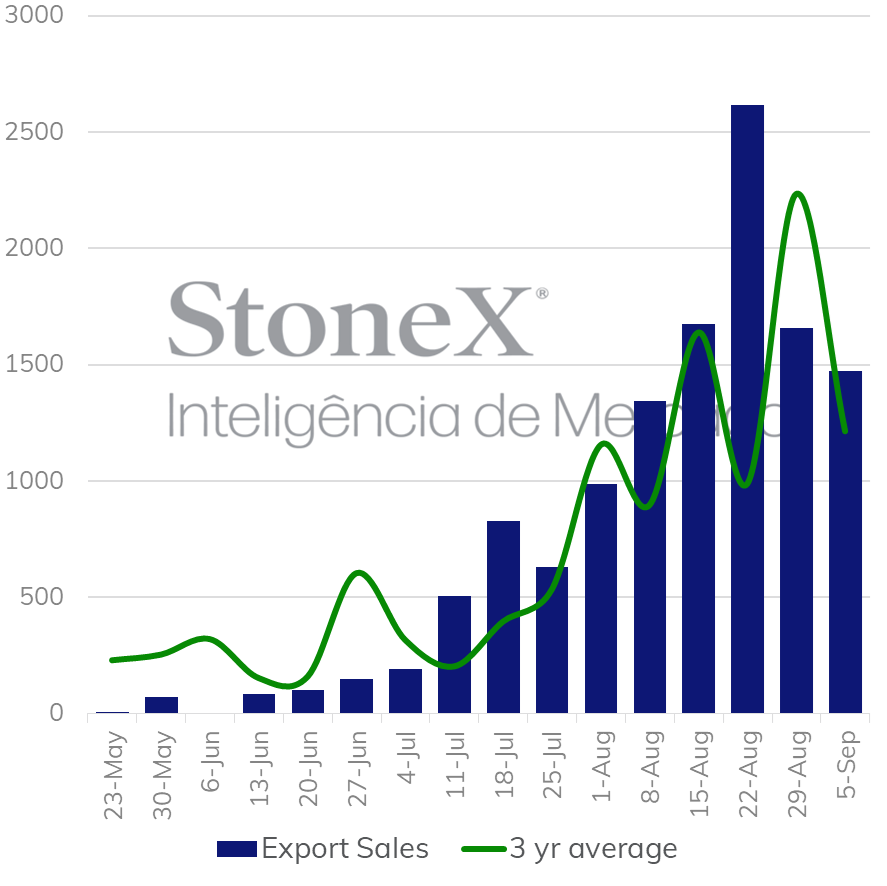
On the demand side, export sales for the 24/25 crop in the week ending on 09/05 totaled 1.474 million tonnes, within the estimated range between 900 thousand and 1.6 million tonnes, and above the three-year average for the period of 1.2 million. Accumulated, the crop totals 15.4 million tonnes, still below the previous crop, which stood at 16.7 million tonnes for the same period.
Meanwhile, in Brazil, traders continue to monitor low moisture levels and high temperatures, which have hampered the early planting of soybeans. So far, only small areas in the states of Paraná and Mato Grosso have been planted, with a delay compared to the same period last year. It is worth noting that current rain forecast models point to some precipitation in producing regions later this month. However, rains are still expected to be irregular, which could raise concerns in some areas of the Center-West and Northeast.
At the beginning of this week, traders are likely to react to US soybean crushing data from the National Oilseed Processors Association (NOPA), released early this Monday afternoon (16). The association reported a crush of 4.3 million tonnes, a decrease of 13.6% compared to July and 2.1% from August 2023, when 4.394 million tonnes were crushed. The result was significantly below the median estimates, which projected a crush of 4.663 million tonnes. Soybean oil stocks were recorded at 516 thousand tonnes, a sharp drop of 24.1% from the previous month and 9.0% compared to August 2023. This result was also below agent estimates, which had projected 615 thousand tonnes.
A reduction in crushing pace was seasonally expected for this time of year, as the crop is nearing its end, with smaller volumes available, and part of the crushers enters maintenance in preparation for the next cycle, starting in October. However, the result shows a weaker-than-expected demand from the industry. It is also worth noting that the weak crush combined with low stocks provides some support for soybean oil prices. On the other hand, with the arrival of the new crop and the recent expansion of the US crushing capacity, it is expected that significantly larger volumes of soybeans will be processed in the US in the last quarter of the year.
Moreover, the macroeconomic scenario is expected to have a significant influence amid the Federal Reserve's monetary policy decision, with expectations that the US central bank will reduce its benchmark interest rate for the first time since March 2020. However, there are uncertainties about whether the cut will be 25 or 50 basis points. As analyzed in the last FX Weekly Report, by the end of last week, a 25-basis point cut seemed more likely, as recent indicators point to a gradually slowing US economy, not a sharp and intense slowdown. This Monday, after some statements from monetary authorities about the possibility of a more significant initial cut, 59% of bets are for a 0.50 percentage point reduction, while 41% are betting on a smaller cut. If confirmed, the reduction could provide some support to the commodity complex in general. Additionally, the release of the Fed members' quarterly projections for the main US economic variables will be important, serving as a guide for expectations regarding the Fed's next steps.