- Bearish Factors
- World production 24/25 increases the difference compared to consumption, according to USDA;
- Record production estimate for the US;
- Concerns about the pace of global demand;
- StoneX estimates record production for the Brazilian 24/25 crop;
- Harvest period in the US;
- Accumulated export sales for the 24/25 crop are weaker than necessary.
- Bullish Factors
- New incentive measures adopted by the Chinese government;
- Funds shortcovering;
- Conversion of plants to renewable diesel in California;
- US considering limiting the import of used cooking oil (UCO);
- Dry weather in Brazil delays the start of planting;
- Start of the Fed's interest rate cut cycle.
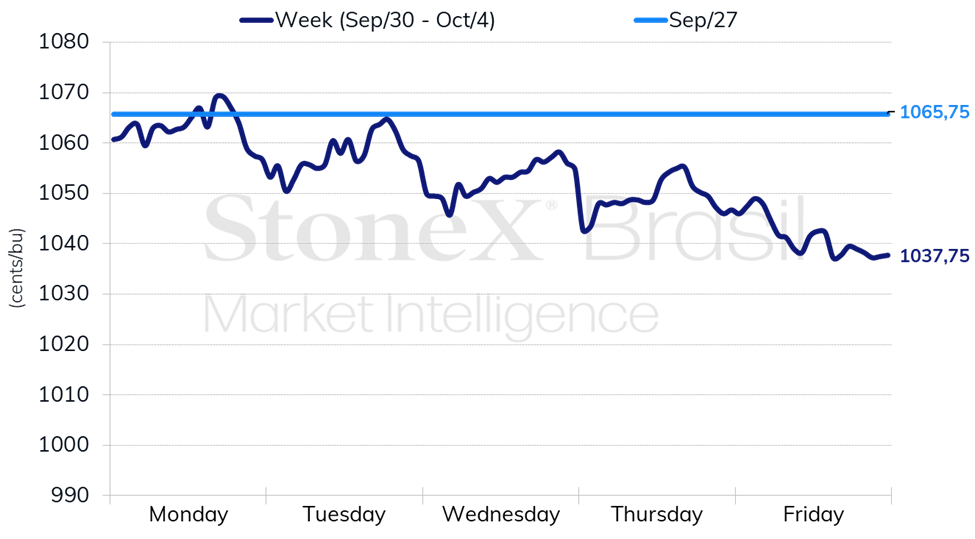
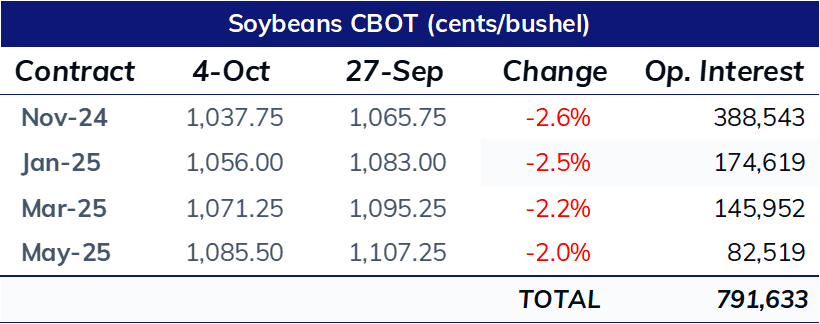
Soybean prices in Chicago fell last week, following recent significant gains, as the market monitored the progress of the South American crop, as well as new developments on the demand side. November futures ended Friday (4) at 1037.75 cents per bushel, down 2.6% for the period.
At the beginning of the week, the USDA released US stocks as of 9/1, which corresponds to the ending stocks of the 23/24 crop. The result of 9.31 million tonnes was very close to the USDA's latest estimate, at 9.55 million, bringing no major surprises to the market and keeping the supply and demand balance more comfortable.
The harvest of the 24/25 US crop reached 26% of the total on 9/29, an advance of 13 percentage points in one week, remaining above the five-year average of 18% and also higher than the same period last year, when it reached 20%. Prospects remain very positive, with the outcome heading towards a record. The percentage of crops rated good/excellent stood at 64%, against a five-year average of 57%.
StoneX updated its estimate for the US crop through a productivity survey, considering the USDA's official area. The national average yield stood at 3.6 tons per hectare, a record level and higher than the USDA's official estimate of 3.58. With this yield of 3.6 tonnes per hectare, production would reach 125.55 million tonnes, the highest volume ever recorded.
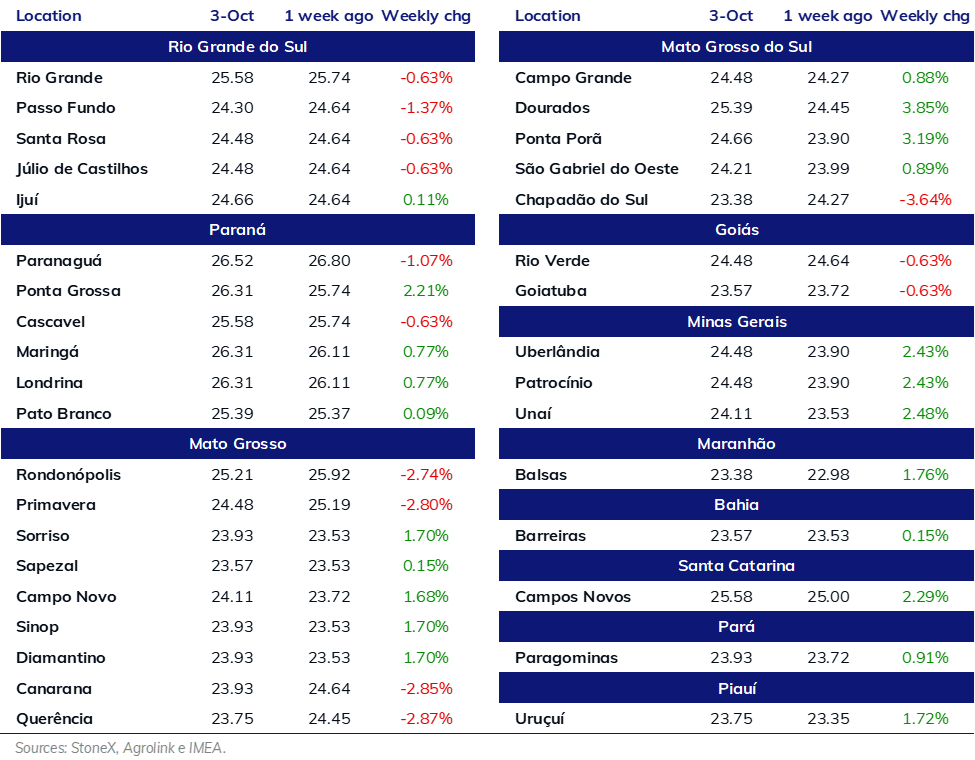
Regardless of the final number of the US crop, all indications point to a record level being confirmed, with attention on the supply side increasingly focused on the South American crop. According to StoneX Brazil's monitoring, as of Friday (October 4), sowing in Brazil had reached 5.3% of the total, compared to 10.1% in the same period last year. There is a notable delay in Mato Grosso, where planting reached 2.3%, against 15.3% in the same period last year. Last week, rains were still more concentrated in the South and North of the country, but forecasts are more favorable for the next 15 days, indicating more widespread rains across much of the soybean-producing region.
Therefore, while these weather issues have offered support to prices in the recent period, it is still too early to estimate any damage, as even with delays, if the weather remains normal during the crop development, the crop can still be bountiful. Thus, StoneX updated its estimate for the Brazilian 24/25 crop, maintaining the expected production at 165 million tonnes. In the next update, at the beginning of November, if the weather does not align more closely with the usual for this time of year, concerns about possible losses will begin to increase.
On the demand side, the market is monitoring the US biofuel sector, with measures that could limit the use of soybean oil on the radar, despite the current moment being favorable. As previously signaled, the country's crushing in August reached 4.56 million tonnes, 13.3% less than last month, and 0.9% compared to the same month in 2023. As a result, oil stocks also fell, to 547 thousand tonnes.
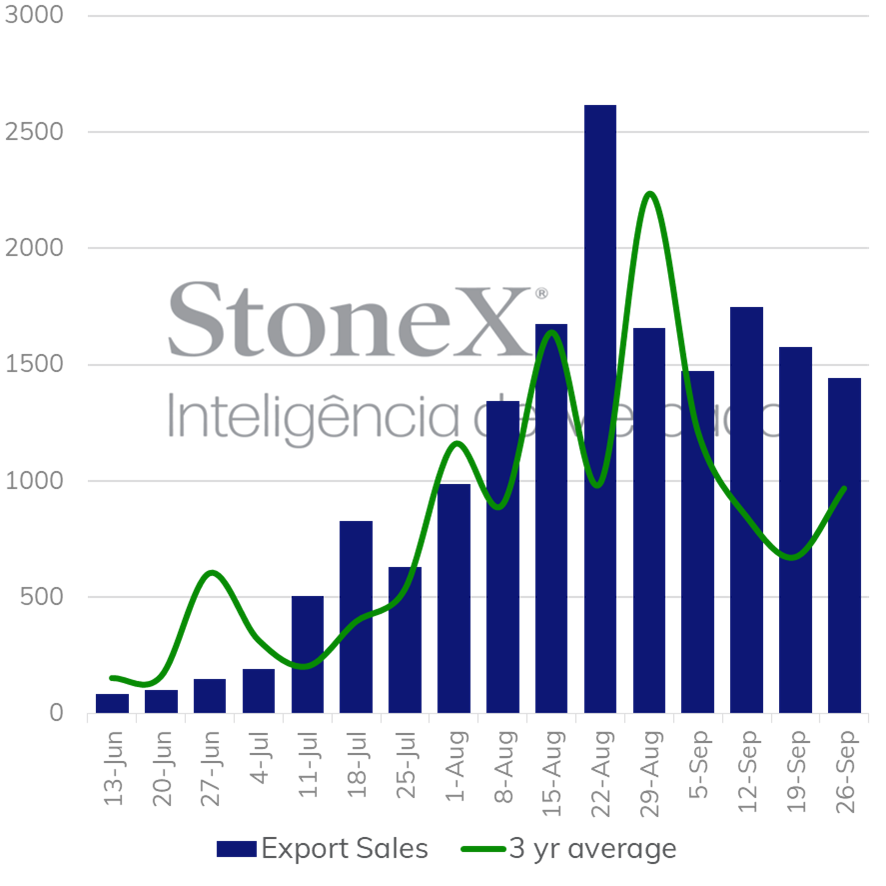
US export sales for the 24/25 crop reached 1.4 million tonnes in the week ending 9/26, a level within the range of estimates, which ranged from 1 to 1.6 million tonnes. Of this total, China was responsible for 730 thousand tonnes, with the accumulated sales to the country being 500 thousand tons below what was recorded in the same period of the previous year. Meanwhile, total US sales are at 18.9 million tonnes, slightly above what was recorded last year, at 18.4 million, but noting that the USDA estimates an increase in shipments in the 24/25 crop year. Thus, the accumulated sales so far are about 2 million tonnes below what is needed to reach the export estimate of 50.35 million tonnes.
This week, attention should continue to be focused on the weather here in South America, highlighting that planting in Argentina is approaching its start period, with the weather also being monitored there. On Friday (11), the always-anticipated USDA monthly supply and demand report will be released. Typically, the October release does not tend to bring major surprises for US crop production, but changes in other players and also on the demand side can always occur.