- Bearish factors
- Global production for 24/25 expands difference from consumption, according to USDA;
- Record production estimate for the US;
- Concerns regarding the pace of global demand;
- StoneX estimates record production for Brazil's 24/25 crop;
- Harvest period in the US;
- More widespread rainfall with good volumes in Brazil.
- Bullish factors
- New incentive measures adopted by the Chinese government;
- Speculative funds with a net short position;
- Conversion of plants to renewable diesel in California;
- Strong soybean crushing in the US in September;
- Start of the Fed's interest rate cut cycle.
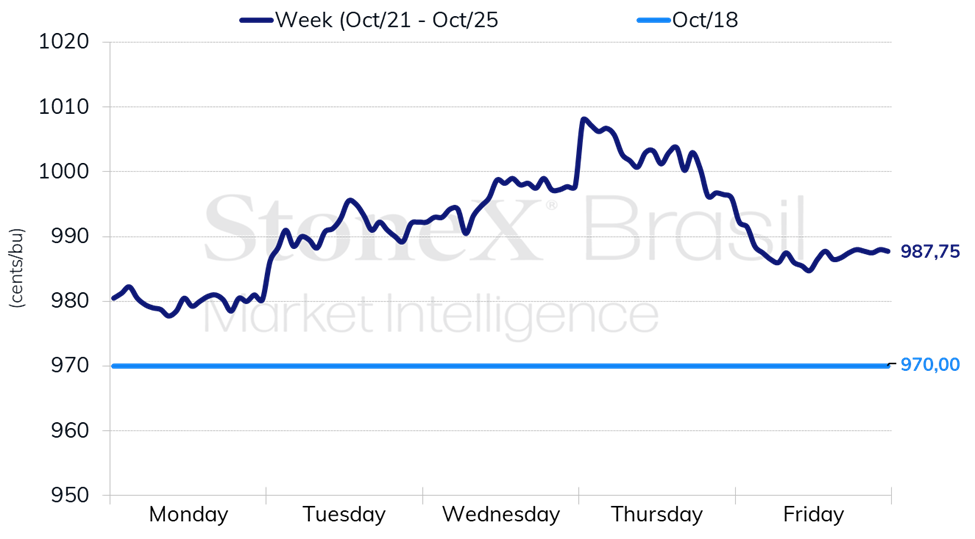
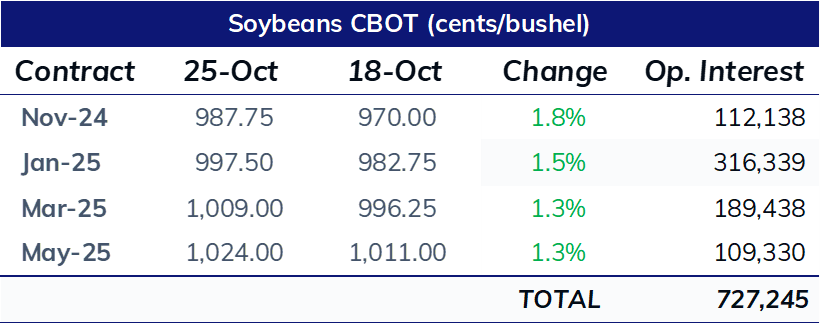
Soybean prices in Chicago posted gains this week, with November futures closing on Friday (25) at 987.75 cents per bushel, up 1.8% for the period. It’s worth noting that adjustments and positions near the contract's expiration, along with SXSF spread trades, influenced the price over the week. However, the market continues to monitor the US harvest and Brazil's fast planting pace, following the return of rains, which limits upward movement due to a lack of major fundamental changes.
In the week ending October 20, the US soybean harvest reached 81% completion, above last year's 72% and the five-year average of 67%. While soybean availability increases domestically, consumption is also expected to grow through exports and crushing.
Even so, while demand remains on the radar, it’s supply that could lead to more significant market movements, as weather can result in substantial production variations. Recent concerns over dry weather in Brazil led to specs shortcovering , but the movement has already cooled, with traders returning to a bearish stance. As of October 22, speculative funds in soybeans on the CBOT showed a net short position of 59.6 thousand contracts, an increase of 19.2 thousand contracts compared to the previous report. This marked the second consecutive week of increased net short positioning following a period of covering.
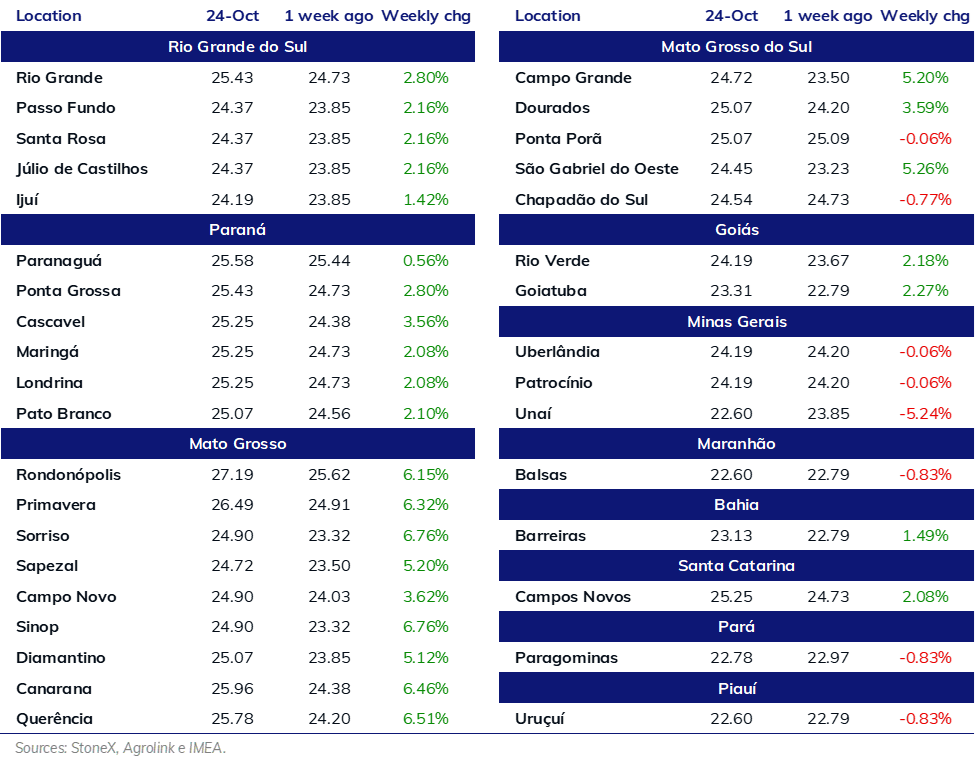
In Brazil, according to StoneX's follow-up, soybean planting for 24/25 reached 41.5% of the total area on October 25, up 18.3 percentage points in one week, approaching last year's pace of 43.2%. All states monitored by StoneX have now started soybean seeding. Forecasts for the next 14 days continue to indicate rain across almost all of Brazil's soybean-producing regions, which should help maintain the fast pace of fieldwork.
In Argentina, soybean planting has not yet been reported, but last week's rains were deemed very favorable for soil moisture replenishment after a drier period in some areas. This should allow fieldwork to start soon, with the Buenos Aires Grain Exchange estimating a 24/25 production of 52 million tonnes.
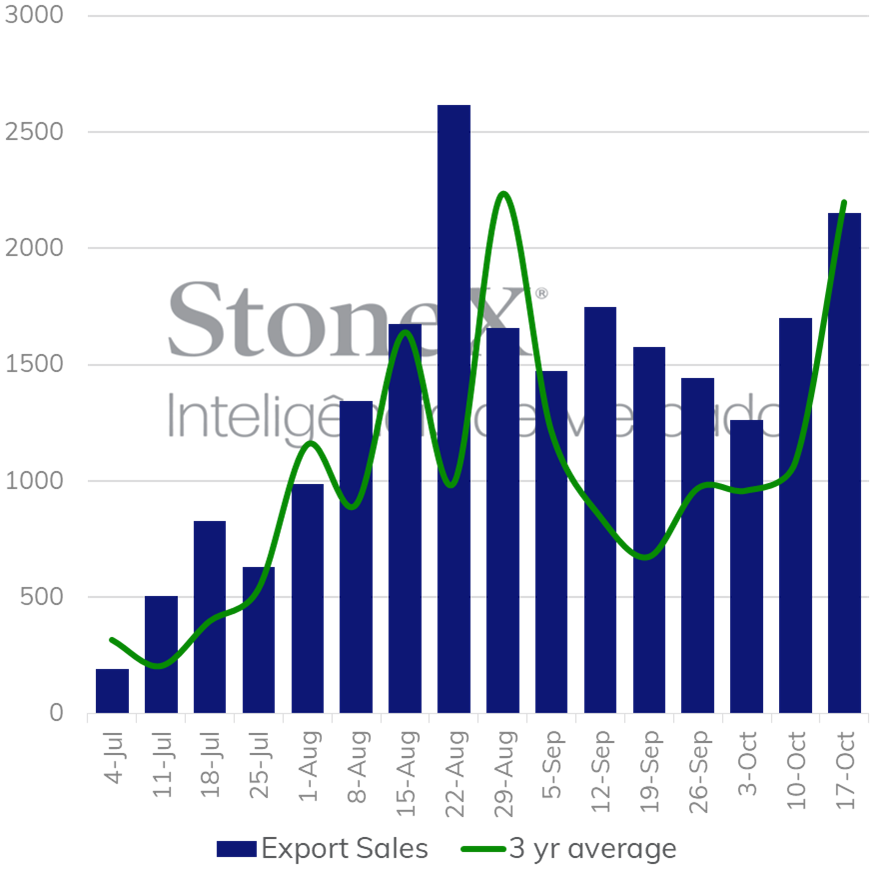
On the demand side, much attention is on Chinese behavior and US soybean sales as the harvest progresses. China's recent economic stimulus measures were well-received by the market, but the impact on meat consumption and, consequently, on feed demand remains to be seen. US soybean sales to China remain below last year, totaling 600 thousand tonnes, with China having purchased 1.3 million tonnes of soybeans from the US in the week ending October 17. Total export sales for the 24/25 season reached 2.15 million tonnes for the week, at the high end of estimates, which ranged from 1 to 2.2 million tonnes.
This week, attention is expected to remain on Brazil's crop and the start of Argentina’s season. In the US, the Mississippi River levels are monitored, as they affect the competitiveness of US grains, but forecasts for the next ten days indicate a return of rain with higher volumes in the central region, which should help restore levels along the waterway.
Additionally, important macroeconomic data will be released in the coming days, such as US GDP. Another point of attention is the ongoing conflict in the Middle East.