- Bearish factors
- Global 24/25 production exceeds consumption, according to the USDA;
- US supply and demand balance remains unstrained;
- Concerns over the pace of global demand;
- Record production estimate for the Brazilian 24/25 crop;
- Rainfall in Argentina;
- Doubts about subsidies for biofuels in the US.
- Bullish factors
- New incentive measures adopted by the Chinese government;
- Short covering by funds;
- Reduction in US production for 24/25;
- Loss of potential in the Argentine crop.
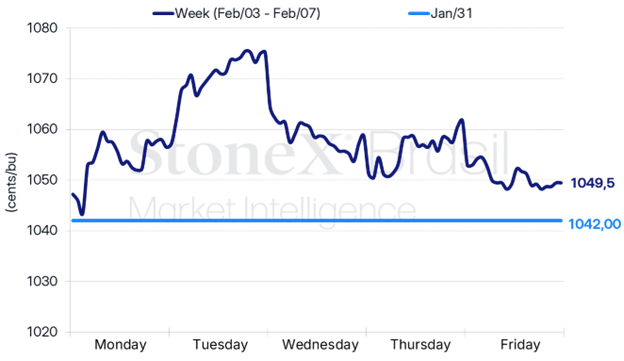
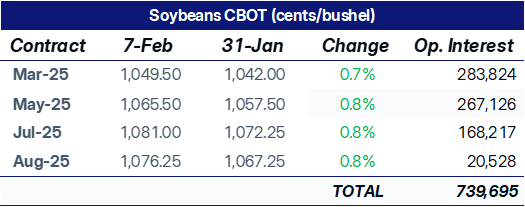
Last week, soybean prices continued oscillating, with the March contract closing the period at 1049.5 cents per bushel, up 0.7% for the period.
The market continues monitoring the development of the South American crop and the measures taken by Trump's second term in the US. Last week, after the US announced tariffs on Mexico, Canada, and China—justified by migration issues and the influx of opioids into US territory—neighboring countries managed to postpone the implementation of the tariffs by 30 days, alongside reinforcing measures to curb migration to the US. Meanwhile, China took retaliatory measures effective from January 10, implementing a 15% tariff on coal and liquefied natural gas products, 10% on crude oil, agricultural machinery, pickup trucks, and some luxury cars, as well as export restrictions on certain critical minerals for the high-tech industry.
Although agricultural products are not covered, at least for now, concerns about a possible escalation of trade tensions between the two countries persist. During Trump's first term, China taxed US soybeans at 25%, which pressured US oilseed prices—harming competitiveness—and reduced the country's exports, with Brazil further reinforcing its role as a supplier to China. In any case, for now, any measure between the two countries that directly impacts the soybean market remains speculative.
Currently, expectations are that Brazilian exports will gain strength as the crop advances, and that Brazilian soy for China remains more competitive than its US counterpart. Shipment lineup data already indicate considerable export volumes of the oilseed from Brazil in February.
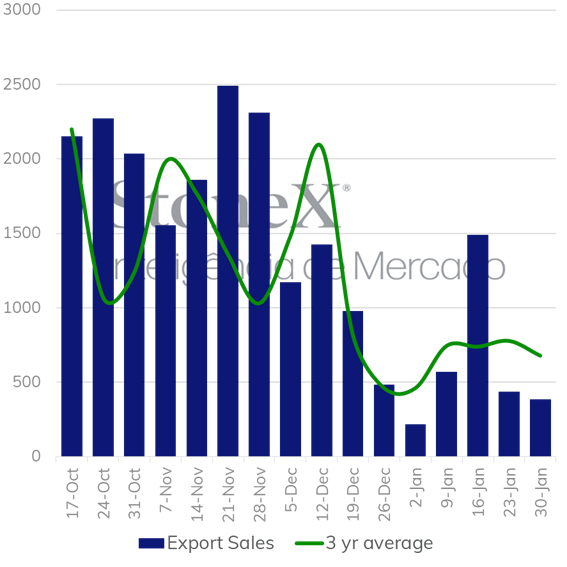
In the US, export sales for the 24/25 crop in the week ending on January 30 reached 387.7 thousand tonnes, a volume closer to the lower bound of estimates—ranging from 300 thousand to 1.1 million tonnes—bringing the cumulative volume to just over 43 million tonnes. Nevertheless, the pace of trades is more than sufficient to reach the US export estimate, according to the USDA, of 49.7 million tonnes.
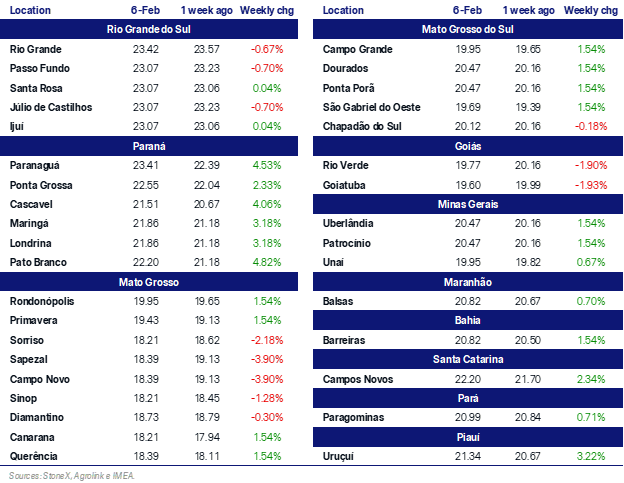
Regarding the South American crop, in Brazil—as mentioned in last week’s report—StoneX is estimating soybean production at 170.9 million tonnes, even with losses in Rio Grande do Sul due to drought. Other states, such as Mato Grosso and Goiás, have very positive prospects, justifying the maintenance of a record estimate. It is noteworthy that other private estimates also indicate a similar scenario, with bets on a robust outcome, even with the drought that affected the southernmost region of the country.
In Argentina, last week’s rainfall was very positive, mitigating the impacts of drought on the country’s crop potential. The percentage of fields in normal or excellent condition still showed a weekly drop, according to the Buenos Aires Stock Exchange, to 67%, but the rainfall improved soil moisture conditions, with the adequate/optimal percentage rising by 6 percentage points to 64%. The Rosario Stock Exchange also highlighted the good rainfall volumes in the country, which occurred at a critical time for part of the plants, limiting losses. Thus, even if a reduction in the Argentine crop is expected compared to initial estimates, the result could still be close to 50 million tonnes, bearing in mind that the weather remains on the radar.
Forecasts for the next two weeks indicate rainfall concentrated further north (including Mato Grosso) and in the south of the country, with the Southeast, parts of the Center-West, and Northeast expected to record less significant volumes. It is noteworthy that this rainfall should not be too excessive in the main soybean-producing regions and will be very welcome in Rio Grande do Sul, which has a later production cycle.
This week, the monthly reports from the USDA and Conab will be released, which are highly anticipated by the market, with both institutions estimating the Brazilian crop to be below 170 million tonnes in their latest releases.
Furthermore, the measures taken by the Trump administration continue to be on the radar, highlighting the possible announcement of a 25% tariff on imports of steel and aluminum, with Brazil being one of the most affected. Consequently, the behavior of the dollar exchange rate is being closely monitored.