- Bearish Factors
- Global production for 24/25 exceeds consumption, according to the USDA;
- U.S. supply-demand balance still not tight;
- Concerns over the pace of global demand;
- Record production estimate for the Brazilian 24/25 crop;
- Improvement in crop conditions in Argentina;
- China imposes a 10% tariff on U.S. soybeans.
- Bullish Factors
- New incentive measures adopted by the Chinese government;
- Hot and dry weather in parts of South America;
- Estimated reduction in planted area for the U.S. 25/26 crop;
- Loss of potential in the Argentine harvest;
- StoneX lowers the Brazilian crop forecast to below 170 million tonnes.
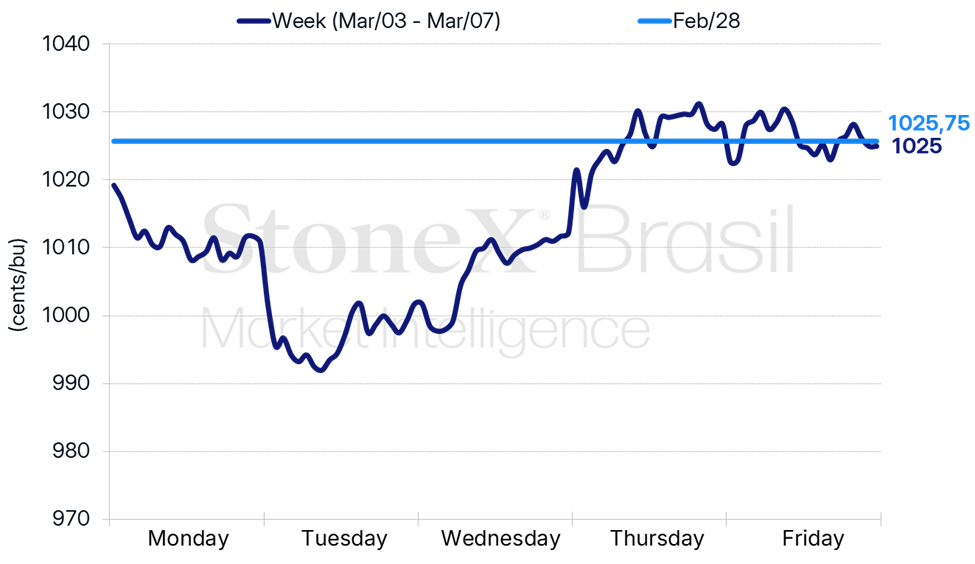
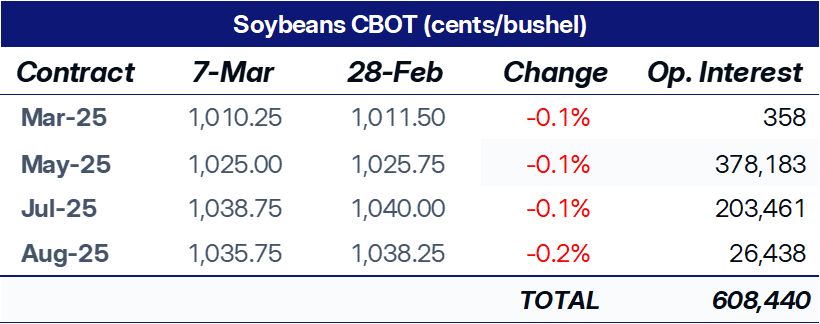
Soybean quotes in Chicago ended the first week of March virtually unchanged after being pressured by geopolitical issues throughout the period. The May contract closed on Friday (the 7th) at 1025 cents per bushel—almost the same as the previous week’s close, which was 1025.75 cents per bushel.
The confirmation that the tariffs announced by the Trump administration on Mexico, Canada, and China would be implemented triggered responses from those countries through the announcement of retaliatory measures. This context ended up weighing on commodity prices, which are considered riskier assets.
In the case of soybeans, China announced a 10% tariff, effective from March 10th. Although this percentage is lower compared to the 25% applied during Trump’s first term, the competitiveness of U.S. soybeans is likely to be impaired. As a result, Brazilian soybeans may see reinforced demand—especially considering that Brazil already exports over 100 million tonnes to various destinations in favorable harvest years, as is expected for the 24/25 cycle.
However, it is important to note that even though demand for Brazilian soybeans is expected to increase in this tariff-war context (with premiums sustained at local ports), China has been reducing its dependence on the U.S. product over recent years, and this new round of trade tensions is expected to have a smaller overall impact on the soybean market. Additionally, the Asian country has been making efforts to reduce the protein content in animal feed, which directly affects soybean meal.
In any case, if China purchases even more Brazilian soybeans, other destinations might shift towards the U.S. market, leading to a reorganization of the international flows of the oilseed rather than necessarily creating a large surplus of U.S. soybeans. In other words, there wouldn’t be a shortage of soy for other markets if China buys more of the Brazilian grain; at least initially, this change in global flows would tend to favor the Brazilian product, resulting in higher demand for it.
It is noteworthy that throughout last week, there were discussions among the countries involved in the tariff measures, and Mexico and Canada were granted an additional month, with the implementation of their tariffs postponed until April 2nd. In the case of China, no concessions were made by either side, and for now, the 10% tariff on U.S. soybeans remains in effect.
Even so, after the initial impact of these heightened trade tensions, soybean prices recovered their losses, reflecting a scenario in which demand for U.S. soybeans is not necessarily going to falter, but rather that the global flows of the oilseed are being reorganized. Moreover, it is important to remember that between 2018 and 2019, China was hit by African swine fever—which reduced its pig herd by nearly half and consequently lowered global soybean demand. Currently, the context is different, and global demand for soybeans is expected to continue growing annually as the population increases and protein consumption rises.
The South American harvest also remains on the radar, with expectations of robust production despite some loss in yield potential due to weather conditions.
In Brazil, as highlighted in last week’s report, estimates point to a record crop, with StoneX’s latest figure at 168.3 million tonnes. Even though this volume is lower than the initial potential—mainly due to a downturn in Rio Grande do Sul—it would still represent a 12.1% year-on-year growth.
In Argentina, following the recent improvement in weather—with higher precipitation levels—harvest estimates have stabilized around 49 million tonnes, with the Buenos Aires Exchange indicating further improvements in crop conditions, with the percentage of “good to excellent” rising from 24% to 29%. Hydrological conditions have also improved, with the percentage of crops still facing drought conditions falling from 31% to 21%.
Over the coming weeks, as the harvest advances, the total size of the Brazilian crop will become increasingly clear; as of last Friday, StoneX reported that 60.1% of the fields had been harvested. In Argentina, the harvest is still ahead, with the weather remaining a key factor. Forecasts for the next two weeks indicate lighter rainfall in Argentina, while in Brazil the arrival of a cold front is expected to bring precipitation to the central region along with a drop in temperatures.
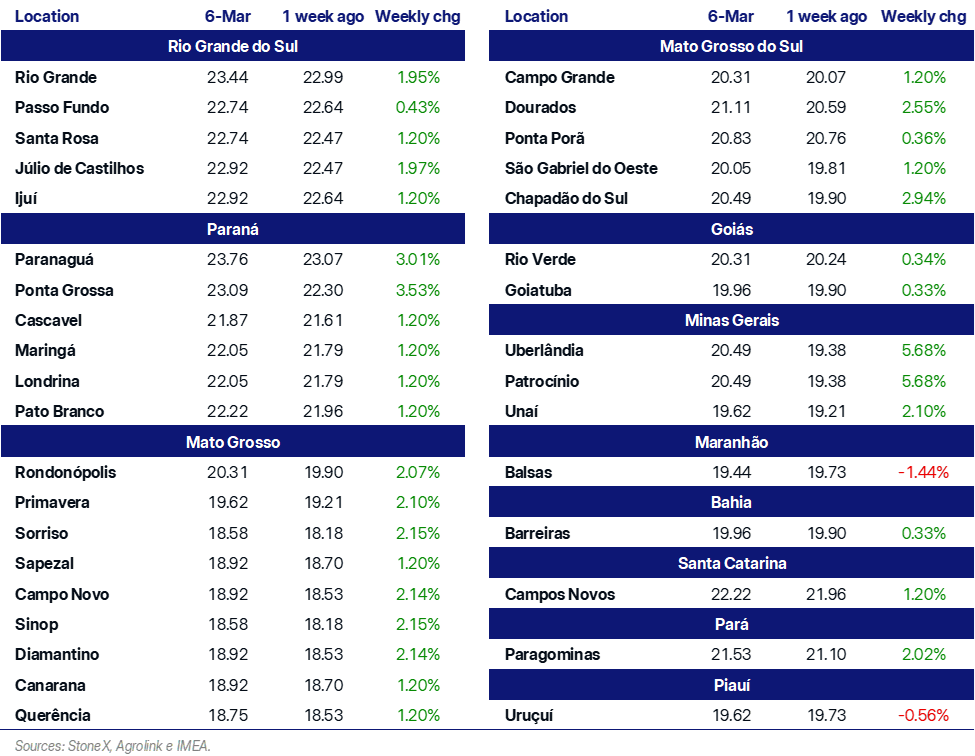
This week, special attention is drawn to the monthly reports from the USDA and Conab. The March release from the U.S. Department of Agriculture is not expected to bring major surprises, although changes in the South American harvest may occur.