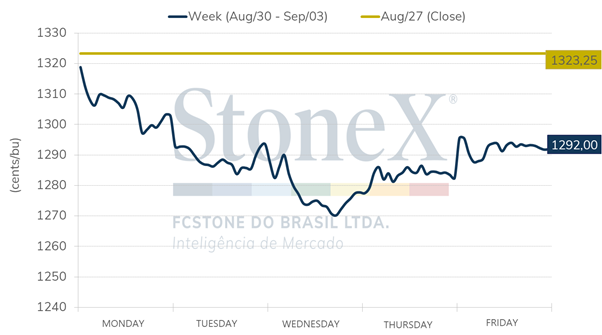
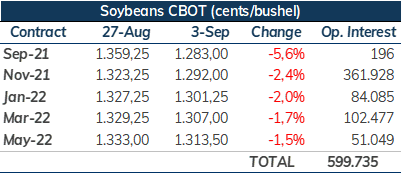
Soybean quotes in Chicago started last week with a sharp drop as the SUSX spread plummeted, in addition to positive expectations for the US crop.
Good rainfall in the west-most region of the belt, which is the one that has suffered most from dry conditions, fuels the possibility of productivity gains for the 2021/22 US crop.
On the demand side, the USDA reported sales of new crop soybean to China in a volume of 256,000 tonnes. Even so, sales still need to pick up in order to reach the pace observed one year earlier.
Export inspections in the week ended in August 26 stood at 377,000 tonnes, with accumulated shipments reaching 60.3 million tonnes, over 1 million tonnes short of the USDA estimate at 61.5 million tonnes, and with only five days left until the end of the 2020/21 crop year. With this, this exports estimate will not likely be reached, impacting ending stocks.
Late in the afternoon, the USDA crop follow-up report kept US crops’ good/excellent conditions unchanged at 56%, 9 points below the average for the period. It is noteworthy that improved conditions in Illinois and North Dakota were sufficient to compensate for losses in several other states.
Weekly Intraday - November/21 (CME)
Source: CME. Design: StoneX.
Source: CME. Design: StoneX.
On Tuesday, soybean remained in the negative field, with a wetter weather in the northwest of the US producing region weighing on prices, as well as the movement in the crude oil market and concerns about the impacts of hurricane Ida on port facilities in the Gulf region.
The market also monitors purchases of US soybean by China, which are weaker, with fears that the record crop in Brazil may negatively impact the volumes traded between the two countries. It should be pointed out that the best export period of US soybean is the last quarter of the year, soon after harvest.
Wednesday was a continuation of the downward movement of quotes, with the market monitoring hurricane Ida and the possibility of reduced interest in US exports through the Gulf region. It is noteworthy that no US sales to China were reported on the day.
Moreover, weather forecasts continued to indicate good rainfall for the western-most region of the US grain belt.
On Thursday, soybean closed again in the positive field, but with small gains, after news that a large refinery in the US would invest in renewable diesel together with a large soybean crusher. It is noteworthy that the conversion of crude oil refineries to renewable diesel is not a new fact in the US. Some refineries have already been going through this process in recent years.
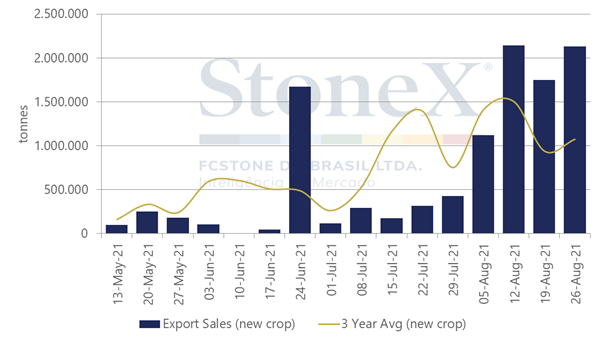
US export sales in the week ending August 26 reached 68,200 tonnes for 2020/21, falling within estimates, and 2.1 million tonnes for 2021/22, exceeding the upper end of estimates, which ranged from 725,000 to 1.4 million tonnes. Even with this positive result for the new crop, the accumulated figure is still about 6.5 million tonnes below the same period in 2020, with 5 million tonnes less to China alone.
Late in the afternoon, StoneX released its US crop estimate, showing an increase in average productivity to 3.42 tonnes per hectare, which led to a production rise to 120 million tonnes.
Weekly US export sales - 2021/22
Source: USDA. Design: StoneX.
On Friday, prices closed slightly higher again, with the market monitoring sales that would be shipped out of the central Gulf region. The USDA announced sales of 163,000 tonnes of 2021/22 soybean to China. However, it should be noted that producer sales in the US are still weaker following the recent price drop.
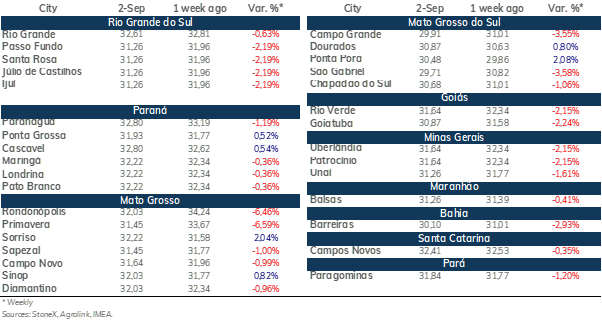
SPOT PRICES (USD/60kg-bag)