Bearish factors
- Record area and production estimate in Brazil;
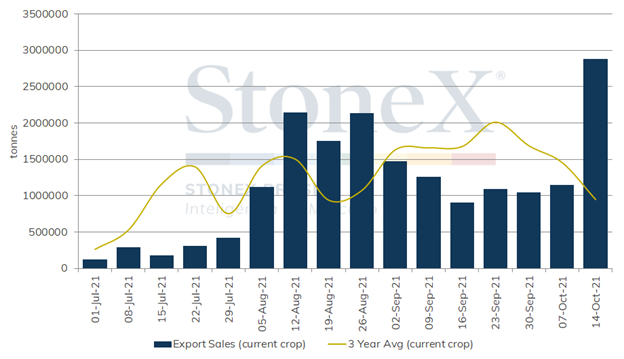
- Sluggish US export sales;
- Even lower shipment in the Gulf region after hurricane Ida;
- Harvest progresses in the US with good production prospects.
Bullish factors
- Possibility of a new La Niña;
- US balance still does not suggest loose stocks;
- Crushing margin in recovery in China;
- Advancing vaccination roll out against Covid-19.
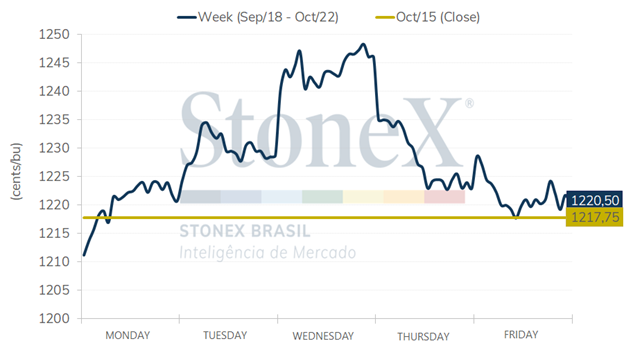
Soybean quotes in Chicago started last week lower, pressured by the low crushing volume in the United States in September. According to NOPA data released on October 15, the country crushed 4.19 million tonnes last month, below the market expectation of 4.22 million tonnes and the 4.32 million registered in August.
However, as soon as in Monday’s session (18), soybean futures began to recover, driven by US export inspections data. According to the USDA, the US shipped just over 2.29 million tonnes of soybean in the week ended October 14, an increase of 31.8% compared to the previous week.
This growth in exports led to a bullish trend after the last few weeks were marked by a low export volume from the US, which is still far behind 2020/21 exports for the same period (5.87 against 11.89 million tonnes). The weekly increase of over 30% brought prospects for a possible recovery. November/21 ended the day with gains worth of 3.75 cents/bushel.
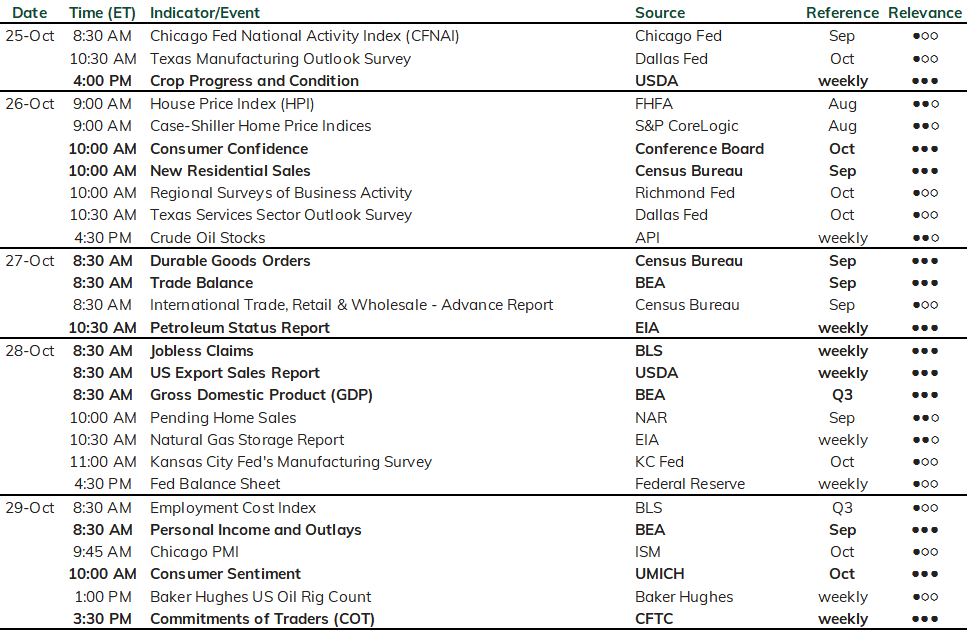
Also on Monday (18), the USDA crop progress report showed that, as of October 17, 60% of the US crop had already been harvested. In the last five years, the harvest rate has been 55% for the same period. In relation to the quality of the harvest, the USDA did not update the weekly figures. The Department stated that, with more than half of the crop already out of the soil, there will be no further meaningful changes to soybean conditions. With this, 59% of the crops in good/excellent conditions is the final data for the 2021/22 crop.
On Tuesday (19), the soybean rally continued. This time, it was driven by the meal price, which rose 1.48% and caused the soybean quote to rise by 6.5 cents/bu.
It is interesting to point out that the soybean market still presents relevant bearish fundamentals, such as the steady advance of the US harvest and the prospects for great production in the US and Brazil. Even so, in mid-week, beans rose higher again, also due to one of its byproducts. On Wednesday (20), it was soybean oil’s turn to support the commodity, which appreciated for the fifth consecutive day, concluding the session with a 17.5 -cent/bu rise.
The reasons for oil gains in Chicago were related to the rally of its main competitors. Crude oil WTI rose to a seven-year high in New York, which was also followed by gains in palm oil in Bursa and a shortage of canola oil in Europe. These factors should continue to boost soybean oil and, therefore, it is possible that in the near future they will again influence soybean prices.
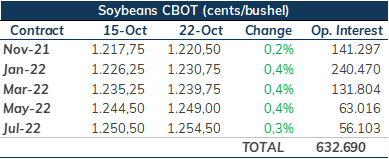
On Thursday (21), soybean futures had a sharp decline, with the November/21 contract in Chicago closing at USD 12.335/bushel, down 21.50 cents/bu. The bearish movement was sustained by losses in the palm oil market, whose prices were pressured by liquidation after anti-speculative comments by the Chinese government and rumors that India could remove palm and soybean oil contracts from MCX, as a way to reduce increases generated by speculative movements.
With regard to US export sales, which had their weekly data disclosed on Thursday, the USDA reported sales of 2.88 million tonnes in the week ended October 14. It is worth noting that problems in the Gulf region continue to reflect on the pace of US exports, especially to China, which has been buying from Brazil at a premium in relation to the US.
On the last day of the week, soybean futures closed the session down. The good weather conditions in South America and the good progress of field work in Brazil contributed to the retreat in the day. According to StoneX’s follow-up, soybean corn planting in Brazil reached 39.2% up to October 22, compared to 24.3% last year. On the CBOT, the November/21 contract closed the session being quoted at USD 12.205/bushel, a slight weekly rise of 0.2% or 2.75 cents/bu.