Bearish drivers
-
World 2022/23 production estimated above consumption;
-
Fighting inflation can generate recession;
-
Possibility of record production in Brazil;
-
COVID-19 rising in China and signs of economic slowdown.
Bullish drivers
-
Weather concerns for the 2022/23 crop in South America, already with production cuts in Brazil;
-
Relaxation of anti COVID measures in China;
-
Delayed soybean planting in Argentina, due to the weather;
-
Increase of mandatory biodiesel blend in Brazil, from April 2023.
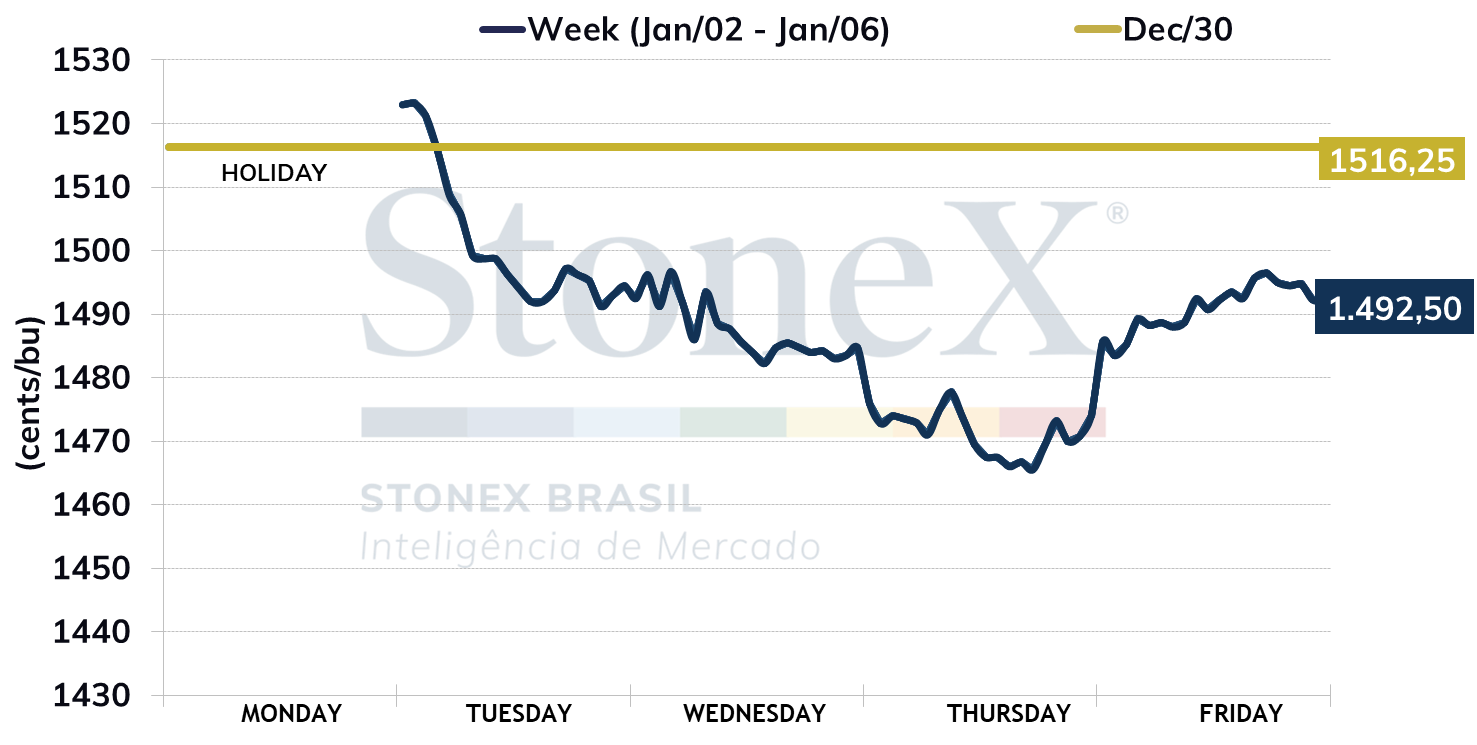
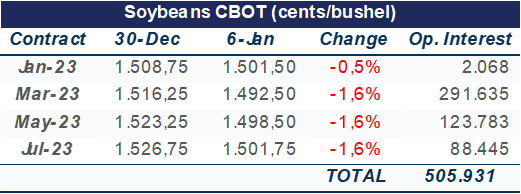
The downward trend predominated for soybean prices in Chicago last week, with the contract for March ending Friday (6) at 1492.5 cents per bushel, although the last trading session of the period had a considerable high.
The first week of 2023 was shorter on the CBOT, with no negotiation on January 2nd. In any case, the crop in South America remains at the center of attention, given the concerns about the weather. In addition, on the demand side, Chinese behavior is also followed, at a time when information about COVID-19 infections generates doubts.
StoneX released its crop estimate on the 3rd, bringing a 0.8% decrease in Brazilian soybean production expected for the 2022/23 cycle. With this, the volume fell from 155 to 153.8 million tonnes, a level that still sets an absolute record. This reduction was mainly conditioned by the negative adjustments made in the crops of Rio Grande do Sul and Parana, which were impacted by adverse weather throughout December. States such as Mato Grosso and Mato Grosso do Sul also recorded a small reduction in expected productivity due to some areas most affected by irregularities.
On the other hand, more positive expectations for the states of Sao Paulo and Goias contributed to avoid greater losses for Brazilian production. In the case of Sao Paulo, the increase in production was motivated by an increase in the area, while for Goias, productivity is expected to be a little higher than that estimated previously.
It should be noted that other private estimates have also made cuts in the number for soybeans, and the update from Conab’s crop survey next Thursday (12) is highly anticipated.
Weekly Intraday—March/23 (CME)
Source: CME. Design: StoneX.
The weather will continue to be important in the coming weeks, especially in the later planting regions, such as Rio Grande do Sul. With this, new adjustments are not discarded, even with the harvest already started in some areas. For the next few weeks, forecasts indicate the occurrence of rainfall in practically the entire soybean belt in Brazil, but these rains should be lighter again in Rio Grande do Sul, a situation that should be followed closely.
In Argentina, the rainfall record in the central and southern regions of the country's agricultural area allowed the advance of soybean sowing, according to the report of the Buenos Aires Exchange, released the previous week. With this, planting reached 81.8% of the estimated area of 16.7 million hectares, which represents a delay of 11.7 points compared to last year.
In any case, since the planting window in the Central-North of Santa Fe regions is closing, sowing may occur outside the period, due to lack of surface moisture.
For the time being, the Buenos Aires Exchange maintains the estimate of soybean production for 2022/23 at 48 million tonnes, despite the worsening of crop conditions, with 38% rate as regular/poor. With this, the possibility of cuts in this number is large, with the market betting that the USDA will promote some reduction in its estimate for Argentina in the monthly report of supply and demand, which will be released on Thursday (12).
A cut in Argentine soybean production tends to directly impact the exported volume of the grain and, depending on the size of the losses, crushing can also suffer more considerable reductions, with Brazil becoming the alternative to supply this smaller supply, both of grain and meal/oil. It should be noted that Brazil has idle crushing capacity.
On the demand side, the economic situation and rising COVID-19 cases in China is on the radar. Weaker indicators of the country continue to be released. Moreover, with the relaxation of the zero tolerance policy, the number of infections and deaths from the disease in China has advanced, generating doubts about official information released by the country.
Brazilian soybean placed in China is more competitive than the US, a situation that tends to be reinforced by the advance of the harvest in Brazil.
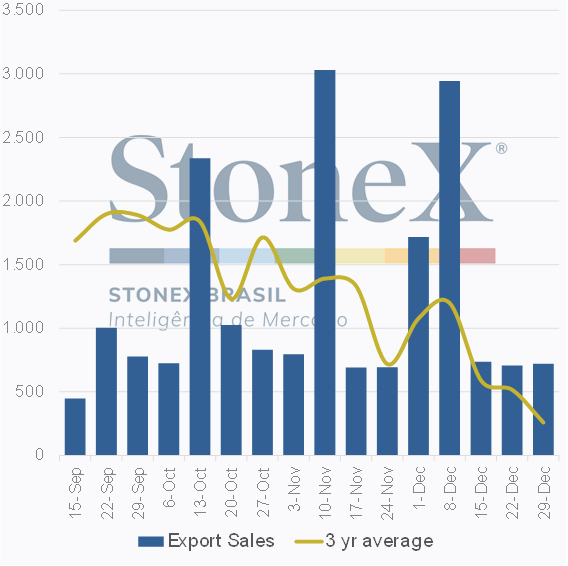
In the US, export sales for the 2022/23 crop reached 721,000 tonnes in the week ended December 29, bringing the accumulated to 43.8 million tonnes, above one year ago at 41.7 million. Negotiations with China reach 26.1 million tonnes, 2.3 million more than that same time last year.
On the other hand, shipments are lagging behind in the annual comparison, reaching 28.2 million, compared to more than 31 million tonnes last year.
Weekly US export sales (000 tonnes)
Source: USDA. Design: StoneX.
As already pointed out, this week, the monthly reports of Conab and USDA will be released, much awaited because of weather issues in South America.