Bearish drivers
- World 2022/23 production estimated above consumption;
- Fighting inflation can generate recession;
- Possibility of still record production in Brazil;
- COVID-19 rising in China and signs of economic slowdown.
Bullish drivers
- Weather concerns for the 2022/23 crop in South America, already with production cuts in Brazil;
- Relaxation of anti-COVID measures in China;
- Crop failure in Argentina due to the weather;
- Possibility of increased mandatory biodiesel blend in Brazil, from April 2023.
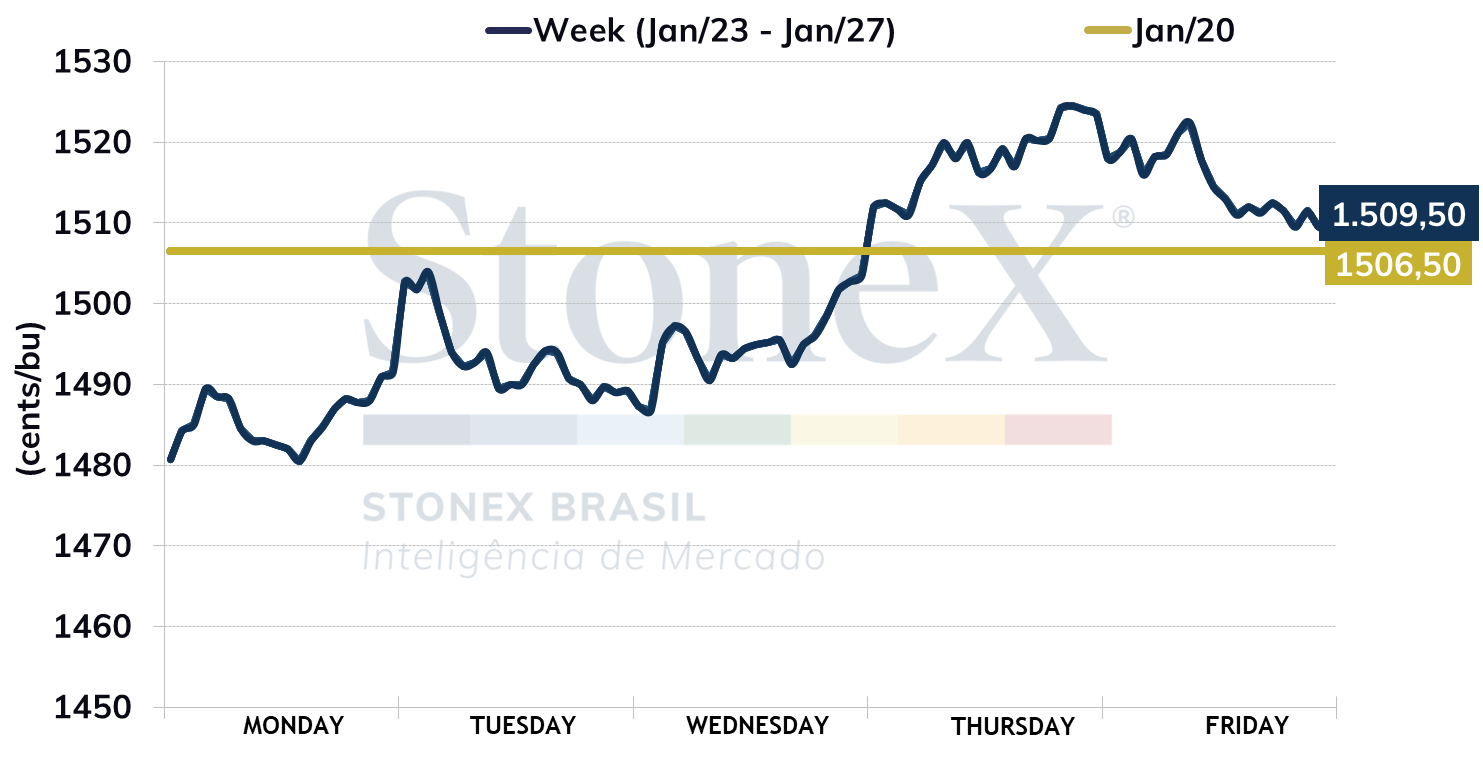
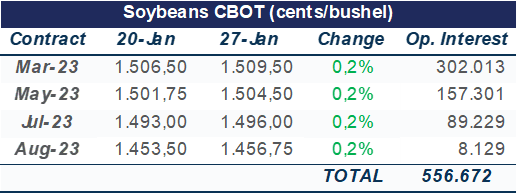
Soybean prices in Chicago started last week in decline, but reversed and ended the period in a positive field. The contract for March ended Friday (27) at 1509.5 cents per bushel, a slight increase of 0.2%.
Rainfall in Argentina on the weekend of January 21 and 22, in addition to the good forecasts for the next 10 days, weighed on soybean prices in the first trading sessions of the week. However, doubts about the regularity of the expected rains and the positive impacts on the country's crops gained ground again in the middle of the week, offering support to prices.
Last weekend (January 28 and 29), the northernmost regions of the provinces of Córdoba, Santa Fé and Entre Rios received good volumes of precipitation. Even so, the drier conditions in other areas of these provinces and also in Buenos Aires remain present. For this week, there are some lighter rains forecast for the country, but the weather should return to being predominantly dry. As more than 40% of Argentine crops are in the reproductive stages, according to the Buenos Aires Cereales Exchange, the weather will continue to be central to define the size of soybean production, in addition to influencing the movement in prices, since global supply is very much concentrated in Brazil, the US and Argentina.
In any case, although recent rains have been very welcome, as they decelerated the deterioration of the Argentine soybean crop, the general conditions are still poor. The good/excellent percentage rose from 3% to 7% in the latest follow-up by the Buenos Aires Exchange, but 54% of the plants are rate as poor/very poor, reinforcing doubts about how much these precipitations were able to reverse this season's drought.
Weekly intraday—March/23 (CME)
Source: CME. Design: StoneX.
In Brazil, 5.3% of soybeans have already been harvested, according to StoneX's report released last Friday (27), which was a weekly rise of 3 points. Compared to last year, fieldwork is behind last year by 12.1%, but this slower pace does not raise concerns for the time being. There have been rains in several parts of Brazil, but the heaviest volumes, which impact both the soybean crop and safrinha corn planting, were more concentrated in some areas.
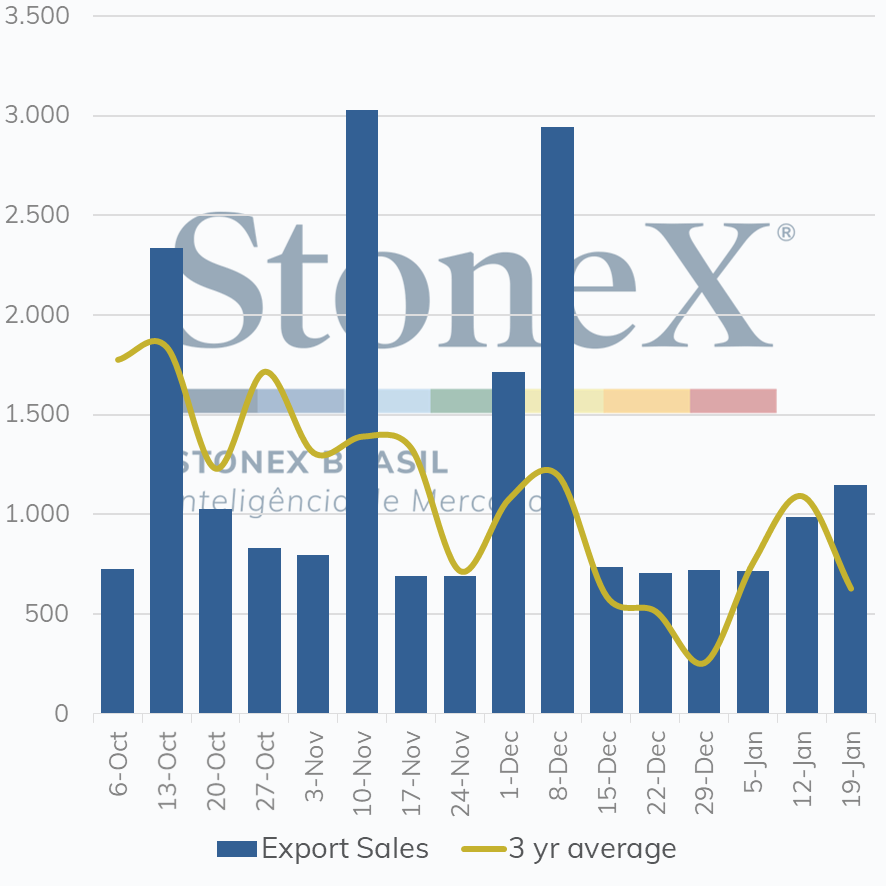
Regarding demand, it should be noted that US export sales data referring to the week ended January 19 and released last Thursday (26) also contributed to the positive weekly closing of prices in Chicago, as 1.15 million tonnes of the 2022/23 crop were traded, a volume closer to the ceiling of estimates, which ranged from 600,000 to 1.2 million tonnes. Of this total, 940,000 tonnes were sold to China. In accumulated terms, sales of the current crop are at 46.5 million tonnes, above the 44.1 million recorded in the same period last year, with China being responsible for these stronger sales.
US soybean shipments reached 1.8 million tonnes in the same period, a volume below a week before, but above last year. These recent volumes have helped to reduce the difference in relation to the accumulated shipments registered until that same week of 2022. So far, 34.1 million tonnes of soybeans have been exported, against 35 million last year.
Weekly US export sales (000 tonnes)
Source: USDA. Design: StoneX.
Next Wednesday (Feb 1st), StoneX will publish its update for the soybean and corn crop estimates in Brazil, and the weather will be key to define of the productive potential of the soybean crops planted later, as it happens in Rio Grande do Sul.