Bearish drivers
- World 2022/23 production estimated above consumption;
- Fighting inflation can generate recession;
- Possibility of still record production in Brazil;
- COVID-19 rising in China and signs of economic slowdown.
Bullish drivers
- Weather concerns for the 2022/23 crop in South America, already with production cuts in Brazil;
- Relaxation of anti-COVID measures in China;
- Crop failure in Argentina due to the weather;
- Possibility of increased mandatory biodiesel blend in Brazil, from April 2023.
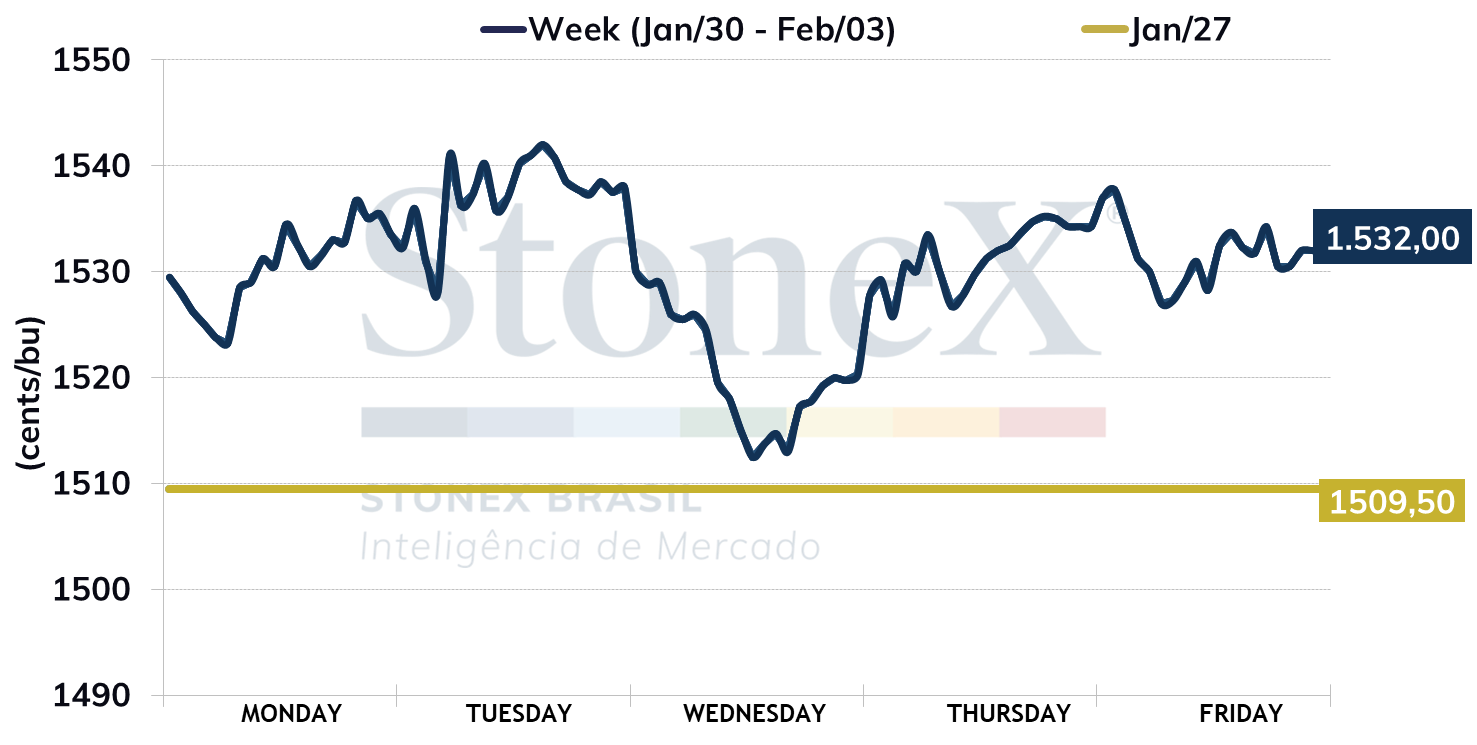
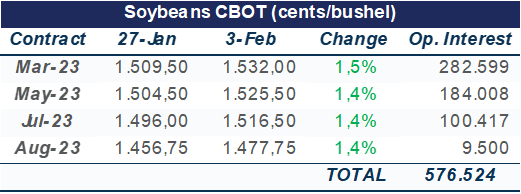
Last week, an upward trend prevailed for soybean prices in Chicago. The March contract ended Friday (3) at 1532 cents per bushel, a weekly gain of 1.5%.
The market remains very much focused on the Argentine crop, given the cuts in estimates for 2022/23 soybean production, with emphasis on meal, since the country is the world's main exporter. With a smaller soybean crop, doubts about the amount that will be crushed and consequently exported by Argentina increase. In years of crop loss, a drop in soybean exports is expected, whose volumes are already less significant, and a greater proportion of supply is directed towards processing. Even so, depending on the size of the country's harvest, crushed volumes may fall, impacting the availability of by-products. In these cases, considering a more restricted supply of meal and oil from Argentina, it should be noted that Brazil would have the capacity to increase soybean crushing, since it currently has approximately 25% of idle capacity. If a crop above 150 million tonnes is confirmed in Brazil, the room for an increase in soybean processing without great competition with exports also rises.
Last Wednesday (1s), StoneX updated its figures for the 2022/23 Brazilian crop and once again raised expectations for soybean production, which rose to 154.2 million tonnes, despite concerns about the dry weather in the south of the country, with an influence of La Niña for the third consecutive year.
There was another cut in Rio Grande do Sul production, now estimated at 19 million tonnes, more than 2 million less than announced in early January, but other states are showing excellent results at the beginning of the harvest. As a result, there was an expected increase in productivity in the Southeast, Midwest, North and Northeast, offsetting the drop in the South, in addition to a review of planted area in some states.
Weekly intraday—March/23 (CME)
Source: CME. Design: StoneX.
In any case, it is important to emphasize that the weather in February will continue to be very important for Rio Grande do Sul, since the soybean cycle in the state starts later, a situation that also occurs in Argentina.
As highlighted, Argentine soybean production estimates are already falling, but an important part of the country's crops are still going through reproductive stages of development, with the weather potentially having important impacts in the coming weeks and months.
According to the latest report from the Buenos Aires exchange, referring to Wednesday (1), planting has been completed in an area of 16.2 million hectares of soybeans in Argentina.
The recent rains that occurred in the country contributed to an improvement in water conditions in several regions, with 47% of the national area being rate with an optimal/adequate water situation, an increase of 10 percentage points in the weekly comparison. Crop conditions in general also registered an improvement in the period, with 12% of the crop in good/excellent condition. Even so, last year, conditions were much more favorable, with 38% of the crop in this rating. It should also be noted that currently 46% of crops are in poor/very poor conditions.
Given this scenario, the Buenos Aires exchange maintains its estimate for the 22/23 soybean crop at 41 million tonnes, noting that the lack of moisture in December and the first half of January affected the crops that were planted right at the beginning of season and were entering their critical periods. In addition, even with the rains recorded in recent weeks, there are still areas of concern, especially the south of Santa Fé and the center-east of Entre Rios, with more precipitation being necessary.
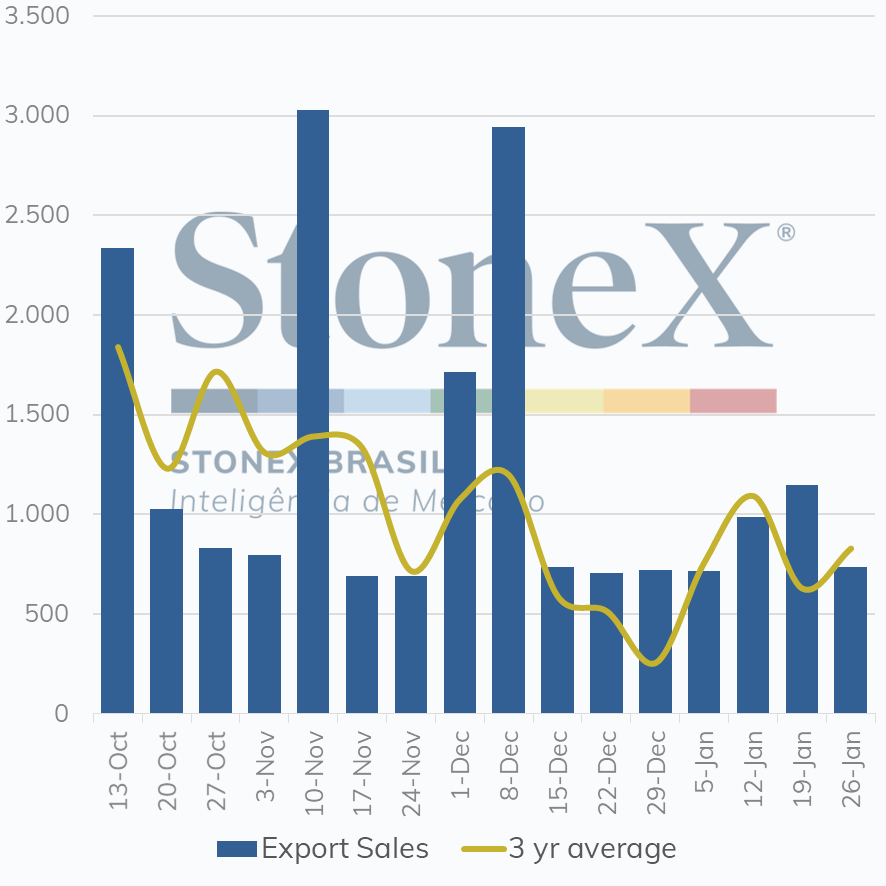
In the US, export sales in the week ended January 26 reached 736,000 tonnes, a volume closer to the floor of the estimates, which ranged from 700,000 to 1.3 million tonnes. On the other hand, in accumulated terms, sales of the 2022/23 crop reach 47.3 million tonnes, 2.1 million more than in the same period of 2022, and at a faster pace than necessary to reach the annual estimate of US exports. Chinese purchases are 3.6 million above last year, offsetting lower sales to with other destinations, at 1.5 million tons.
However, it is necessary to monitor shipments of US soybean. In the week ended January 26, 1.86 million tonnes were inspected, a level that is in line with the previous week, bringing the accumulated to 36 million tonnes, slightly below last year's 36.45 million. The next few weeks of US shipments and sales should be watched closely as the latest crop in Brazil, as the harvest having reached 9.6% last Friday (6), down from 17.7% a year ago, provide a larger window of US exports.
Weekly US export sales (000 tonnes)
Source: USDA. Design: StoneX.
This week will be one of major releases for the grains market, with the updated USDA Supply and Demand Report (WASDE) and the Conab Crop Survey, both on Wednesday (8). The USDA report for February generally does not bring major surprises, with average market expectations betting on stability in US ending stocks for the 2022/23 crop year. As for Argentina, another soybean production cut is expected this season, as the latest USDA figure is considerably above other estimates at 44.5 million tonnes.