BEARISH FACTORS
- World production estimated above consumption in 2022/23;
- Fighting inflation could lead to recession;
- Possibility of absolute production record in Brazil;
- Signs of economic slowdown in China;
US crush cut by USDA.
BULLISH FACTORS
- Weather concerns in southern Brazil;
- Easing of Covid restrictions in China;
- Crop losses in Argentina due to weather;
- Increase in biodiesel blend mandate in Brazil from April 2023.
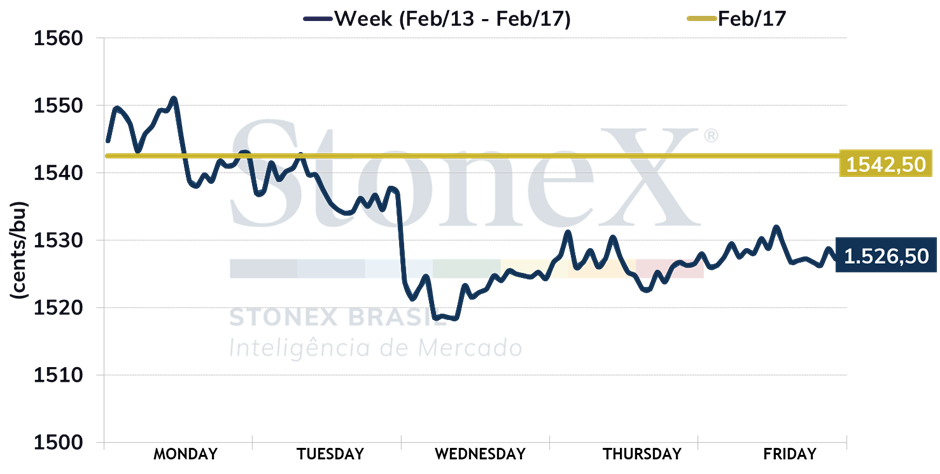
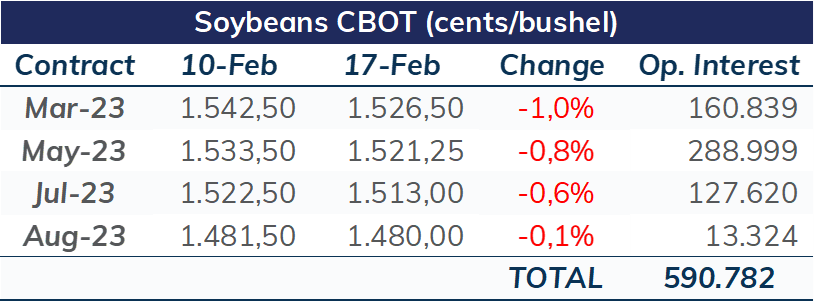
In this week leading up to Brazilian Carnival and President's day in the US, celebrated on Monday (20), soybean prices in Chicago trended lower, with the March contract ending Friday (17) at 1526.5 cents per bushel.
The market remained very focused on the soybean crop progress in South America, in addition to demand issues, emphasizing the pace of exports and the US crushing.
As for Argentina and southern Brazil, some forecasts indicating higher volumes of rainfall weighed on soybean prices, including meal prices, since Argentina is the world's largest exporter of oilseed products. In addition, spec funds were active in selling meal.
Even with these rainfall forecasts weighing on prices, it is important to note that crops already affected by drought in their reproductive phases, especially the filling one, do not recover greatly. Moreover, forecasts continue to change frequently and often do not confirm themselves.
The USDA's estimate for 22/23 production of Argentine soybeans is the most optimistic, even with the cut in the last report, standing at 41 million tonnes. The Buenos Aires Exchange estimates 38 million, while Rosario estimates 34.5 million tonnes.
Given this scenario, the doubts are no longer whether Argentina will have a crop loss but how this lower supply will affect the country's soybean processing. The bets are that Brazilian soy imports can reach significant volumes in this, highlighting that there are already ships leaving Brazil towards Argentina through ports in the Arco Norte. Argentine soybean imports could be significant if a crop of around 35 million tonnes is confirmed, with Brazil as the preferred origin.
Weekly Intraday – March/23 (CME)
Source: CME. Design: StoneX.
Brazil, even with the harvest delay, which is at 25%, according to StoneX, has achieved very positive results in several states, such as those in the Center-West, a situation that should largely compensate for the losses in Rio Grande do Sul.
StoneX updates its crop numbers every beginning of the month, but due to weather issues, it brought a cut in the soybean crop in the state of Rio Grande do Sul in mid-February. The state oscillates between second and third places in national production and recorded large losses due to weather in the 21/22 cycle.
Since planting began in the last four months, since October 2022, rainfall has been considerably below average in practically all of Rio Grande do Sul. In addition, precipitation was fundamental and disappointing in the first half of February, with a lack of regularity and good volumes. The lack of moisture was further aggravated by high temperatures, increasing plant stress.
With this, StoneX promoted another cut in the state's production estimate to 16 million tonnes, 15.8% less than the one released at the beginning of February (at 19 million). The average productivity for the state fell to 2.43 tonnes per hectare (40.5 bags per hectare), highlighting that losses exceed 40% in some regions. It is also important to note that further losses are not ruled out, depending on the weather in the last two weeks of this month.
On the demand side, the National Oilseed Processors Association (NOPA) reported US crushing in January at 4.87 million tonnes, below the average market estimate of 4.94 million tonnes, reinforcing the USDA's position by cutting the country's soybean processing in the 22/23 cycle, in the report released on 02/08.
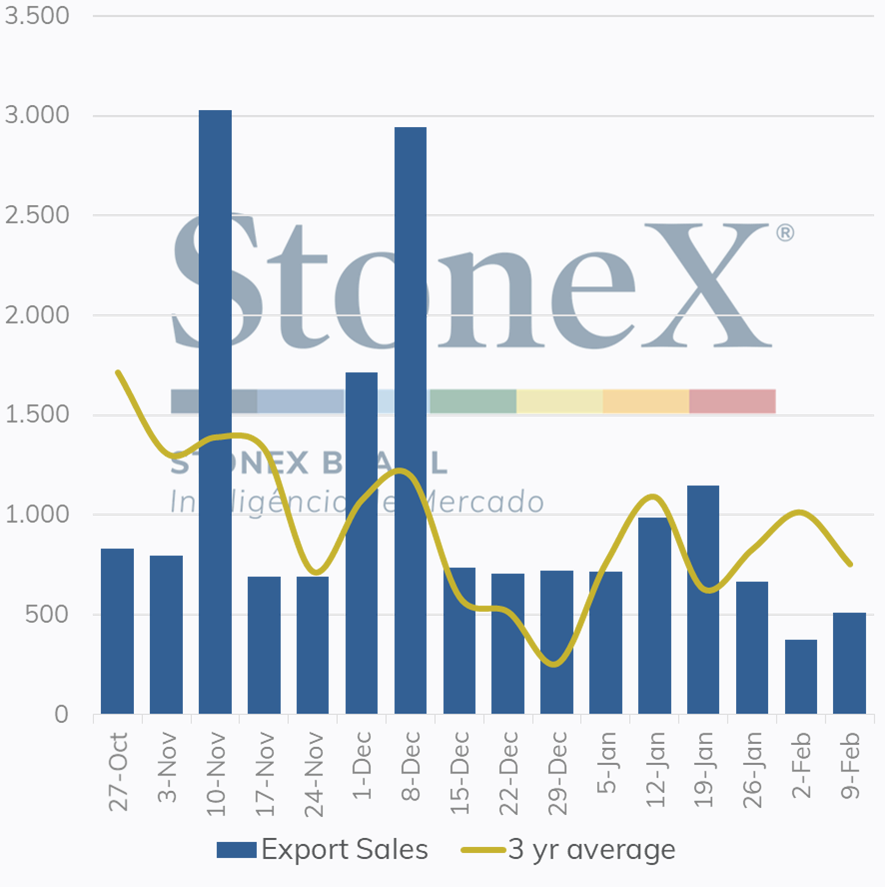
As highlighted in the previous weekly report, the USDA did not bring adjustments to exports, which could more than compensate for this reduction in crushing, but which will compete with the Brazilian crop in the coming months. Through the week ended 09/02, 48.1 million tons of US soybeans were sold 22/23, roughly the same volume as a year ago, while the USDA estimates that shipments from the country will be 4.5 million tonnes weaker this season.
Shipments already exceeded the accumulated last year, maintaining this position. Until 02/09, 39.54 million tonnes of soybeans were inspected for shipment, against 38.9 million a year ago. In the week, inspections stood at 1.6 million versus 1.9 million from the previous year.
Weekly export sales - US (TMT)
Source: USDA. Design: StoneX.
Next week, the big highlight will be the USDA Agricultural Forum, an annual event that brings the first estimates for the planted area of the new US crop (23/24).