Bearish drivers
- World 2022/23 production estimated above consumption;
- Fighting inflation can generate recession;
- Possibility of absolute record production in Brazil;
- Signs of economic slowdown in China;
- USDA Agricultural Forum brings production growth for 2023/24 US crop.
Bullish drivers
- Relaxation of anti-COVID measures in China;
- Considerable crop losses in Argentina, due to the weather;
- US balance sheet estimated at the Agricultural Forum does not indicate loose stocks;
- Possibility of increased mandatory biodiesel blend in Brazil, from April 2023.
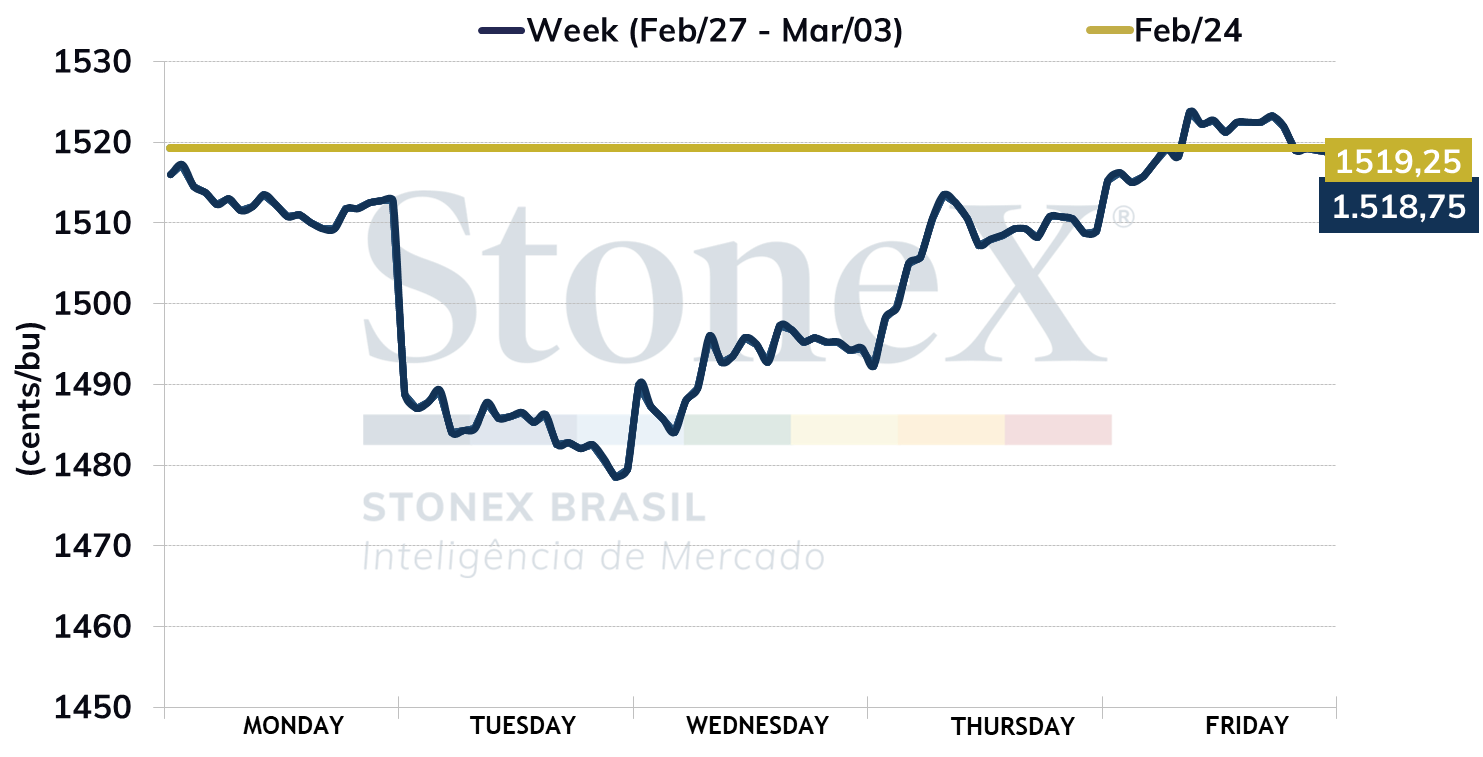
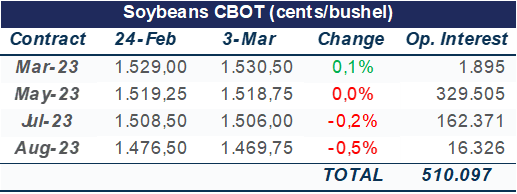
Last week, soybean prices had a dip during the first few trading sessions but made a comeback starting on Wednesday (1) and ended the week on Friday (3) with a nearly unchanged quote compared to the previous week's close. The May contract concluded the period at 1518.75 cents per bushel.
The role of funds was key in the downward movement of soybean prices at the beginning of last week, as they acted on the sell side of the grain market, while also buying meal. It is also noteworthy that there was a recovery from the middle of the week onwards, with funds resuming soybean purchases due to renewed concerns about the Argentine crop.
As mentioned in previous reports, the Buenos Aires Stock Exchange (BCBA) has lowered its forecast for Argentina's soybean crop to 33.5 million tonnes, which was initially estimated at 48 million. In its latest weekly report, the BCBA indicated that it may have to further revise the Argentine production figure down. The conditions of crops in the country have deteriorated even further, with only 2% of the plants rated as good/excellent (G/E), a decline of over 1 percentage point and the worst result ever recorded in the history of soybean production in the country.
It is worth noting that the USDA has a much more positive outlook for the 2022/23 season. The Department's supply and demand report, which will be updated on Wednesday (8), is expected to reflect an average market estimate of 37 million hectares for soybean production in Argentina. This figure is higher than the BCBA, which also has the potential for further downward revisions.
Weekly intraday—May/23 (CME)
Source: CME. Design: StoneX.
As a result, the USDA's global world supply and demand balance is currently overestimating soybean supply, which for now remains above consumption.
On the other hand, in Brazil, the soybean crop is on the way to confirming a result above 150 million tonnes, even with the losses in Rio Grande do Sul, due to the dry weather in yet another year of La Niña.
StoneX updated its estimate for the 2022/23 crop in Brazil last Wednesday (1), with production in the state dropping to 16 million tonnes, 3 million less than the previous 19 million. Even so, the national total had a slight increase to 154.7 million tonnes, with good prospects in other states offsetting losses in Rio Grande do Sul.
Several regions, including the Center-West and the states of the MATOPIBA area, are reporting excellent yields despite delays in harvesting. Additionally, it is worth noting that there have been upward revisions of the planted area.
On the demand side, the market is closely monitoring Brazilian exports, as the nation plays a leading role in global shipments in the first half of the year, especially with the record crop that will also result in record exports this year.
In February, Brazil exported 5.2 million tonnes of soybean, a lower volume than the 6.3 million shipped in the same month of 2022. In addition, the accumulated is also weaker this year, reaching just over 6 million tonnes. It should be noted that these lower volumes occur in a year of delayed soybean harvest, which reached 41.6% last Friday (4), according to StoneX’s monitoring, against 56.2% in this same week last year. In any case, the coming months should see very strong shipments of Brazilian soybeans.
As Brazilian soybean exports gain momentum, exports from the United States are expected to decline due to the typical seasonal patterns seen throughout the year.
In the week ending February 23, US soybean export inspections totaled 691,000 tonnes, a lower volume than the previous week and the same period last year, which is in line with the usual seasonality of soybean exports from the country. However, in terms of accumulated shipments, the US has already exported over 42 million tonnes, surpassing the 40.7 million shipped at the same time last year. This also indicates that the USDA's export estimates for the 2022/23 cycle are lower than the actual shipments.
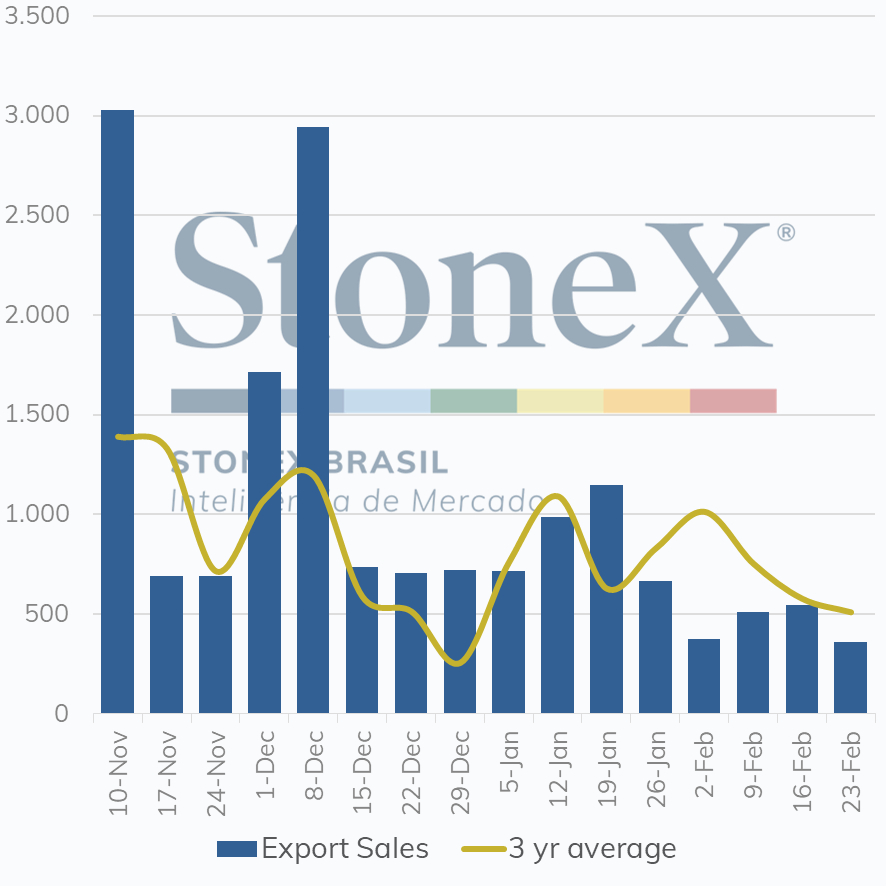
Export sales in the same week reached 360,700 tonnes, at the lower limit of estimates, which ranged from 300,000 to 850,000 tonnes, and well below the same week of 2022. In the accumulated result, 48.8 million tonnes were traded, down from 50.2 million last year.
Weekly US export sales (000 tonnes)
Source: USDA. Design: StoneX.
This week, as mentioned earlier, the highly anticipated USDA monthly report will be released, with many waiting for the adjustment that will be made for the Argentine crop.
In Brazil, Conab will also publish its crop survey on Thursday (9).