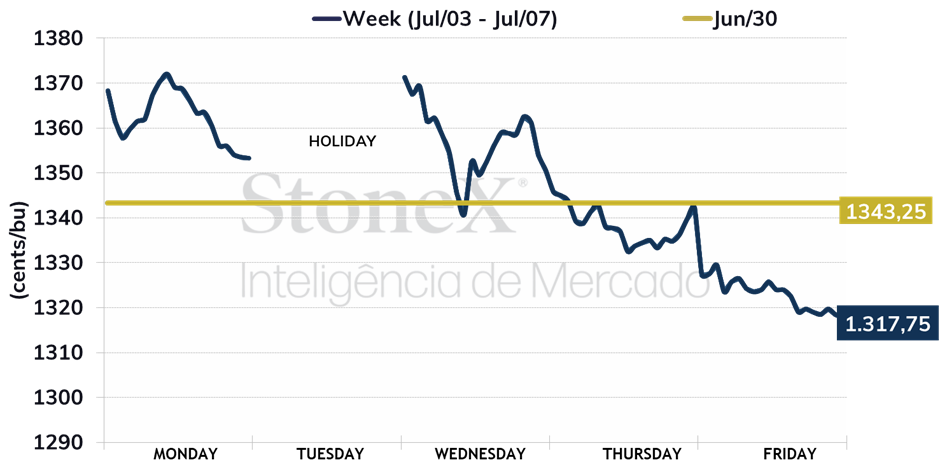
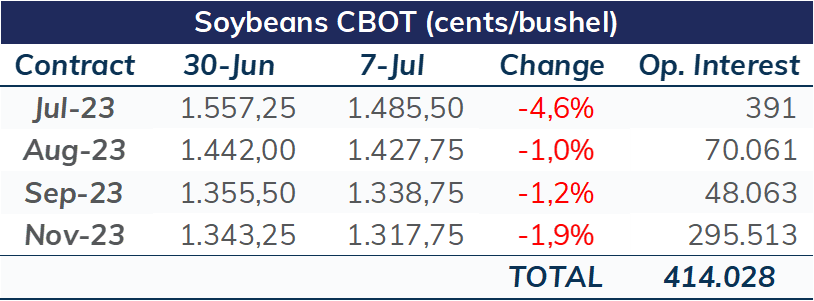
Last week, soybean prices in Chicago recorded a drop, with the contract for November closing on Friday (07) at 1317.75 cents per bushel, a drop of 1.9% compared to the closing of 07/30, following the surprise with the planted area in the US.
The week began with the market still digesting the drop of 1.6 million hectares of the planted area of the US 2023/24 crop when expectations were for a small increase. With an area of 33.8 million hectares, the country does not have space for productivity losses. Considering the demand levels estimated by the USDA, even with the current yield, at 3.5 tonnes per hectare, the balance would already be very limited, resulting in some rationing on the consumption side of the oilseed.
Either way, in addition to profit-taking movements, after the very expressive rally conditioned by the area data, the weather in the US continued to be the center of attention, with the occurrence of rains in important areas of the Midwest alleviating concerns about the drier pattern that prevailed in June.
Since the beginning of July, the weather in the US has changed to a wetter pattern, which is already impacting crop conditions. In the week ending on 07/02, the good/excellent percentage in the national average still declined, falling from 51% to 50%, when expectations were for an improvement. However, some key states, such as Illinois and Iowa, have reported increased crops with good/excellent ratings.
With this, the update that will be released by the USDA later this afternoon is highly anticipated, with prospects that this improvement will continue, even reflected in the national percentage.
During this past weekend, good amounts of rain were recorded in the central region of the US, with the highest volumes occurring in areas of Illinois, Indiana and Arkansas. The northernmost and northwest regions of the North American grain belt still remained with a drier pattern, a situation that raises concern regarding the development of crops.
In any case, until next Friday (14), considerable amounts of precipitation are expected in practically all of the Midwest, while the forecast for the period between July 15to 19 indicates rain concentrated in the south and east of the belt. Thus, the weather continues to have the potential to bring significant changes to the supply of the North American crop, remembering that, in the case of soybeans, grain filling, the most critical phase in terms of lack of moisture, is concentrated only in August.
Although the current focus is on North American production and the weather market, it is important to make some considerations from the demand side, which also directly impacts the US balance.
As mentioned, the smaller area would tend to result in some rationing on the demand side, and the first variable impacted in case of a lower-than-expected supply is the exports. However, the pace of North American exports has already been slower even before any major tightening in the country's balance.
In this way, if this less-than-expected pace continues, there would be a drop in USDA's current export estimates, helping to alleviate the scenario of balance constraints somewhat.
Brazilian soybeans intended for China have remained more competitive than the North American ones exported through the Gulf, even with the recent strengthening of the Brazilian real. In addition, China is taking advantage of the Brazilian record crop to make purchases, which could impact the new US crop exports at the end of the year.
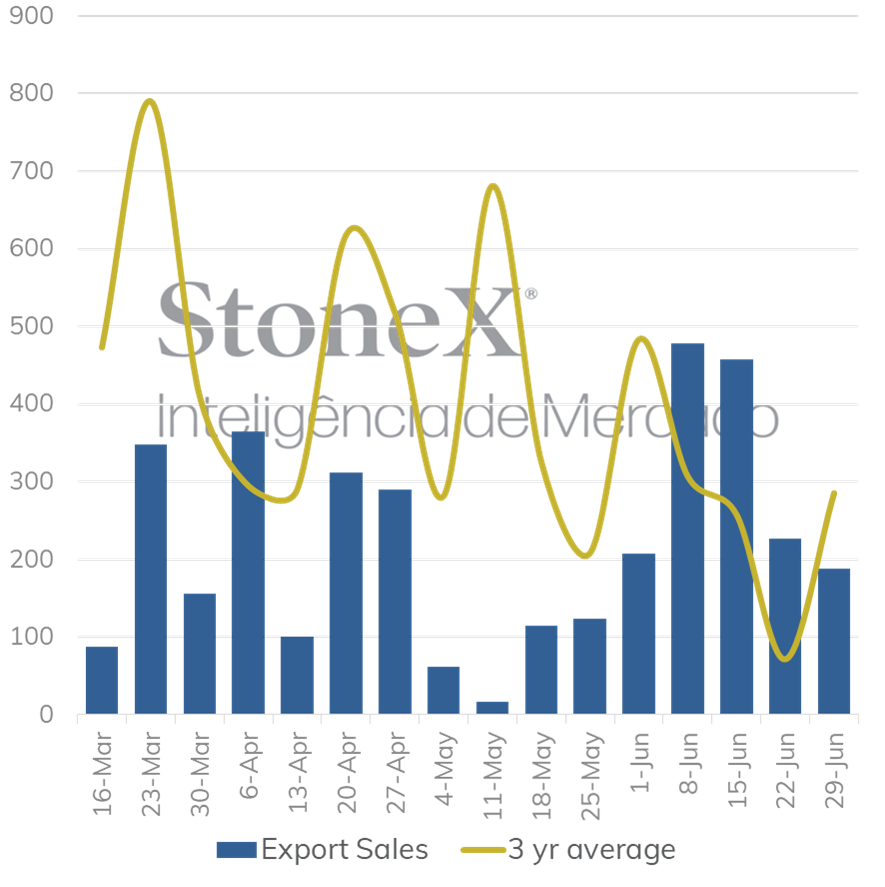
The data on American export sales continue to show a slower pace, as commented, raising doubts about whether the current 2022/23 crop estimate will be reached, highlighting that the USDA has already made negative adjustments in the monthly supply and demand report. In the week ending on 06/29, the net sales of the 2022/23 crop were 187.8 thousand tonnes, bringing the total to 52.5 million.
On the other hand, sales of the 2023/24 crop reached 592.8 thousand tonnes, exceeding the market estimate ceiling of 400 thousand tonnes. Even so, sales are at 3.9 million tonnes, a considerably lower volume than that recorded during the same period in previous years.
This week, in addition to the US weather continuing to be the center of attention, with the weekly crop follow-up being eagerly awaited, the highlights are the announcements of the Conab Crop Survey and the USDA WASDE report. Usually, the USDA's July update does not change the US productivity number, only incorporating the area announced at the end of June. However, after a very dry June, some surprises in terms of productivity revision could occur.