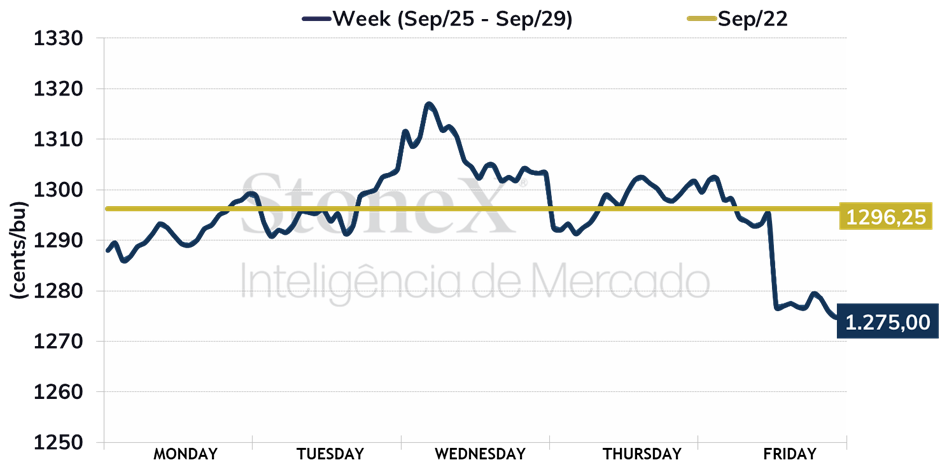
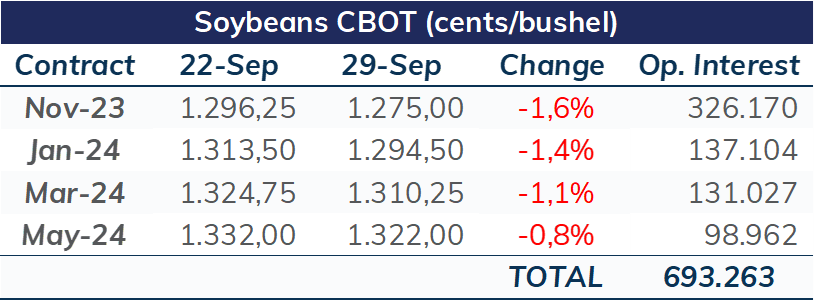
Last week, soybean quotes continued to trend lower in Chicago. The November contract ended Friday's session (29) at 1275 cents per bushel, a weekly decrease of 1.6%.
The lack of major news on the fundamentals, amidst expectations of a more relaxed global balance, in addition to the period of the North American crop, set the tone for the trade. Only on Friday (the 29th) the long-awaited quarterly stocks report in the US was released, contributing to the price drop during the week.
The country's harvest reached 12% on Sunday (24), a level slightly above the five-year average for the period, at 11%. The crop conditions recorded a 2% decrease in the good/excellent percentage, which dropped from 52% to 50% when stability was expected. Even so, this worsening did not have major impacts on the market since the correlation of the conditions evaluated by USDA at this point in the crop with the final productivity result is generally low.
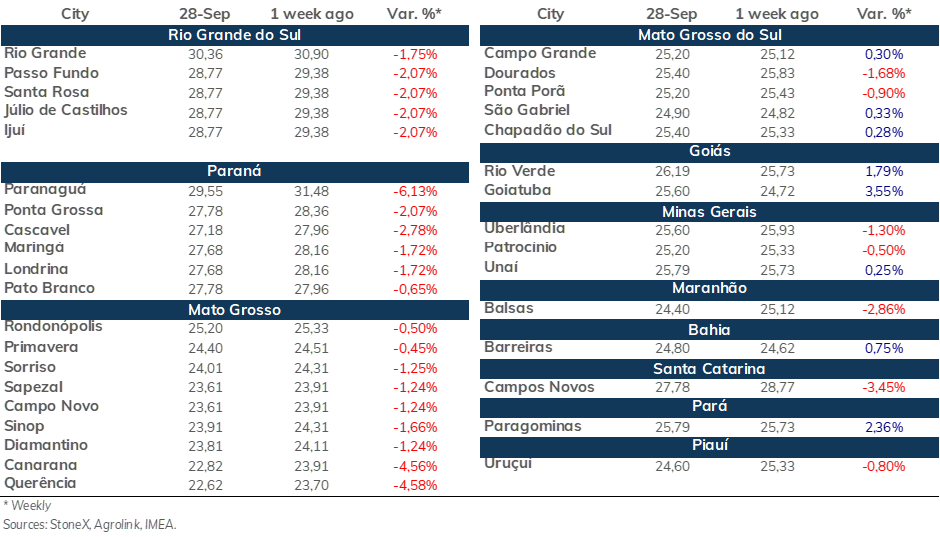
With the American crop harvest, the availability of soybeans increases, which also helps to explain the recent drop in prices. In addition, the country's exports tend to gain even more relevance since the quarter between October and December seasonally records the highest volumes exported. However, this year, Brazilian soybeans have remained competitive even in the second half of the year, a situation reinforced by the low levels of the Mississippi River, as happened last year, complicating and increasing the country's logistics costs.
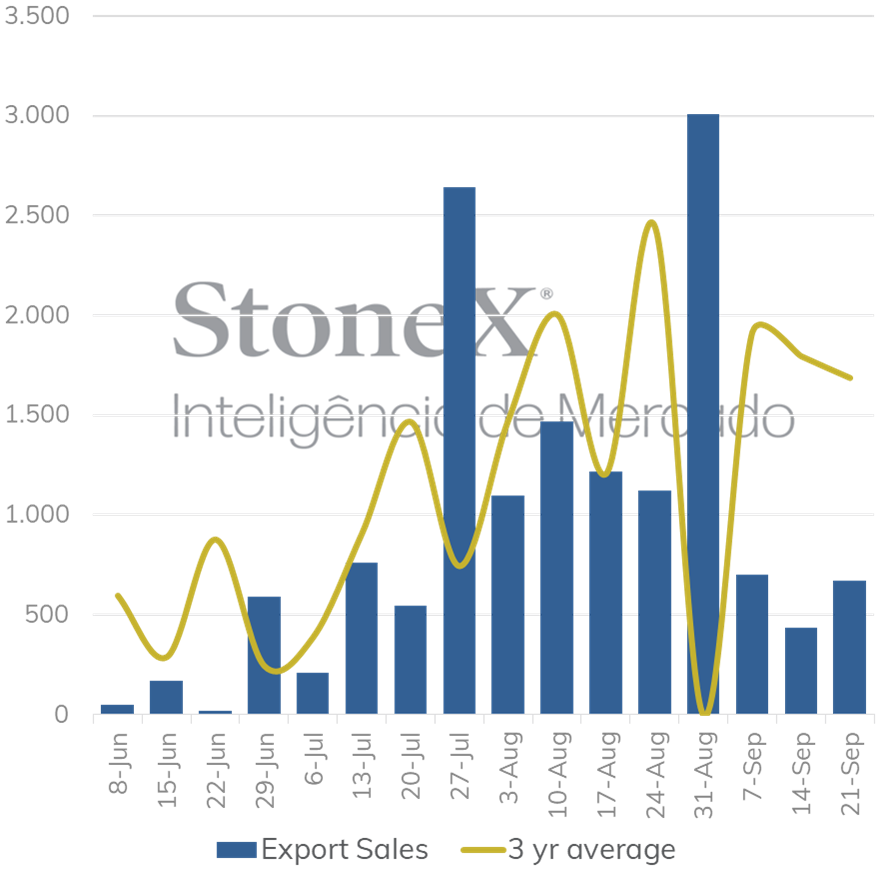
Export sales in the week ended on 09/21 reached 672.2 thousand tonnes, a volume closer to the lower end of the estimated range, which ranged from 500 thousand to 1.2 million tonnes. To date, negotiations for the US 2023/24 crop reached 17.75 million tonnes, a lower volume than the 26.7 million registered in the same period last year. It's important to remember that the USDA's export estimate for the 2023/24 crop year is also lower, at 48.7 million tonnes, compared to 54.16 million in the previous cycle.
On Friday (29), the downward price trend received a boost from the quarterly stock position report in the US. On September 01, the country had 7.29 million tonnes of soybeans in stock, representing the ending stocks for 2022/23 and indicating adjustments in the supply and demand balance. This inventory level is not loose, but it signals a lower use of soybeans in the fourth quarter of the crop year, which weighed on prices. The expectations for the American soybean crush remain positive, given the progress of renewable diesel production, but this data from the last quarter of the 2022/23 crop season ended up surprising.
In Brazil, today, the data on exports for the complete month of September will be released, with the accumulated amount until September 29 already reaching 4.8 million tonnes, above what was recorded for September 2022 as a whole. In the accumulated period, since the beginning of January, shipments have reached 85.7 million tonnes. For the 2022/23 crop year (calendar year 2023), StoneX estimates that Brazilian exports could reach 99 million tonnes.
The planting of the 2023/24 crop in Brazil reached 4.1% of the total estimated area last Friday (29), according to StoneX follow-up, a level slightly below that recorded in the same week last year, at 4.8%.
It should be noted that this morning, StoneX updated its crop estimate for Brazil, with soybean production for 2023/24 rising to 164.1 million tonnes. Highlighting the revisions of planted area in some states, with the national total rising to 45.3 million hectares, 2.7% more than last year and also a record. Access the full report here.
This week, the pace of US export sales is expected to remain in the spotlight, as well as the harvest progress in the country and the logistical issues associated with the Mississippi River.