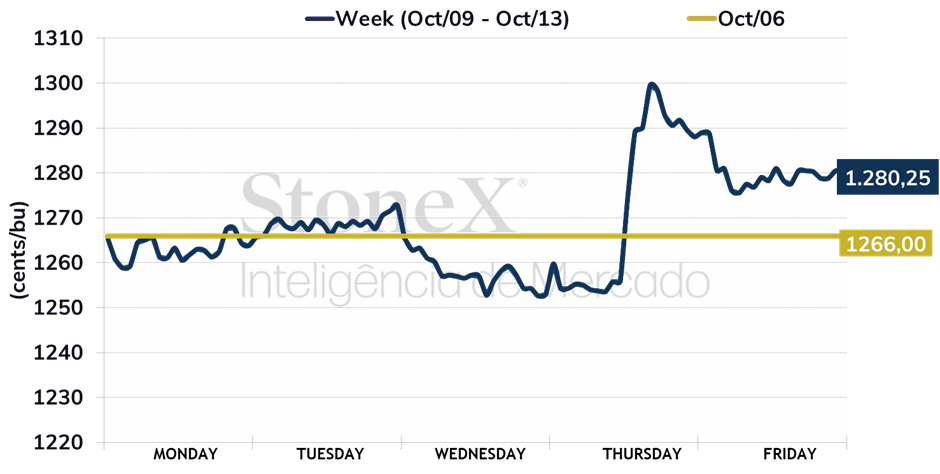
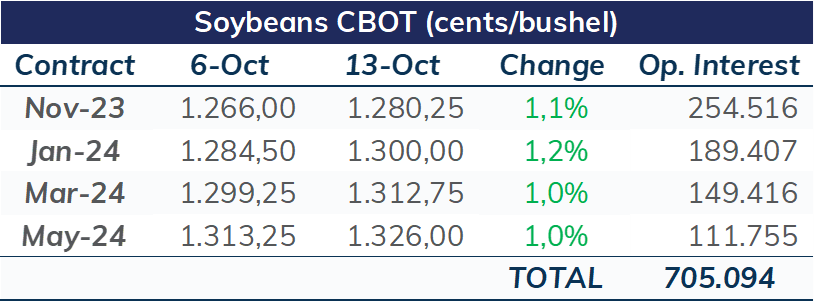
The soybean quotes accumulated weekly gains for the first time since August after the release of the USDA supply and demand report on Thursday (12). In any case, the first sessions of the week still saw prices fall. The November contract ended Friday's session (13) at 1280.25 cents per bushel, an increase of 1.1% in the period.
The tone of risk aversion was very much present on Monday (09) after the Hamas attack on Israeli localities and the conflict that has ensued since then. The Middle East is not among the largest players in soybean consumption and production, but the greatest pessimism has weighed on commodities.
As for the fundamentals, the US 2023/24 crop harvest reached 43% of the total area on Sunday (8), an increase of 20 p.p. in the week and above the five-year average for the period, at 37%. The progress of the US is a factor that has weighed on prices, as it increases the availability of soybeans.
On the demand side, the country's export inspections in the week ended 10/05 were slightly above 1 million tonnes, up from a week earlier and in line with last year. There was an error in the disclosure of the data, which first came in at 1.6 million tonnes but represented a double count in cargoes at the Pacific Northwest (PNW) ports. This error has been corrected, which has weighed on the quotes. Considering the cumulative of the 2023/24 crop, inspections align with that achieved in 2022 at 3 million tonnes.
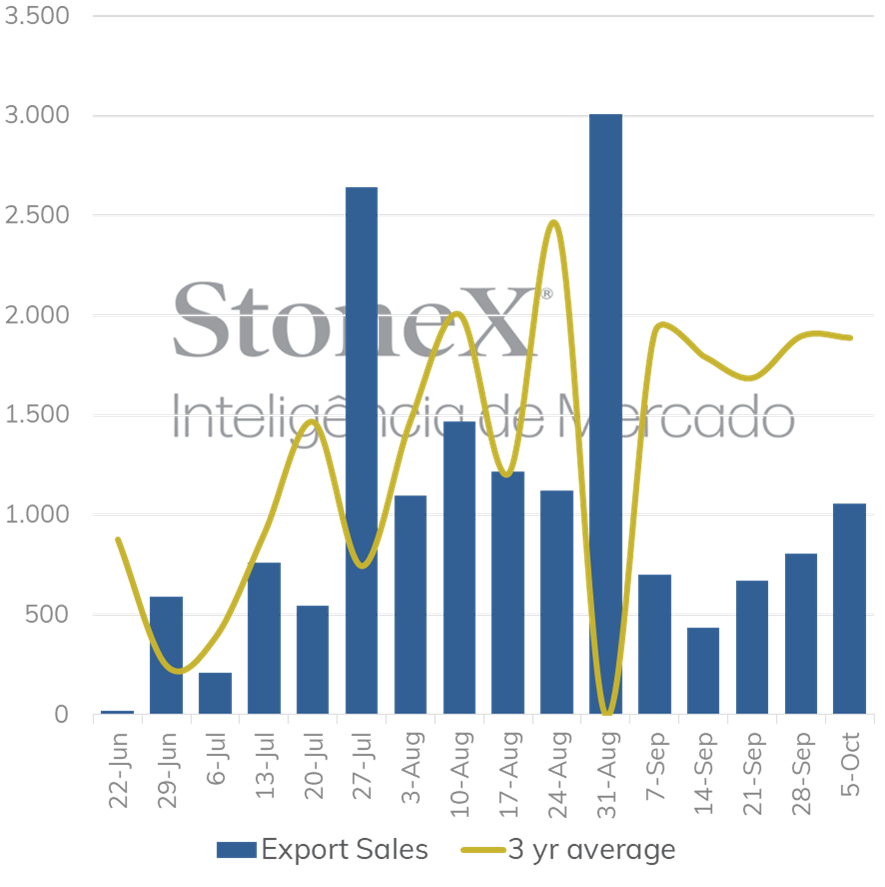
Export sales in the same week reached 1.06 million tonnes, a volume at the top of estimates, which ranged from 650,000 to 1 million tonnes. In the cumulative index, soybean negotiations for the 2023/24 crop reached 19.5 million tonnes, lower levels than in the same period in previous years. It is important to remember that the USDA expects US shipments to be weaker in the 2023/24 cycle.
The USDA brought a new cut in the US 2023/24 production, which fell from 112.8 to 111.7 million tonnes, with another negative productivity adjustment. There was a slight increase in projected crushing, while the export estimate was cut by 1 million tonnes. In addition, with adjustments in the 2022/23 crop, already expected due to the quarterly stock position report, the opening stocks for the 2023/24 cycle increased, contributing to the maintenance of the estimate of ending stocks for the new crop.
This cut in US productivity and production made room for a considerable rally on the day, with the performance of speculative funds. However, there was profit-taking in the following session, on Friday (13).
As for other important players in the soybean market, there were no significant adjustments, and the global supply and demand balance continued to indicate a production considerably above consumption, at 16.22 million tonnes, maintaining the scenario of greater global slack, even with the prospects of a restricted balance in the US.
Of particular note was the release of China's exports in September, which reached 7.15 million tonnes, 7.3% less than in the same month last year and below expectations. Between October 2022 and September 2023, China imported 100.9 million tonnes, making the 2022/23 crop year a record for the country but below the USDA estimate of 102 million tonnes. China took advantage of the record crop in Brazil and originated a lot of soybeans here, contributing to a recomposition of its stocks and raising doubts about how much US 2023/24 soybeans the country will import. In this context, the available Brazilian oilseed continues to compete with the US grain, even at a seasonally advantageous time for the US product. In addition, the flow of the US crop faces logistical challenges, with the low of the Mississippi River and the drought in the Panama Canal, situations that make grain shipments more expensive and delayed, harming the country's competitiveness.
In Brazil, the 2023/24 crop planting reaches 18% of the projected area, below the percentage in the same week of 2022, at 22.6%. The market follows the weather, with rainfall still quite irregular in several parts of the country, such as in regions of Mato Grosso.
In the coming week, the weather in Brazil should continue to be on the radar, as well as the harvest in the US and the progress of the country's exports.