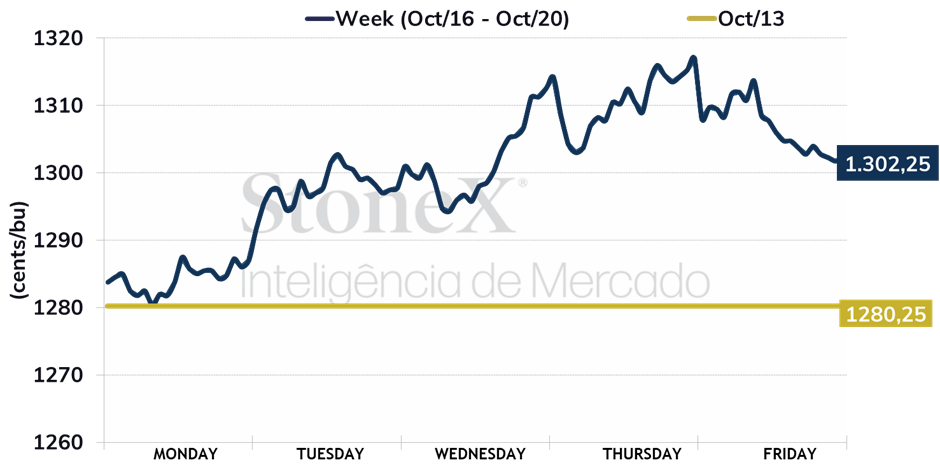
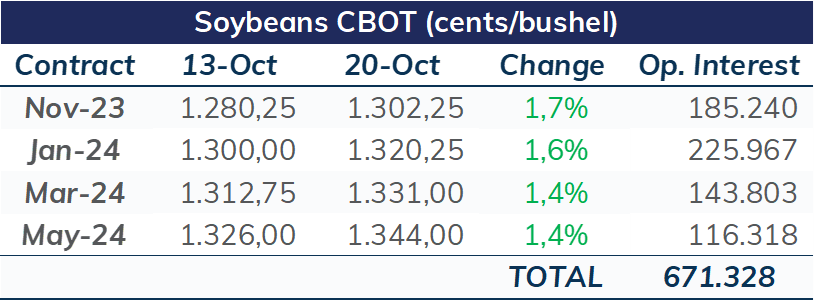
Soybean quotes in Chicago trended higher for the second consecutive week, with the November contract ending Friday (20) at 1302.25 cents per bushel, a 1.7% increase in the period.
The harvest period in the US, with 62% of the work completed by 10/15, continues to weigh on prices due to the seasonal increase in soybean availability. However, a tight balance in the country and a heated domestic demand supported prices.
On Monday (16), the National Association of Oilseed Processors (NOPA) released the US soybean crush for September, which reached 4.5 million tonnes, above the market's average expectations of 4.4 million. In addition, the result represents a record for September, given the positive prospects for the advancement of crushing and renewable diesel production in the country. Regarding soybean oil, stocks remained at 502.6 thousand tonnes, below expectations, which may indicate that even the prospects of a more heated crushing may still fall short of the volumes of soybean oil that the market will need.
Regarding exports, inspections in the week ending on 10/12 reached 2 million tonnes, a volume that is not a big surprise during this time of the year and remained in line with the same week of 2022. The accumulated for the 2023/24 crop year is 5.4 million tonnes above the same period last year.
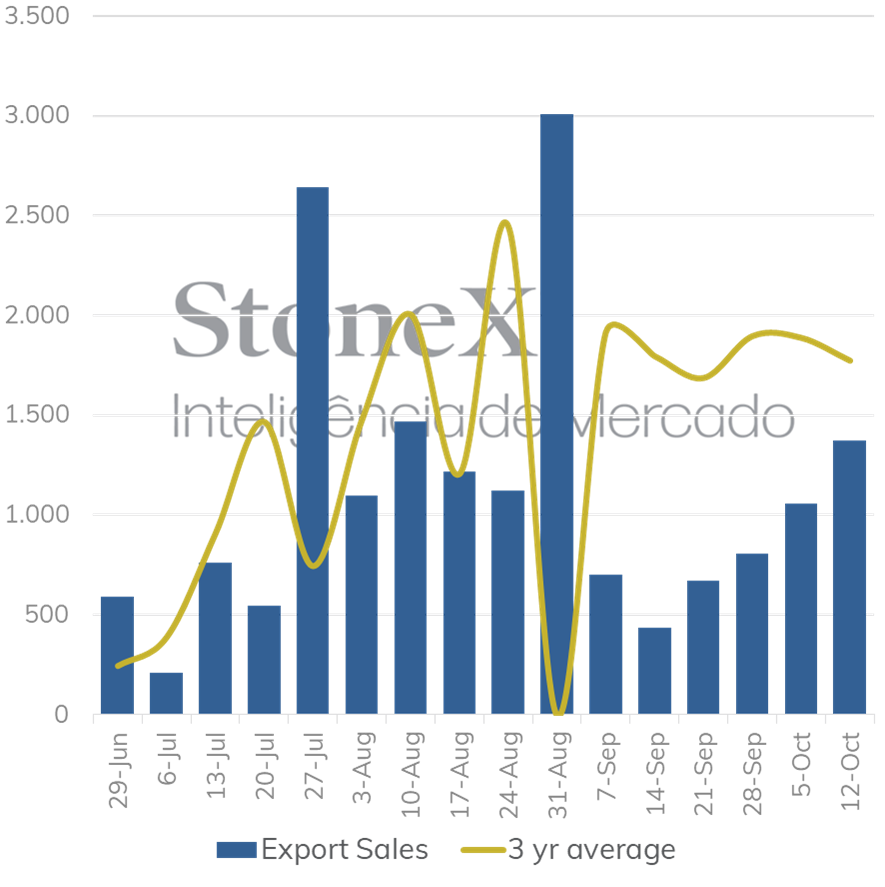
Export sales in the same week were 1.37 million tonnes, a volume within market estimates, which ranged from 950,000 to 1.6 million. In the crop year, 20.9 million tonnes have been traded, 9.6 million less than last year. However, as USDA expects shipments for the 2023/24 cycle to be 6.5 million tonnes lower than in 2022/23, the annual delay would be around 3 million tonnes.
Business with China is down by 6.7 million tonnes compared to last year. Brazilian soybeans remain highly competitive in the spot market, even during this time of year, which is traditionally dominated by American exports.
Of the volume imported by the Chinese in September, 6.88 million tonnes originated from Brazil, out of a total of 7.15 million tonnes, representing a 23% increase in Brazilian participation compared to the same month in 2022.
In addition to the record Brazilian crop in 2022/23 and the strengthened dollar, the logistical issues that end up affecting the competitiveness of the American oilseed stand out. The low level of the Mississippi River has increased freight costs at a time of great increase in grain supply in the US, and the drought in the Panama Canal also impacts the costs and travel time of shipments leaving the Gulf towards Asia.
Here in Brazil, the impacts of weather on logistics have also been gaining relevance, with the lowest levels in a century reached by the tributaries of the Amazon River. Some barge companies have interrupted operations, while many convoys are carrying reduced loads, and pushers are being used to cross shallower points.
Moreover, a small portion of the cargo was diverted to terminals in the South/Southeast, with Santos being particularly noteworthy. Even so, for the time being, the outlook for exports remains positive, bearing in mind that the current period is dominated by corn in port flows, even though significant volumes of soybeans are still being shipped.
Regarding the Brazilian 2023/24 crop, StoneX released its planting update on Friday (20), reaching 27.4% of the total, the lowest level compared to the same week last year, at 36.4%, due to still irregular rainfall in several regions. Highlight the slightly slower pace in the Center-West states. In the next ten days, rainfall is expected throughout the country, but with more significant volumes in the South region and in the southernmost areas of the Center-West and Southeast. The volumes can be very large in much of Paraná between the last days of October and the beginning of November.
In Argentina, the forecasts indicate good rainfall volumes in the next ten days, which should improve the drought conditions recorded in several regions. In the case of soybeans, the planting window is still in the beginning, with these precipitations aiding soil moisture.
In this week that begins, the weather conditions in South America should continue to be the center of attention for the progress of the 2023/24 crop and for logistics in northern Brazil.
In the US, export and harvest data will be on the radar.