- World production estimated to exceed consumption in 2023/24, according to USDA.
- Record rainfall in Brazilian soybean areas.
- StoneX still forecasts a record 2023/24 harvest for Brazil.
- Potential for a full harvest in Argentina, with good forecasted rains.
- Weak cumulative export sales from the US to China.
- Increased domestic consumption in the US.
- Argentina may face a shortage of soybeans for crushing.
- Need for more rains in Brazil's producing regions.
- Production cuts estimated by Conab and USDA.
- StoneX's production estimate cut.
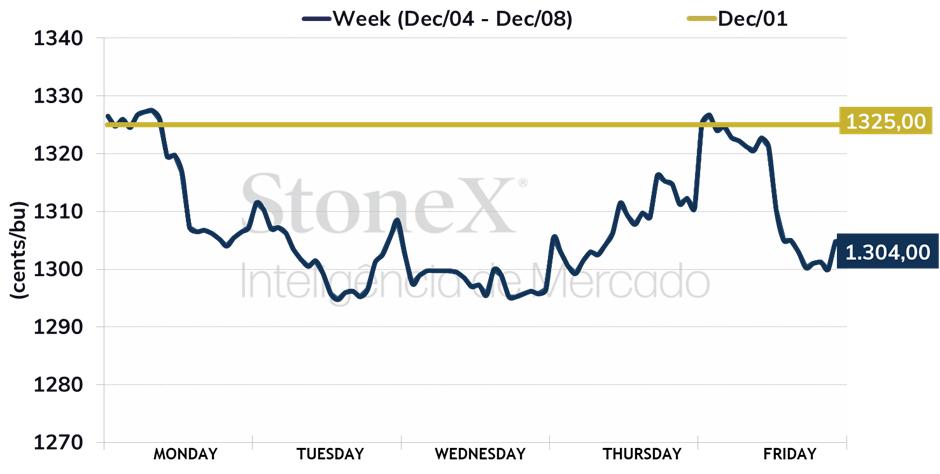
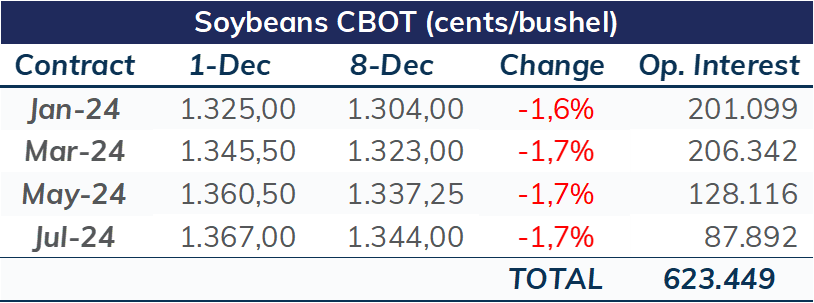
The soybean quotes in Chicago showed another week of depreciation, with the January contract ending Friday's session (08) at 1304 cents per bushel, a 1.6% decrease in the period.
The market continued to monitor the weather outlook in South America, focusing on concerns in Brazil and soybean exports from the US. In addition, the monthly reports from CONAB and USDA were released.
The occurrence of rainfall in Brazil and the forecasts that December should be rainier continued to weigh on the quotes, while the crop in Argentina is progressing in a favorable scenario of precipitations.
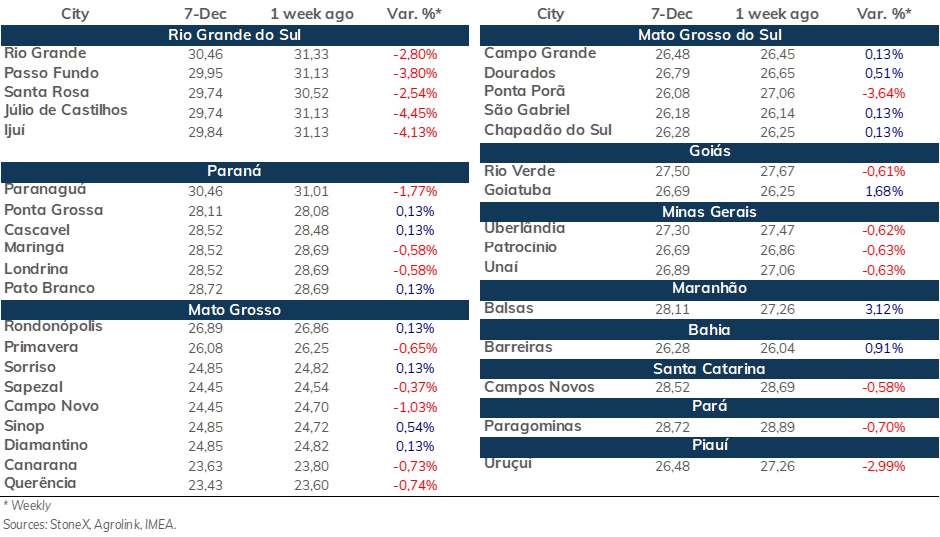
Even so, it is worth noting that, despite the record of more significant rainfall volumes in the soybean-producing regions of Brazil, the rains still do not have the desired regularity in some areas. Thus, the next few weeks should be central regarding the weather to define soybean productivity.
The soybean planting reached 90.7% of the total area on Friday (08), according to StoneX, with the rains of the last weeks contributing to a slightly faster pace.
In Argentina, planting the 2023/24 soybean crop reached 51.7% of the total on Wednesday (06), and forecasts indicate a wetter pattern in the coming months in the country.
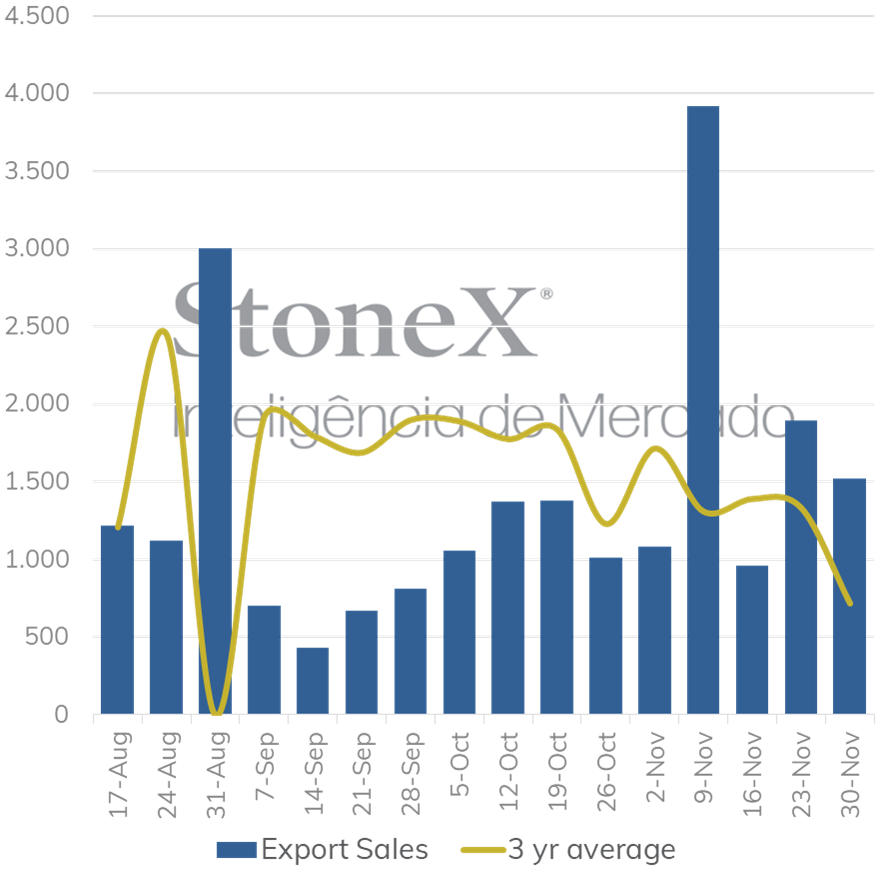
On the demand side, sales and shipments from the US are closely monitored. Inspections in the week ended on 11/30 were at 1.1 mmt, lower than the previous week and well below the level recorded at the same time last year.
The country's export sales in the same week reached 1.52 million tonnes, a volume within the range of estimates, which ranged from 1 to 1.8 million, bringing the total to 32.4 million tonnes, 6.4 million less than last year. Nonetheless, USDA estimates that exports for the American crop cycle 2023/24 will be 6.5 million tonnes lower than the 2022/23 crop recorded. Thus, the current season's sales are in tandem with the USDA's export estimate.
It should be noted that China is responsible for almost all of the delay in American sales compared to last year, having booked almost 6 million less than at the same time of the 2022/23 crop. In general, the shipments leaving the US through the ports of the Pacific Northwest have an advantage compared to Brazilian soybeans, which is normal for this time of the year.
On Thursday (07), CONAB updated its monthly crop survey and reduced the estimate for Brazilian soybean production by just over 2 million tonnes compared to the November figure, expecting a crop of 160.2 million tonnes. This drop occurred due to productivity adjustments due to the country's weather issues, with November still recording below-average rainfall in much of the soybean-producing region. CONAB also brought cuts in its expected domestic demand and export figures.
The USDA monthly report was released on Friday (08) and did not bring any revisions to US production, which is already expected in the department's December report. In addition, there were no changes in demand variables, keeping the ending stocks of the 2023/24 cycle estimated at 6.67 million tonnes.
On the other hand, the USDA cut Brazilian production, which is not so usual in its December update, from 163 to 161 million tonnes. Despite the production cut, USDA raised its estimate for Brazil's exports from 97.5 to 99.5 million tonnes.
For China, the USDA increased expected imports by 2 million tonnes, reaching 102 million tonnes. Still, the country's consumption was not revised, with these higher imports reflected in higher stocks.
This week, the Brazilian crop is expected to continue being the main factor driving the market.
In addition to the usual data released weekly, such as export figures, on Friday (15th), the report from the National Oilseed Processors Association (NOPA) in the US is expected amidst rising domestic consumption and macroeconomic data.