- World production estimated above consumption in 2023/24, according to the USD;
- More abundant rainfall in Brazil's soybean areas;
- Full crop potential in Argentina, with good rainfall forecasted;
- Concerns about the pace of global demand;
- Weak accumulated sales of exports from the US to China.
- Heated American domestic consumption;
- StoneX cuts soybean production for 2023/24, which is no longer a record;
- Production cut by CONAB and USDA;
- The Argentine situation still favors holding soybeans as insurance;
- Brazilian exports above 100 million tonnes in 2023.
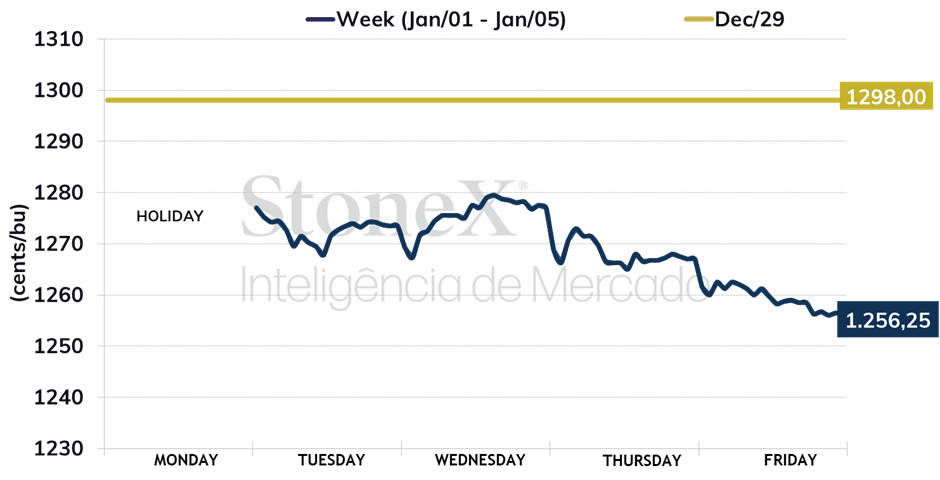
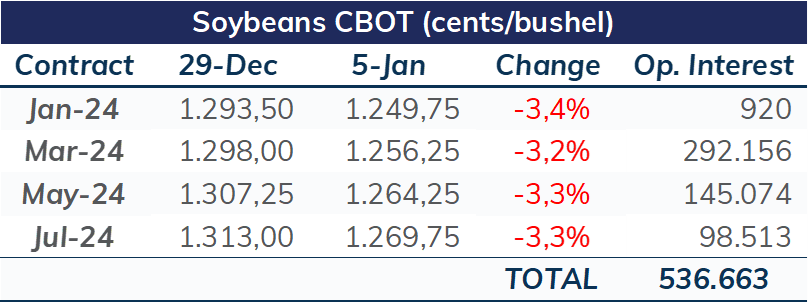
The first week of 2024 was bearish for soybean quotes in Chicago. The March contract ended Friday's session (05) at 1256.25 cents per bushel, a drop of 3.6%.
The main determinant of these losses was the occurrence of more significant and widespread rains in a large part of the soybean producing region in Brazil. Since the last week of December, it has been raining more intensely, alleviating the crops' drought conditions. Nevertheless, it should be noted that this improvement in moisture will mainly impact what was planted later. Even with the delays, the soybean planted early in the cycle, from mid-September onwards, has been affected by below-average rainfall since then and by high temperatures and heat waves.
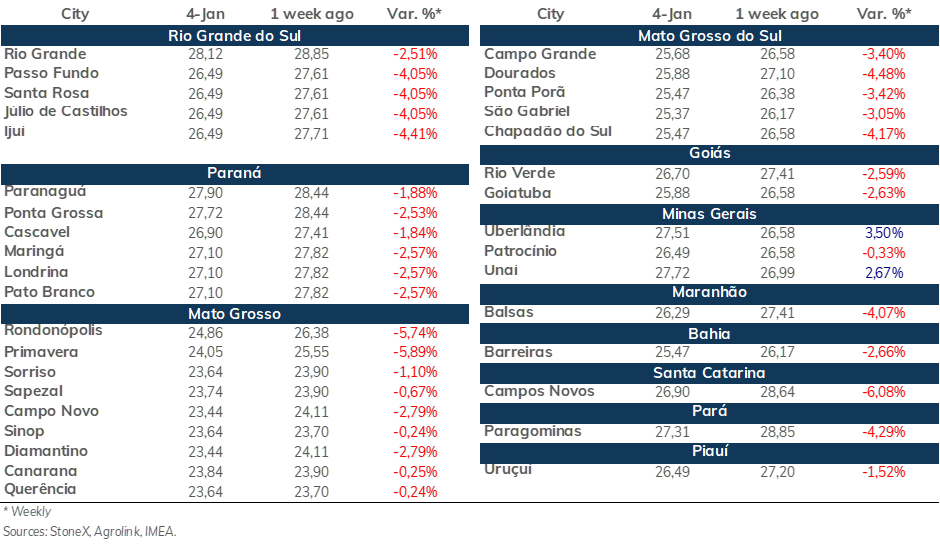
Thus, highlighting that the first half of December still had irregular rainfall, StoneX cut its soybean production estimate for Brazil in the 2023/24 cycle to 152.8 million tonnes in its January review, a 5.6% fall compared to the figure released in early December. This volume will not set a record if confirmed, staying below the previous crop.
Anyway, it is important to highlight the great variability of soybean crops in various regions and that the actual production size will only be known with the harvest.
Even with this prospect of lower production in Brazil, the market is "looking" at other factors besides the weather, which helps explain why the quotes in Chicago continue without the strength to rise.
Argentine production stands out on the supply side, with several estimates betting on a crop above 50 million tonnes. The USDA still has a production figure for the country at 48 million.
Regarding demand, there are concerns about the pace of global consumption, especially in China, where crushing margins are under pressure.
Given this scenario, it is worth remembering that the supply and demand balance worldwide, estimated by the USDA, indicates a production of almost 15 million tonnes above consumption (data released in December). Even with a cut in Brazilian production, around 10 million tonnes, there would not be a tight scenario in the global balance, remembering, once again, that Argentine production can achieve a slightly higher result.
Anyway, even though a tight global balance is not expected yet, even with negative adjustments in Brazilian production, the losses here impact the flow of oilseeds between exporters and importers.
With the lower availability of Brazilian soybean, the exported volume is also expected to decrease, falling below the more than 100 million tonnes shipped in 2023, which should encourage the search for grain in other players, especially the USA. As the country has a heated consumption and the balance is not comfortable, this situation could significantly boost prices in Chicago since the exchange in North American territory reflects what happens internally more closely.
Regarding Argentina, even with the recovery of its supply, there should be little room for more significant exports of soybeans, as the oilseed processing sector is currently facing low availability and should take advantage of it to recover its activity level after the harvest. In addition, the political and economic situation of the country is quite uncertain, which can be a disincentive to soybean exports, which end up being stored as insurance against inflation.
Accordingly, the market should continue to react to the weather conditions here until the progress of the harvest confirms the size of the Brazilian crop and the possible impact on the global supply and demand balance and international flows of the oilseed.
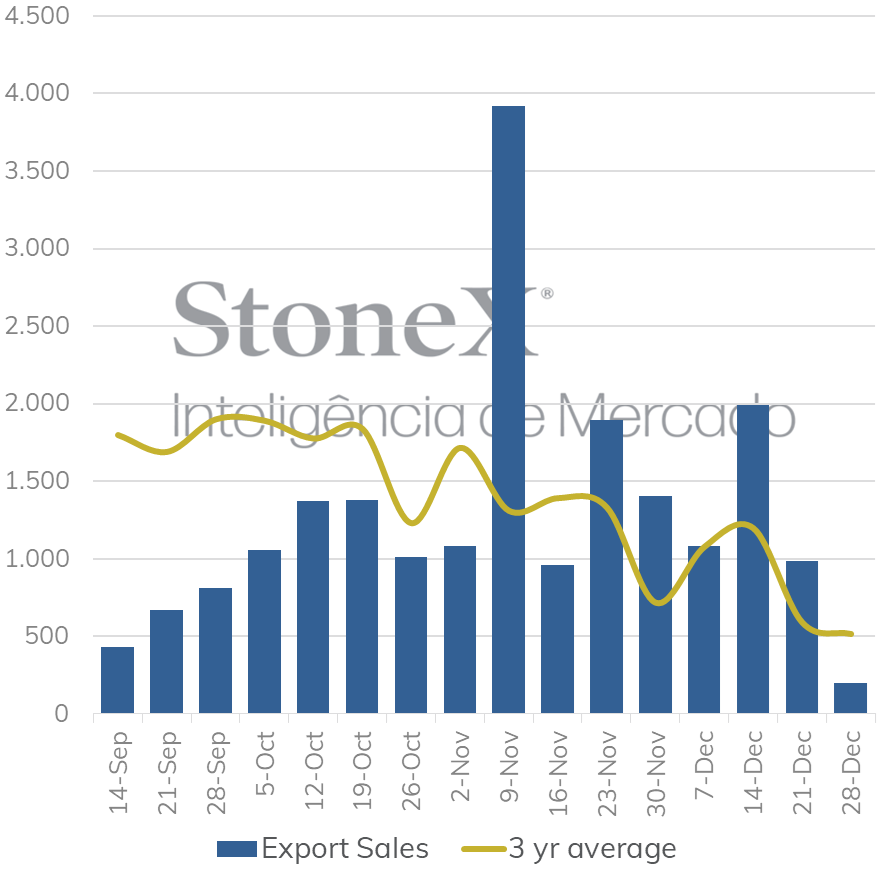
On the demand side, US export sales volumes fell below expectations in the week ended on November 28, reaching only 201.6 thousand tonnes, compared to expectations ranging from 500 thousand to 1.3 million tonnes. In the accumulated crop negotiations for 2023/24, they reached 36.5 million tonnes, more than 7 million below the same period last year. However, remember that USDA estimates an annual fall in shipments of 6.45 million tonnes. It should be noted that China is responsible for 6.4 million tonnes of this difference in negotiations compared to last year.
In Brazil, the exports for December were announced, reaching 3.8 million tonnes, bringing the total for 2023 to 101.9 million tonnes, a historical record for shipments. The record Brazilian production in 2022/23 also contributed to the replenishment of Chinese stocks, with the country taking advantage of the supply here to procure 74.5 million tonnes of the total exported.
This week, the monthly reports from CONAB and USDA will be released, which is highly anticipated due to the expectations of adjustments in the Brazilian crop. According to the USDA, market expectations average around 154 million tonnes for the 2023/24 production.
Brazil. In the case of Argentina, USDA may fetch some increase in its estimates for the country's production.
In addition, the USDA report for January brings revisions in US production, but no major surprises are expected.