- World production estimated above consumption in 2023/24, according to the USDA;
- Improvement in productivity with the harvest progress in Brazil;
- USDA cuts Brazil's crop by just 1 million tonnes;
- Crop should be favorable in Argentina;
- Concerns about the pace of global demand;
- Weak US export sales;
- Agricultural Forum brings growth in the US area.
- StoneX cuts soybean production again for 2023/24;
- Production estimates cut by CONAB and USDA;
- Hot and dry weather worsens crop conditions in Argentina;
- The Argentine situation still favors holding soybeans as insurance.
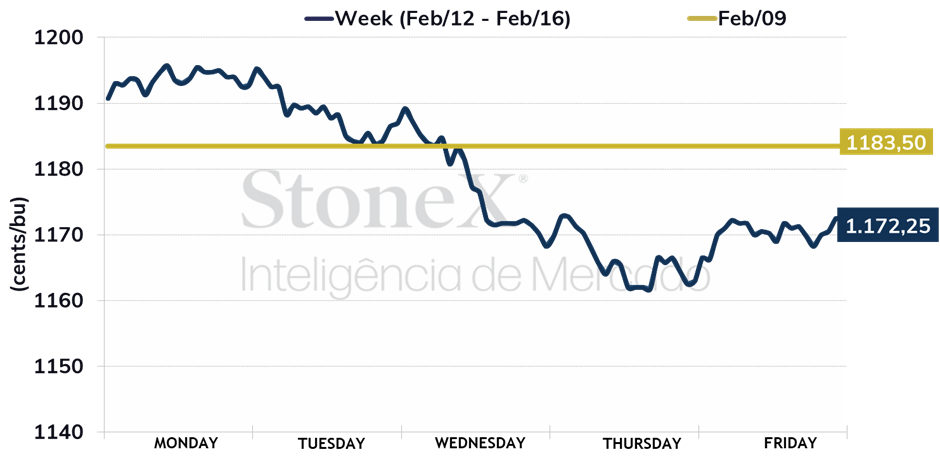
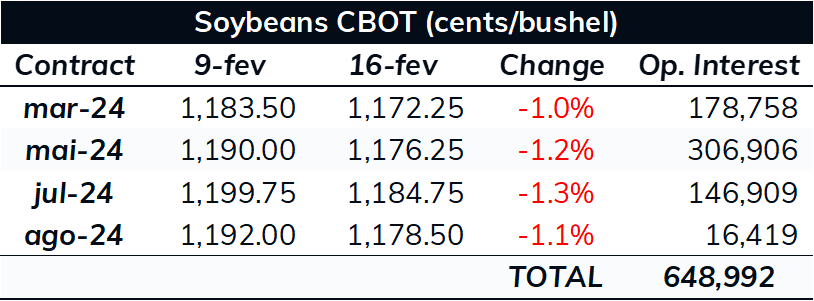
Last week was once again marked by a drop in soybean quotes in Chicago despite the positive daily results on Monday (12) and Friday (16). The March contract ended the period at 1172.25 cents per bushel, a 1% weekly drop.
The market continues to face concerns about the pace of demand, while the disruptions in Brazil are not enough to reduce the global supply to cause any significant constraints in the oilseed balance.
The weather in South America is being monitored, but as time goes by, a smaller proportion of crops are subject to significant changes due to the weather. The Brazilian harvest reached 32.3% last Friday (16), according to StoneX, while the weather in Argentina improved, positively impacting the conditions of the country's soybean crops.
After the heatwave, associated with less precipitation, that affected Argentina, the occurrence of recent rains improved the water conditions, with the optimal/adequate condition rising 13 p.p. to 73% of the country's agricultural area. There was also an improvement in the overall conditions of the plants, with 50% classified as G/E, compared to 47% a week earlier, while there was a decrease in the percentage of poor/regular from 22% to 19%.
Thus, even though the weather may have damaged the productive potential, the outlook has not changed, pointing to a bountiful crop in Argentina, with the Buenos Aires Exchange estimating soybean production at 52.5 million tonnes.
The week's highlight was the USDA Agricultural Forum, held on September 15 and 16, which brought figures for the 2024/25 crop in the US. Although these figures do not yet reflect producers’ intentions, based on field research, they indicate the expected trend because of the supply and demand scenario and grain prices.
The acreage for the country was estimated at 35.4 million hectares, compared to 33.8 million in the 2023/24 cycle, a difference of 1.58 million hectares in the annual comparison. Considering the trend yield at 3.5 tonnes per hectare, production would reach 122.6 million tonnes. The bets for this year are on soybean gaining area over corn since the US balance for the oilseed is adjusted and, considering the price behavior since last year. Anyway, a lot can still change, and the size of the acreage will only be known more accurately in the planted area report at the end of June.
On the demand side, it is still very early, but the USDA estimates a hike in both domestic consumption and exports. Even so, the higher production would lead to a more comfortable balance in the country, with ending stocks estimated at 11.8 million tonnes. Access the full S&D balance here.
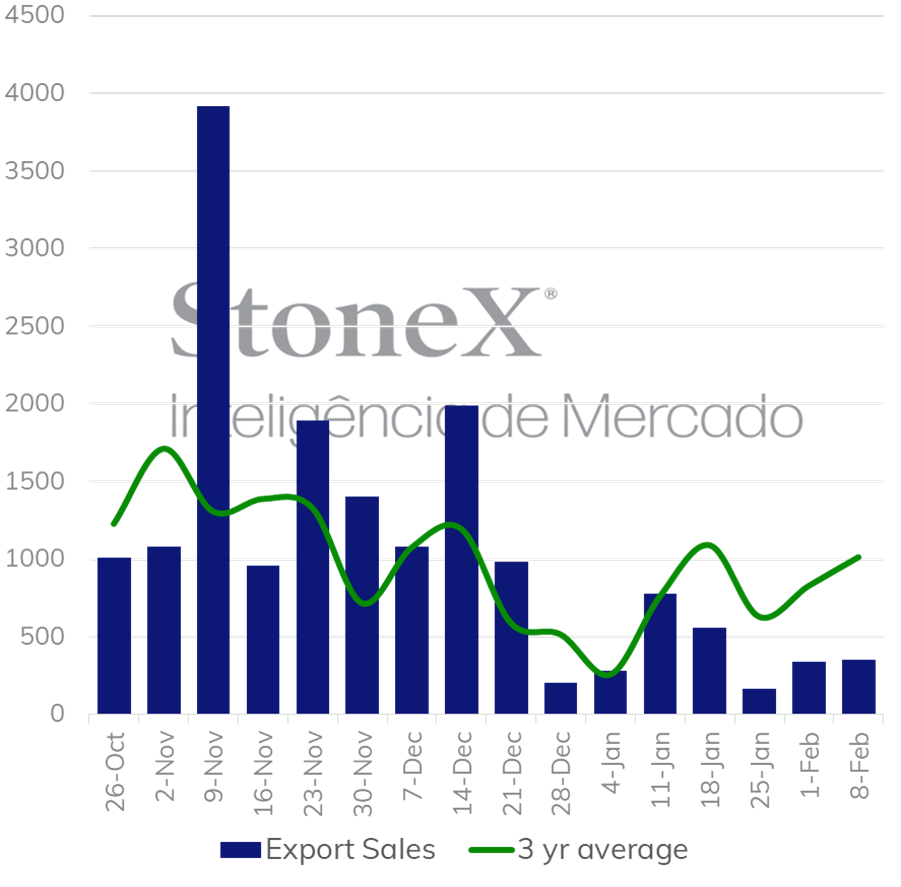
Regarding demand for American soybeans, export sales continue to show weak results. In the week ended on 02/08, net sales of the 2023/24 crop reached 353.8 thousand tonnes, at the lower end of the estimates, which ranged from 300 to 800 thousand tonnes. In total, sales reached 38.8 million tonnes, below last year by almost 48 million, but remember that the USDA adjusted the country's shipment estimate downwards to 47.76 million tonnes. It is important to remember that Brazilian soybeans remain more competitive than American soybeans in the context of concerns about the progress of global demand, especially with China's performance.
The National Oilseed Processors Association (NOPA) reported a crushing of 5.056 million tonnes of soybeans in January, below the market's average expectations of 5.17 million tonnes. Part of this result, below expectations, stemmed from climatic issues in the Midwest, but that does not fully explain the lower figure. Even so, it is worth noting that the grinding pace is more than enough to reach USDA's current processing estimate for the 2023/24 crop at 62.6 million tonnes. Even so, the market monitors the country's renewable diesel segment, which, despite being on the rise, has shown some less positive signs, such as the drop in D4 RINs. As the biofuel industry depends on sector incentive policies, any factor that may modify/affect these policies, such as soybean oil, has a very high potential to affect the feedstock market.