- World production estimated above consumption in 2023/24, according to the USDA;
- Improvement in productivity with the harvest progress in Brazil;
- Crop should be favorable in Argentina, even with recent adverse weather;
- Concerns about the pace of global demand;
- Weak US exports sales;
- Agricultural Forum brings growth in US area.
- Rosario Exchange reduces estimate for the Argentine crop due to adverse weather in the second half of January and beginning of March;
- The Argentine situation still favors holding soybeans as insurance.
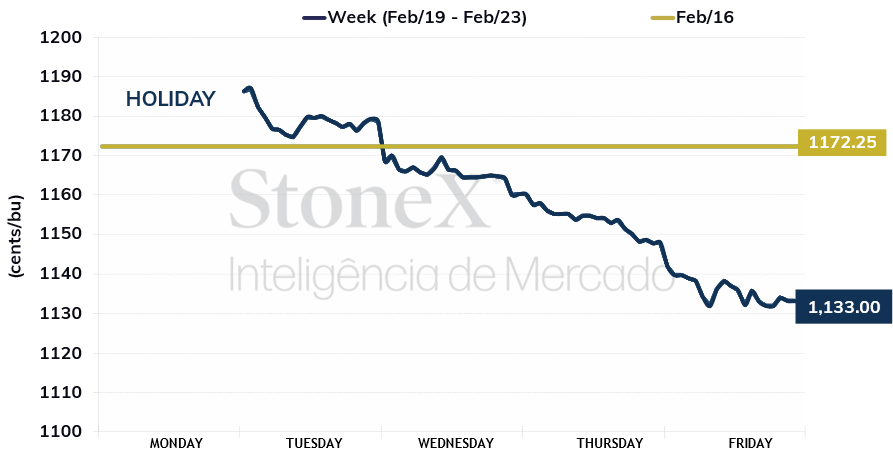
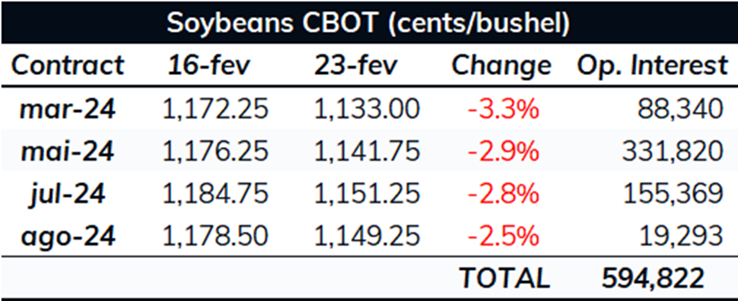
Even with positive results at the beginning of last week, soybean futures ended the period in the negative field. The March contract ended the week quoted at 1,133 cents per bushel, a 3.3% drop versus the closing of the previous Friday (Feb 16).
Despite the uncertainties about the South American crop still present in the market, the bearish trend continues to prevail, and, in general, the recent weather conditions have brought some reprieve to production on the continent, especially Brazilian production. Although new cuts may occur, China continues to signal weak demand, which has contributed to limiting oilseed prices. The margins of the hog market in the Asian giant remain negative, which contributes to uncertainties regarding the country's demand for soymeal and soybean.
US export inspections: The USDA Export Inspections Report indicated that US soybean shipments for the week ending February 15 totaled 1.19 mmt, a volume 11.6% lower than a week before (1.34 mmt) and 25% below the amount recorded in the equivalent week of 2023 (1.58 mmt). Thus, total exports in the 23/24 season reached 31.97 million tonnes, 9.42 million less than in the same period of 22/23.
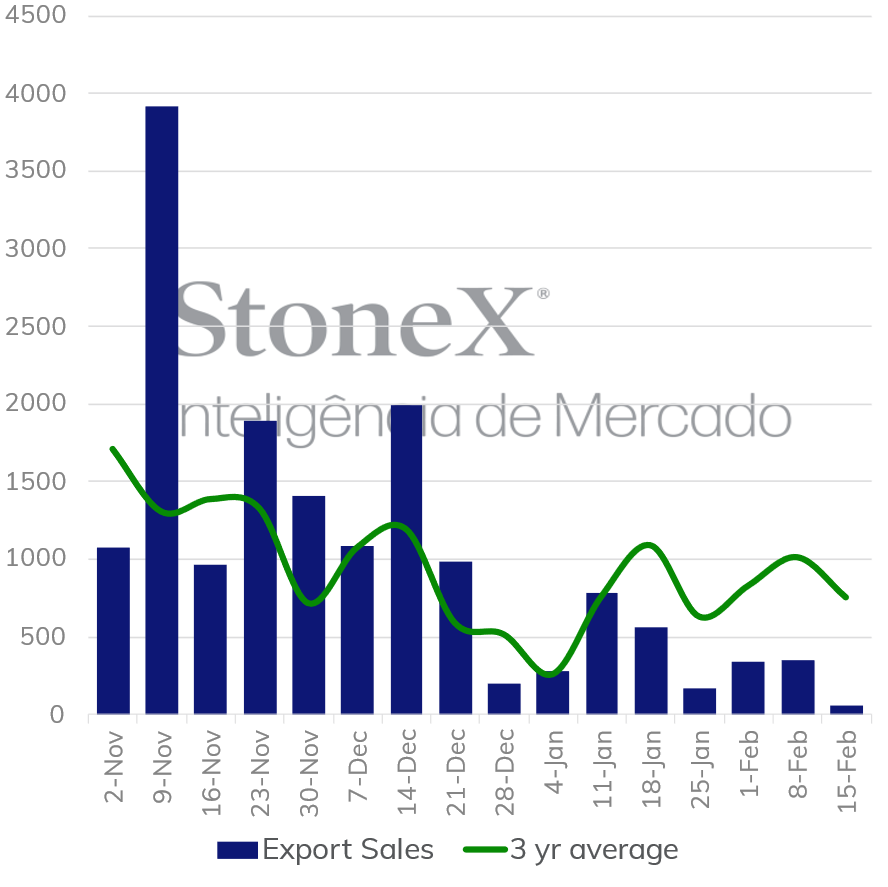
US export sales: Contrary to the Export Inspections Report, which still brought considerable shipments, the USDA's Export Sales Report brought disappointing volumes. The Department reported that the US documented only 55.9 tmt of net sales in the week ended on Feb 15, compared to 414.1 tmt in the previous week and 419.7 tmt in the equivalent week of 2023. The figure was well below the lower market estimate limit, between 300,000 and 800,000 tonnes. In the accumulated, the sales of the 23/24 crop totaled 38.9 million tonnes, against 48.4 million in the same period of 22/23.
Argentinian crop: In Argentina, the Rosario Exchange reduced its estimate for the 23/24 soybean crop to 49.5 million tonnes, 2.5 million less than previously estimated. The cut was motivated by the hot and dry pattern recorded in the country between mid-January and the first weeks of February. On the other hand, the Buenos Aires Exchange reported that the country's soybean crops improved their conditions due to the recent rains. According to BCBA, 31% of the national soybean area was in good or excellent condition at the end of last week, in line with the previous week, but 29 p.p. above the level recorded a year earlier. Soybean crops in poor/very poor condition currently represent 17% of the total, two percentage points less than the previous week and 41 percentage points below the level observed in the same period of 2023. Thus, despite the recent climatic adversities, the prospects remain positive for the Argentine crop, with the Buenos Aires Exchange having a more optimistic outlook than Rosario, estimating our neighbors' 23/24 production at 52.5 million tonnes.
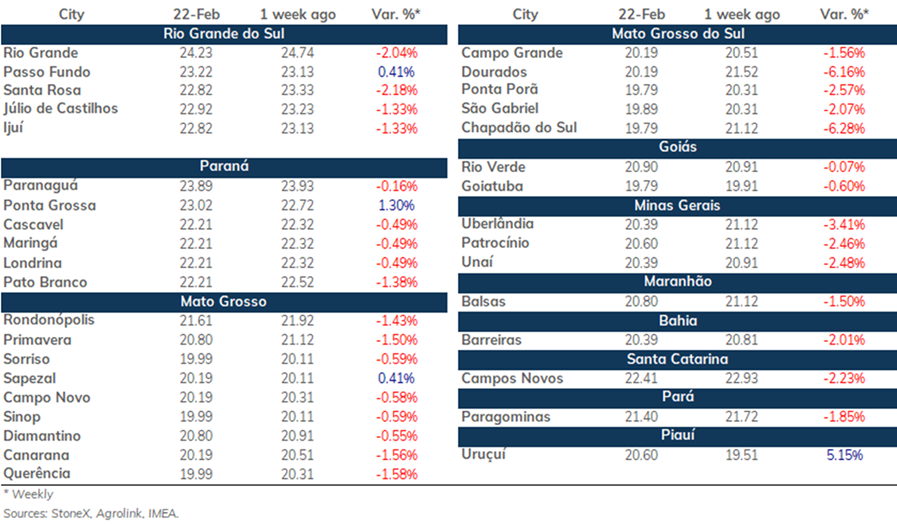
Brazilian crop: The production of Brazil's 23/24 crop remains the center of attention and is projected to continue at least until the harvest is closer to its completion. In the last two weeks, good precipitation volumes have been recorded in most of Brazil's soybean-producing regions, bringing more optimistic prospects, especially for the crops planted later. Versus the progress of the crop, according to StoneX's monitoring, the oilseed harvest reached 41.6% at the end of last week, about ten p.p. more than the same period last year. The weather models indicate a drier pattern in the coming days, which could help fieldwork progress.
In this upcoming week, the highlight is the release of the new figures from StoneX for the Brazilian crop next Friday (Mar 1).