- Bearish factors
- Global production for 24/25 exceeds consumption, according to the USDA;
- Concerns about the pace of global demand;
- Record production estimate for Brazil’s 24/25 crop;
- Strong initial harvest results in Argentina;
- China raises retaliatory tariffs on the U.S.
- Bullish factors
- New incentive measures adopted by the Chinese government;
- Estimated decrease in U.S. planted area for the 25/26 crop;
- Loss of potential in the Argentine crop;
- Possible increase in the U.S. biodiesel and renewable diesel mandates;
- Possible easing/delay of Chinese ship inspections at U.S. ports;
- Alleviation of trade tensions following U.S. officials’ statements.
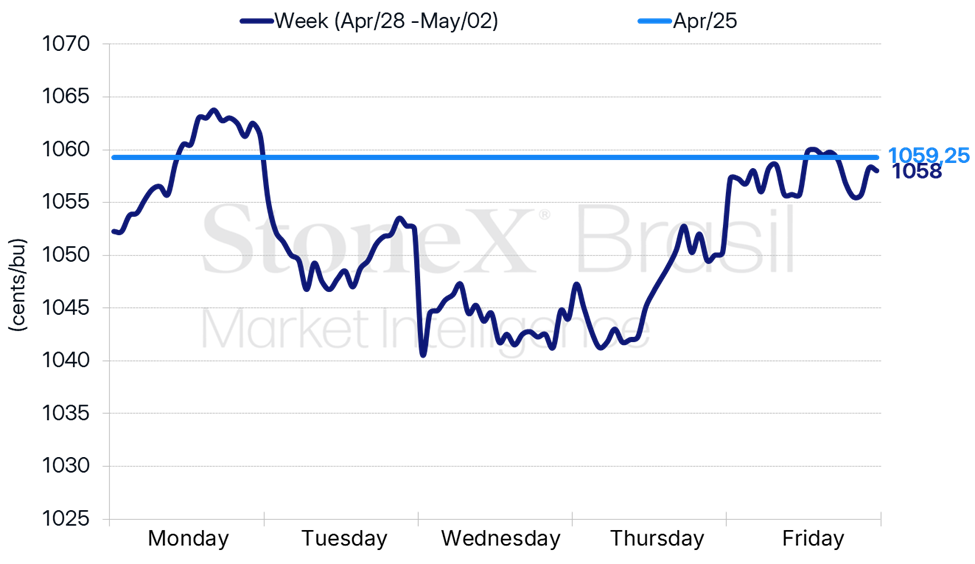
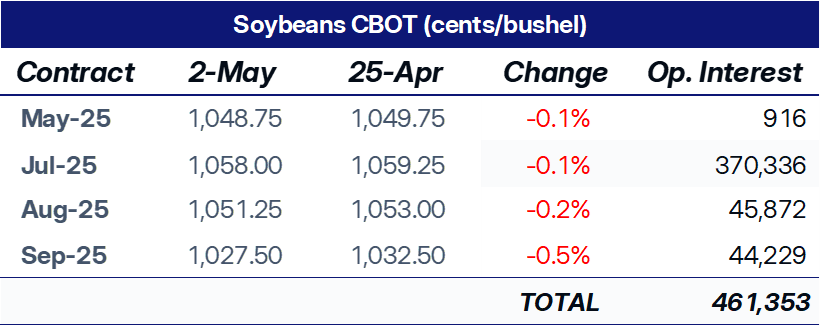
Last week, soybean prices at the CBOT saw limited fluctuations and ended the period slightly lower. The May 2 close for the July contract was 1058 cents per bushel, down 0.1% over seven days.
The market continues to monitor U.S.–China trade tensions, potential updates on the U.S. biofuels policy, and planting progress of the 25/26 crop. In South America, Brazilian exports remain under scrutiny, as does the progress of the Argentine crop.
U.S. officials commented early in the week that talks with China were underway, which China denied on multiple occasions. Later, China stated it was considering possible discussions on trade and tariff issues with the U.S. Even so, there is nothing concrete yet to ease the situation for U.S. soybean exports, which remain taxed by the world’s largest buyer. At this time of year, China largely sources from Brazil, buying little from the U.S., so concerns are lower. However, if China continues imposing tariffs during the year’s final quarter—when U.S. export volumes peak—the impact would be significant. Although Brazil is wrapping up a record crop and is already China’s main supplier, the U.S. still exports over 25 million tonnes of soybeans to China annually, so any reduction in purchases would have a substantial effect.
In a broader perspective, it’s important to remember that Chinese imports are no longer growing as they did before the pandemic, and the Chinese government is working to reduce soybean meal inclusion in feed—from a 13% rate in 2025 to 10% by 2030. Thus, regardless of the current tariff war context, Chinese consumption and purchasing behavior will remain central in the coming years, given China’s importance to global soybean demand.
The U.S. has been investing in renewable diesel capacity in recent years to boost domestic soybean use amid export competition with Brazil. Crush capacity investments are advancing to meet that demand. However, biofuel production depends on incentive programs, so the market is awaiting announcements of increased mandates after Trump urged fossil and renewable sectors to reach an agreement. The outlook is for significantly higher biodiesel and renewable diesel mandates.
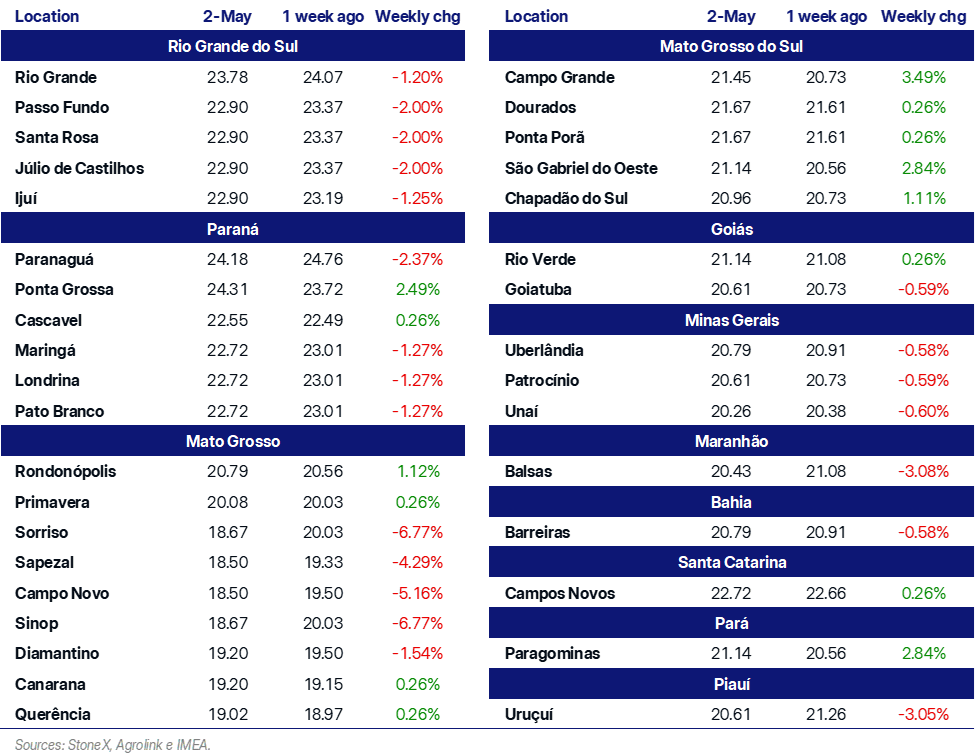
In South America, Brazil’s crop is nearly complete, and the market is monitoring demand. Last week, Brazil’s port premiums declined, further enhancing Brazilian competitiveness against the U.S. In any case, the current U.S.–China tariffs remain prohibitive—even if Brazil’s premium levels stay elevated.
Through April 25, nearly 13 million tonnes of Brazilian soybeans were shipped, with full-month data due tomorrow, indicating very robust exports typical for the period. With Brazil’s record crop, shipments are expected to remain significant into the year’s second half as production continues to grow.
In Argentina, the 24/25 soybean harvest reached 23.6% of the total, per the Buenos Aires Grain Exchange—still 12 percentage points behind last year’s pace. Regions such as Córdoba and Entre Ríos have shown better-than-expected results, suggesting a strong crop. However, with three-quarters of the harvest still to go, the Exchange keeps its production forecast at 48.6 million tonnes. Despite promising early prospects, the share of crops rated good or excellent declined from 43% to 39%, though it remains well above last year’s 27%.
This week, attention remains focused on potential China–U.S. talks and on U.S. planting progress, which reached 18% as of Sunday the 27th—ahead of the five-year average and slightly above last year’s pace.