- Bearish factors
- World production in 25/26 still surpassing consumption, according to the USDA;
- Concerns about the pace of global demand;
- Estimate of record production for the Brazilian 24/25 crop;
- Good crop results in Argentina, with an upward revision of the crop;
- Accelerated sowing in the USA;
- Avian influenza outbreaks in Brazil.
- Bullish factors
- Estimate of decline in area in the 25/26 crop in the US;
- Possible increase in the biodiesel and renewable diesel mandate in the US;
- Possible relaxation/postponement of the taxation of Chinese ships in US ports;
- Retreat in tariffs charged between the USA and China;
- Excessive rainfall in Argentina.
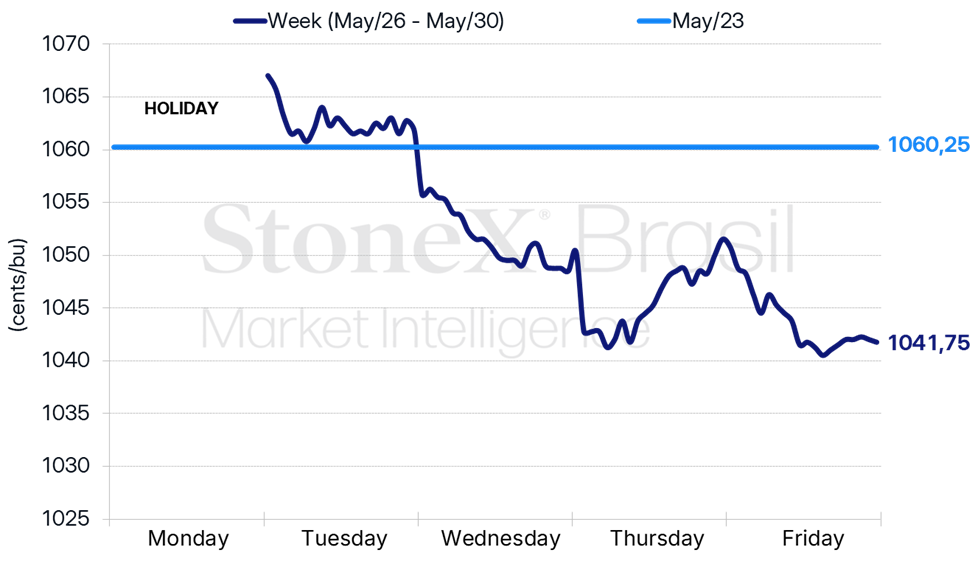
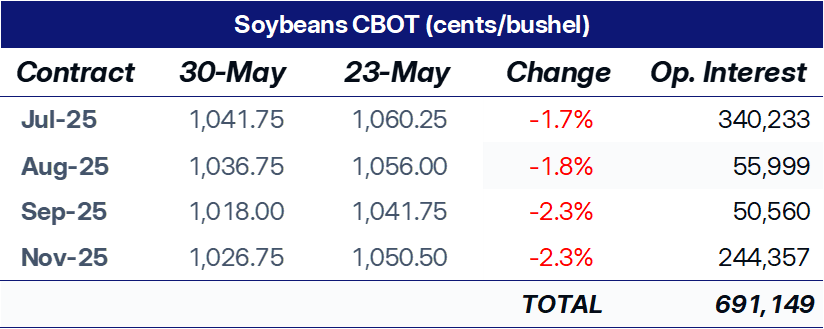
Soybean quotes in Chicago posted a drop last week, with the July contract closing on Friday (the 30th) at 1041.75 cents per bushel, a decrease of 1.7% for the period. The market continues to follow updates on US biofuel policies, the country's crop, as well as the completion of the harvest in South America. Another point of attention is the new intensification of tensions between the US and China.
Regarding biofuels in the US, many uncertainties still remain about the progress of the 45Z project, even with expectations indicating a favorable outcome for soybean oil consumption and, consequently, for soybean. It is expected that local feedstocks will be favored over imported ones, in addition to the length of the program for the coming years, providing predictability for the segment. Regarding the proposal for the RVOs (the biofuel mandates) in the USA, rumors are that the Environmental Protection Agency (EPA) would have indicated volumes lower than the 5.25 billion gallons requested by the sector. If confirmed, the news could frustrate expectations, since the market had been betting on the approval of more robust volumes.
Another point is the issue of exemptions for small refineries in complying with the mandates, with rumors, based on a news report, indicating that the government is considering approving part of the requests related to 2024, made by 19 refineries, and postponing decisions on the older ones, in order to avoid major impacts on the biofuel credit market (RINs). More than 160 requests remain outstanding. It would also be under review the possibility of requiring larger refineries to offset the exempt volumes.
Meanwhile, the 25/26 North American crop continues to show good progress, with sowing having reached 76% of the total on Sunday, 05/25, a percentage above last year, at 66%, and the average, which was at 68%. The sowing more advanced is considered favorable and the market awaits the release of the acreage data by the USDA, at the end of June, which could indicate last-minute changes. A point of attention is the occurrence of heavier rains in the eastern part of the country's grain belt, which could result in delays in corn and a last-minute switch to soybean. However, it is only speculation, with area revisions possibly occurring even after the report at the end of June.
In South America, the focus on the supply side is on Argentina, after the country recorded excessive rainfall in the last few weeks. The 24/25 soybean harvest slowed down a bit, reaching 80.7% in the latest release from the Buenos Aires Exchange, 5 p.p. below what was recorded in the same period last year and 7 p.p. behind the five-year average. In any case, the Buenos Aires Exchange continues to indicate quite favorable yield, maintaining the estimated production at 50 million tonnes, despite concerns about possible impacts from the rains.
In Brazil, exports remain strong, with the total from May up to the 23rd reaching 11.1 million tonnes. The number set for the month will be released in the coming days. With the record soybean production, the prospects are that the exports will also be record-breaking in 2025, and the premiums in Brazil remain more competitive than in the USA, which is usual for this time of year. A point to follow is the tensions between the US and China, with the two countries accusing each other of not complying with the terms of the agreement negotiated in May in Switzerland.
For now, there is no news that directly impacts the market and soybean, but it is always a factor to watch, especially if there is any significant tax from China on North American soybean later in the year, when the availability of the oilseed from the US increases, leading to the country's best export period in the last quarter of the year.
This week, attention should be quite focused on the relationship between the US and China, as well as the monitoring of the US and Argentina crop.