- Bearish factors
- World production in 25/26 still surpassing consumption, according to the USDA;
- Concerns about the pace of global demand;
- Estimate of record production for the Brazilian 24/25 crop;
- Good crop results in Argentina, with an upward revision of the crop;
- Accelerated sowing in the USA;
- Avian influenza outbreaks in Brazil.
- Bullish factors
- Estimate of decline in area in the 25/26 crop in the US;
- Possible increase in the biodiesel and renewable diesel mandate in the US;
- Possible relaxation/postponement of the taxation of Chinese ships in US ports;
- Retreat in tariffs charged between the USA and China;
- Delays in the Argentine harvest.
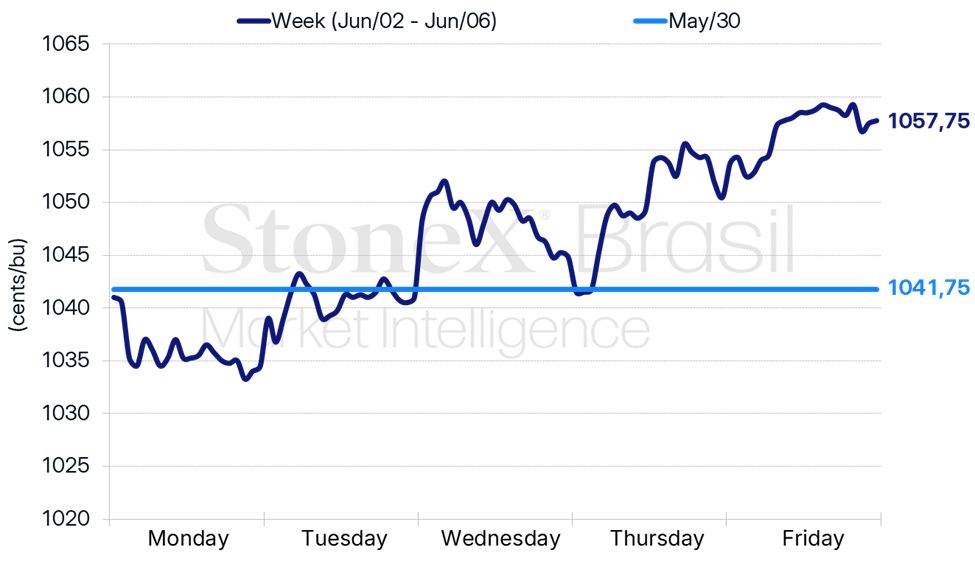
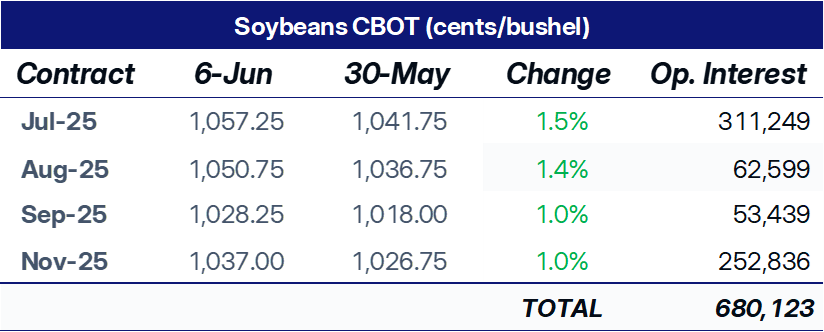
Soybean quotes in Chicago registered an increase last week, with a position adjustment and lower prices attracting buyers to the market, which continues to follow the developments of biofuel negotiations in the US, as well as the progress of the country's crop. In South America, attention is focused on the harvest of the Argentine crop 24/25, with weather conditions on the radar. The expiry for July closed on Friday (06) at 1057.25 cents per bushel, a weekly increase of 1.5%.
The shortage of concrete news about biofuel policies in the US, such as the definition of mandates by the Environmental Protection Agency (EPA), weighed on soybean oil prices and consequently on the grain, in the first trading sessions of the week. Due to this lack of definition, renewable diesel production in the country fell by 12% in the first quarter of the year compared to the immediately preceding quarter. The estimates also point to a decrease in biodiesel production in 2025, with the excess soybean oil being directed to exports.
Regarding the 25/26 crop in the US, sowing reached 84% of the total projected area as of 06/01, remaining above the five-year average at 80%, and surpassing last year, when it reached 77%. Although this is an average fast pace, it is noted that some states in the eastern part of the belt are further behind due to excessive rainfall during certain periods. These are the more lagging states, like Ohio, Kentucky, and Tennessee, that showed a slightly below usual G/E percentage in the first release of this indicator. Other states that have faced drier conditions, and are further along with the sowing, also report slightly worse conditions, as is the case with Nebraska and North Dakota. Even so, the national G/E percentage stood at 67%, close to what the market expected, at 68%, indicating, overall, good conditions of the crops.
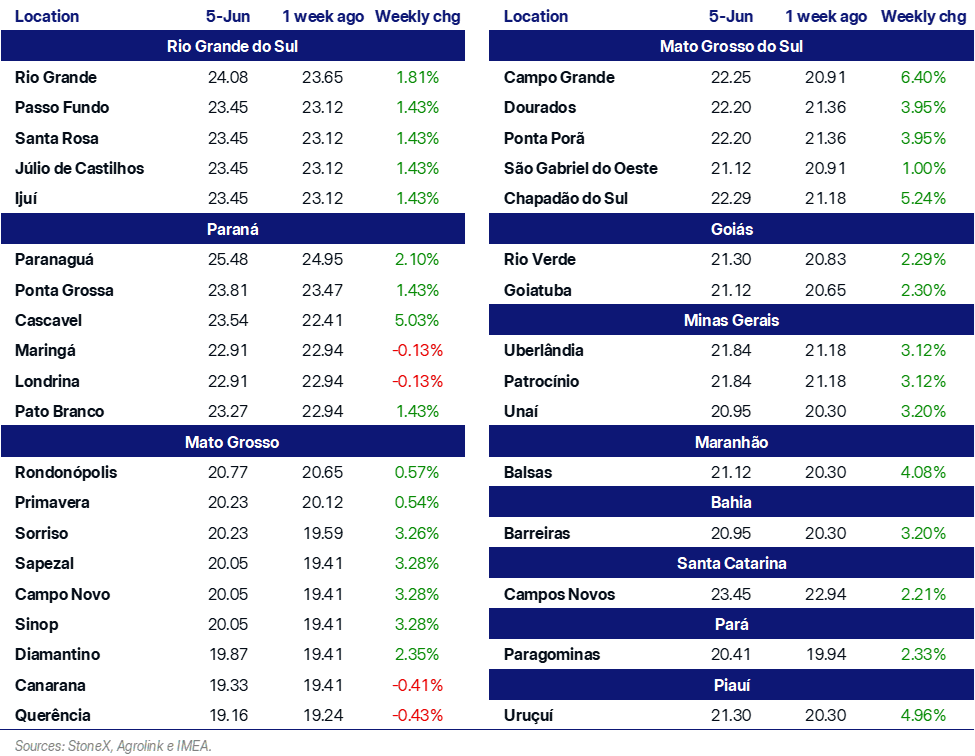
In Brazil, with the harvest completed, attention is currently more focused on the demand side, with exports remaining strong and Brazilian grain competitive, even with the recent strengthening of premiums at the ports. The official data for May indicated shipments at 14 million tonnes, a volume above that recorded in the same month last year, when it was 13.4 million. In the cumulative total for 2025, 51.5 mmt of soybean were shipped, also above what was recorded in the first five months of 2024. With the record soybean crop, estimated at 168.25 million tonnes by StoneX, the expectations are that the exports will also reach the highest level in history this year. This situation can be further reinforced by the tensions between the US and China, if any significant taxation on American soybean is in effect, especially towards the end of the year, when the US records the highest exported volumes, after the harvest.
In Argentina, the harvest of the 24/25 soybean crop reached 88.7% of the total last Wednesday (4), according to the Buenos Aires Grain Exchange. Even though no precipitation was recorded during the assessed period, fieldwork is still 3.5 p.p. behind last year and 3.7 p.p. below the five-year average, due to excess rainfall recorded in some regions of the country in May. Even with these delays, the observed productivity has been above the initial expectations, with the Buenos Aires Exchange maintaining its estimate at 50 mmt.
This week, the main highlight should be the release of the USDA supply and demand report, in addition to possible advances in talks between China and the US, after both countries signaled willingness to negotiate, reducing fears of escalating tensions. Officials from both countries are meeting in London this Monday (09).
The USDA report for June should not bring any major surprises as is usually the case, especially with the good progress of the US crop so far. The most anticipated data this month should be the country's acreage, which will be updated on June 30, revising the sowing intentions, which is the number currently adopted as a reference by the USDA for the 25/26 crop in the USA. Consequently, this new acreage will be incorporated into the USDA's monthly report in July.
Regarding South America, the average of market estimates for Argentine 24/25 production is at 49 million tonnes, a little lower than expected by the Buenos Aires exchange.