- Bearish Factors
- 2025/26 global production still exceeding consumption, according to USDA;
- Concerns over global demand pace;
- Record production estimate for Brazil’s 2024/25 season;
- Buenos Aires Stock Exchange revises Argentina’s harvest estimate upward;
- Accelerated planting in the U.S.;
- Favorable weather forecasts in the U.S.
- Bullish Factors
- Estimated reduction in U.S. crop area for 2025/26;
- EPA announces increase in biodiesel and renewable diesel mandates in the U.S.;
- Possible relaxation/delay of taxation on Chinese ships at U.S. ports;
- Progress in China–U.S. trade talks;
- Increased biodiesel blend in diesel in Brazil.
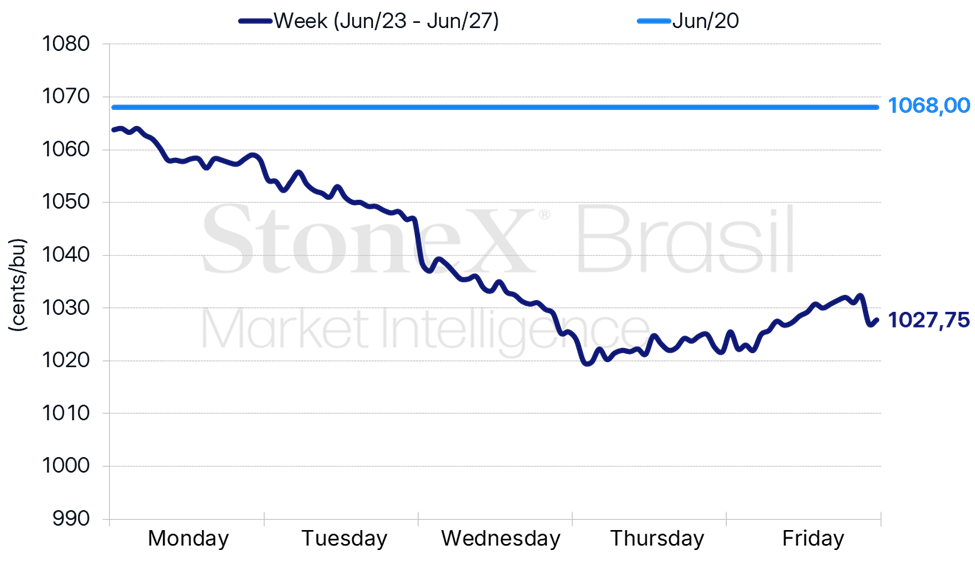
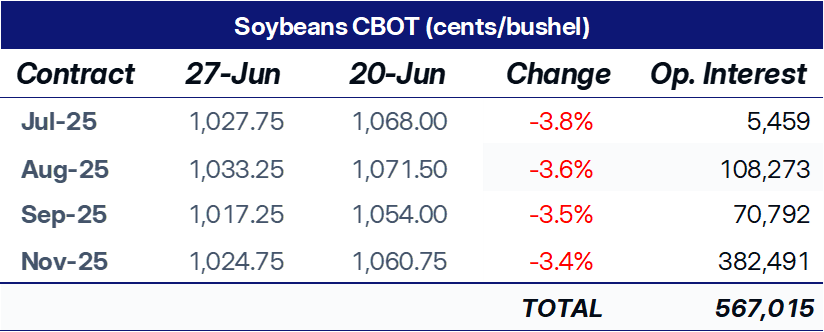
Soybean prices retreated in Chicago last week, driven by strong prospects for the 2025/26 U.S. crop and uncertainty around U.S. biofuels mandates, with position adjustments. The July contract closed on Friday (the 27th) at 1,027.75 cents per bushel, down 3.8% over the period.
U.S. planting is nearly complete, having reached 96% of the total as of June 22, the same percentage as last year and close to the five-year average of 97%. Crop conditions remained rated good to excellent at 66%, with improvements in the eastern belt offsetting deterioration further west. The weather outlook for the coming days is favorable, with rain expected in drier areas and milder temperatures, which should support crop conditions.
Regarding the U.S. biofuels program, although mandates proposed for next year came in slightly above expectations—supporting soybean oil and soy in recent weeks—the final rule is still pending. There may be questions and amendments before the text is finalized, and significant uncertainty remains about whether the rule that imported feedstocks generate only half the credits applies solely to imported oils and fats or also to imported and processed grains in the U.S.
Another point of attention is the price differential between soybean oil and meal. As oil use increases and soybean crushing rises, meal availability grows. However, domestic demand for meal does not expand at the same pace as oil demand, which tends to strengthen oil prices and weaken meal prices. Thus, while higher soybean oil prices positively impact crush margins, lower meal prices work in the opposite direction, requiring a larger share of the protein byproduct to be exported, competing with other exporters like Argentina and Brazil.
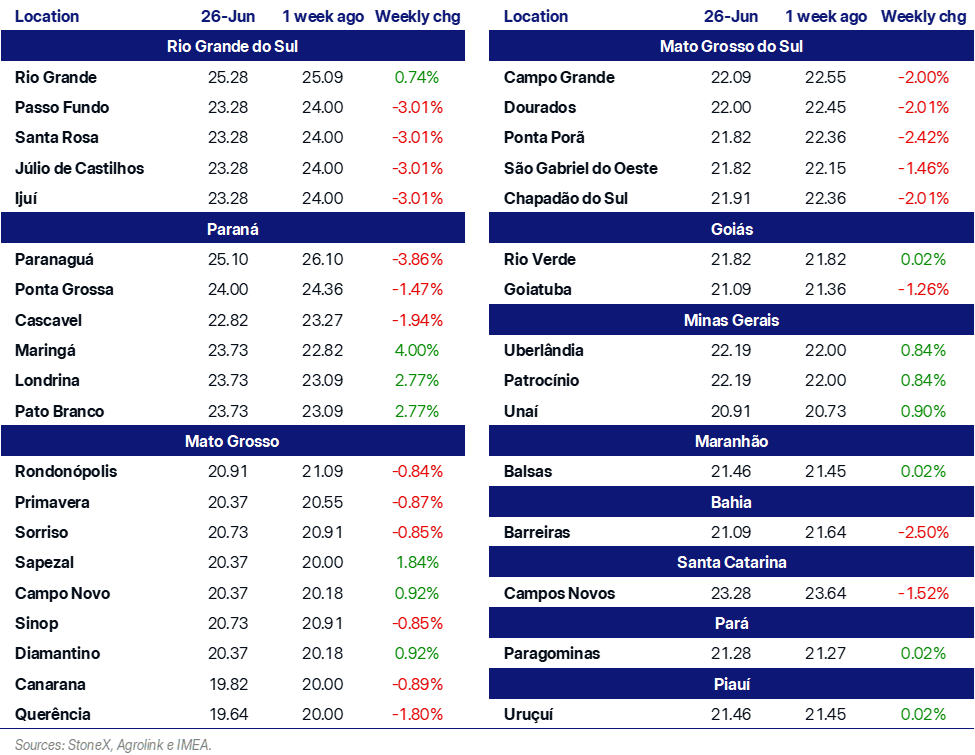
This concern about increased soybean meal availability due to expanding biofuels programs exists not only in the U.S. but also in Brazil. Last week, Brazil announced an increase in the biodiesel blend in diesel from 14% to 15% starting in August. Although this increase is delayed, the measure is likely to further support soybean crushing, which has been strong, even though the blend remained at 14% earlier this year. Brazil is already the world’s second-largest exporter of soybean meal, behind Argentina, with increased soybean processing reinforcing this scenario.
It is worth noting that major importers generally prefer to source the grain and process the oilseeds domestically, as is the case with China. However, last week saw an announcement of an Argentine soybean meal sale to China in a volume between 30,000 and 60,000 tonnes—the first such transaction in six years. Since China imports very little meal annually—around 50,000 tonnes—this purchase should stay on the radar. The volume is still low and could simply be a new Chinese strategy to minimize U.S. soy imports. Nonetheless, given the ample meal availability in major exporting countries, China might eventually buy slightly more soybean meal directly.
In Argentina, the 2024/25 harvest reached 98.3% completion, according to the Buenos Aires Stock Exchange, with an average yield to date of 2.98 tonnes per hectare—15% above the average of the last five seasons and 4% higher than in the 2022/23 cycle. Accordingly, the institution maintains its harvest estimate at 50.3 million tonnes.
In Brazil, soybean exports reached 9 million tonnes as of June 20, bringing the year-to-date total since January to 60.6 million tonnes. The data for the full month will be released next Friday (the 4th).
This week, the U.S. crop will continue to be monitored, with prospects for positive weather conditions. In Brazil, StoneX will release its crop update tomorrow, the 1st, still covering the 2024/25 cycle. Starting in August, the publication will include numbers for the new 2025/26 season.