- Bearish factors
- World production in 25/26 still exceeding consumption, according to the USDA;
- Concerns about the pace of global demand;
- StoneX estimates a record production for the Brazilian 25/26 crop;
- StoneX estimates a crop above 120 mmt for the US;
- Good crop conditions in the US;
- Favorable weather in the US;
- USDA estimates record productivity for the US.
- Bullish factors
- Revision of the crop area for the 25/26 season in the US, with a decrease of 1 million hectares;
- EPA announces increased mandate for biodiesel and renewable diesel in the US;
- Approval of the 45Z credit in the US, which should benefit soybean oil;
- Possible extension of the truce between China and the US;
- Trump says he would like China to buy more soybean from the US;
- Increase of the biodiesel-diesel blend in Brazil;
- Chinese soybean imports are heating up.
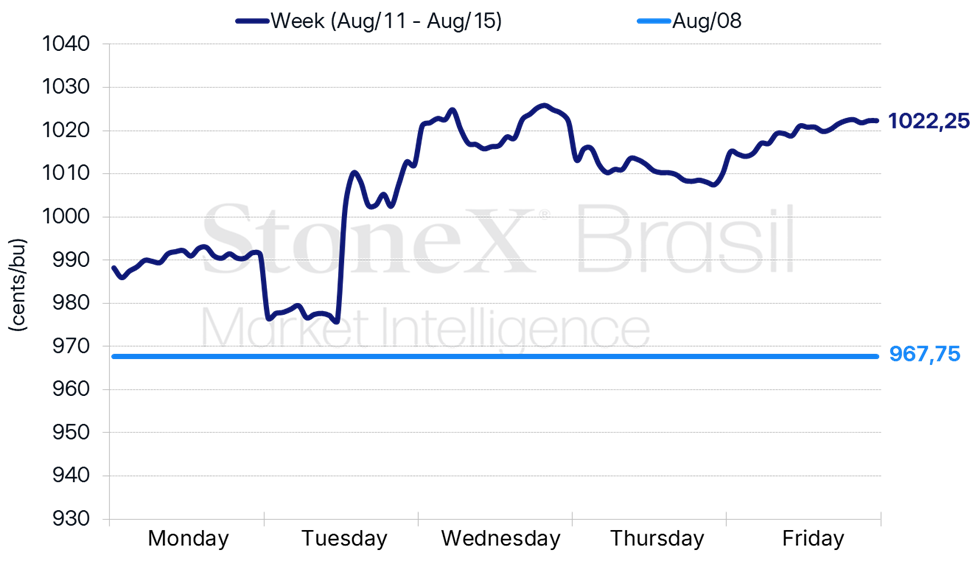
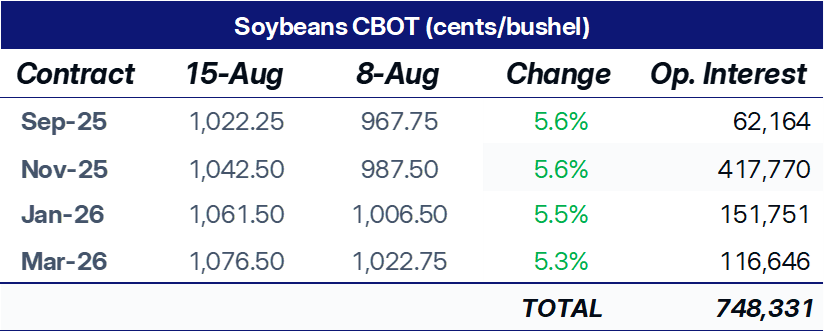
Soybean quotes in Chicago posted gains last week, with the expiration for September closing on Friday (15) at 1022.25 cents per bushel, a 5.6% increase for the period. Besides Donald Trump's post about wanting China to increase purchases of US soybean, the USDA's monthly supply and demand report was surprising.
As highlighted in last week's publication, Trump's statement on a social network that he would like China to quadruple its imports of soybean from the U.S. provided important support to the oilseed prices. Despite the rise in prices, it must be remembered that there is no official agreement announced. Furthermore, during Trump's first term, China did not meet the agreed purchase volumes of American agricultural products. Accordingly, this possibility will continue to be monitored, especially with the American crop harvest approaching and with the last quarter of the year being the best period for U.S. exports. However, even if there is some type of agreement that increases the purchases of American soybean by the US, other destinations should start to source from Brazil more. There are no greater expectations that a potential agreement will increase global imports, with a rearrangement of commercial flows.
The USDA supply and demand report for August is always highly anticipated by the market due to possible productivity adjustments. For soybean, the Department raised the national average yield from 3.53 to 3.6 tonnes per hectare, the same level estimated by StoneX a week earlier. This optimism about the result reflects the good conditions that, overall, have prevailed since the beginning of the cycle, resulting, including, in low volatility in prices, even during a period known as the "weather market." The G/E percentage of the country's crops stood at 68% in the week ending August 10, a drop of 1 p.p., but above the five-year average of 63%, and the same percentage recorded at this time in 2024.
In any case, the big surprise was the reduction of one million hectares in the soybean acreage in the US. As a result, even with the increase in productivity, there was a decline in the production number, which fell to 116.8 mmt. Furthermore, it is noteworthy that the USDA reduced the country's expected exports for the 25/26 cycle by about 1 mmt, to 46.4 mmt. Thus, the supply and demand balance was not so tight, with the ending stocks at 7.89 mmt.
Although a lot can still change, with the exports period for the 25/26 North American crop running from September 2025 to August 2026, it is also not guaranteed that production will remain at this level, recording an average record yield of 3.6 tonnes per hectare. Since 2017, only in two years, there was no cut in the yield between the USDA reports from August and January, when the final production numbers are usually known. Thus, even though the prospects for the country's crop are very positive, significant changes on the supply side may still occur.
On the demand side, domestic consumption in the United States is more consolidated, given the prospects of increased biofuel mandates, a situation that will increase the supply of soybean meal, a larger portion of which will need to be directed to the foreign market.
For Brazil, the USDA made no changes to its figures, with the 25/26 crop production estimated at 175 mmt. With the month of September approaching, weather conditions should be increasingly on the radar. In Mato Grosso, the soybean fallow period lasts until September 6, while some areas in Paraná can start planting from the 10th. However, rainfall is necessary to provide adequate soil moisture conditions and the start of sowing.
Brazilian shipments, on the other hand, remain strong, having reached 2.77 mmt as of August 8. Since the beginning of January, 80 mmt have been exported. China continues to reserve a significant amount of Brazilian soybean, taking advantage of the supply derived from the harvest of a record crop here.
This week, the progress of the US crop should remain on the radar, with the month of August being central to determining productivity, due to the grain filling stage. Moreover, any news about the relationship between China and the US will be carefully evaluated.