- Bearish factors
- World production in 25/26 still surpassing consumption, according to the USDA;
- Concerns about the pace of global demand;
- StoneX estimates a record production for the Brazilian crop 25/26;
- China is not buying soybean from the US;
- Good crop conditions in the USA;
- Favorable weather in the USA;
- USDA estimates record productivity for the US.
- Bullish factors
- Revision of the crop area for the 25/26 crop in the US, with a decrease of 1 million hectares;
- EPA announces increased mandate for biodiesel and renewable diesel in the US;
- Approval of the 45Z credit in the US, which should benefit soybean oil;
- Large refineries in the US will be able to absorb exemptions from small ones;
- Trump says he would like China to buy more soybean from the US;
- Increase of the biodiesel-diesel blend in Brazil;
- Chinese soybean imports are heating up, with a focus on South America.
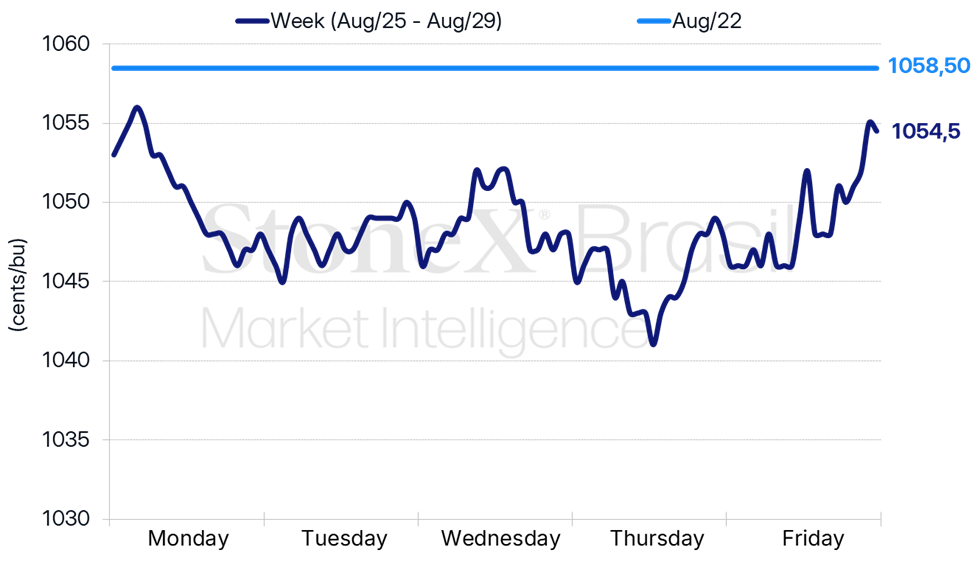
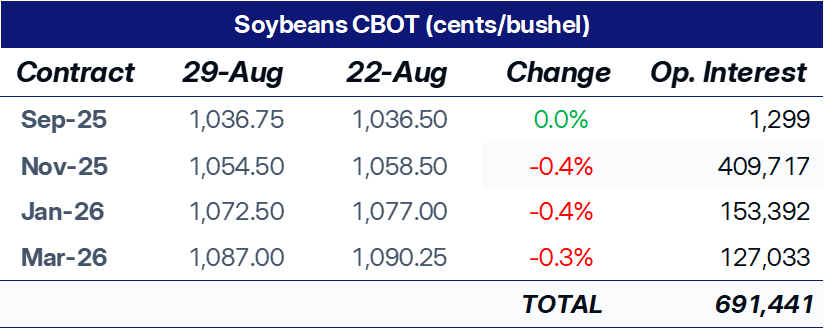
Soybean quotes in Chicago had a week of more limited fluctuations, with the November maturity ending Friday (29th) near stability, at 1054.5 cents per bushel. There were no major updates on the fundamentals side, with expectations of an excellent crop in the US, the relationship with China on the radar, and Brazil’s 25/26 crop still not yet started.
In August, very positive productivity figures were released for the US 25/26 crop, with the USDA, and also StoneX, presenting a national average of 3.6 tonnes per hectare. However, the USDA unexpectedly reduced the oilseed acreage by 1 million hectares, which negatively impacted the production outlook, even with record productivity.
Despite some concerns about possible impacts from heavier rainfall and lower temperatures in some regions of the US, crop conditions remain very positive, with the G/E percentage rising by 1 p.p. in the monitoring week ending August 24, reaching 69%. This level is well above the five-year average for the period, at 61%, and also that recorded last year, at 67%.
Anyway, even with the estimated production of 116.8 million tonnes, not being a record, there are no major concerns about a tightening in the supply and demand balance. Despite the good prospects for crushing, there are still uncertainties about the country's biofuels policy, such as the exemption for small refineries and the compensation by large ones. But it is exports that raise the greatest concerns. China has not yet purchased soybean from the new US crop, remembering that the best period for American shipments is the last quarter of the year, right after the harvest. With the record production this year in Brazil, China is still buying a lot of soybean from Brazil, at a time when trade tensions are raising concerns. The Chinese president has not shown himself open to a meeting with Trump, which reduces the possibility of any broader agreement between the two countries, which could directly involve the soybean market.
Moreover, the Asian country has been buying more soybean from Argentina and Uruguay for the 25/26 cycle, which further raises concerns regarding US exports, but would be a precautionary measure by China in case tensions escalate with the Trump administration. China always seeks to ensure its food security and, in addition to the record crop in Brazil this year, the harvests in Argentina and Uruguay were also favorable, which opens up opportunities for greater Chinese purchases.
In Brazil, the weather is closely monitored for the start of the sowing of the 25/26 crop, with forecasts of rain in the South region in the coming weeks, and the precipitation is expected to spread to areas of the Southeast and Center-West starting next week. This scenario is considered positive, with sowing able to start soon after the end of the sanitary void in several regions, if the expected humidity materializes.
On the other hand, the market also monitors the possibility of La Niña occurring in the spring. The chances of the phenomenon occurring between September 2025 and January 2026 are between 50% and 60%, which is still considered a low probability. Even so, this is a point of attention for the soybean crop, as La Niña tends to change the rainfall pattern, with drier weather in the South of the country. In any case, if the phenomenon is confirmed, it should be of low intensity.
A drier pattern due to the La Niña phenomenon would also be a concern for Argentina, highlighting that sowing in the country starts later, in the second half of October.
This week, attention is likely to remain focused on the progress of the US crop, with estimates expected to be updated by the market before the official USDA figure on September 12. In addition, the weather in Brazil will be increasingly on the radar, due to the sowing calendar for the 25/26 crop.