- Bearish Factors
- Global production 24/25 above consumption, according to the USDA;
- Concerns over the pace of global demand;
- Record production estimate for the 24/25 Brazilian crop;
- Improved crop conditions in Argentina;
- China tariffs U.S. soy at 10%;
- China tariffs Canadian canola and derivatives.
- Bullish Factors
- New incentive measures adopted by the Chinese government;
- Crop in Rio Grande do Sul heavily impacted by weather;
- Estimated decrease in U.S. crop area for 25/26;
- Loss of potential for the Argentine crop;
- StoneX cuts Brazilian crop estimate to below 170 million tonnes.
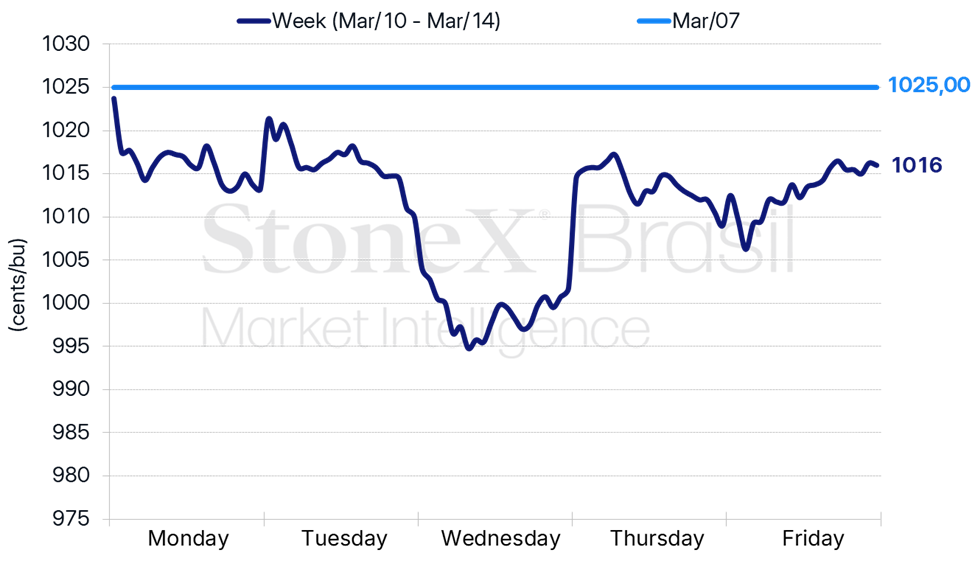
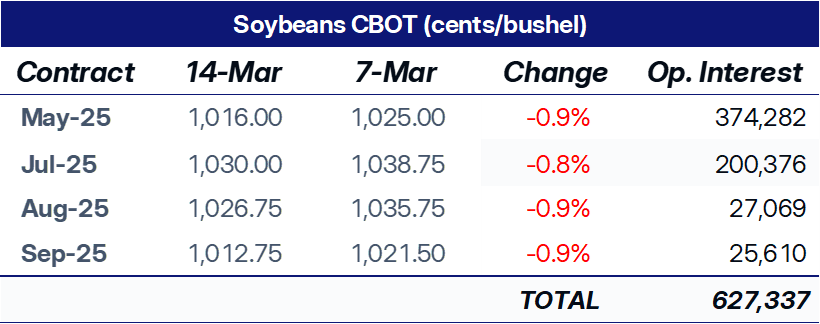
Soybean prices in Chicago were under increased pressure last week, following the implementation of China’s tariff on U.S. soy, while the market also follows the progress of the South American crop. The May contract closed on Friday (14) at 1016 cents per bushel, down 0.9% for the period.
As highlighted in the previous report, China imposed a 10% tariff on U.S. soybean, which came into effect last week. This tariff undermines the competitiveness of U.S. soybean, favoring the purchase of Brazilian soy by China, especially at a time when a very large crop is being harvested in South America.
It is also noteworthy that China announced tariffs on Canadian products, in retaliation for tariffs on Chinese electric vehicles, steel, and aluminum, which included canola and its derivatives. As a result, there are fears that these products could eventually be redirected to the U.S., increasing competition with soybean and soybean oil.
The release of the USDA’s WASDE report did not bring any changes to the U.S. balance, highlighting that estimates for the 25/26 crop have not yet been disclosed. The May report begins to include figures for the new crop. For the Brazilian and Argentine crops, the USDA also made no adjustments, with 24/25 production estimated at 169 million tonnes for Brazil and 49 million for Argentina.
For the Chinese balance, the USDA increased crush and, consequently, domestic consumption by 2 million tonnes for the 24/25 crop, but kept imports at 109 million tonnes, which resulted in a 2-million-tonne decrease in estimated ending stocks. It is noteworthy that, on the other hand, Chinese government estimates indicate that the country’s soybean consumption may drop by more than 2 million tonnes, in addition to the USDA figure being 7 million tonnes higher than the official Chinese number, widening the discrepancies in the figures, remembering that the USDA has already been reporting stronger Chinese soybean imports than the official volumes disclosed by the country.
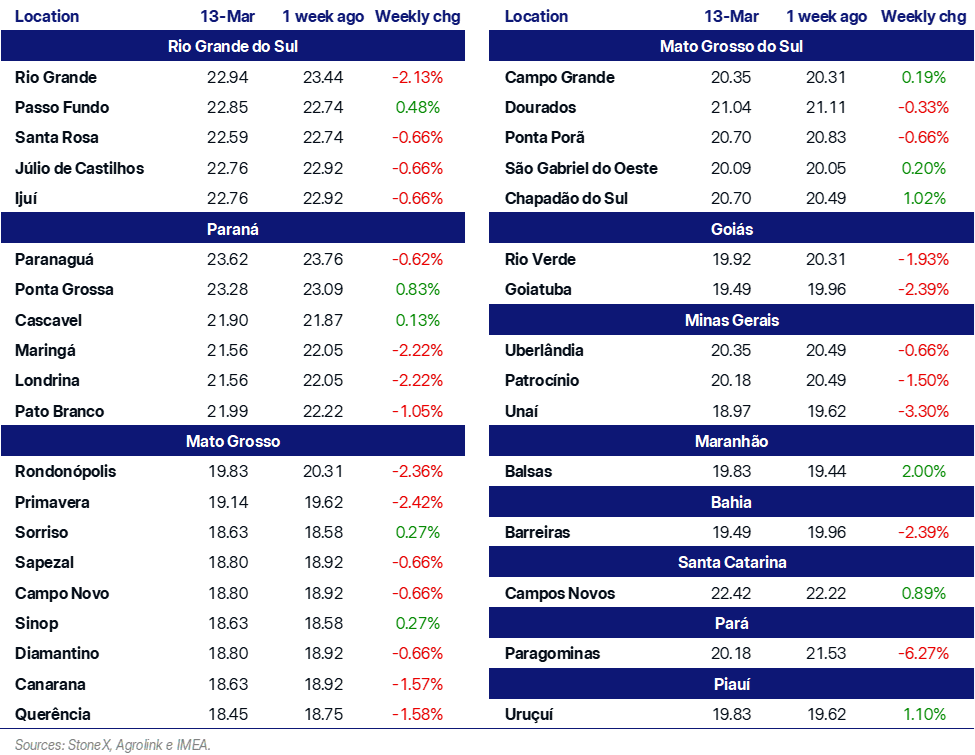
In Brazil, the Conab report raised the 24/25 soybean production estimate by just over 1 million tonnes, reaching 167.4 million, highlighting improved yields observed as the harvest advanced, with records expected for Mato Grosso, Goiás, and Minas Gerais. On the other hand, the company pointed out losses in Rio Grande do Sul, with an estimated average yield for the state of 2495 kg per hectare.
Regarding Argentina, the Buenos Aires Exchange continues to maintain its 24/25 soybean crop estimate at 49.6 million tonnes, noting the occurrence of heavier rains last week, which added to previously recorded precipitation. There was a slight improvement in crop conditions, with the percentage of regular/poor ratings dropping by 1 percentage point to 26%. On the other hand, it is noteworthy that the Rosario Exchange further cut its Argentine soybean estimate from 47.5 to 46.5 million tonnes, still reflecting the lack of rains in January and February.
On the demand side, Brazilian soybean exports are increasingly robust, with preliminary official data indicating shipments of 3.1 million tonnes in the first week of March. Expectations, considering ship lineup data, suggest that total soy exports in March could be around 15 million tonnes.
In the U.S., export sales in the week ending 03/06 were 751.7 thousand tonnes, bringing the 24/25 crop cumulative total to 45.1 million. It is noteworthy that the pace remains above what is needed to reach the USDA’s export estimate of 49.7 million tonnes, but with the Chinese tariffs, the U.S. soybean export market should be closely monitored in the coming weeks and months.
This week, geopolitical issues around the world are expected to remain at the forefront, with Brazilian exports also on the radar, in addition to the harvest progress, which continues to consolidate the size of the crop domestically.