What We Got Right in 2024, Where We'll Go Next in 2025

Executive Summary
- Market trading color: Volatile week with perceived risk assets exposed, anticipation of the US government selling BTC, and ETF two-way flows
- Theme of the week – Recap of 2024 predictions and overview of what is to come in 2025
- Links of the week: BTC dips, ETF inflows, stablecoins’ rise, miner expansions, and SEC updates
Market Trading Color (Nolan Aibel)
Volatile week for digital assets to say the least. Enter Monday, Bitcoin was back over $100,000 after the holiday capitulation. Many were calling for new all-time highs as momentum picked up heading into Trump’s inauguration. Monday saw BTC ETFs bring in $979M, the largest amount since November 21st. ETH ETFs brought in $129M as well. The Coinbase Premium had flipped positive, 7 days after the metric was oversold and down to around -0.21.
Fast forward to Tuesday, and renewed inflation concerns causing rates volatility was all the market needed to turn its back on risk assets. At the time of writing, Bitcoin is down over 6%, below $93,000 from a local high of $102,000, causing over $1B in longs to be liquidated over the past three days. News that the DOJ has been cleared to sell 69,370 Bitcoin, $6.5B, seized from Silk Road has not helped the tape. The good news is no tokens have been sold thus far. More good news is that historically, previous sell pressure from the US Government has been absorbed by the market. Between March ’23 and now, the US Government has seen holdings reduced by ~38,000 BTC, ~$3.5B. During this time frame, BTC has surged over 350%. This news always seems to spook retail sellers and allows us the opportunity to remind those nervous that if these tokens are ever sold, it won’t be in market order fashion.
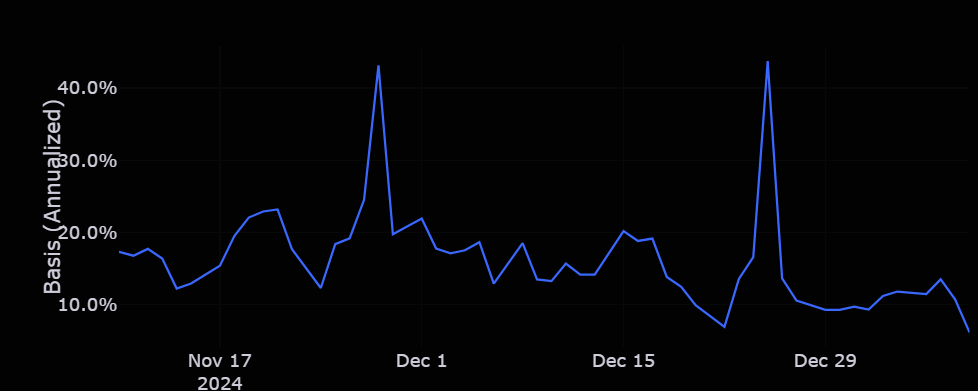
In this rocky environment, BTC ETFs saw $568 in outflows yesterday after trading under spot for the majority of Tuesday and Wednesday. We saw many reverse their usual arbitrage, selling spot to buy ETF. On the other end, CME futures annualized basis has compressed from 40% to 6% in the span of two weeks. Despite this, CME OI remains slightly below all time highs at $61B.
Source: TheTie
Predictions We Got Right in 2024
1) Spot BTC ETF Approvals
- We expected multiple spot Bitcoin ETFs to be approved in 2024, unlocking large inflows from RIAs and traditional institutions.
- Outcome: Exactly that happened in early 2024 following court battles. Several high-profile issuers launched their ETFs, bringing combined BTC ETF AUM to around $36 billion by year-end—slightly below our $43 billion estimate.
2) Bitcoin Halving
- We correctly pinpointed the halving in April 2024, noting it would reduce block rewards to 3.125 BTC. This event would again spotlight Bitcoin’s scarcity and historically has preceded major bull runs.
- Outcome: The halving unfolded on schedule. BTC did see a moderate price rally afterward (from about $29,000 pre-halving to $93,000 by year-end).
3) Ongoing Regulatory Headwinds in the US
- We forecasted that SEC enforcement would persist, with the courts continuing to shape policy while the 2024 election offered little immediate relief.
- Outcome: Indeed, the SEC remained highly active, winning some cases and losing others. Major exchanges faced sizeable fines, and no sweeping pro-crypto legislation arrived after the election.
4) Ethereum Scaling with EIP-4844 (Cancun)
- We highlighted EIP-4844 as a key upgrade to reduce L2 fees and advance Ethereum’s modular roadmap.
- Outcome: The Cancun upgrade (including Proto-Danksharding) successfully launched in late March 2024, reducing L2 fees by ~98%. This drew more users and bolstered Ethereum’s daily transactions.
5) Meme Coins’ Cyclical Hype
- We predicted that meme coins would continue to mirror the high-beta, community-driven mania previously seen with NFTs.
- Outcome: Meme coins had multiple hype cycles throughout 2024, especially on Solana and Ethereum L2s. As expected, their volatility soared, and they remained a gateway for new retail participants.
6) Real World Asset (RWA) Tokenization
- We forecasted a major wave of RWA tokenization—treasuries, bonds, private credit—on Ethereum and predicted large-scale institutional adoption.
- Outcome: RWA tokenization did grow significantly (e.g., $3 billion in tokenized Treasuries/bonds on Ethereum by late 2024), up from $300m at the beginning of the year.
Predictions We Mostly Got Right (But Were Less Dramatic Than Expected)
7) Bitcoin Layer 2 Adoption
- We expected Ordinals, BRC-20, and related “Bitcoin L2” narratives to keep expanding, generating higher on-chain fees and developer attention.
- Outcome: Ordinals and BRC-20 indeed contributed to noticeable fee spikes and remain far from dead, but overall “Bitcoin L2” activity is still modest compared to Ethereum’s L2 ecosystem.
8) Decentralized Physical Infrastructure (DePIN)
- We highlighted Render, Helium, Arweave, Filecoin, and others as prime beneficiaries of Web3 + AI/data convergence.
- Outcome: These projects’ market cap grew 45% according to Artemis data, to $35 billion over 2024, mostly from small AI startups using decentralized storage. However, large enterprises still rely on traditional cloud providers, so the sector hasn’t exploded into the mainstream yet.
Predictions We Got Wrong
9) Spot ETH ETF Timing
- We were skeptical that any spot ETH ETF would launch in 2024, expecting regulatory approval no sooner than 2025.
- Outcome: This turned out to be one of the bigger surprises of mid-2024. The SEC did approve spot ETH ETFs which together ended 2024 with $2.5 billion in combined AUM.
2025 Predictions
Bitcoin Reaches $120k–$180k Range. We believe Bitcoin can climb into the $150,000–$160,000 range by 2025, propelled by a variety of bullish factors. Institutional demand remains a key catalyst, especially as spot BTC ETFs continue to gain traction— we estimate combined assets under management could exceed $90 billion, a windfall of capital that further constrains supply. At the same time, major economies and U.S. states have shown increasing openness to holding BTC as a treasury asset, with at least one large nation (e.g., the United States, Brazil, or Russia) or a powerful state like Texas predicted to adopt Bitcoin officially in 2025. This kind of endorsement not only generates unprecedented headlines but also legitimizes Bitcoin’s role as a strategic reserve and a store of value, laying the groundwork for a potential market cap of Bitcoin near $3 trillion.
On the mining front, the United States appears ready to capture over half of Bitcoin’s global hashrate, drawing firms like Hive, Marathon, and Riot to states offering cheap energy and crypto-friendly rules. Meanwhile, new borrowing platforms such as Libre are reducing overall sell pressure by allowing BTC holders to collateralize rather than liquidate. Adding to this momentum, long-term holder reserves have recently dropped from 71% to 61%, nearing historic pivot points where supply squeezes can magnify price surges. Altogether, these overlapping dynamics—ranging from surging institutional flows to government-level adoption—are creating a powerful tailwind that could push Bitcoin into the $150k–$160k zone before the end of 2025.
Ethereum Reclaims $5,000 and Pushes Beyond. Ethereum could surpass its previous all-time high near $5,000, buoyed by significant expansion of layer-1 and layer-2 usage. Total value locked (TVL) on Ethereum—combining L1 and L2—may exceed $150 billion, up from roughly $30–$40 billion just a few years earlier and $70 billion in 2024. This growth stems from post-EIP-4844 scaling, the rollout of potential spot ETH ETFs with over $10 billion in AUM, and the network’s entrenched reputation as a “global computer” for DeFi and dApp ecosystems.
Surge of Altcoin ETFs & Broader Market Cap Boom. A friendlier regulatory environment, shaped by the departure of Gary Gensler at the SEC and a potential shift of oversight to the more crypto-accommodative CFTC, sets the stage for multiple spot altcoin ETFs. Solana, XRP, and Litecoin, among others, are strong candidates. If approved, these funds could amass over $15 billion in AUM within 12 months. Mirroring Bitcoin’s 2024 ETF momentum, altcoins would likely attract new institutional capital, particularly those boasting mature, less “risky” profiles such as long-standing proof-of-stake chains. Additionally, multi-coin ETFs bundling several top digital assets into a single investment vehicle we anticipate emerging, opening broader avenues for institutional and retail inflows helping create a diversified crypto portfolio.
“40%–45%” Bitcoin Dominance Despite Bullish Alt Market. Although Bitcoin’s entrenched appeal as “digital gold” and its ETF inflows will keep it strong, a thriving altcoin sector might compress BTC’s share of the total crypto market to 40%–45%. Ethereum, Solana, and other top altcoins—likely fueled by new ETF approvals, better UX/UI, a broader interest in the space, and major developmental milestones will continue to drive demand for alts higher.
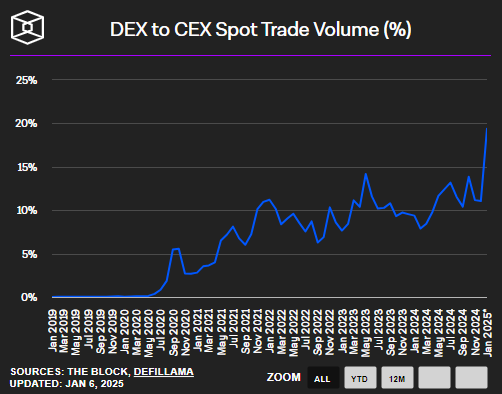
Massive Growth in Decentralized Exchanges (DEX). DEXs could surpass 40% of total crypto trading volume, a colossal jump from around 10–15% in 2024. Innovations in user experience, cross-chain swapping, and cheaper layer-2 transactions will make DEX trading far more efficient for retail and institutional users alike. Evidence of this shift can be seen in platforms like Jupiter and Raydium, where on-chain metrics reveal sharply increasing usage—driven by improved execution, pooled liquidity, and a growing developer ecosystem.
Source: The Block, DeFiLlama
AI Crossover with Memecoins: Launch Platforms, On-Chain Agents, and Protocol Synergy.
A new wave of AI-driven memecoin projects is poised to capture the spotlight in 2025, propelled by innovative launch platforms such as pump.fun that blend token creation, AI-driven marketing, and vibrant community engagement. We anticipate at least five of these AI-infused memecoins to surpass $1 billion in market cap, fueled by automated hype cycles, NFT integrations, and the ease of deploying AI-centric features across multiple protocols. Crucially, on-chain agents—autonomous AI modules capable of executing tasks on L1s and L2s—will be a recurring theme in 2025, with developers integrating agent-based functionality via specialized SDKs. This multi-protocol approach allows AI to transcend simple memecoin narratives, bringing smart automation and richer user experiences and engagement to established DeFi ecosystems, gaming platforms, and social media. Taken together, these factors could not only replicate but exceed the buzz of past memecoin booms, showcasing how AI’s crossover into various blockchains fundamentally elevates both the technical sophistication and market appeal of crypto.
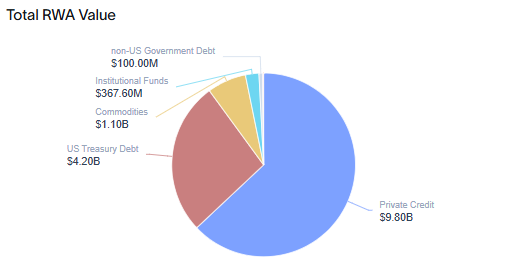
Real-World Assets (RWA) & Tokenization Top $30 Billion. Major financial institutions are set to escalate their pilot projects in tokenized treasuries, bonds, real estate, and private credit, pushing on-chain value beyond $30 billion. Specifically, on-chain treasuries we view as a major catalyst for this leap from $15 billion to $30 billion by 2025, as more governments and corporations explore tokenized debt instruments with faster settlement and transparent ownership. Traditional banks and investment funds increasingly see the appeal of 24/7 liquidity, and Ethereum, Solana, and other key L1s will likely serve as the primary rails, further bridging TradFi yields with DeFi in the coming year.

Source: rwa.xyz
Stablecoins Hit $400 Billion Market Cap. The aggregate market capitalization of stablecoins—including major incumbents like USDT and USDC, as well as newer euro- or yen-backed tokens—may breach $400 billion. This near 100% growth reflects continued demand for cross-border payments, tokenized real-world assets, and on-chain liquidity. Deeply integrated within DeFi protocols, stablecoins serve as the core liquidity layer, fueling everything from remittances to real estate tokenization. This coupled with our prediction regarding RWAs are the drivers for growth.
Global Crypto Market Cap Approaches $5 Trillion. Many conversations we have had point to a late 2025 peak, roughly 12–18 months post-halving, yet it is our opinion that we will see a pullback in Q1 before another leg up. This could mean the cycle wraps by the end of Q3—getting in front of broader market sentiment—or, if momentum persists, we might not peak until Q1 2026. If inflows accelerate too quickly, a blow-off top could be followed by a sharp retracement; conversely, a steadier climb will help dampen volatility. Ultimately, Bitcoin and Ethereum rallies, surging stablecoin usage, growing altcoin ETFs, enthusiastic AI memecoin crossovers, and extensive RWA tokenization could lift the total cryptocurrency market to around $4.5–$5 trillion. Alongside potential global competition among major economies, regulatory clarity, institutional adoption, and a supportive cycle dynamic together create fertile ground for a massive expansion in overall market capitalization.
Links of the Week
- StoneX Digital Top 10 Links of the Week
- Bitcoin ($BTC): Bitcoin Dips Below $98K as Strong U.S. Economic Data Leads to $300M of Crypto Liquidations (link)
- Bitcoin ($BTC): Bitcoin Traders Eye $109K as Trump Anticipation Builds, BTC ETFs Rake in Nearly $1B (link)
- Bitcoin ($BTC): Bitcoin Price Rally Could Be Accelerated by China's Market Meltdown, Crypto Observer Says (link)
- Bitcoin ($BTC): Bitcoin ‘debasement trade’ is here to stay: JPMorgan (link)
- Coinbase premium flips positive for first time in weeks, indicating rising bitcoin demand from US investors (link)
- The Daily (The Block): Bernstein sets out 10 crypto predictions for 2025, MicroStrategy buys another $101 million worth of bitcoin and more (link)
- Agora’s Nick van Eck Is All-In on Stablecoins (link)
- Bitcoin miner’s data center project to be ‘game-changer’ (link)
- BTC miners adopted ‘treasury strategy,’ diversified business in 2024: Report (link)
- SEC v. Coinbase case update (link)