Executive Summary
- Market trading color: BTC price action and holdings
- Theme of the week –BTC ETF Flow and Ethereum’s Dencun Upgrade: we highlight the recent activity in inflows of Bitcoin ETFs and explore the potential benefits that Ethereum’s Dencun upgrade will bring to the network
- Sector commentary: Vitalik’s ideas to decrease max block size, NEAR’s recent movement in activity, and social blockchains picking up traction
Market Trading Color
$BTC rallied 6.5% over the past week and is now sitting at $44,900, up 16% from January’s low of $38,500. The leg up yesterday afternoon was driven largely by spot buying. Heading into the morning session, it looks like spot bids have slowed down while $BTC open interest has significantly increased overnight up and is now up 10% in the past 24 hours to a total of $19.81B. CME has reclaimed its thrown with $4.97B of this total OI as compared to Binance’s $4.90B. On the rally, funding rates have remained stable and are currently screening slightly positive. $86M in shorts were liquidated over the past 24 hours. The liquidity zone present around $41k remains the key support area.
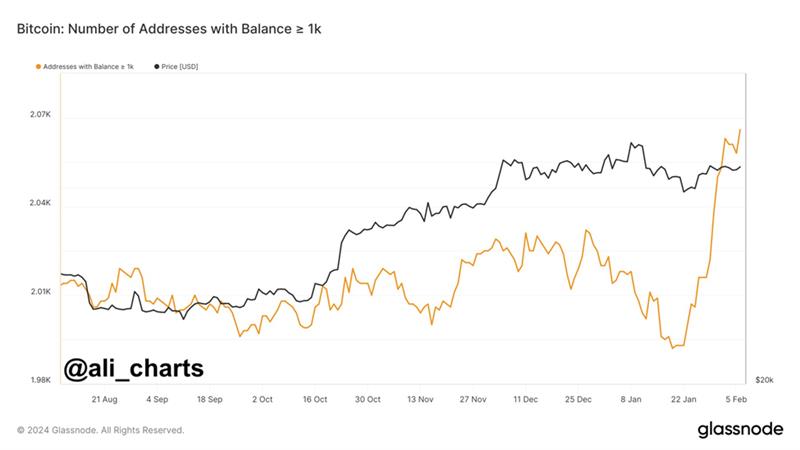
While Blackrock now owns nearly 0.37% of the total $BTC supply through their $IBIT ETF, they’re not the only large entity continuing to accumulate. As we reported yesterday, Microstrategy acquired an additional 850 $BTC worth $37.2M. The company now holds 190,000 $BTC for a total cost of $5.93B and have announced their strategy to become a Bitcoin Development Company. Bitcoin whales also continue to accumulate as 73 new whales now hold 1,000 $BTC, a 3.66% increase in two weeks (Ali_charts).

Source: Glassnode
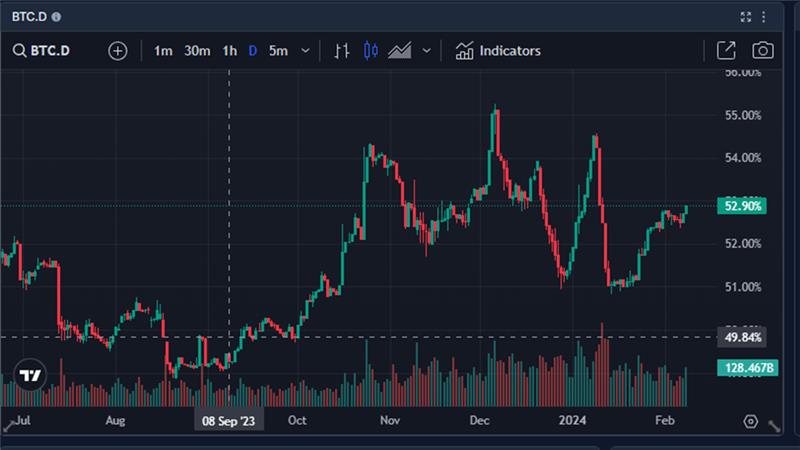
BTC dominance has been steadily climbing since the 1-week violent move to ETH following the ETF - i.e., we are not seeing follow through on flows to ETH/Alts, but a return to BTC.

Source: TradeView
In our 2024 outlook we published two weeks ago, we noted that we will start to see the US RIA market that holds an estimated $5T of assets under management dip their toes into Bitcoin. We continue to get closer to this realization. In their All-in-One Conservative ETF, Fidelity now has a 1-3% allocation option for their funds in Canada using spot $BTC ETFs. In terms of the make up of the different portfolios, 3.1% would be in the aggressive portfolio while 2.5% in the balanced portfolio. We believe we will see other providers begin to offer similar.
BTC ETF Inflows
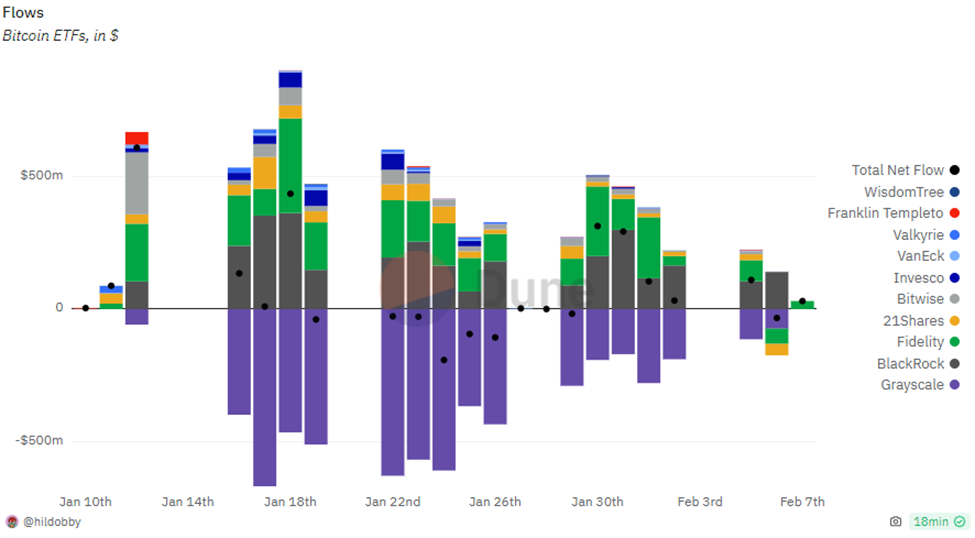
The Spot Bitcoin ETFs witnessed a significant variation in their Bitcoin holdings from January 10th to February 6th, as illustrated by the bar chart. This period was marked by a stark contrast in investor behavior, showcasing days of aggressive net buying compared with intervals of net selling. The graph reached a peak buying moment on January 11, indicative of a surge in investor confidence or a reaction to favorable market conditions from the SEC’s approval of a Bitcoin SPOT ETF on January 10th. This regulatory approval was a significant endorsement for the cryptocurrency market, increasing legitimacy and prompting investment into Bitcoin ETFs.
Source: HODL15Capital
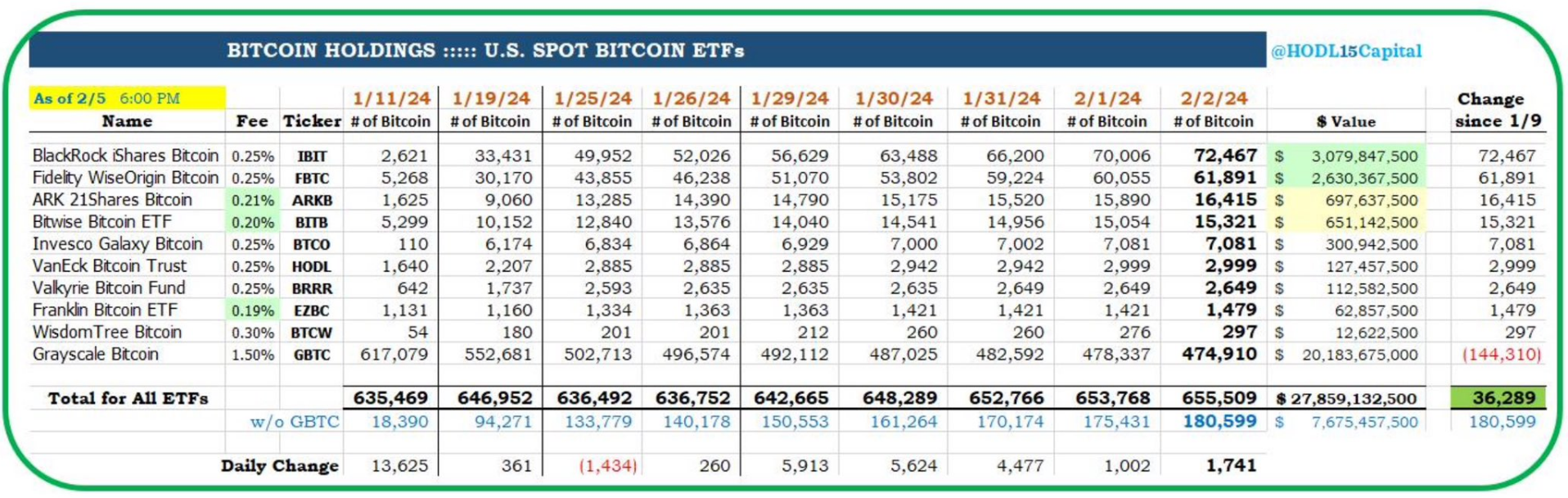
We are also monitoring movements within U.S. Spot Bitcoin ETFs. As of February 5th, the landscape has shown a net increase of Bitcoin holdings by 36,289 across all ETFs since January 9th. This aggregate growth, however, masks a divergence in individual ETF performance. Notably, Grayscale Bitcoin Trust (GBTC) has seen a substantial reduction, with its Bitcoin holdings decreasing by 144,310. This outflow, while subsiding each day, contrasts sharply with the rest of the market, with other ETFs having increased their holdings as investors are shifting their preferences away from the Grayscale Bitcoin Trust due to its substantially higher fees of 1.5% versus .25%.
Genesis's move to seek judicial approval to sell its substantial holdings in GBTC could potentially introduce a fresh wave of selling pressure in the Bitcoin market. This proposed liquidation, over $1.6 billion worth of Bitcoin, Ether, and Ethereum Classic held in Grayscale’s products, echoes the market tremors felt during the FTX's sale of their GBTC holdings during January. The previous sale by FTX coincided with a sharp decline in Bitcoin's price, dropping from $49,000 to $39,000.
Ethereum’s Scalability Concerns
The scalability challenge has significantly impeded Ethereum, impacting developers and users alike. Various solutions, from sidechains and state channels to rollups and sharding, have been pursued to address this issue. Currently, rollups stand out as leaders in tackling scalability on the execution side. However, they still struggle with overcoming data availability challenges. The Dencun upgrade, a fundamental Ethereum improvement centered on proto-danksharding, introduces the concept of 'blobs' to address these issues.
What is the Dencun upgrade?
The Dencun upgrade is Ethereum's upcoming major hard fork, succeeding the Shapella upgrade. It combines elements from 'Deneb' and 'Cancun,' involving upgrades to both Ethereum's consensus layer (CL) and execution layer (EL). The main objective is to enhance execution efficiency and data availability in the network, emphasizing proto-danksharding (EIP-4844). Proto-danksharding, addresses Ethereum scalability by introducing blob-carrying transactions. Blobs, large off-chain data packets, use new opcodes (BLOBSTORE and BLOBLOAD) for efficient storage and retrieval. This lays the groundwork for future sharding without immediate network fragmentation.
Dencun's implementation on the Goerli testnet on January 17th and the Sepolia testnet January 30th is part of a three-phase strategy to introduce "proto-danksharding," which enhances data availability and reduces layer-2 transaction costs on the Ethereum mainnet. The last and most recent test was on February 7th on the Holesky testnet, initiated around 6:30am ET and confirmed by the Ethereum execution client. The testnet enables developers to test and validate the technical enhancements introduced by the Dencun upgrade under real-world conditions. The successful execution of the Holesky testnet is important for ensuring the upgrade's compatibility with the existing Ethereum infrastructure and verifying its intended scalability and efficiency improvements before its final release on the mainnet. The anticipated launch of Dencun is at the end of February or March but will be set during the Ethereum All Core Developers call today.
Key differences between Sepolia and Holesky include validator sets (closed for Sepolia and open for Holesky), test token supply mechanics (uncapped for Sepolia and capped at 1.6 billion holETH for Holesky) and intended use cases (focused on testing smart contracts for Sepolia and testing validators and staking for Holesky).
In addition to proto-danksharding, the Dencun hard fork incorporates eight other Ethereum Improvement Proposals (EIPs). Here's a concise overview of their significance for Ethereum:
- EIP-1153 introduces transient storage to Ethereum smart contracts, clearing temporary data after transactions, reducing storage overheads, enhancing efficiency without increased gas costs.
- EIP-4788 introduces a protocol-level oracle, exposing the beacon block root in the EVM, reducing reliance on external oracles for consensus state data.
- EIP-5656 introduces MCOPY, a new EVM opcode streamlining memory copying in smart contracts for improved efficiency, simpler coding, and reduced gas costs.
- EIP-6780 amends SELFDESTRUCT, permitting contract deletion only in the creation transaction, fortifying Ethereum smart contract security. Existing contracts are unaffected, ensuring enhanced security and predictability for future deployments.
- EIP-7044 enables perpetually valid signed voluntary exits, offering ETH stakers increased control and flexibility in staking operations.
- EIP-7045 boosts max attestation slots to two non-rolling epochs, enhancing security, robustness, and confirmation speed in Ethereum's PoS consensus.
- EIP-7514 sets a cap at 8 for per-epoch churn limit, transitioning Ethereum validator growth from exponential to linear, addressing performance and state-size concerns.
- EIP-7516 introduces BLOBBASEFEE opcode, enhancing proto-danksharding by allowing smart contracts to access current blob base fees programmatically, simplifying gas price calculations for large data blobs trustlessly.
Next Upgrades (Prague and Osaka)
Tim Beiko, Ethereum Foundation's Head of Protocol Support, provided insights from the recent execution layer meeting on 2/1/24. The key focus was on three proposed candidate forks: Verkle Trees, EOF, and EIP-4444. Ethereum teams unanimously favored Verkle for the post-Prague fork, Osaka, leading to a decision to prioritize its further development along with other EIPs slated for Prague inclusion. However, despite substantial progress in Verkle's components, concerns were raised during the meeting, particularly by Lukasz Rozmej and other developers. They expressed reservations about committing to code changes for the Prague upgrade due to Verkle's complexity and the need for additional research on its implementation. Guillaume Ballet acknowledged that Verkle might not be ready for Prague but highlighted the importance of scheduling it for an upgrade in either Prague or Osaka. He emphasized the motivation it provides to client teams and addressed concerns about the Ethereum state's annual growth of 25%, stressing the need to execute Verkle sooner to avoid extensive data overhauls during the transition.
What is a Verkle tree? A Verkle tree is a clever way of organizing data in Ethereum, similar to a Merkle tree but more efficient. It helps speed up how the Ethereum network processes information. Unlike traditional methods, it uses a unique approach, changing how keys are structured and introducing a different way of making sure data is secure. The Verkle tree is like a filing system that makes it quicker and easier to find specific information. It uses advanced math and a special curve called Bandersnatch to ensure everything works smoothly. This design not only reduces the amount of data Ethereum needs to store but also makes the proof, or evidence, of transactions smaller and more manageable. It's like having a more efficient and organized filing cabinet for Ethereum's information, making the whole system work better.
The benefits of Verkle:
- Lower hardware requirements
- Improved performance and scalability through reduced disk OP
- Smaller proofs
- Instantly Sync allowing for execution and validating blocks immediately
- Verkle snarks are ZK friendly due to their less complex nature relative to Merkle snarks
Source: Ethereum Foundation, Dune Analytics, Tim Beiko
Sector Commentary
- Layer One / Altcoins
- Bitcoin ($BTC): 3 Bitcoin price forecasts calling new all-time highs and more in 2024 (link)
- Bitcoin ($BTC): Bitcoin price flirts with $43K, but derivatives data points to traders’ low confidence (link)
- Bitcoin ($BTC): Bitcoin ETFs Mean 'Substitution' From Gold Into BTC Will Continue, Says Cathie Wood (link)
- Ethereum ($ETH): ETH price may repeat $2.7K January spike as Bitcoin cools — analysis (link)
- Ethereum ($ETH): Vitalik Buterin floats 5 designs to decrease Ethereum max block size (link)
- Ethereum ($ETH): Apparent 'Insiders’ Make Millions After Grabbing Ethereum Version of Dogwifhat (link)
- Solana ($SOL): Solana network restarts after outage that lasted five hours (link)
- Chainlink ($LINK): Chainlink's 40% weekly rally might be a 'bull trap' for LINK price (link)
- Monero ($XMR): Monero hits 5-month low as Binance plans delisting (link)
- DeFi
- NFTs / Web3
- Bitcoin NFT Project Taproot Wizards Sells Out First Collection, Raking in $13M (link)
- Farcaster sees 400% increase in daily active users amid ‘frames’ frenzy (link)
- Filecoin liquid leasing protocol Glif raises $4.5 million, offers reward points ahead of token launch (link)
- Trump-Themed Tokens Rocket as Prominent Crypto Fund Bets on Coins Modeled After Ex-President (link)
- Metaverse / Gaming
- Digital Infrastructure: Capital Markets / Exchanges / DAOs / Mining
- Bitcoin ETFs See $700M Net Inflows as BlackRock, Fidelity Gains Offset GBTC Outflows: CoinShares (link)
- Genesis Seeks Approval to Sell $1.6B in Bitcoin, Ether Trust Holdings (link)
- Bankrupt Genesis settles SEC lawsuit over Gemini Earn program (link)
- Bybit seeks VATP license in Hong Kong for crypto expansion (link)
- Op-Ed: From Speculation to Fundamentals: A New Paradigm for Crypto Markets (link)
- Federal Reserve drops enforcement action against FTX-linked US bank (link)
- SEC adopts rule to have stricter oversight over dealers, looping in crypto and DeFi (link)
- Robinhood Connect integrates MetaMask Buy Crypto aggregator to facilitate easier crypto purchases (link)
- Opinion: China Never Completely Banned Crypto (link)
- Treasury Secretary Yellen Says U.S. Needs Better Stablecoin Regulation (link)