Executive Summary
- Market trading color: Price action rangebound for $BTC and $ETH vs AI tokens gaining, ECB FUD amid ETF flows, $ETH outperformance, and bullish options sentiment
- David Kroger's theme of the week – We explain what decentralized physical infrastructure is, along with the benefits, economics, and leading blockchains and names in different subsectors
- Sector commentary: How Bitcoin benefits from global stresses, OP airdrop, and how much does it cost to attack Bitcoin and Ethereum?
Market Trading Color
The past week has brought small amounts of price volatility for majors with $BTC staying rangebound between $50,600 and $53,000. $ETH has seen similar price action, ranging between $2,700 and $3,030. The largest gainers over the past week have undoubtedly been AI tokens. After another strong day on the back of positive $NVDA earnings, weekly totals for the top performing AI tokens are as follows: $WLD +168.8%, $AGIX +122.2%, $FET +67.2%, and $RNDR +46.2%. Look for these tokens to continue to build upon their current $17B combined market cap vs $NVDAs solo $1.8T market cap.
The European Central Bank came out of nowhere this morning to state that “Bitcoin has failed to become a global decentralized digital currency, instead falling victim to fraud and manipulation. The recent approval of an ETF doesn’t change the fact that Bitcoin is costly, slow and inconvenient.” Alongside this, with increased sell pressure from $GBTC, BTC ETFs (excluding Fidelity who hasn’t reported numbers yet) saw net outflow for the first time since January 25th. Over the past 7 days, $ETH +6.5% has outperformed $BTC (1.7%). With heavy liquidity both above and below $BTC, we expect the asset to remain rangebound for the time being. Given this, the Dencun upgrade around the corner, all time highs in terms of CME OI, and continued Spot ETF buzz, look for $ETH to continue this outperformance and ETHBTC to rise above 0.06 for only the second time since October.
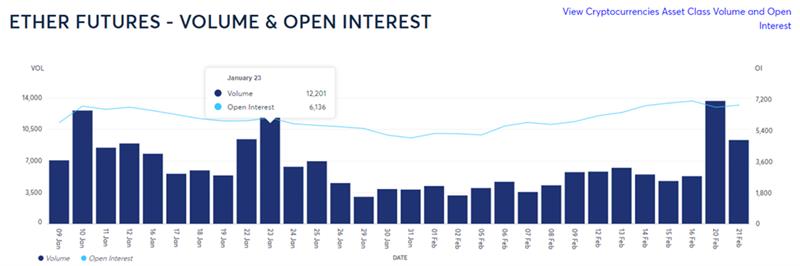
Source: CME
Mentioned above, Ethereum volume on the CME is at all-time highs. Before Tuesday’s sell off, open interest on the CME hit highs as well. Look for this activity to pick up further as $ETH continues to gain momentum. $3,300 is a key level for $ETH as $500M in shorts would be liquidated.
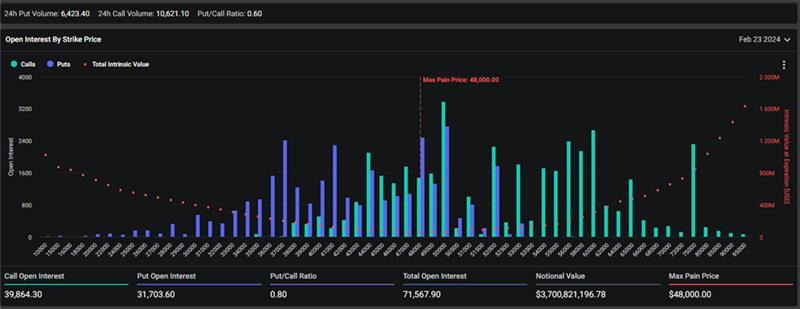
Source: Deribit
In option world, nearly $3.7B worth of $BTC options are set to expire tomorrow. The outstanding positioning screens bullish as put call ratio sits at 0.76. Large amount of open interest lies at $53,000 and $60,000. While those $60,000 strikes seem likely to expire worthless, $53,000 is in range and would be actionable with a 3.5% increase from current prices. Last large expiry day saw a similar set up heading in and resulted in a rally heading into the weekend.
What is DePIN?
A trending topic gaining momentum in the crypto ecosystem is Decentralized Physical Infrastructure Networks (DePIN). This concept introduces a novel approach to constructing and managing infrastructure in the physical realm. Historically, large corporations have monopolized the deployment and administration of physical infrastructure such as cloud services, wireless networks, and power grids. This dominance arises from substantial capital requirements and logistical complexities, enabling these corporations to dictate pricing and service provision to end-users, effectively stifling competition and inhibiting further innovation. Infrastructure projects that employ tokenization to organize and incentivize their initial development phase can be categorized under this newly coined term, "DePIN."
What are the Benefits of DePIN?
Collective Ownership/Decentralization: By offering token rewards, contributors are motivated to deploy and maintain infrastructure. DePIN's grassroots methodology ensures that the network is collectively owned by its participants rather than a select group of shareholders. With incentives provided to those maintaining infrastructure, this decentralized network offers a more robust and secure infrastructure than conventional centralized networks. Consequently, this mitigates issues such as corruption, hijacking, hacks, and other adverse effects of centralized control.
Distributed Infrastructure Cost: A decentralized physical infrastructure network reduces overhead and costs by leveraging the combined resources of network participants.
Open Competition and Innovation: DePIN fosters elevated levels of innovation across various sectors. By eliminating the entry barriers associated with traditional infrastructure networks, DePIN encourages new entrants to penetrate markets previously dominated by a few established entities. The graphic below from Messari illustrates the disparities in characteristics mentioned above compared to today’s centralized infrastructure.
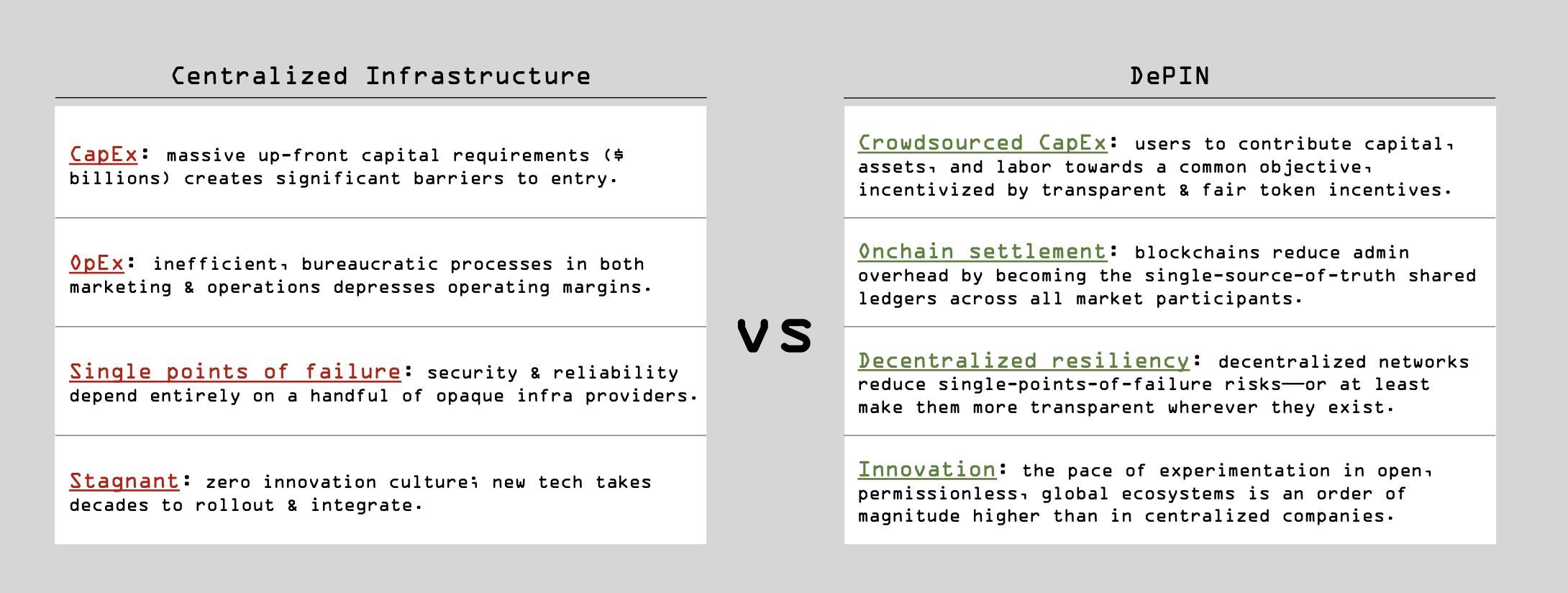
Sources: EV3
DePin Economics
The table shows revenue generation in different blockchain sectors, including DeFi, Layer 1/Layer 2 protocols, and DePINs. In DeFi, revenue comes from trading, lending, and insuring. Layer 1 and 2 protocols earn revenue through transaction fees and the value captured from miner extractable value (MEV). DePINs' revenue model is grounded in providing computational services, including data transfer, computation power leasing, and energy consumption. This marks a shift from traditional financial models to one that values actual service provision, fostering a utility-centric ecosystem.
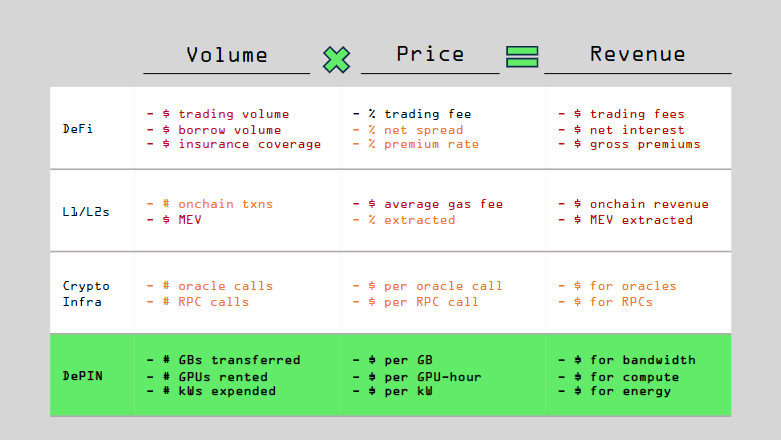
Sources: EV3
Solana Emerges as a Leading DePIN Chain
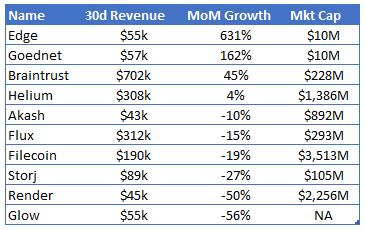
Solana is quickly becoming the preferred foundation for DePIN projects, as its unique capabilities drive the growth and resilience of these decentralized networks. Projects like Render ($RNDR), with a market cap of over $2.3 billion, are tapping into Solana's strengths to revolutionize GPU rendering. Helium ($HNT), valued at $1.5 billion, is another standout, expanding wireless communication capabilities. The Render Network successfully shifted from Ethereum to Solana, enabling token migration via the Upgrade Assistant on November 2nd, 2023. Up to 1.14 million RNDR in grants subsidize transfer fees for three months, ensuring a smooth transition. Similarly, the Helium Network migrated to Solana on April 18, 2023, enhancing scalability, lowering costs, and boosting performance, thereby enabling greater IoT network scale and robustness. Both networks' migration to Solana signified a need for higher performing chains as demand and interest both grew for these chains.
Moreover, Solana's ecosystem offers diverse applications such as Hivemapper ($HONEY) and PowerLedger ($POWR) which provide global mapping and energy distribution. Filecoin ($FIL), with a market cap of $3.3 billion, announced on February 16th that it is collaborating with Solana to improve the storage of data on the blockchain. Solana will leverage Filecoin's technology to enhance its storage capabilities, making it more dependable and scalable.
Source: Depin.ninja
Categories of DePIN
With 758 projects contributing $24 million in annual recurring revenue and boasting a collective market capitalization of $44 billion, DePIN is a growing ecosystem and narrative. Among its key sectors, compute holds the largest share at 43%, followed by blockchain infrastructure at 20%, and wireless technologies at 9%. AI (6%), services (1%), sensors (.27%), and other sectors collectively contribute to the remaining percentages, highlighting the breadth and depth of innovation within the DePIN ecosystem. Expanding on transformative DePIN's projects, we highlight three other players who are reshaping their fields.
Akash Network ($AKT) is making waves in the cloud computing industry, boasting a market capitalization of around $875 million. Akash's decentralized cloud platform is designed to be more economical and efficient than traditional offerings, aiming to make cloud services more accessible and equitable. It appeals to a global audience by lowering the entry barrier to high-quality cloud resources.
Theta Network ($THETA), with a market cap nearing $1.2 billion, and 11,910 nodes as of today’s writing, is at the forefront of digital content delivery. Theta Network effectively enhances video streaming capabilities, supports advanced technologies like virtual reality, and enriches the digital entertainment experience by incentivizing individuals to share their unused bandwidth.
IoTeX ($IOTX) is significant in the DePIN sector, with a market cap of over $616 million. It's building a connected and trusted ecosystem for the Internet of Things, offering a secure and scalable platform that bridges the physical and digital worlds through blockchain technology.
The Mechanics of the DePIN Network Flywheel
Source: iotex.io
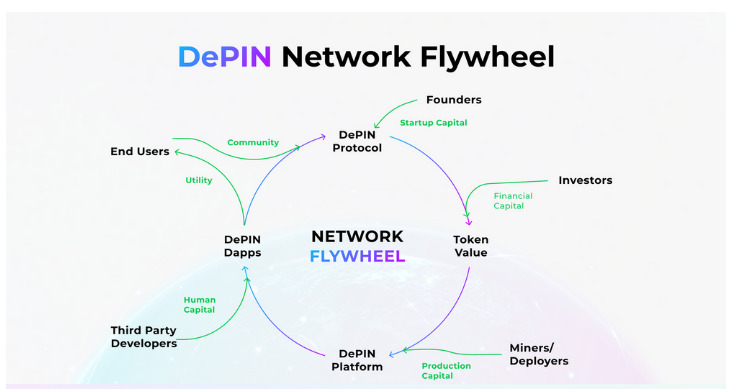
The DePIN Flywheel is a virtuous cycle in the ecosystem, where the usage of tokens spurs a positive feedback loop. Increased demand for tokens, often driven by the network's utility, can enhance their value. This appreciation in value is a powerful motivator for network participants to invest further in the platform, enriching the network's offerings. As the ecosystem matures, it garners more attention from investors, encouraging funding and the development of new applications. This, in turn, bolsters the ecosystem's value, attracting even more users and contributors and propelling the cycle forward. For example, The Helium Network($HNT) has effectively demonstrated the power of the DePIN Flywheel, showing how strategic token utilization can drive substantial network growth. As of February 19th, the network boasts an impressive 393,103 active hotspots globally.
Challenges DePIN Faces
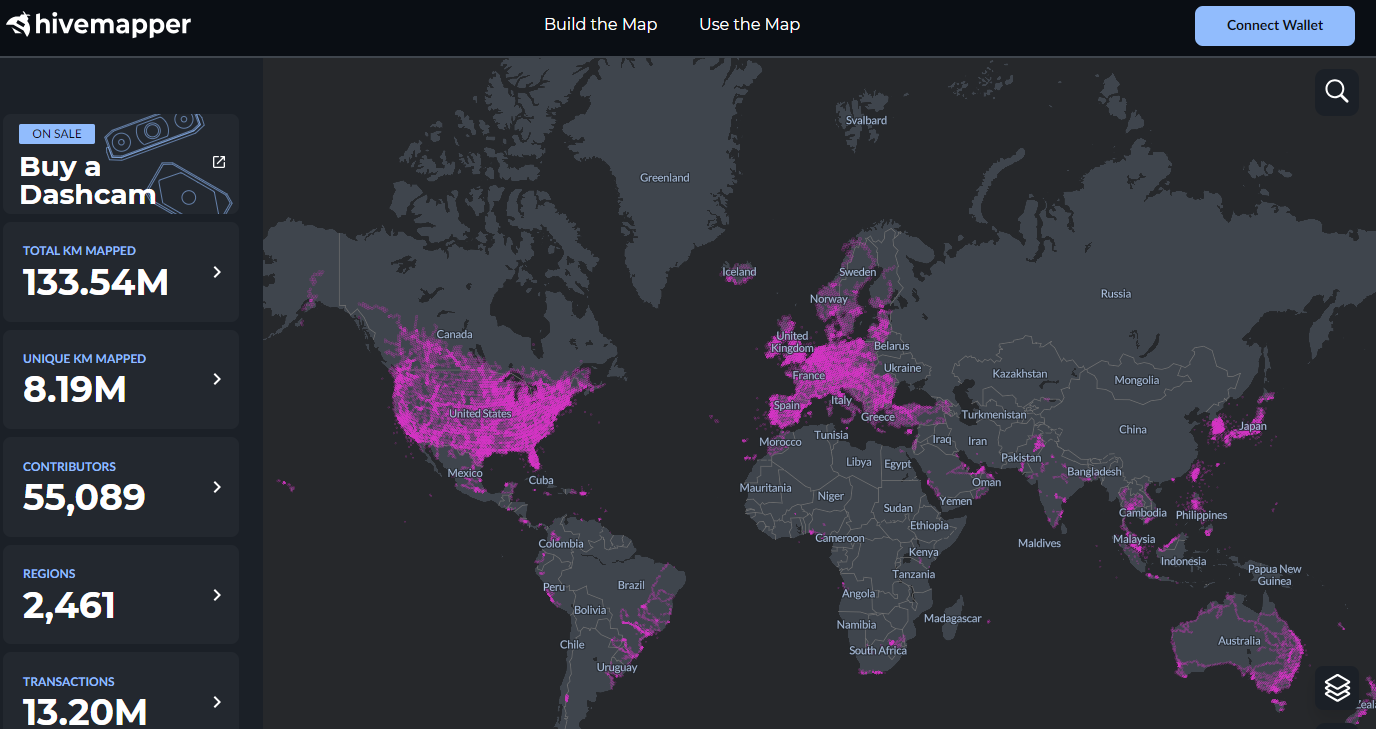
The most obvious challenge DePIN projects face is widespread adoption. Adoption must be significant enough to compete against web2 giants like Google, Microsoft, and Amazon. Without this adoption, incentive models are highly dilutive, and tokens may not appreciate, causing providers to be reluctant to participate in the network. For widespread adoption to occur, there needs to be increased levels of education to explain the technological complexities associated with utilizing applications in the DePIN space and transparency of coverage and usage of applications.
Source: hivemapper
To address the challenge of widespread adoption and improve transparency, DePIN projects have implemented comprehensive dashboards to monitor coverage and run analytics, providing valuable insights into network performance and user engagement. These dashboards allow project teams to track adoption rates, identify areas for improvement, and optimize incentive models to encourage participation among providers.
Source: Solana Foundation, EV3, Hivemapper, Geodnetwork, IoteX
Sector Commentary
- Layer One / Altcoins
- Bitcoin ($BTC): Bitcoin Suffers Swift Reversal at $53K, Suggesting More Consolidation Ahead (link)
- Bitcoin ($BTC): 2 Reasons Bitcoin Could Challenge Record High of $69K Before Halving (link)
- Bitcoin ($BTC): Op-Ed by Jennifer Murphy (Runa Digital Assets): How Bitcoin Benefits From Global Stresses (link)
- Bitcoin ($BTC): Bitcoin-Yen Pair Hits Record High, Reflects Stress on Japan's Fiat Currency (link)
- Bitcoin ($BTC): What Happens After All 21 Million Bitcoins Are Mined? (link)
- Bitcoin ($BTC); Ethereum ($ETH): How much does it cost to 51% attack Bitcoin and Ethereum? (link)
- Ethereum ($ETH): Ether hits $3,000 for the first time since 2022 amid spot ETF speculation (link)
- Ethereum ($ETH): Ether Could Be the Next 'Institutional Darling,' Bernstein Says (link)
- Ethereum ($ETH): Ether put options concentrate at $2,200. Is it a hedge or a bearish indicator? (link)
- Starknet ($STRK): Starknet Token STRK Begins Trading at $5 After Mammoth Airdrop (link)
- Bonk ($BONK): Revolut to List Bonk, Distribute $1.2M of Meme Coin in 'Learn' Campaign (link)
- DeFi
- DeFi Platform Earning Yield by Shorting Ether Attracts $300M (link)
- Oxford economist who predicted crypto going mainstream says ‘quantum economics’ is next (link)
- Liquid Restaking Tokens or 'LRTs' Revived Ethereum DeFi. Can the Hype Last? (link)
- Stellar Starts Phased Rollout of 'Soroban' Smart Contracts (link)
- NFTs / Web3
- VanEck’s Crypto AI Revenue Predictions by 2030 (link)
- MetaMask and Robinhood Connect Integrate to Make it Easier to Access Web3 (link)
- Hack VC closes $150 million for new venture fund, eyes web3, AI startups (link)
- Optimism distributes over 10 million OP worth nearly $41 million in fourth airdrop (link)
- Metaverse / Gaming
- Digital Infrastructure: Capital Markets / Exchanges / DAOs / Mining
- CME to launch euro-denominated micro bitcoin and ether futures next month (link)
- Bitcoin holdings on Coinbase reach lowest level since 2015 as whales withdraw $1B BTC (link)
- Coinbase drops native Bitcoin payments from merchants’ platform (link)
- Pantera Blockchain Letter, February 2024 – The Absence of Bad Things (link)
- Nickel Digital: Nickel News Roundup – Week 7 (link)
- Bitwise: “Supply/demand mismatch” (link)
- VanEck's spot bitcoin ETF volume skyrockets over 1000% day before lower fee comes into effect (link)
- JPMorgan says US regulators can 'exert some control' over Tether via OFAC (link)
- Op-Ed: The Crypto Vibe Shift (link)
- Binance to shut down multiple leveraged token services (link)
- ECB execs respond to banks’ objections to digital euro, suggest priorities (link)
- Lawyer running to unseat Elizabeth Warren doesn’t mention crypto in campaign launch (link)