Market Intelligence Link
Trading
Buzz surrounding spot BTC ETF approval continues, $BTC soared past $45k for the first time in nearly two years on Tuesday before plummeting towards 40k following yesterday’s funding flush. During this event, over $500M in longs were liquidated over the course of an hour. Tokens such as $SOL that saw all time highs in funding rates have returned to healthy levels. $BTC has now recovered and settled around $43k after experiencing over $40bn in volume yesterday, the highest level of trading volume since March.
Part of this buzz mentioned initially has included the race to the bottom when it comes to BTC ETF providers and their initial AP fee structures. Invesco and Galaxy have announced they are waiving fees on their offering for the first 6 months while Fidelity will charge 0.39%. As traditional institutions try to gain exposure to $BTC spot prices, CME futures volume/open interest is at all time highs. Given this, CME $BTC open interest dominance hit a new all time high of 32% today. With the grind higher in futures and spot from $26k in October to $43k now, a 70% increase, many are still debating whether the actual approval will be a “sell the news event”. Perhaps there will be profit taking after an anticipated initial green candle. After this though, the long-term outlook for $BTC is stronger than it’s ever been. There will be more institutional money involved than ever before and a halving around the corner. In derivative world, there doesn’t appear to be many signs of hedging going on as 7-day $BTC skew remains in the low singles, increasing OI on BTC delta1 instruments and positive/increasing funding rates on $BTC perps. If you’ve yet to read or receive our note surrounding all things BTC ETF approval, please reach out!
Option data showcases a large shift up the curve for the Jan 12th expiry, capturing the Jan 10th ETF decision deadline. $BTC Jan 12th IV is ~78 now. $ETH IV sits just above ~70. $BTC back month Vol is ~63 while $ETH back month screens ~68. The options implied move for BTC on next week’s event is ~3.5%. While $ETH IV has historically traded above $BTC, it is interesting to see this short term discrepancy preside when $BTC is the asset most affected with the upcoming headlines (ETF/Halving).
As activity on Solana continues to soar and new traders come to love the material lower fees vs ETH, many on crypto twitter are calling for the death of Ethereum. While Solana’s TVL increased by $1.2B in 2023, a 560% growth YoY and now sits at $1.42B, Ethereum’s TVL trumps in comparison at $29.5B. However, there is reason for Solana token holders to be enthused. The chain survived a crypto winter, during which many thought the chain would die off due to its association with FTX. Now reignited, developers and VCs are flocking back. As this has happened, there have been many firsts for the chain this week including $SOL stablecoin transfers and $SOL monthly NFT sales flipping $ETH. Alongside this, Solana has set records for monthly new and active addresses as search volumes on Google have increased 250% over the past two months. It will be interesting to monitor the battle as the once dubbed “ETH killer” re-enters prominence.
Monolithic vs Modular Blockchains

- Execution: is where blockchain nodes validate and process transactions, involving user interactions like signing transactions and executing smart contracts. In modular setups, execution is specialized, with certain chains focusing solely on transaction processing. For instance, rollups, like those used on top of Celestia, specialize in execution and offload this task to dedicated blockchains while maintaining a seamless user experience.
- Settlement: ensures the immutability of transactions on the blockchain, preventing alterations to recorded transactions. In modular designs, settlement can be handled separately, allowing for customization based on specific use cases. For example, a blockchain might specialize in fast and low-cost settlements, while another prioritizes high-security transactions.
- Consensus: this process establishes a shared agreement on transaction validity. In modular architectures, consensus mechanisms can be tailored to specific needs, with full nodes collaborating in specialized chains. This separation enables efficient and scalable consensus protocols, adapting to the requirements of different blockchain applications.
- Data Availability: ensures access to requested data within the blockchain. Modular architectures decentralize data availability, requiring block producers to publish transaction data for network peers to download and store. This guarantees accessibility of transaction data and is essential for proper blockchain functioning. Specialized chains in a modular approach optimize storage and retrieval processes for efficient data handling.
Challenges in Monolithic Blockchains:
- High Hardware Requirements: Monolithic blockchains often face challenges related to scalability. While they can increase the number of transactions processed, this comes at the cost of high hardware requirements for nodes that validate the chain. As the system grows, the demand for computational power and storage increases significantly, posing scalability hurdles.
- Bootstrapping Validators: Deploying a new monolithic blockchain requires the establishment of a secure validator set and the maintenance of a consensus network. This process, known as bootstrapping validators, adds overhead to the deployment of a new blockchain, making it resource-intensive, expensive, and complex.
- Limited Control for Apps: Applications deployed on monolithic blockchains must adhere to predetermined rules set by the blockchain protocol. This includes restrictions on the programming model, forking capabilities, and adherence to the community's culture. This structure can limit the flexibility for developers and app creators, as they must conform to the predefined parameters set by the monolithic blockchain.
Challenges in Modular Blockchains:
- Complexity in Multi-Layered Architecture: Modular blockchains introduce a multi-layered architecture where components are separated for specialized functionality. While this modular approach offers advantages, it also brings about increased complexity. Managing and coordinating various layers, each responsible for specific tasks, can be challenging. Developers may face difficulties in ensuring seamless communication and interoperability between the different modules. The intricacies of a multi-layered architecture require careful design and implementation to avoid complications in development, maintenance, and user adoption.
- Limited Track Record Compared to Monolithic Counterparts: Modular blockchains, being a newer approach, have not been tested as extensively as their monolithic counterparts. The traditional monolithic model has a longer track record, having been employed in various blockchain projects over time. In contrast, modular architectures are still evolving, and their real-world performance and resilience may not have been thoroughly validated. This limited track record can impact the confidence of users, developers, and stakeholders in adopting modular blockchain solutions, potentially slowing down their widespread adoption.
- Discussion on Sharding's Role and Challenges: Sharding, a fundamental aspect of many modular blockchains, introduces both opportunities and challenges. While sharding enables parallel processing and enhances scalability, its implementation is not without difficulties. Coordinating and synchronizing data across different shards can be intricate, leading to potential issues with data consistency and integrity. Ensuring secure cross-shard communication and preventing possible attack vectors pose additional challenges. Striking the right balance between decentralization, security, and scalability in a sharded environment requires careful consideration and ongoing refinement of protocols.
Ethereum's Evolution relative to other Blockchains
Ethereum's roadmap has evolved, initially focusing on sharding the blockchain and later placing a renewed emphasis on leveraging layer 2 scaling solutions to boost transactions and reduce fees. Each decision comes with its own set of pros and cons, sparking a variety of opinions within the ecosystem. While some argue that Ethereum is moving away from being a monolithic chain accessible to users, Vitalik Buterin, co-founder of Ethereum, asserts in the statement below that the plan has always been for layer 2 solutions to handle most of the execution.
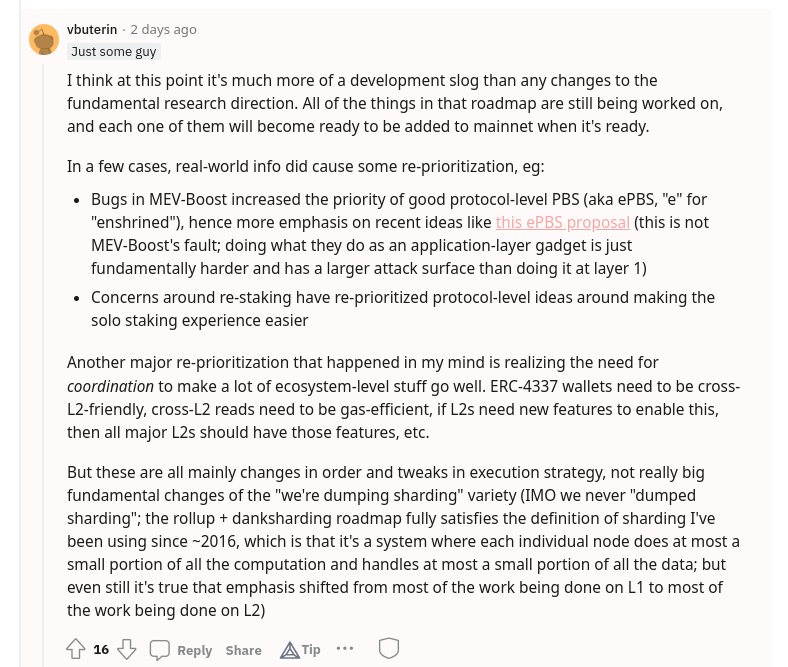
Source: Reddit user vbuterin
Vitalik has also put out an updated roadmap at the end of 2023, found here, stating significant progress has been made on the Surge (rollup scaling).
- Sharding Dilemma and Data Availability: Ethereum's approach to scalability involves the nuanced dilemma of implementing sharding. This architecture holds the potential to significantly boost Ethereum's transaction throughput. However, critics raise concerns about potential compromises in maintaining data consistency and communication between these shards. The delicate balance between achieving sharding's scalability benefits while ensuring robust data accessibility remains a pivotal challenge for Ethereum's continued development. Striking the right trade-offs is crucial for preserving the network's decentralization, security, and overall functionality.
- Proto-Danksharding as an Incremental Upgrade: In response to the sharding challenge, Ethereum introduced Proto-Danksharding as an incremental upgrade. This protocol enhancement introduces innovative features like "blob-carrying transactions" and a 2-Dimensional fee market. These additions create additional space for transaction data, facilitating cost-effective off-chain processing on layer 2 solutions.
- Scaling with Rollups: Modular blockchains, including Ethereum, explore scalability through specialization, allowing different components to focus on specific tasks. These components are often referred to as layer 2s and use rollups for specialized execution tasks. By delegating execution to specialized blockchains, Ethereum enhances scalability without compromising on security or decentralization. This approach optimizes resource utilization and mitigates bottlenecks across the network. However, concerns within the blockchain community, notably expressed on Twitter, shed light on apprehensions regarding layer 2 solutions and their reliance on administrative keys. Several prominent layer 2 scaling solutions, including Arbitrum, Optimism, Base, ZkSync, and DyDx, incorporate administrative keys, introducing a centralized element that poses potential security and trust issues. This scrutiny underscores the critical need to preserve decentralization principles in layer 2 solutions, aligning with the foundational ethos of blockchain technology within the broader ecosystem.
- Avalanche, Polkadot, Cosmos: These blockchains have multichain architectures composed of a base layer with varying deployments of additional blockchains or layers. They split the single network into multiple parts with subnetworks that are dependent on the single network.
- Avalanche has subnets, which are defined as validators functioning together to reach a consensus on the state of blockchains. Subnets facilitate app chains by supplying validators that various blockchains can share.
- Polkadot has parachains, formally a parallelizable chain, is an individual layer-one blockchain that functions in the Polkadot network. A parachain can have different implementations and features and can be public or private, with its own functions, tokens and governance.
- Cosmos is the blockchain that uses the Hub & Spoke architecture. Hubs act as routers for Zones. “Zones” are Cosmos-speak for “application-specific blockchains.” Each Zone is a spoke connected to a hub. Hubs can be connected with other hubs.
- Celestia: launched its mainnet on October 21st, 2023 and serves as a modular blockchain that provides functions like consensus and data availability, complementing the specialized execution capabilities of rollups. This collaborative approach optimizes performance and scalability, demonstrating how rollup frameworks contribute to the modular design by distributing tasks efficiently across the blockchain ecosystem. We believe Celesita and its ecosystem will be a continued theme for the first quarter of 2024 as many anticipate airdrops for staking the native token ($TIA).
- Manta Pacific: utilizing Celestia's modular data availability, is presented as the first EVM-equivalent ZK-application platform, ensuring scalability and security through Celestia DA and Polygon zkEVM. The Manta Pacific mainnet, a zero-knowledge application layer 2 within the Ethereum ecosystem, allows developers to create efficient applications with low fees and fast transaction speeds. Manta Network's total value locked (TVL) is $333 million, up 13x M/M, as its campaign provides opportunities for users to earn Manta tokens through asset transfers and participation in DeFi protocols and NFTs. Additionally, Manta Pacific is transitioning to a zkEVM validium using Polygon's Chain Development Kit, as it is considered to set higher standards in Layer 2 design and execution compared to the modified OP Stack by Caldera.
The blockchain space is witnessing a fundamental debate between monolithic and modular architectures. Monolithic blockchains, characterized by a centralized structure, face challenges such as high hardware requirements and limitations on application flexibility. On the other hand, modular blockchains, exemplified by projects like Celestia, adopt a decentralized approach by separating key functionalities, offering advantages in scalability and customization. Ethereum's evolving roadmap emphasizes layer 2 scaling solutions like rollups to address scalability concerns while maintaining execution on the main chain. The introduction of Proto-Danksharding and the scrutiny surrounding layer 2 solutions emphasize the ongoing challenges in achieving the right balance between scalability, security, and decentralization. Other blockchain projects like Avalanche, Polkadot, and Cosmos adopt multichain architectures, further diversifying the landscape. The launch of Celestia's mainnet and the emergence of Manta Pacific as an EVM-equivalent ZK-application platform showcase the industry's pursuit of modular designs for improved performance and scalability, with potential airdrops contributing to the anticipated themes in early 2024.
Sector Commentary
- Layer One / Altcoins
- Bitcoin ($BTC): Bitcoin targets $48K in ‘spot-driven’ BTC price rally (link)
- Bitcoin ($BTC): Bitcoin ETF launch may be a ‘let down’ but could attract trillions over time (link)
- Bitcoin ($BTC): Countdown to US spot ETF: 5 things to know in Bitcoin this week (link)
- Ethereum ($ETH): Why is Ether (ETH) price up today? (link)
- Ethereum ($ETH): Vitalik Buterin shares updated 2024 roadmap for Ethereum (link)
- Solana ($SOL): Analyst says Solana is a better buy than Ethereum but could this new altcoin outpace both? (link)
- Arbitrum ($ARB); Optimism ($OP): Arbitrum and Optimism tokens trade near all-time high price levels (link)
- DeFi
- NFTs / Web3
- Metaverse / Gaming
- Digital Infrastructure: Capital Markets / Exchanges / DAOs / Mining
- BlackRock, Van Eck, Valkyrie file last-minute Bitcoin ETF amendments, StoneX designated as Valkyrie’s lead market maker (link)
- Grayscale’s latest spot Bitcoin ETF amendment omits authorized participants (link)
- Coinbase, MicroStrategy shares surge in pre-market trading amid bitcoin breakout (link)
- Hong Kong Spot Bitcoin ETF Signals Bullish Market Shift More Than U.S. (link)
- FTX bankruptcy could go on for years, legal expert says (link)
- Crypto exchange volume cracks $1 trillion for first time since late 2022 (link)