- Market trading color: BTC liquidity, volatility, dominance, and Jupiter airdrop
- Theme of the week – Solana Growth and Airdrop: we highlight the recent spike in active users on the Solana blockchain stemming from a variety of airdrops including Jupiter, Solana’s largest decentralized exchange (DEX)
- Sector commentary: Ethereum’s development, Polygon Labs DeFi framework, and AI agents
Market Trading Color
After we saw $BTC rise from $25,000 to $49,000 post ETF approval, the digital currency has seen violent swings within the range of $39,000 to $44,000. $BTC failed to break $43.8k yesterday, the area with the highest liquidity concentration and subsequently sank 4%. You can see liquidity piling around the $39,200 area. This remains a key and severe liquidation level.
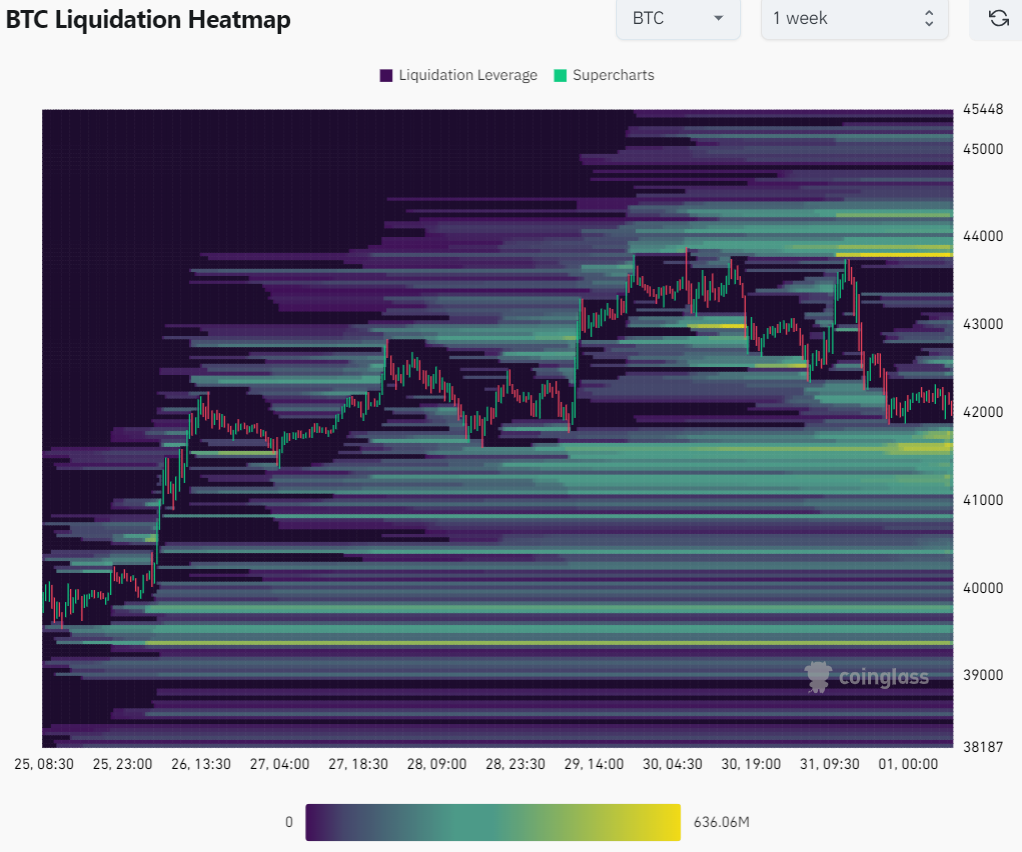
Source: Coinglass
Despite these violent price swings, front-month BTC vols continue to materially soften as realized vol is now 10pts under implied.
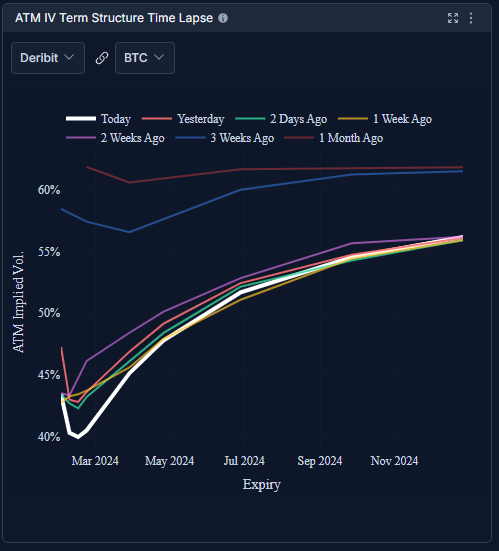
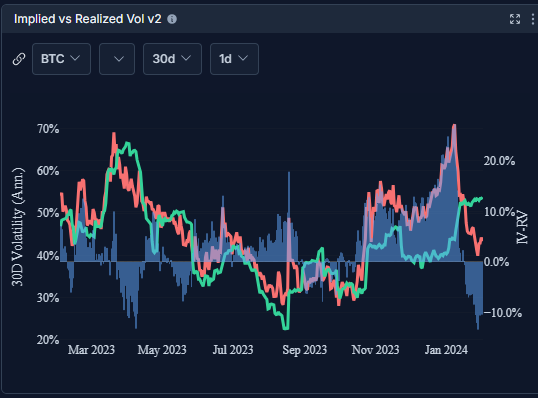
Source: TheTie
While below a 6M high of 51.66%, $BTC dominance still remains well above 45.27% lows seen in August. Since the spot $BTC ETF went live on January 10th, $BTC dominance has seen a steady uptick. This comes as total $BTC holdings in all 10 spot Bitcoin ETFs is above 647,000, 3.3% of the total BTC supply.
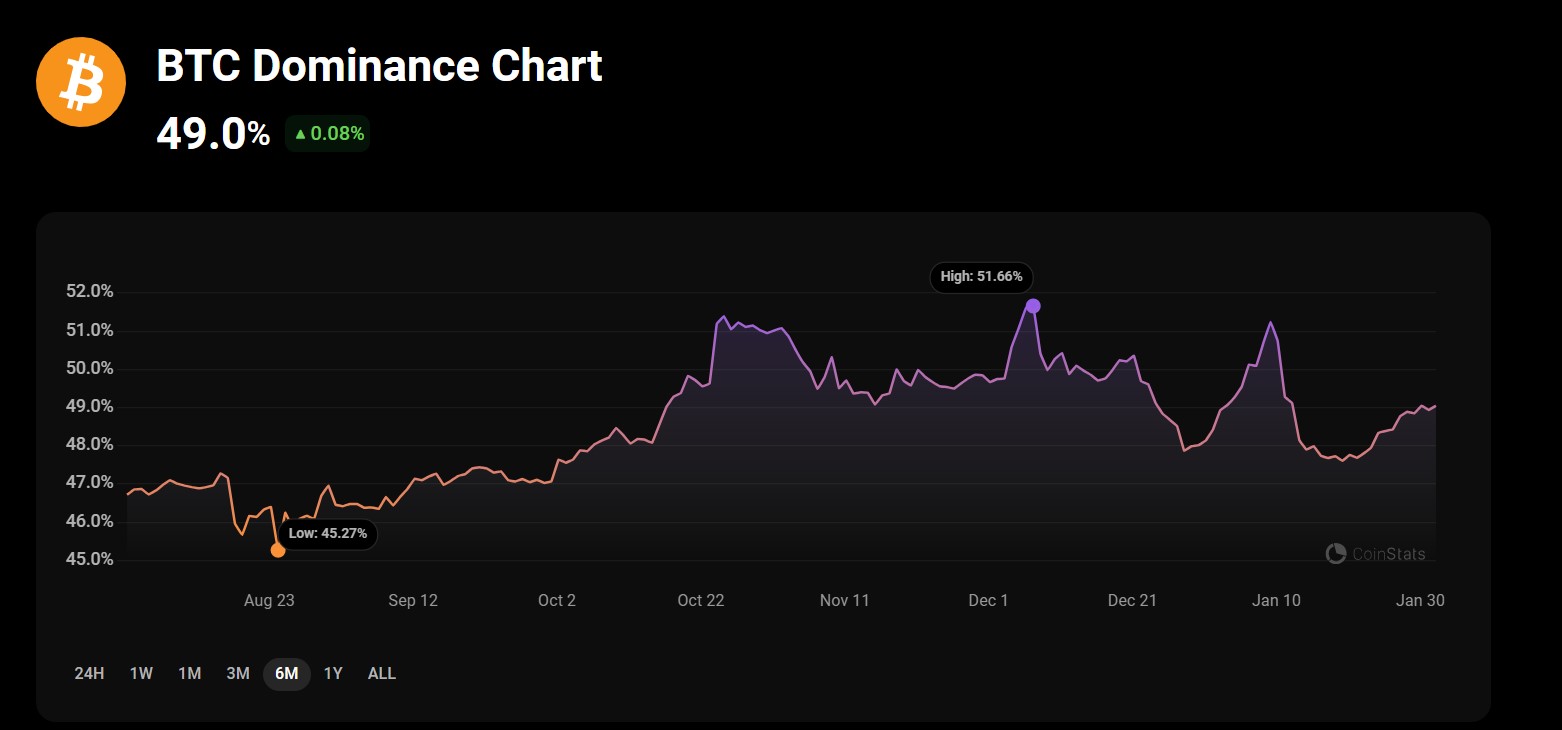
Source: CoinStats
Despite Solana sinking 5% in price over the past 24 hours, yesterday’s Jupiter airdrop should in large part be considered a success. Despite RPC nodes struggling to keep up with demand over the first hour of the drop, Solana maintained 100% uptime during peak traffic of the drop which saw roughly $750M worth of tokens distributed. With 20% of tokens airdropped in the round, $JUP sits just below $6B fully diluted market cap. Validators came away as big winners, raking in MEV fees. One trading bot known as robot.sol paid validators $50,000 to process a $625,000 trade. The buzz saw DeFi trading volume on Solana overtake that of Ethereum with Jupiter outpacing Uniswap.
Beyond the Stars: Jupiter's Airdrop on Solana
Solana's Growth
Solana has established itself as a formidable player in the competitive realm of cryptocurrencies, positioning itself as a compelling alternative to the likes of Bitcoin and Ethereum. The blockchain's popularity is due to its high throughput, mitigated transaction costs, and a flourishing ecosystem that encompasses a diverse array of decentralized applications (dApps), decentralized finance (DeFi) initiatives, and non-fungible tokens (NFTs). This trajectory closely mirrors the developmental path witnessed by Ethereum during the DeFi summer in 2020.
Beyond its inherent technical strengths, Solana's ecosystem has drawn in thousands of new wallets due to various airdrops over the past months from projects like Jito Network (JTO), Pyth Network (PYTH), and Jupiter (JUP). Jito Network contributes to the Solana landscape through its JitoSOL liquid staking pool and innovative MEV products. The JTO token, airdropped in December 2023, garnered substantial attention with 85 million JTO claimed and has a current market capitalization of $250M. The Pyth Network, recognized as the largest and fastest-growing first-party oracle network, delivers real-time market data to financial dApps across multiple blockchains. PYTH airdrop occurred November 20th, 2023, with over 90k wallets being eligible to claim and now has a $630M market cap.
Most recently, Jupiter’s airdrop occurs yesterday, placing the JUP token 70th by market capitalization with over 247k wallets claiming the token, of which 60% are still holding. Jupiter is the largest DEX on Solana and currently has the most monthly active users (MAU) across any other DEX. The lower gas fees on Solana, particularly evident on Jupiter, contribute to a more transaction-friendly environment compared to Ethereum.
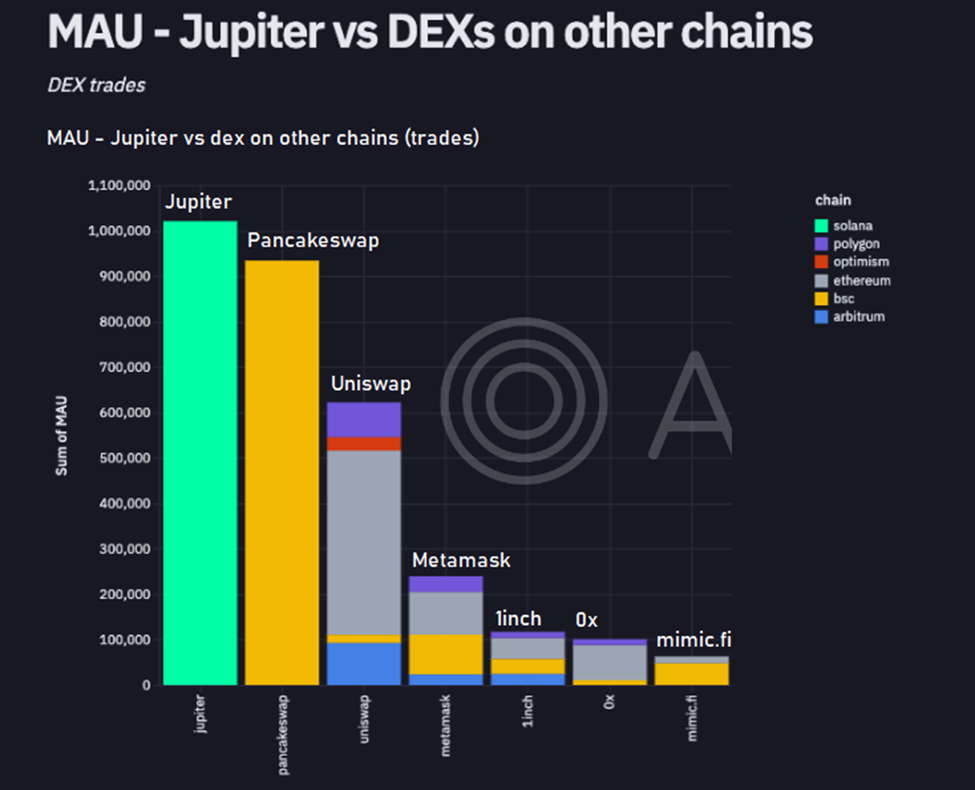
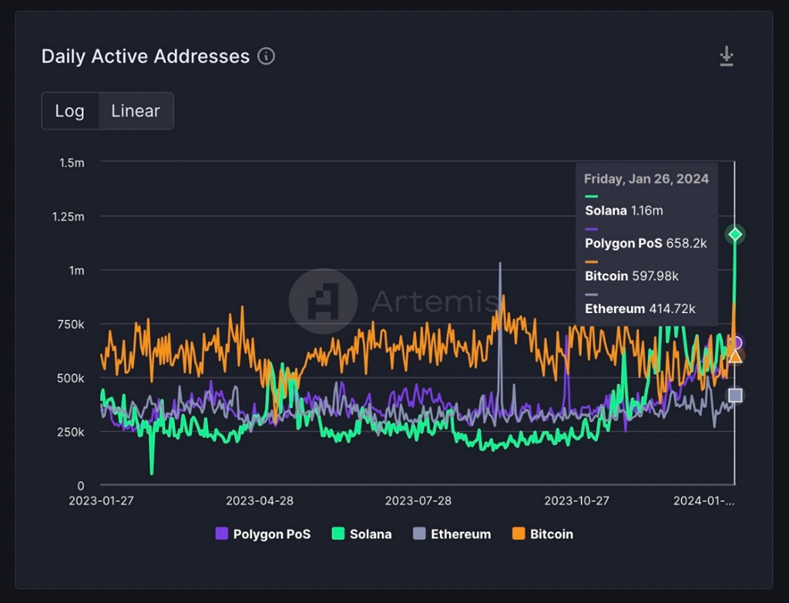
Source: Dune Analytics
New projects, alongside airdrops and community-driven initiatives, contribute to the continuous growth and vibrancy of Solana's ecosystem. With Jupiter taking the lead in both interest and volume, we explore why everyone is talking about it.
Jupiter's Evolution and Ecosystem Initiatives
Jupiter, a significant player in Solana's decentralized finance (DeFi) protocols, has demonstrated its influence by processing a substantial $3.7 billion in transaction volume and leads in MAU across DEXs. This accomplishment solidifies Jupiter's position as a major player within the realm of decentralized finance. With a focus on becoming a full-stack ecosystem, focusing on:
- Comprehensive Trading Products: Offering a full array of trading products.
- Leveraging Liquidity: Actively driving and leveraging liquidity across the entire ecosystem.
- Ecosystem Growth Initiatives: Initiatives like Jupiter Educate and LFG Launchpad contribute to growing the overall ecosystem.
In addition to the large amount of volume and easy to use interface that Jupiter has; it has captured crypto Twitter’s attention due to the airdrop for the JUP token that took place on January 31st, 2024. As a reminder, an airdrop refers to the distribution of free tokens or cryptocurrencies to a specific group of existing holders or to the broader crypto community. In this case, the tokens are being given to early users of the exchange.
At the time of writing, following the Jupiter airdrop yesterday, the token has experienced notable market volatility. Ranked 70th in market capitalization, JUP's price dropped by 57.91% in the last 24 hours, currently priced at around $0.673, a market cap of $908M, and a fully diluted market cap of $6.7B. Despite this decline, trading volume remains high with over $307 million traded, indicating sustained trader interest.
The airdrop was executed across five wallet tiers, with the top 2,000 users approximately receiving 100,000 tokens each, and subsequent tiers receiving decreasing amounts down to 200 tokens for the final tier of 743,000 users. Currently, 60% of the 247k wallets that claimed JUP are still holding.
In terms of circulating supply, contrary to initial communications of 1.7B, the initial circulating supply will now be 1.35B, including 1B for the airdrop, 250M for the launchpool, 50M for CEX MM loans, and 50M for any immediate onchain LP needs.
The JUP token primarily serves as a governance token for the Jupiter ecosystem, allowing voting on critical matters such as launchpad projects, list disputes, and grants. The platform rejects the notion that utility alone grows token value, emphasizing that utility is not part of the genesis narrative.
Jupiter envisions being a long-term player in the industry, proposing Jupuary (January) 31st as an annual event for significant token distributions that are still in reserve while launching key initiatives like the launch of the JUP governance token, Jupiter Start, and Labs, reflecting a commitment to long-term success and collaboration within the crypto space.
Meme Coins and Airdrops: Shaping Market Dynamics
Gaining insights into user behaviors and motivations becomes possible by understanding the eligibility criteria for airdrops, such as the WEN airdrop, which required actions taken before January 19th, 2024. Exploring the token transfer volume on Jupiter reveals interesting trends for WEN and others like it. The recent surge in both token transfer volume and swaps on Jupiter and Solana can be attributed to traders strategically positioning themselves for potential price increases in meme coins. Furthermore, active user participation in farming both the WEN and Jupiter airdrops significantly contributes to the vibrancy of a layer 1’s ecosystem as well as a platform's ecosystem.
In our recent macro analysis, we explored the narrative surrounding meme coins, drawing parallels with the communal nature observed in NFTs. Early investment in meme coins fosters a sense of community similar to NFT groups, with potential airdrops acting as an additional incentive. Despite fungibility differences, meme coins display high beta potential, reminiscent of NFTs in previous bull markets. The successful integration of meme coins with tangible rewards, as seen with the Solana Phones and the BONK meme coin's airdrop, indicates a growing trend, underscored by the growth in new active addresses in mid-December through January. For access to our full macro 2024 outlook, please reach out.
Sources: Phantom, Artemis, Dune Analytics, Jupiter
Sector Commentary
- Layer One / Altcoins
- Bitcoin ($BTC): Bitcoin January 30 daily chart alert - Bulls gaining momentum (link)
- Bitcoin ($BTC): German Police Seizes Record 50,000 BTC Worth $2.17B in Major Piracy Case (link)
- Bitcoin ($BTC): Bitcoin Price Nears $44K as ETFs See Net Inflows for First Time in a Week (link)
- Bitcoin ($BTC): FOMC on Hold? Bitcoin Braces for Sideways Move Amid Rate Cut Uncertainty (link)
- Ethereum ($ETH): Ethereum Developers Set Timeline for Final ‘Dencun’ Testnet Upgrades (link)
- Ethereum ($ETH): Ethereum Breaks Records: January 2024 Staking Data Unveils Surge to 30 Million ETH (link)
- Ethereum ($ETH): Ethereum To See Significant Growth in Q1 2024: Analyst (link)
- Solana ($SOL): AI Agents Could Be Important 'Buyers' of Crypto, Says Palantir Co-Founder Joe Lonsdale (link)
- Ripple ($XRP): Speculations on XRP ETF Approval Amidst Investor Optimism (link)
- Solana's WEN Token Plummets Despite Burning 27% of Supply (link)
- DeFi
- NFTs / Web3
- Which Is the Best Self-Custody Lightning Wallet? (link)
- Metaverse / Gaming
- Digital Infrastructure: Capital Markets / Exchanges / DAOs / Mining
- Low US spot bitcoin ETF fees spark ongoing price decreases in Europe (link)
- Chair of digital assets subcommittee hopes to see crypto bills ’coming to fruition’ in 2024 (link)
- How the Crypto Industry Responded to FinCEN's Proposed Mixer Rule (link)
- UK Supreme Court Refuses Craig Wright Appeal (link)
- Jack Dorsey's Block Inc. Begins Layoffs Under Previously Disclosed Plan to Cut Staff by 10% (link)
- Swan Bitcoin Unveils Its Newly Formed Mining Business Unit (link)
- Bitpanda Crypto Exchange to Withdraw From Netherlands (link)