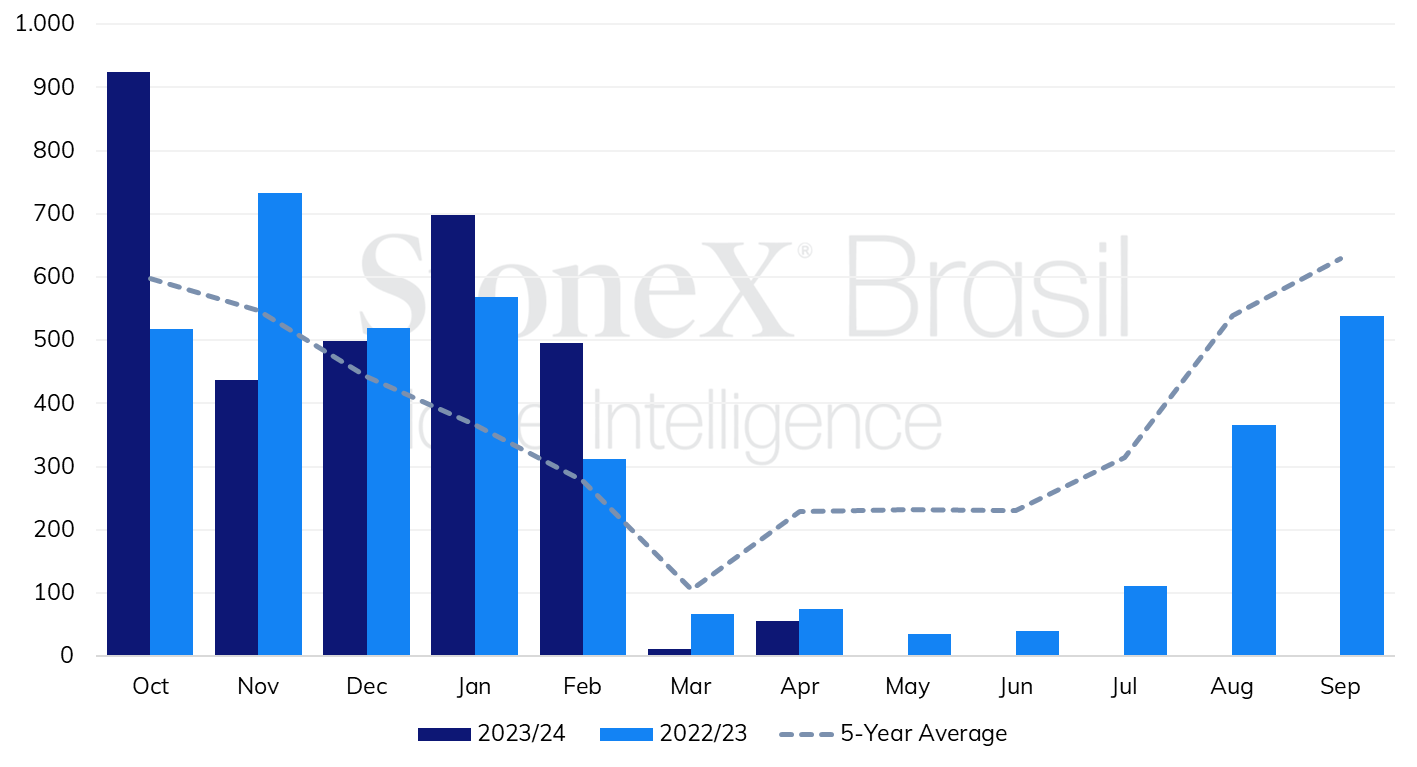
China's sugar import data for April has been released by the Chinese General Administration of Customs. Only about 55,000 tonnes of sugar were imported in the month, down 26.5% from April/23 and the lowest volume for the period in at least eight years, as it was in March of this year. However, the performance of China's purchases in the last two months does not represent the standard for the 2023/24 crop (out-set).
Until February, Chinese sugar imports were 37% above the five-year average, especially due to the amount imported in October, which was one of the highest monthly figures in history. In addition, January and February also saw high volumes, responding to more attractive prices at the turn of the year. Seasonally, more than half of China's imports are concentrated in the first two months of the crop (Oct-Nov) and the last two (Aug-Sep), so the volume imported between April and July is naturally lower.
Sugar imports by China ('000 tonnes)
At this point in the season, China is at the end of the harvest, which should end in May. Up to April, production in the country reached 9.95 million tonnes, 11.1% higher than last year's crop. Between June and September, therefore, domestic sugar production comes to a standstill, theoretically increasing the demand for imports. As evidenced by the seasonal movement, the period between March and June, which mixes a lower volume of sugarcane and beet harvests and the start of the inter-crop period, features lower Chinese imports and consequently consumption of domestic stocks, which will therefore be replenished by the growth in foreign purchases from July onwards and, above all, between August and November.
Monthly sugar production in China (million tonnes)
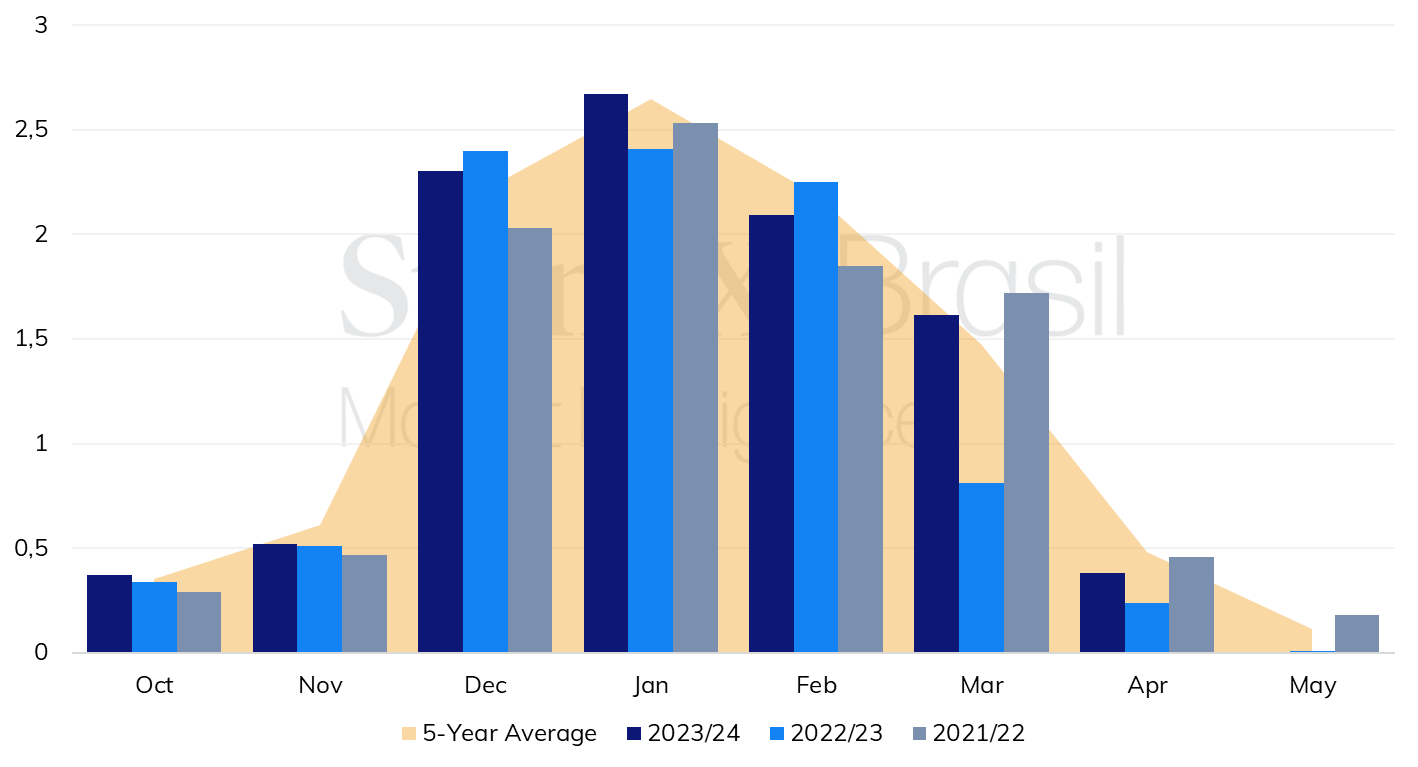
 Source: China Sugar Commission. Design: StoneX.
In the current 2023/24 crop, an important highlight in the Chinese sugar sector is the import of alternative products to raw, white and refined sugars, such as liquid sugars or “premix powders”, which are mixtures of white sugar with other substances. Between October and April, the 2023/24 cycle already totaled 920,000 tonnes of these products imported by China, an annual increase of 37.7%, a record volume that consolidates the country's search for these other sources of sugar.
From now on, as mentioned, China's import volumes may remain lower, as seasonality points out, until July, since the large domestic crop provides better levels of internal stocks, in addition to the volume that has already been imported until February. However, demand for imports in China remains high, as it inherits carryover stocks of around 1.0 MMT (according to the USDA), the lowest amount since 2005/06 and half of what it was in 2022/23.
As such, in terms of price, raw sugar consolidating below US¢19.00/lb is an opportunity for purchases by China, which is already seeing an open import window. However, upward pressure from Chinese demand is more likely to come for the October/24 and March/25 contracts, since, as shown, the country intensifies purchases from July/August onwards. In addition, the entry of the Center-South crop, under a maximized sugar-directed mix, may keep China with room to hold back its buying impetus over the next two months, since high Brazilian production still has a bearish basis for NY#11.
Daily recap
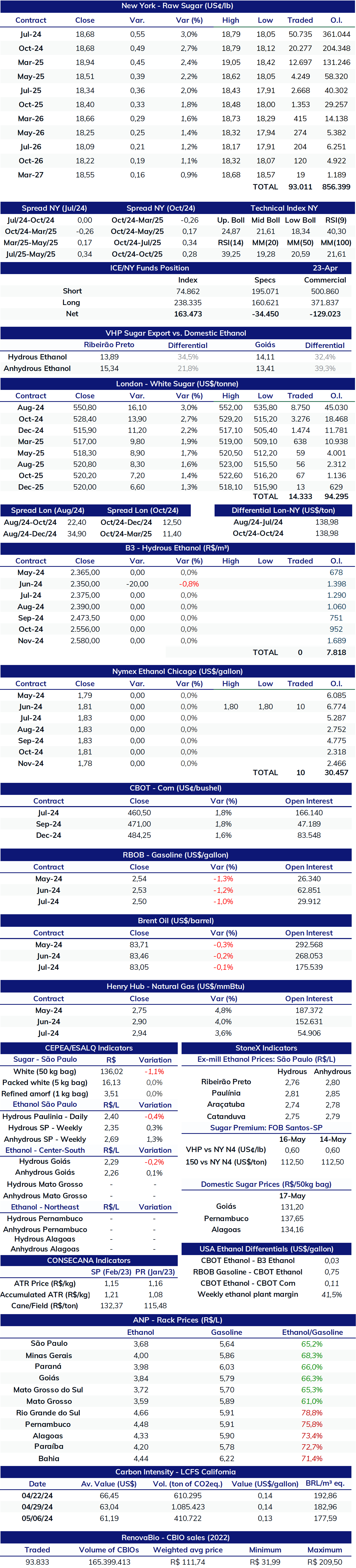
On Monday (05), raw sugar in NY rose sharply by 3.0%, and the July/24 contract was priced at US¢18.68/lb at the end of the session. The rise follows the correction of recent falls, since, for example, prices touched US¢ 17.95/lb last Thursday. The more bearish sentiment on NY#11 follows the high production in the Brazilian Center-South at the start of the 2024/25 crop (Apr-Mar) and the level of US¢18.00/lb seems to be a relevant support for prices in the short term.