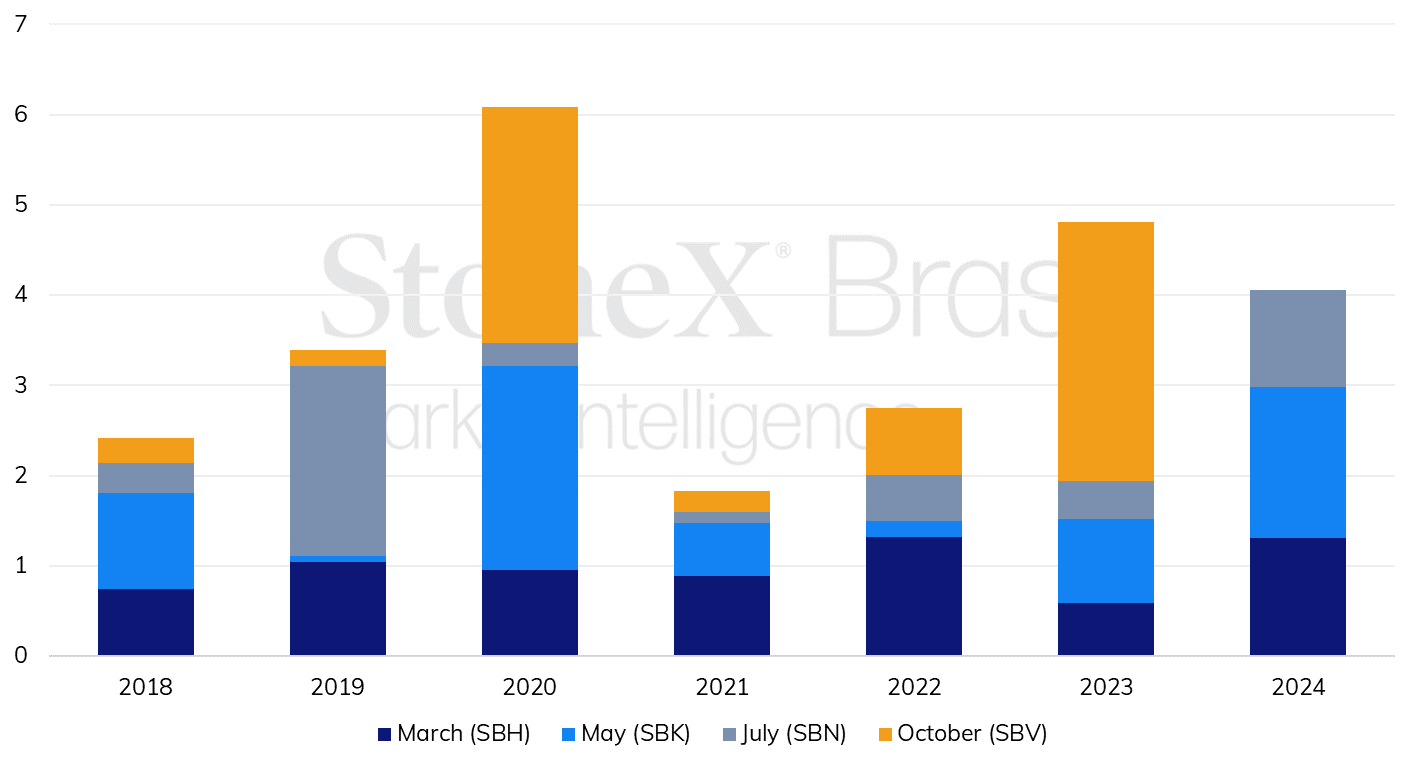
Last Friday saw the expiration of the July/24 sugar contract in New York. According to ICE, deliveries totaled 21,277 contracts, equivalent to around 1.1 million tonnes. Of this amount, 99% will be shipped through Brazil, via the ports of Santos and Paranaguá. Although it was slightly smaller than some traders had expected and also smaller compared to deliveries in October last year and May this year, for example, which were quite large, it is understood that the expiration of the July contract continued to highlight the high availability of Brazilian sugar.
Sugar deliveries on the NY exchange (million tonnes)
 Source: ICE. Design: StoneX.
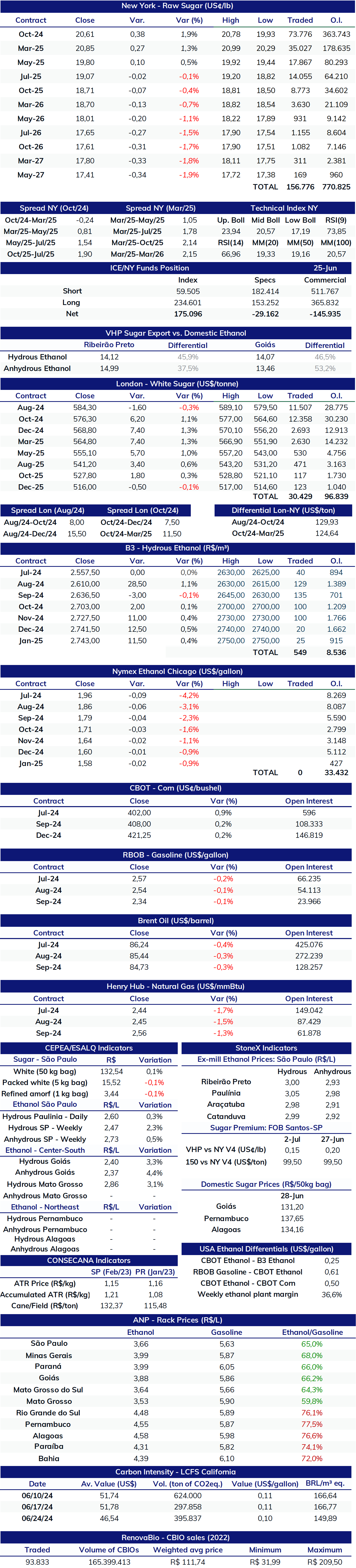
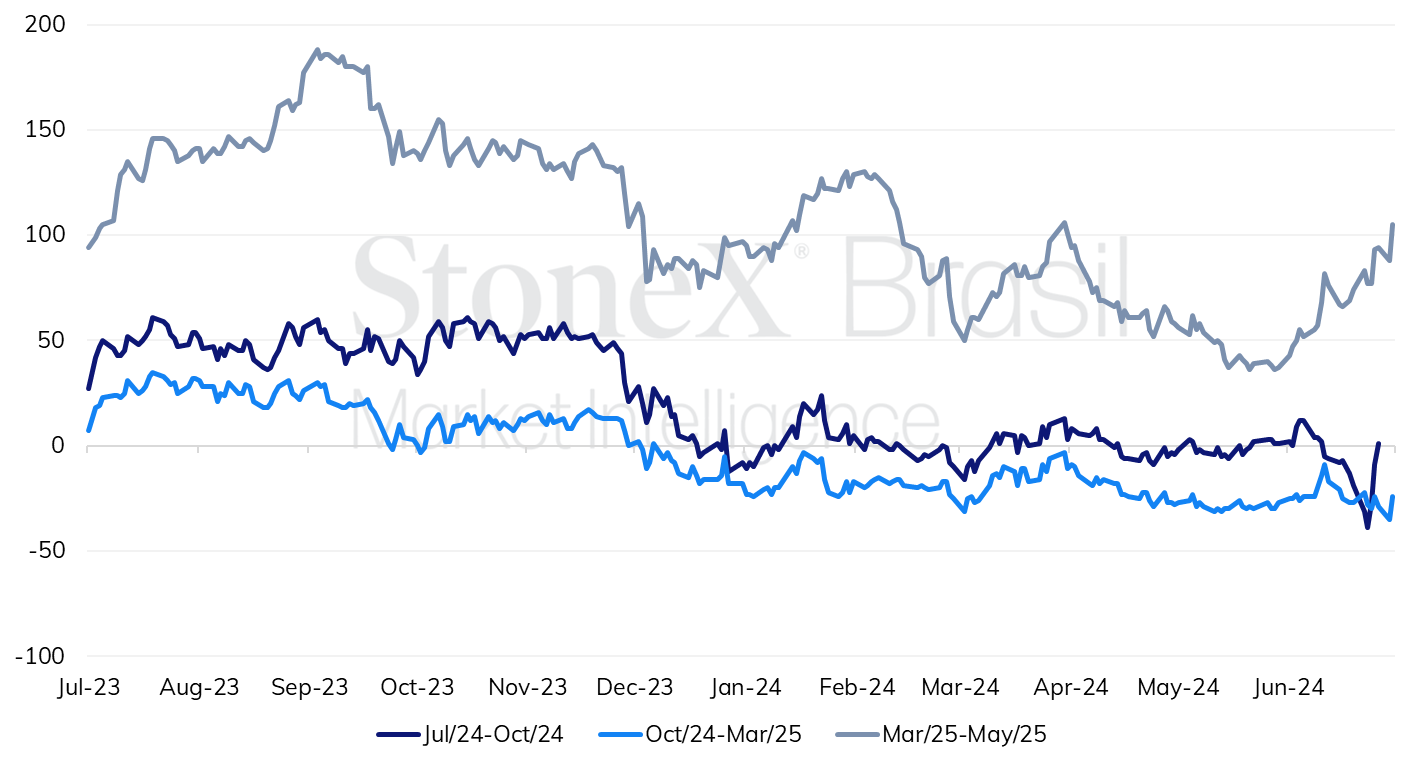
In anticipation of the previous contract, the October (as well as the sugar futures curve as a whole) has been on a clear upward trend since the end of May, closing Tuesday's trading session at US¢20.61/lb, up 186 points (+9.9%) in a month. When looking at the spreads, the July, October and March contracts next year seem to be "walking" together in 2024, since these differentials behaved in a certain pattern: more neutral in July/24-Oct/24, and more bullish in Oct/24-Mar/25.
This may show that, at times when the fundamentals were triggers for a change in market direction, the short-term view was revisited by the market as a whole, focusing mainly on the view of the Brazilian Center-South crop. In summary, for example, prices fell until mid-May, influenced especially by the high volumes of stocks in Brazil, the consolidation of surplus estimates for the 2024/25 global balance (Oct-Sept), as well as La Niña projections for this year. When the market recently began to price the lower than expected sugar mix and TRS results in the Center-South, prices went up, but the spreads on the shorter contracts hardly changed and, on the contrary, intensified the carry scenario for Mar/25, since a sharper drop in sugar production in a context of a smaller harvest this year is even more detrimental to the global sugar trade flow in the last quarter of 2024 and the first quarter of 2025.
Spread between NY#11 contracts (points)
 Source: ICE. Design: StoneX.
In contrast, the Mar/25-May/25 spread, since the start of sugar's recent surge, has risen again after falling sharply since September last year. This indicates that, although the short term is pressured by an expectation of more limited stocks and availability of sugar, especially in the fourth quarter of the year, the longer term horizon may have a more relaxed balance, possibly due to a lower need for imports in Asian (China and Indonesia, in particular) and European countries in the following months of the 2024/25 crop (Oct-Sept), which is set to be larger year-on-year in these regions, or, as in the case of Asia, will have other major exporters operating with a larger volume of sugar available, such as Thailand and Pakistan.
As a result, although permeated by bullish factors in recent weeks, NY#11, after the July/24 expiration, is awaiting important results around the world. The direction of the contract could have a bearish influence, for example, due to the volume of deliveries observed in July, or the scenario of improved monsoons in India, but it is still pressured by the production situation in the Center-South of Brazil.
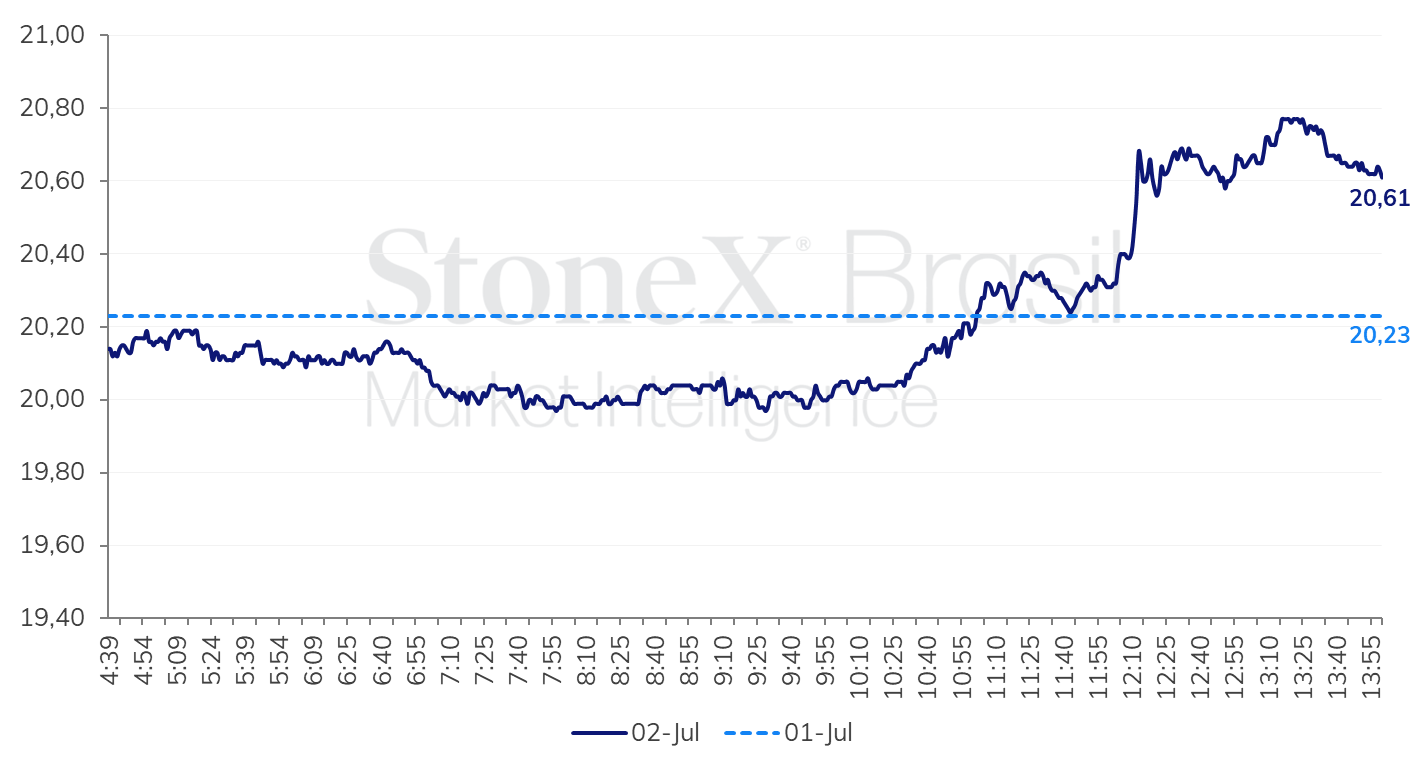
In Tuesay's trading session (02), after the previous day's slight drop, the contracts began to fall, testing the level below US¢20.00/lb and touching the daily low of US¢19.93/lb. However, given the current sensitivity of the market, prices began to rise significantly, closing higher, as mentioned. The day's high was US¢20.78/lb, a long way from the low, indicating volatility, which has been on the rise in recent sessions.
Intraday - October/24 contract (US¢/lb)
 Source: ICE. Design: StoneX.
Therefore, since agents are waiting for various indicators, July could be a busy month for sugar. At the center of discussions is the Center-South, which already has a crop "in full swing", as was brought about by the crushing in the first half of June. Expectations are that the TRS will continue to be below estimates, but the sugar-directed mix should increase in the next few weeks. In addition, the monsoon, which took a break in the middle of June, is now spreading throughout India and is reducing the water deficit. To date, the country's rainfall is 4.8% below normal, compared to a 20% deficit last month. While June was 11% below the historical average, the IMD expects above-normal volumes.