Last Friday (4), the Indian Sugar Mills Association (ISMA) released a new crop follow-up. According to the report, by the end of February, 25.3 million tonnes of sugar had been produced in the country, an annual growth of 7.7%. This performance is the result of a higher number of plants in operation compared to last crop, as well as the beneficial weather of recent months.
In Maharashtra, 9.7 million tonnes of sugar were produced up to the reference date, accumulating an annual increase of 14.5%. An even more significant growth was recorded in the state of Karnataka, where production reached around 5.1 million tonnes (+24.5%). Finally, sugar supply in Uttar Pradesh remains below that observed in 2020/21, at 6.9 million tonnes, compared to 7.4 million tonnes last year.
As pointed out in our analysis, one of the main factors determining the current crop’s good performance has been the weather, especially in Maharashtra and Karnataka, which were favored by regular precipitations until the end of January 2022. The month of February, on the other hand, was marked by water deficit in these states, which may have contributed to the speedy progress of field work, while the country’s reservoirs are well supplied. In parallel, Uttar Pradesh received within-average rainfall.
Over the next 14 days, rainfall should remain mild in Uttar Pradesh, while Maharashtra and Karnataka are expected to receive up to 10 mm, according to StoneX’s weather follow-up. If confirmed, this condition should be beneficial for crops located in regions that have been experiencing excessive moisture.
Based on these points, the ISMA has positively revised its estimates for the season. The current perspective is that Indian production will reach 33.3 million tonnes in 2021/22, already considering 3.4 million tonnes of sugar that will be used for ethanol production. For now, StoneX contacts in Asia expect nearly 3.0 million tonnes to be used for that purpose, a volume which can be increased as crude oil surges on the international market, causing the Indian government to invest even more to reach E20 by 2025.
In light of New Delhi’s plans, state-owned distributors are increasing their storage capacity by 51%, which could raise current capacity from 4.3 million m³ of ethanol to 10.6 million in 2025. Of course, the production rise should also be based on other feedstock than sugar, keeping the commodity’s stock in line with the last few years.
Still in relation to sugar production, given larger domestic supply, it seems likely that the country has the potential to export around 7.5 million tonnes, alleviating the global balance’s deficit in 2021/22. So far, about 6.0 million tonnes have already been contracted for export, with 4.2 million already shipped and between 1.2 and 1.3 million tonnes to be shipped abroad this month. In a long-term horizon, however, the advance of the ethanol market is a point of attention for India’s role in the global sugar market.
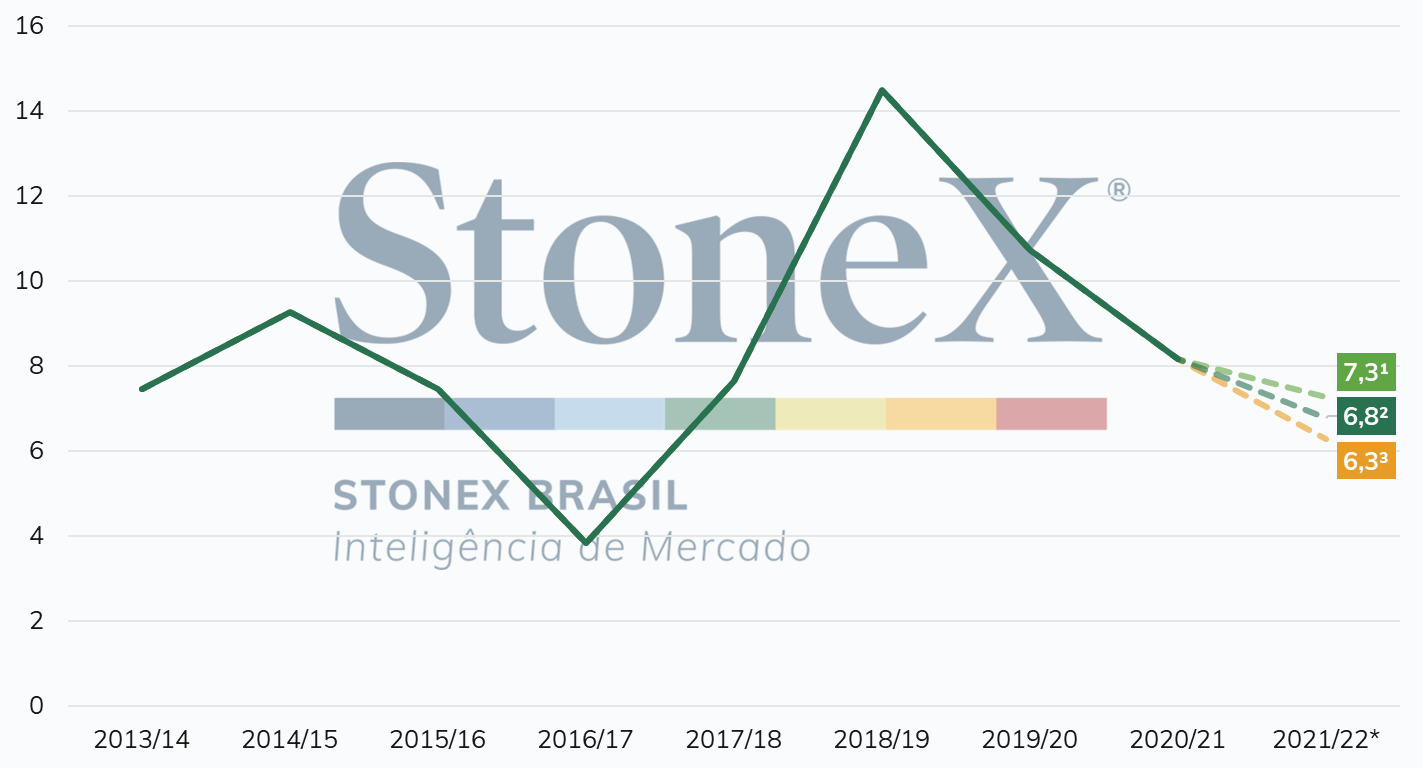
For the current crop year, considering domestic consumption of sugar at 27.2 million tonnes and exports of 7.5 million tonnes, it seems likely that final stocks will be 6.8 million tonnes. In a scenario in which Indian exports reach 8.0 million tonnes, one can expect the carryover stocks to be 6.3 million tonnes, the lowest level in recent years, but still likely to happen, given recent performance.
For the 2022/23 cycle, India’s export potential should fall to a level close to 3.5 million tonnes, considering our initial production expectation of 31 million tonnes, with a 4.0 million tonnes for ethanol distillation and constant stocks throughout the season.
Scenarios for sugar ending stocks in India (million tonnes)
*Estimated. ¹Considers exports of 7.0 mmt. ²Considers exports of 7.5 mmt. ³Considers exports of 8.0 mmt. Sources: ISMA & StoneX. Design: StoneX.
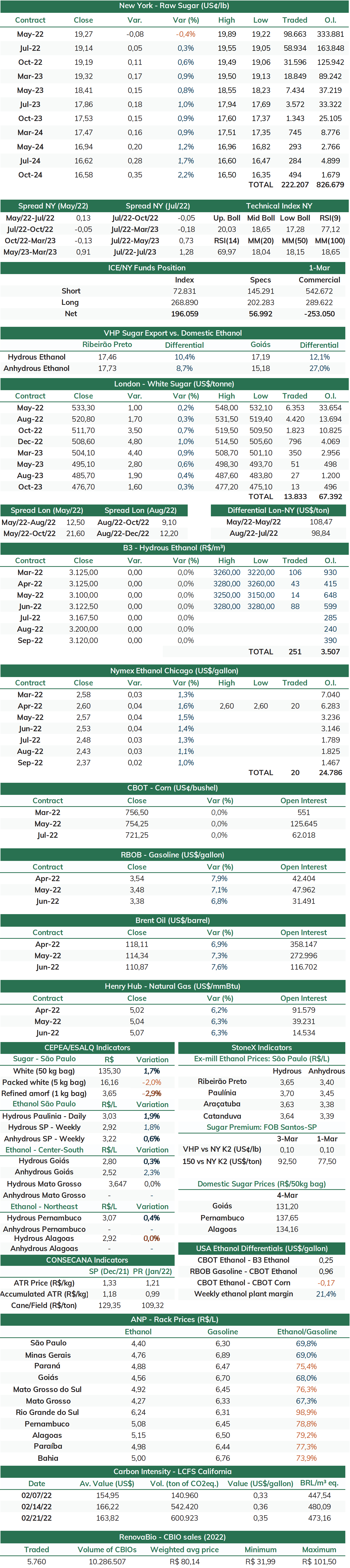
Given the firm appreciation of sugar futures, India’s export parity against #11, which is at 19.80 c/lb, is already closer to opening. On Monday, raw sugar’s May/22 approached resistance at 20.00 c/lb, but closed the ICE/NY session quoted at 19.27 c/lb, a 0.4% decline from last Friday. It is worth remembering that the arbitrage was already favorable for Indian white sugar sales abroad, with the #5 closing negotiations at USD 533.3/t on the ICE-Europe, against a parity level of USD 435.5/t.
It is worth noting that the sharp appreciation of the last few sessions was sustained by the high Brent oil, which reached levels up to USD 139.13/barrel. Crude oil’s bullish trajectory gained new momentum after threats by the United States and European countries to extend the sanctions imposed on Russia’s energy sector. Considering that 30% of oil and 39% of natural gas consumed in Europe originate in Russia, the main concern of the market is a possible energy crisis on the continent. Although the US are not strongly dependent on Russian oil, this origin represented 8% of total acquisitions in 2021, about 20.4 mbpd of oil and derivatives. However, as conversations eased, oil returned some of the gains seen at the beginning of the day.
In the Brazilian fuels market, the main concern is still the difference between domestic and international prices, which damages the import margin and may present risks of supply shortage. Discussions about the pricing policy and possible readjustments by Petrobras will continue on the radar in order to assess the prospects for Otto cycle fuels consumption, as well as for the parity between sugar and ethanol.