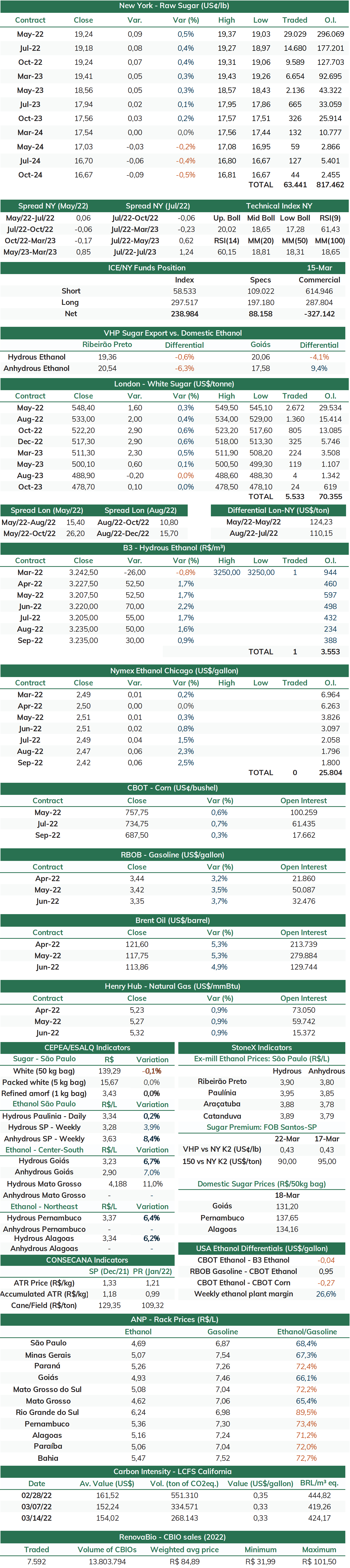
On Wednesday (23), the sugar #11 May/22 contract closed the ICE/NY session at 19.24 c/lb, up 0.5% from the previous day. In addition to the dollar depreciation, raw sugar’s movement continued to followed Brent oil gains on the international market.
While the market evaluates the prospects for the oil sector, some of the attention also goes to the progress of the RenovaBio program in Brazil. In 2022, the accumulated number of CBIOs available on the market or already retired from circulation amounts to 16.2 million Credits, a volume that already accounts for the surplus of 10.4 million at the end of 2021. When considering only the current year generation, the volume is 10.1% below that recorded in the same period of 2021.
The slower rate of CBIO production is due to lower demand for fuels at Brazilian stations, while parity in the pumps has been closed for hydrous in recent months. In addition, reduced sugarcane processing during the beginning of the 2021/22 cycle (Apr-Mar) in the Center-South, combined with the prospect of a sugar-directed mix maximization in the next season, also support this situation.
Of the total available, about 11.4 million Credits are in the hands of the program’s obligated parties, that is, distributors. Considering the purchased and retired volume, more than 30% of the target set for 2022 has already been met. However, it should be noted that B3 data do not specify whether retirement was made by speculators, who are investors that have no obligation under RenovaBio.
In the current year, accumulated stocks of CBIOs in the hands of the non-obligated parties totaled 159,100 Credits, a volume that is almost four times higher than that observed in the same period of 2021. Therefore, it is clear that RenovaBio has also gained liquidity indirectly, as the market increases speculation and Credits are used as a way of proving sustainable actions.
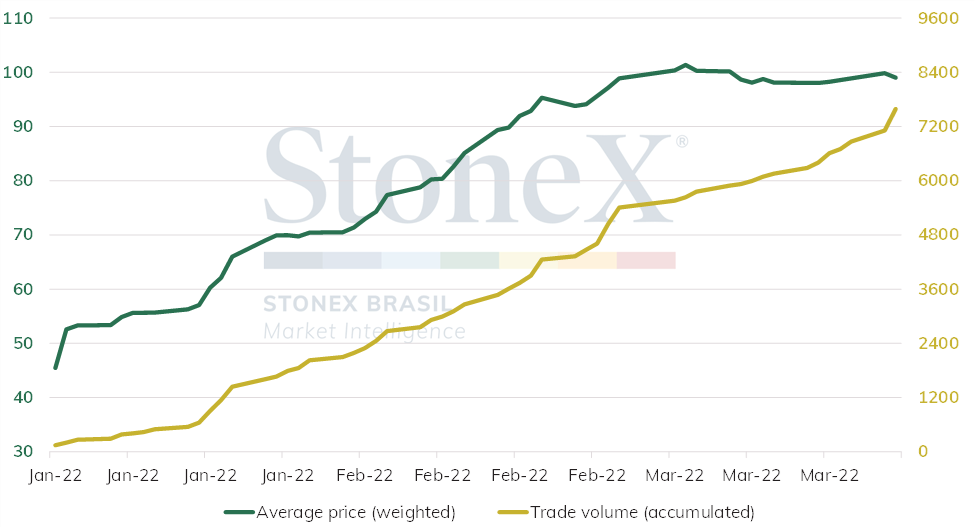
Based on this, the average price of the CBIO, weighted by the volume of negotiations, already reaches BRL 80.69/CBIO in 2022, which is 125.3% higher YoY. Over the last few days, the credit was traded at BRL 99/CBIO, twice the level observed at the beginning of the current year. Consequently, remuneration obtained from the program already reaches BRL 124.5/m³ for hydrous and BRL 132.2/m³ for anhydrous, according to StoneX calculations. At the same time, the impact on the prices of gasoline at the pumps is estimated at around BRL 0.09/L.
Weighted average price (BRL/CBIO) and turnover
Source: B3. Design: StoneX.
There is still room for CBIO prices to rise in order to make production and, as a result, consumption of biofuels even more attractive. For the 2022/23 cycle (Apr-Mar), our expectation is that the production of sugarcane ethanol in the Center-South will increase by 5.6% annually to 25.5 million m³. When considering supply from corn, this volume may increase by 7.3%, being projected at 29.7 million m³.
Amid the barriers in the oil market, it seems likely that hydrous will regain its share in Otto cycle fuel consumption. In fact, our expectation is that the share of hydrous demand for this class of fuel will be 30%, compared to 25% in the current cycle. However, the final consumer’s decapitalization is still a point of attention, which could pressure fuel consumption in general.
In any event, the current year should be closed with a sufficient volume of Credits to meet the target set by the ANP. As long commented in our analysis, the market concern revolves around the long term, as the program’s obligations become more aggressive from 2026 onwards, which could result in a deficit of CBIOs.
There, it is clear there is a need to invest in biofuel supply, especially those produced from waste, such as biomethane, which presents a higher Energy-Environmental Efficiency Rating (NEAA). This objective is in line with the commitments made by Brazil in COP26 to reduce methane emissions by 30% by 2030, with the government launching new credit lines to expand biofuel production, which should stimulate the advance of Brazilian production capacity.
According to the Brazilian Biogas Association (ABiogás), national production has the potential to reach 120 million m³ per day, which is equivalent to 70% of Brazil’s diesel demand. In addition, a new resolution is also discussed for producers of grain-based biofuels, which may favor their participation in CBIO generation