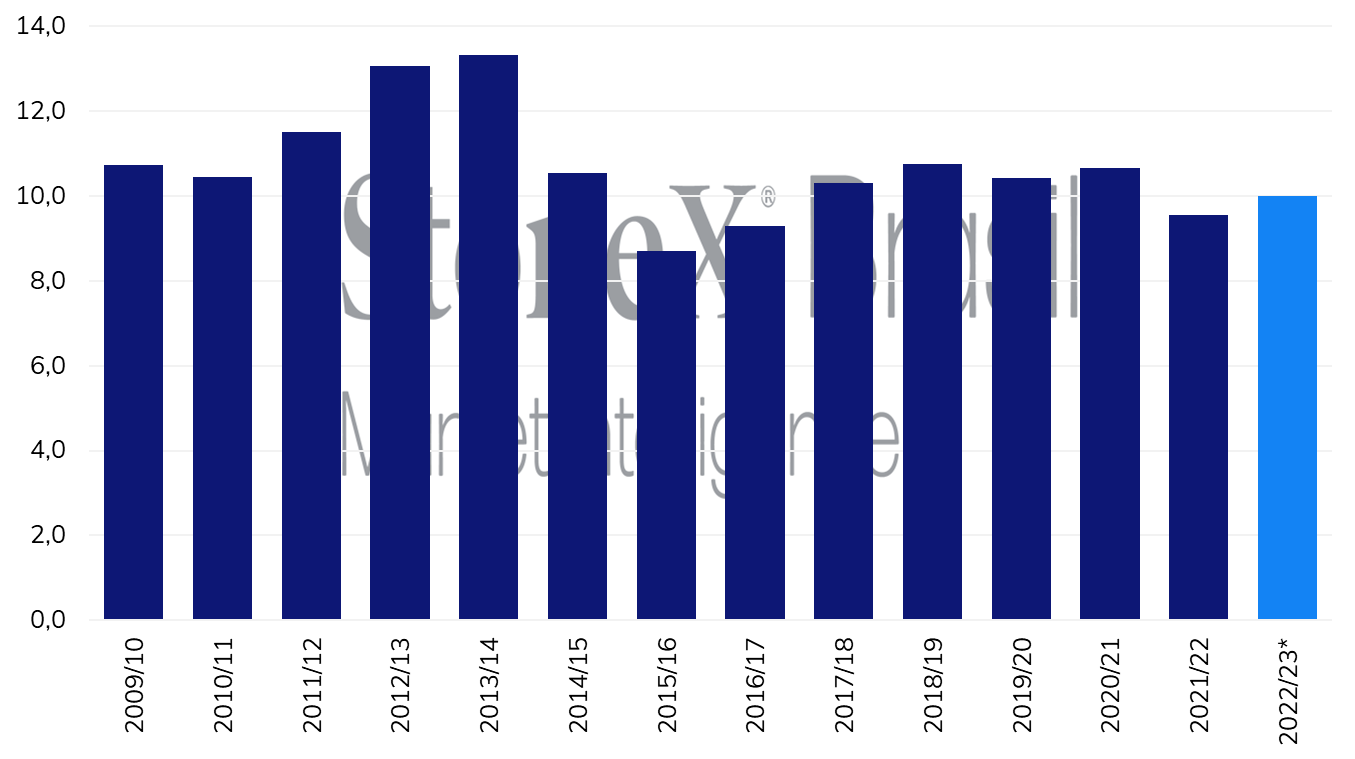
Chinese sugar production saw a decrease of 11.6% in the 2021/22 cycle (Oct-Sept), largely due to abnormal weather conditions throughout much of 2022. These included both floods in southern sugarcane regions and droughts in central regions, leading to a significant drop in production from 10.67 million tonnes in 2020/21 to 9.56 million tonnes in 2021/22.
In addition to the impact of the weather on production, there has also been a reduction in sugar beet planting areas, which make up about 15% of the nation’s sugar production and are grown in central China. These areas have been reduced due to competition with other crops.
Sugar production in China (million tonnes)
*StoneX estimate. Source: China Sugar Industry Association. Design: StoneX.
However, for the 2022/23 season (Oct-Sept), it is expected that Chinese sugar production will recover by 4.6%, returning to a level of 10 million tonnes. This recovery is expected to be aided by an increase in planted areas for both sugarcane and sugar beet. The recovery in sugarcane production is expected to be particularly strong in lower altitude regions that were severely impacted by flooding in June 2022, particularly in the provinces of Guangdong and Guangxi, which together account for about 70% of China's sugarcane production.
Sugar beet production, in turn, is expected to recover in the 2022/23 season following the abnormal reduction of 42% in harvested area in the 2021/22 cycle, as well as less extreme weather conditions and better profitability for sugar compared to other crops. It is worth noting that during the 2021/22 cycle, sugar production from cane in China fell by 3%, reaching 8.86 million tonnes, while production from sugar beet saw a drop of 44%, reaching 0.86 million tonnes.
Although there is a possibility of improvement in Chinese sugar production in the 2022/23 cycle, it is still expected that China will not perform as well as other Asian countries such as India and Thailand. This is due to the lasting impact of bad weather, particularly in the latter half of 2022, which is expected to continue to affect productivity in the current 2022/23 season. Specifically, the prolonged dry weather in southern China, where sugarcane is grown, has led to lower productivity.
Despite the above, the Chinese Sugar Association reports that by the end of November 2022, the country had produced 0.85 million tonnes of sugar, representing an increase of about 4% (or 90,000 tonnes) compared to the previous season. The association also notes that the relaxation of policies to combat the coronavirus in the country has allowed for greater harvest, production, and consumption of sugar.
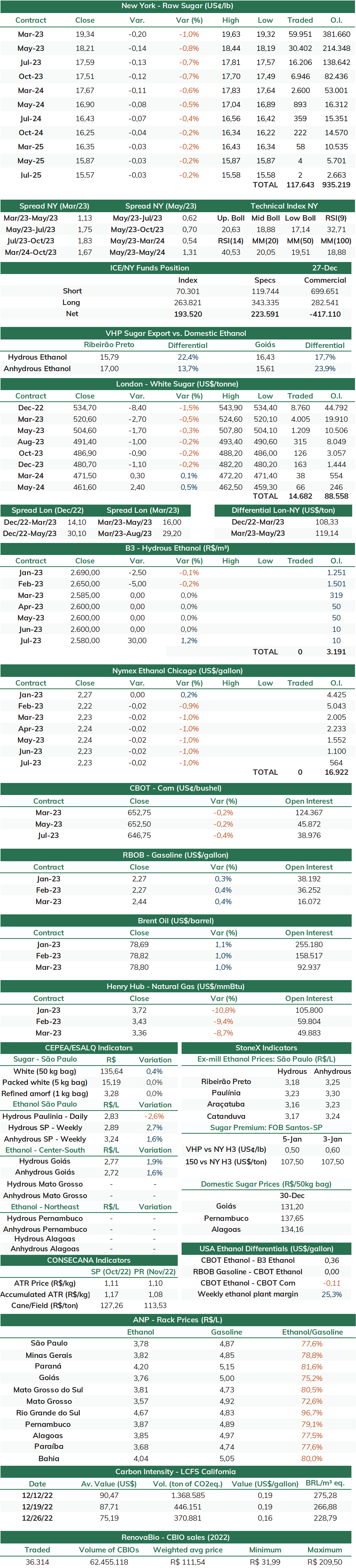
On Thursday (5), the sugar trading session saw another bearish day, with an accumulated drop of 8.4% in New York and 7% in London since December 23, when raw sugar reached its highest level in almost six years. The daily closes on both exchanges were 19.34 c/lb (-1%) and USD 534.7/t (-1.5%), respectively.
Currently, with no significant support from other markets or unexpected developments in the crop, sugar is likely to remain on the defensive, leading to the liquidation of speculators' positions and further declines. Bearish factors contributing to this include the extension of the exemption from federal taxes on gasoline in Brazil, which increases sugar supply on the market due to the lower competitiveness of ethanol at pumps, as well as good prospects for the Brazilian, Indian, and Thai crops.
indicators